What Is The GEO Log?
The GEO Log is the public experiment record of The GEO Lab. Each entry documents a controlled test or measurement conducted against the GEO Stack framework, measuring how structural changes to content affect retrieval probability, Extractability, and citation behaviour across AI search systems.
Updated 24 July 2026: rewrote experiment record to reflect the full 19-study programme (previously listed 2 of 19). Added uncertainty context to E001 headline figure. Corrected E002 status from “scheduled” to completed null result. Fixed link inconsistency between /geo-experiments/ and /field-manual/.
Methodology and measurement approach are detailed in the GEO Field Manual. Apply the findings with the GEO Workbook. The GEO Experiments index lists all completed and pre-registered studies. If you run these experiments on your own content and get different results, I want to know.
How Are Experiments Structured?
Experiments follow a consistent structure: hypothesis, methodology, results, interpretation, and limitations. Pre-registered studies deposit the frozen design before data collection. The goal is replicable evidence, not speculation. Where a null result is the finding, it is published as such.
What Has Been Tested?
19 studies published between March and July 2026. Key findings, most recent first:
llms.txt vs RSS, measured (July 2026). 78 days of IP-verified log analysis. 7 verified AI-bot fetches of llms.txt in the window, against 2,292 RSS feed requests (ratio 1:9.5 raw, 1:74.1 verified). 72% of bot-claimed llms.txt requests failed IP verification. Disclosed a reproducibility gap in the original session counts and corrected the verifier pipeline post-publication. The strongest methodological artifact on the site: null result with full IP verification, published corrections, and a documented spoofing rate.
Agent-readiness conformance vs citation (June 2026). Pre-registered, Zenodo-deposited (DOI: 10.5281/zenodo.20788222). Tested whether agent-readiness conformance predicts AI citation after controlling for domain authority. Result: null held (partial Spearman rho = -0.193, p = 0.27, n = 36). The speculative half of agent-readiness scores is implemented too rarely in the cohort to carry any information.
E043: Zero-variance mechanism capture (June 2026). Demonstrated that Perplexity’s zero-variance citation behaviour (E027) operates at the retrieval layer, not the synthesis layer. Binding breaks propagate deterministically.
E042: Cross-platform retrieval mechanism map (June 2026). Same 9 queries, three platforms. Only 12% of cited sources overlapped across Perplexity, ChatGPT, and Gemini. Platform-specific optimisation is premature without controlled data.
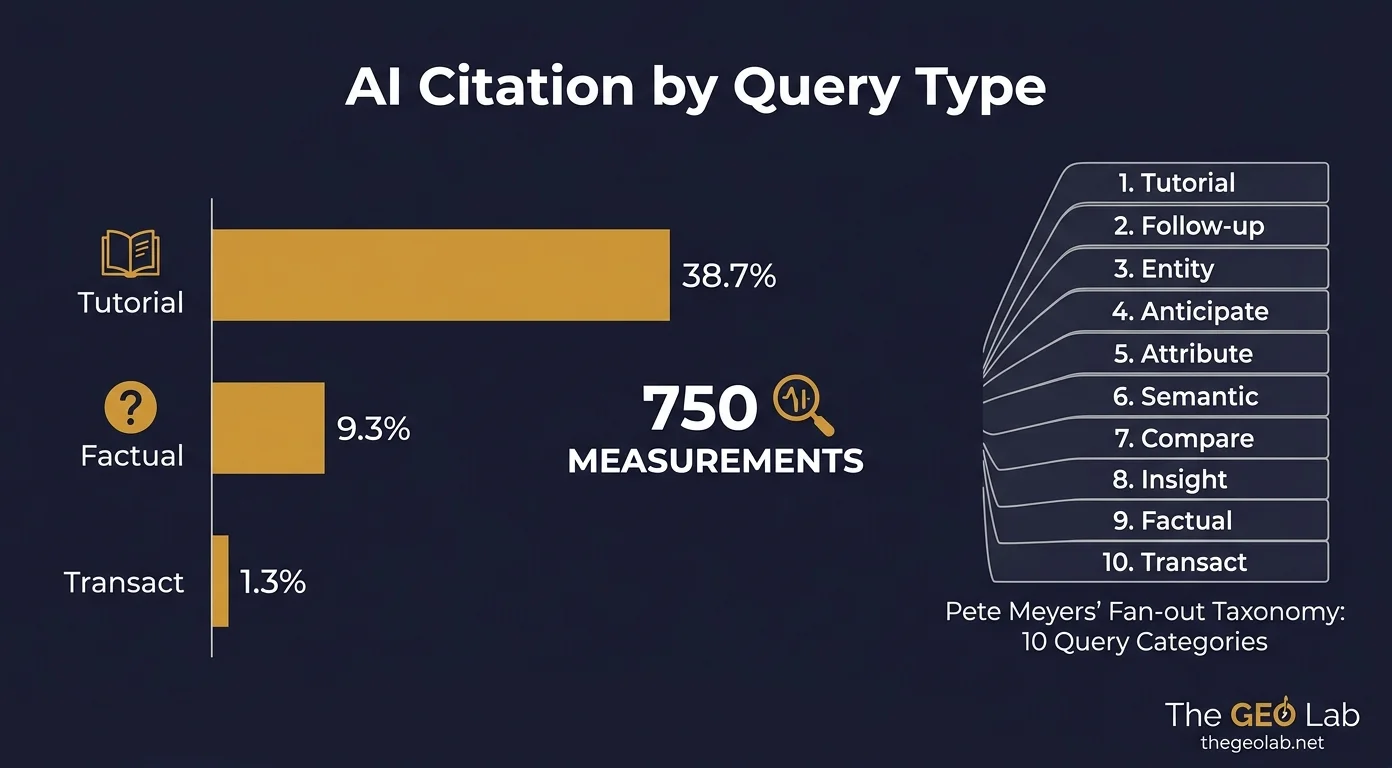
E030: Fan-out query length and citation rate (May 2026). Pre-registered. 225 queries testing whether longer queries produce higher citation rates. Result inverted the hypothesis: shorter queries cited more consistently. Published with the pre-committed analysis.
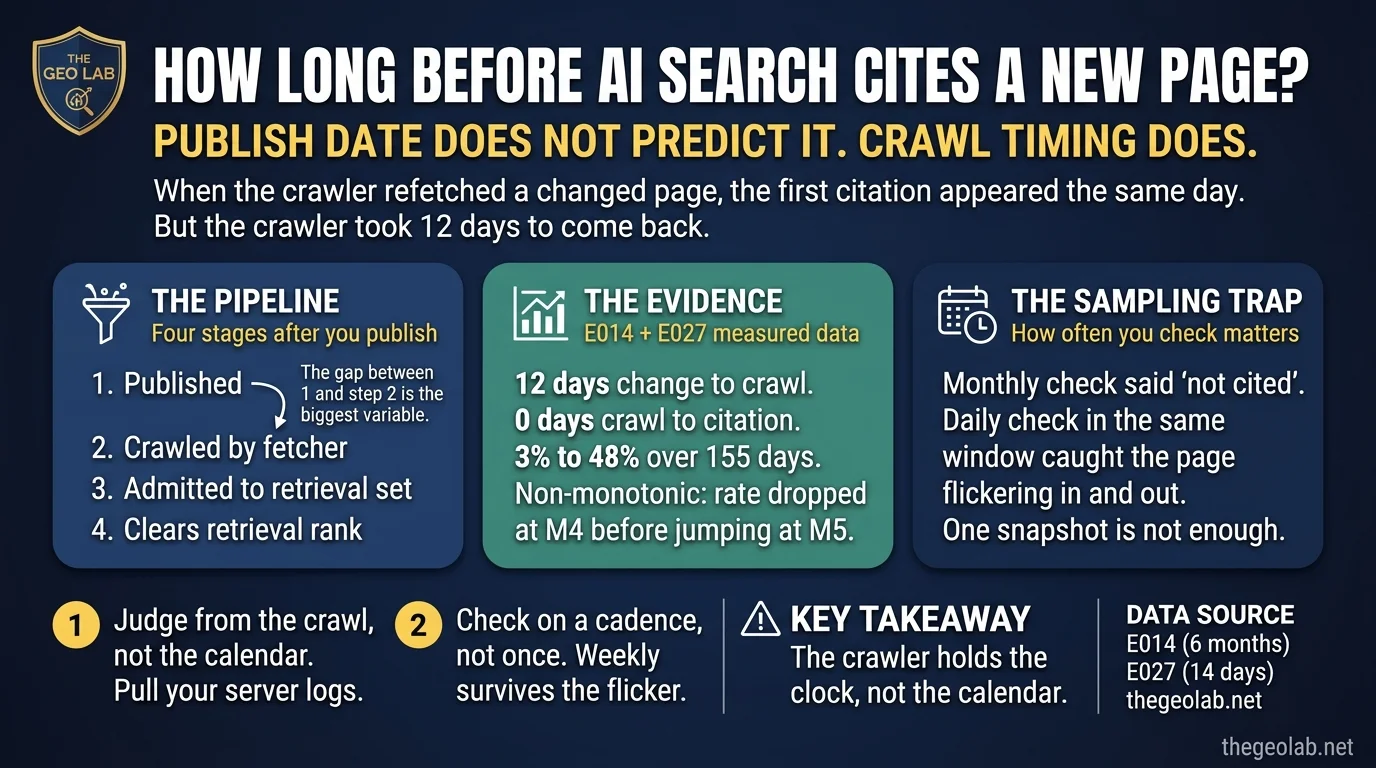
E027: Perplexity zero-variance replication (May 2026). 14-day replication. Perplexity cited the same pages for the same queries every day with zero variance. Established that Perplexity citation is deterministic at the retrieval layer, not stochastic.
E025: Entity reinforcement intervention (April 2026). Tested entity reinforcement as a citation lever. Result: null with confound (Wikidata entity created during the measurement window, contaminating the intervention signal).
FAQPage schema and AI retrieval (April 2026). 480 queries testing whether FAQPage schema affects AI citation. Result: null. FAQPage schema does not influence AI retrieval on any tested platform.
E016: Noise floor measurement (April 2026). 150 checks across Perplexity, ChatGPT, and Google AIO establishing the citation-rate noise floor for this domain. Zenodo preprint with full reproducibility package. Required reading before interpreting any effect size from subsequent experiments.
Entity density experiment (April 2026). 52 queries, 10 pages, 2.3x entity density range. Result: 0% competition citation rate across all density levels. Finding: domain authority gates citation eligibility; entity density operates within that gate, not independently of it.
E001: Declarative vs narrative structure (March 2026). The first experiment. Declarative content was cited in 18 of 30 queries (60.0%) versus 11 of 30 (36.7%) for narrative on Perplexity (z = 1.81, p = 0.07). A 23.3-percentage-point gap from structure alone, with exploratory baselines on ChatGPT and Gemini directionally consistent but individually non-significant. This is a point estimate; the v1 figure of 61% was a mis-rounding of 18/30.
Additional published studies: Share of Model noise floor calibration, E026 fan-out category pre-registration, citation rate vs entity signals gap, citation decay half-life test, E014 Month 1 baseline, noise floor methodology.