
Measurement practice · E042 and E108 · Proposed validation procedure
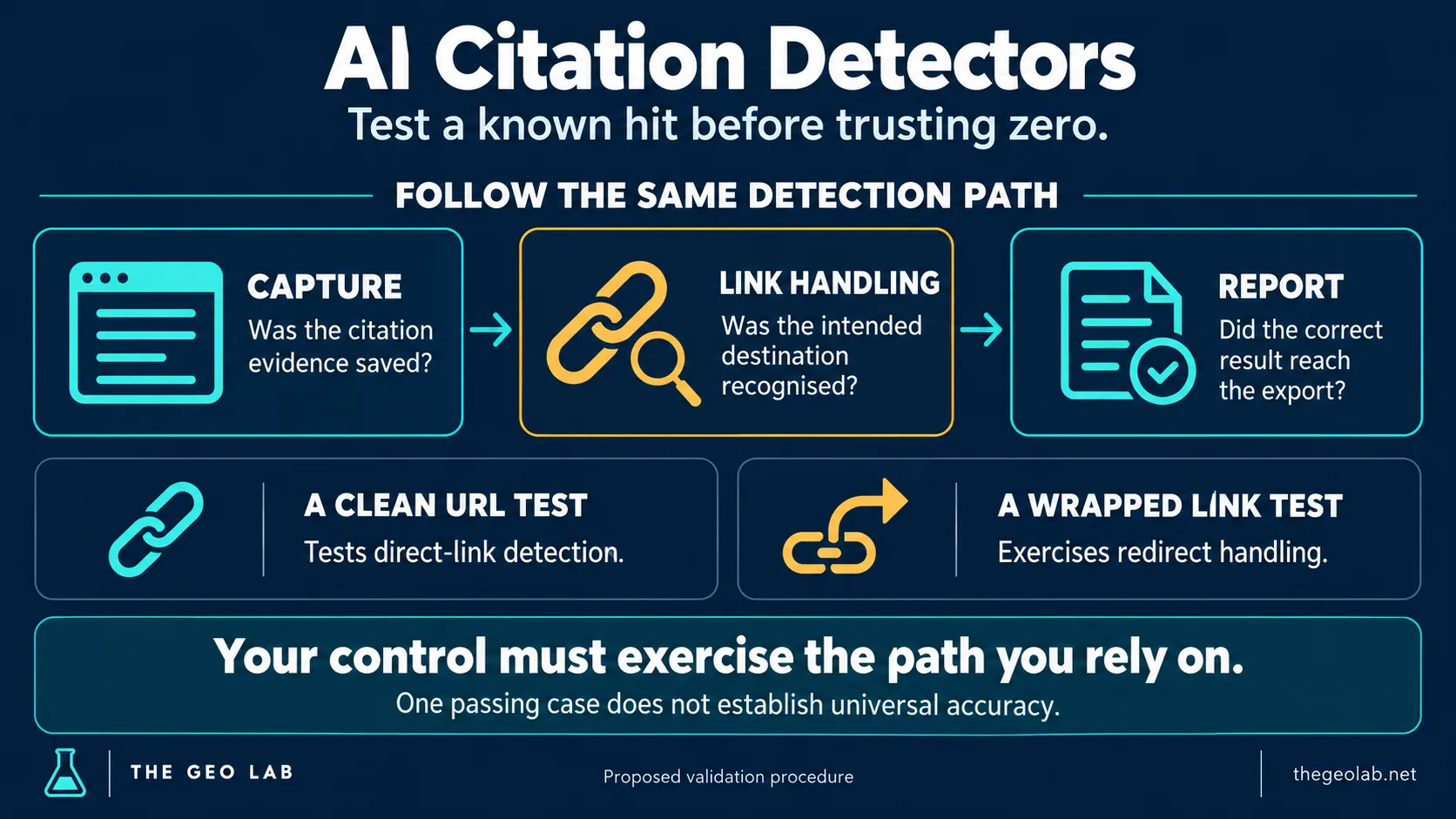
AI citation detectors need a known positive case that passes through the same capture and processing path as the results they report. As of November 2026, detecting a clean URL in a hand-written example does not validate a workflow that must collect source annotations, resolve wrapped links or read dynamically rendered cards. Check where the known citation survives, preserve the evidence and report which paths were tested. A passing control supports that path; it does not establish universal detection accuracy.
Before I trust a run of zeros, I want to see the detector recognise a citation I can independently verify.
That sounds like a small requirement. The difficulty is choosing a control that actually tests the part of the workflow that might be failing.
Suppose the real answers contain links wrapped in redirect URLs. You test the detector by giving it a clean destination URL, and it passes. The redirect handling could still be broken. Your test never reached it.
The same problem appears when a parser can read a saved citation array, but the live collector never saves that array. The parser passes its test while the report continues to miss citations.
I’d make the control follow the route the measurement uses, then check the intermediate evidence when it fails.
AI citation detectors need an independently established positive control
A positive control is a case in which the event being detected is already known to be present.
For AI citation detectors, the expected result needs a reference. That might be a preserved answer with a visible source link, or a captured response containing a source annotation that meets the detector’s declared citation rule.
“This page usually gets cited” is not enough. A new answer might genuinely omit it. The control must establish that the citation exists in the particular response being tested.
Record what makes the case positive. If the claim is about a visible citation, retain evidence of that visible attribution. A source appearing somewhere in a search-results list does not automatically meet that rule.
This keeps the test from becoming circular. The detector’s own output cannot be the only reason a case was labelled positive.
E042 showed how AI citation detectors can be limited by capture method
The E042 cross-platform report includes a Gemini correction dated 19 June 2026. The original method relied on rendered source cards. A later check used grounding metadata and found target-source presence that the earlier method could not establish.
The report also states that the later check cannot retrospectively confirm the earlier answers: their raw payloads were not preserved, and the sessions differed.
I’d retain both boundaries. The case identifies a detection limit; it does not establish that every earlier answer contained a missed visible citation. Grounding-source presence and visible attribution also need separate definitions.
The practical question for a new collection is which evidence the collector can preserve and which claim that evidence supports.
Going deeper? The GEO Field Manual covers the practitioner workflow for auditing, measuring and reporting AI visibility outcomes across platforms.
Test the route AI citation detectors use from capture to report
For a detector that reports citations from collected answers, I’d inspect the following handoffs. This is a proposed validation procedure, not a tested industry standard.
| Handoff | Evidence I’d retain | Question the control answers |
|---|---|---|
| Answer to saved capture | Raw response or documented browser capture. | Did the collector preserve the citation evidence? |
| Capture to extracted sources | Extracted entries with their original locations. | Did the parser read the relevant field or element? |
| Extracted link to destination | Original URL and any resolution outcome. | Did URL handling preserve the intended destination? |
| Destination to target match | Matched host or page, using the declared rule. | Did the matcher recognise the correct target? |
| Match to report | Final exported row and its capture identifier. | Did the result survive aggregation and export? |
A failure at the first handoff cannot be repaired by improving the last one. If the capture omitted the source evidence, a more permissive domain matcher has nothing reliable to match.
Keep the original link alongside any resolved destination. If resolution fails, retain that outcome rather than replacing the original with a guessed URL. The Extractability layer in the GEO Stack addresses whether content can be extracted at the passage level; the handoff chain above addresses whether the detector can extract and match the citation evidence itself.
A wrapped-link test needs a wrapped link
Imagine a captured citation points to an intermediary URL that redirects to the target publisher. A literal comparison against the publisher’s hostname would see only the intermediary.
To test resolution, use a verified example with that structure. Check the original link, the destination reached and the final classification.
If your workflow deliberately measures only the displayed link hostname, it may be working as designed. It would answer a narrower question than “which publisher was cited”. The report needs to make that choice explicit.
This is a hypothetical failure mode. It is not a claim that one redirect format explains all missing citations on any platform.
A browser test needs the browser collector
Pasting a link into a parser tests the parser. It does not test whether the browser collector waits for the relevant content, reads the right elements or saves what the user can see.
For the complete path, collect a response whose citation has been independently verified, then inspect the saved capture and final report together.
If the collector cannot access the needed evidence, state that limit. A different API response may support another measurement, but it does not validate the browser path. The API versus browser audit guide covers the comparability question separately.
Use negative cases alongside AI citation detectors’ known hits
A detector that labels everything cited would pass every positive example. Known negatives are needed to expose that failure.
The expected result should follow the declared rule. A brand name without a source link can be negative for visible citation while remaining positive for name presence.
I’d include cases that distinguish the target from something merely similar:
| Case | Expected behaviour under a target-domain citation rule |
|---|---|
| A verified source link to the target domain. | Recognise the target citation. |
| A target brand name with no qualifying source link. | Do not infer a citation from the name alone. |
| A link to an unrelated domain containing a similar string. | Do not accept a substring match as target identity. |
| A source field missing from an incomplete capture. | Flag the evidence problem rather than claim verified absence. |
These examples test different decisions. Keep their results separate so a correct name match cannot conceal a failed link check.
Static replay and live capture answer different questions about AI citation detectors
In the E108 instrument benchmark, the instrument received supplied response text and visible-citation arrays. No live queries were run. The report also notes the small number of positive citation cases.
That supports a bounded reading of the benchmark. It tests classifications on those supplied cases, without establishing that a live collector can obtain equivalent evidence.
For ongoing validation, I’d use two complementary checks.
A saved case lets you replay exactly the same input after a parser change. That helps identify a regression without introducing a newly generated answer.
A live collection checks the current capture route. Its output must be verified afresh, because the platform can produce a different answer or citation format.
Record which check passed. “The saved wrapped-link case passed” is more informative than “citation detection works”.
Document the schema and citation rule for AI citation detectors
Field names belong to a particular response format. They should not be treated as permanent features of a provider’s products.
For example, Google’s Gemini API grounding documentation, checked on 1 November 2026, describes inline url_citation annotations in text content for the Interactions response. Its “Understanding the grounding response” section distinguishes those annotations from search-call and search-result steps.
A parser written for another endpoint or an older capture needs its own validation. A familiar provider name does not establish that the schema matches. Perplexity’s chat completions API returns a citations array alongside the response text; its structure differs from Gemini’s inline annotations and from any browser-visible source card. The GEO Stack framework treats the detection and measurement layer as foundational; if the instrument cannot reliably detect what happened, the layers above it inherit that uncertainty.
I’d store the endpoint or product surface, collection date and detector version with each control. For the expected label, specify whether the target is a domain or an exact page, and what source evidence qualifies.
What a passing control lets you say about AI citation detectors
One successful case shows that the workflow handled that case. It does not estimate how often it will miss citations across other formats and conditions.
For a first validation report, a compact coverage table would be enough:
| Path tested | Verified positives recognised | Verified negatives rejected | Unresolved cases |
|---|---|---|---|
| Direct links in saved captures | Report counts. | Report counts. | Describe missing evidence. |
| Wrapped links through resolution | Report counts. | Report counts. | Describe resolution failures. |
| Current browser collection | Report counts. | Report counts. | Describe capture limits. |
This is a reporting template, not validation data. Leave an untested path marked untested.
After a detector change, replay the affected cases and inspect the final export. If a control fails, flag the measurements that depend on that path. Preserve the captures so they can be reprocessed if the missing step is recoverable.
Frequently asked questions
What is a positive control for an AI citation detector?
It is a response with independently verified citation evidence and a declared expected classification. The control tests whether the detector can recognise that evidence through the path being evaluated.
Does recognising a pasted URL validate live citation tracking?
It validates the part that received the pasted URL. Live collection still needs a check that citation evidence reaches that part intact.
Should grounding sources count as visible citations?
Only if the evidence meets the visible-citation rule. A source entry and displayed attribution are separate observations; label the measurement accordingly.
Does one passing control prove the detector is accurate?
It establishes success on that case. Broader accuracy claims require a defined evaluation set with sufficient positive and negative examples representing the intended use.
How often should AI citation detectors be revalidated?
After any change to the detector’s parser, capture method, or URL resolution logic. Also after a platform changes its response format. Replay the saved control cases and inspect the final export to check for regressions.
Key GEO Lab Takeaway
Choose a known hit that exercises the path you rely on. Preserve its evidence, check the handoffs and verify that the final report retains the correct result.
If the production path must resolve wrapped links, a clean pasted URL leaves that part untested.
AI citation detectors report what they can see through the paths they use. Validate those paths before trusting either a positive count or a zero.
Ready to apply this? Use the GEO experiments guide to design a validation protocol that tests each handoff in your citation detection workflow.