
Research review · Anthony Lee · Access-channel comparison · Historical observations
TL;DR
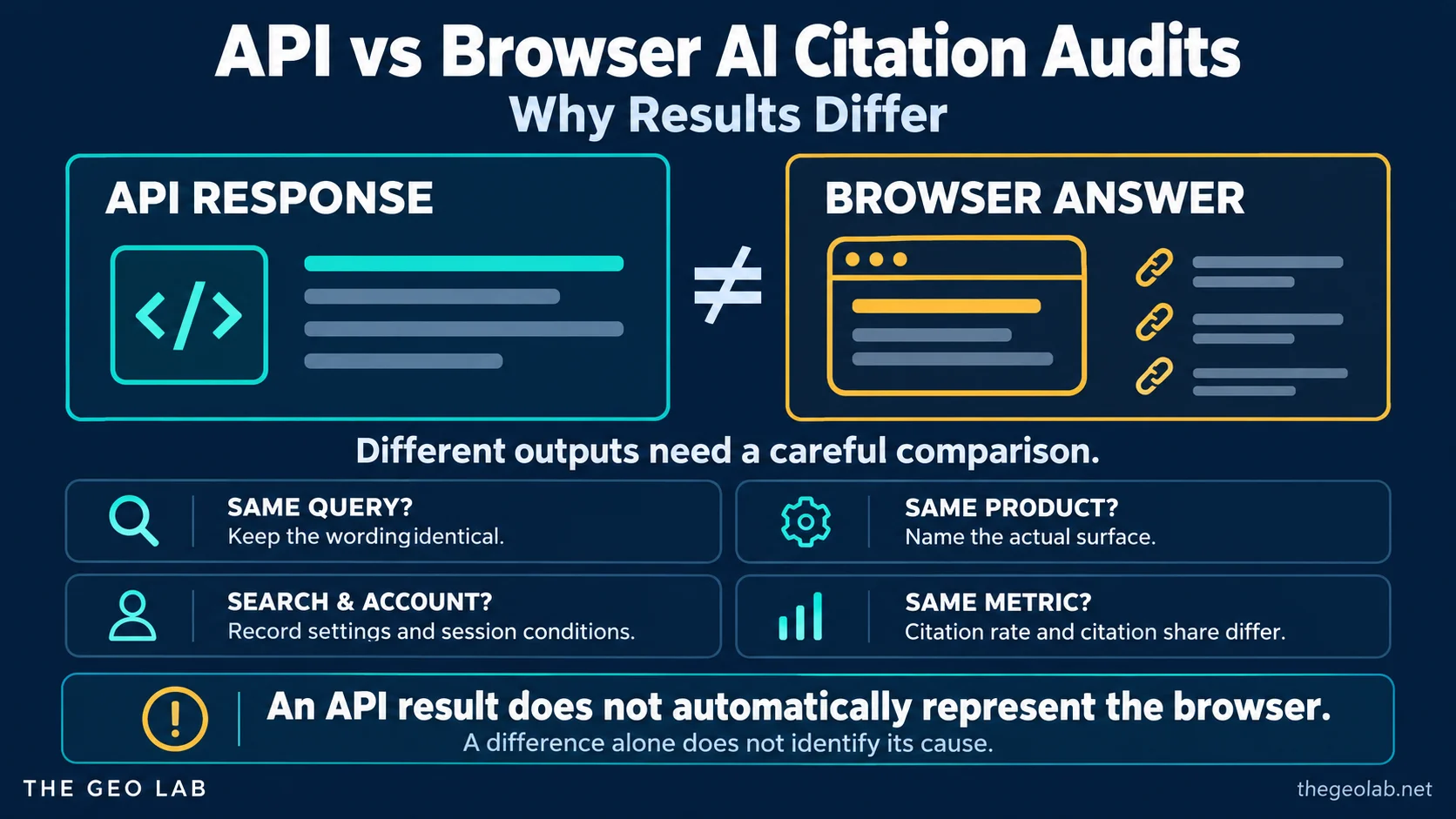
API vs browser AI citation audits need to be treated as separate measurements unless their comparability has been tested. A Reddit study reports different citation outcomes across the two channels, but its query sets and some product conditions also differed. That supports caution when transferring an API finding to a consumer interface. It does not isolate a universal API effect or explain why a source was absent.
If a tracking tool reports no citations from a source that I can see in my browser, I would check what each observation represents before deciding one is wrong.
The tool may be recording an API response accurately. The browser capture may also be accurate. They can describe different experiences.
I would want the report to identify the surface it measured. A broad label such as “ChatGPT visibility” leaves too much room for the reader to assume it describes the version they use.
Anthony Lee’s Reddit research offers a concrete example, along with a limitation that belongs beside the headline.
What the Reddit comparison shows about API vs browser AI citation audits
Lee’s Reddit access-channel paper reports these query-level outcomes in Table 5:
The API queries were SaaS-focused; the browser queries spanned 13 domains. The browser collection used one authenticated session per platform and fresh conversations. Its reported snapshot was February 2026.
The paper also compares Gemini’s API with Google AI Mode. Those are different product surfaces, not a matched pair of interfaces for one identical product.
Its abstract describes the comparison as using the same queries. The methods and limitations specify different sets. I would follow that more detailed account.
The difference is an observation, not an isolated cause
The table gives us evidence of different outcomes in those collections. It does not tell us what the outcome would have been if only the access channel had changed.
Several conditions need checking before calling that an API effect.
This is my proposed comparison checklist. It was not validated by the study as a way to eliminate every source of variation.
A difference can remain useful even when its cause is unresolved. Here, it warns me against presenting an API result as a direct account of what a browser user will see.
A fresh conversation does not establish a fresh account
Starting a new conversation can remove the earlier conversation’s text. It does not demonstrate that every account-level condition has been reset.
For an audit, I would record the account condition rather than infer it from the presence of an empty chat window. If history or personalisation could not be controlled, that would remain part of the interpretation.
This is a control to document, not a claim that personalisation caused the study’s difference.
A zero needs its channel attached in API vs browser AI citation audits
“No Reddit citation appeared in these API responses” is a bounded result.
“Reddit is blocked by the platform” proposes a mechanism. “Reddit is never cited” extends the result to observations the test did not cover.
I would not make either extension from a finite set of absences alone.
The same applies to a business page. If it is not cited in an API collection, I can report that absence. I cannot use it to establish that the consumer interface never cites the page.
These statements let a reader inspect the evidence without having to accept an explanation the collection did not test.
Keep citation rate separate from citation share
There is another way two reports can appear to disagree: they may calculate different things.
Suppose an invented browser audit captures ten valid answers. Two contain a Reddit link. Across all ten answers, there are forty citation entries, of which three link to Reddit.
That gives us two results:
Both describe the invented collection. They answer different questions.
The first asks how often a query produced an answer containing Reddit. The second asks what proportion of the citation entries were Reddit links.
I would not compare one with the other as if the percentages measured the same outcome. Repeated URLs and source-list entries also need an explicit counting rule.
The broader citation share-of-voice guide covers share-based reporting. In a channel comparison, the immediate task is to make sure both sides use the intended unit.
API evidence is useful for the API experience
An API audit can be the appropriate measurement when the product being assessed is an API-powered application.
Its result still needs the configuration and output evidence attached. But it does not become less valid because another product surface behaves differently.
For a claim about what someone sees in a consumer interface, I would want observations from that interface or evidence that the API measurement transfers to it.
Define which experience the report represents
This is where I would draw the reporting boundary.
The AI citation tracking guide covers how to inspect a tool’s scope. This article concerns whether evidence collected through one channel represents another.
How I would investigate a disagreement between API vs browser AI citation audits
I would retain the original API result and browser capture before running anything else.
Next, I would compare the query text and product labels. If those differ, the first finding is a comparison gap, rather than a demonstrated channel effect.
For a follow-up, I would set the collection plan before reviewing more answers. The plan would define which conditions can be matched and which will remain different.
I would inspect a selection of the original outputs against the extracted citation list. A missing link in a spreadsheet could come from the collection or parser rather than the answer itself.
That possibility needs checking before it becomes a theory about source filtering.
Match the question sample too
A broader consumer query set and a narrow software query set may encounter different kinds of sources.
If I am trying to compare channels, I would use the same questions on both sides and retain their group labels. The query-set comparison guide covers why changes in the question sample can move the result.
Even with those controls, I would report what remains unmatched. Identical wording does not guarantee identical search behaviour, and matching a product label does not establish the same hidden configuration.
What remains unproven
A channel difference does not identify a blocklist, licensing policy or search backend. Those are explanations that need evidence of their own.
Citation absence also does not establish that a source influenced the answer through training. That would require a different investigation, not an inference from a missing link.
For present-day claims, the historical findings need current testing. I would not treat their percentages as a current ranking of products.
The useful lesson for an audit is narrower: preserve the channel, conditions and citation unit before generalising beyond the captured output.
Frequently asked questions about API vs browser AI citation audits
Can an API audit represent the consumer browser experience?
It can only support that claim to the extent that comparability has been established. Otherwise, I would label it as an API measurement.
Does a missing API citation mean the browser will omit it?
No. The API observation does not establish the browser outcome.
Did the Reddit comparison isolate access channel as the cause?
No. Its query sets and some product conditions also differed. That limits the causal interpretation.
Is the percentage of answers citing Reddit the same as its citation share?
No. One counts answers containing the source; the other counts its share of citation entries under the chosen rules.
Should I discard API measurements?
No. Keep them scoped to the experience they measure. For a different experience, collect the evidence needed for that claim.
The GEO Lab takeaway
Put the access channel beside the result.
When an API report and a browser answer disagree, preserve both and compare their conditions. Establish what each measured before deciding the difference describes the platform as a whole.
Source and evidence locators
Lee, A., Reddit Doesn’t Get Cited (Through the API): Training Data Influence, Access-Channel Divergence, and the Shadow Corpus in AI Brand Recommendations. Author-hosted February 2026 preprint, with Claude’s AI contribution acknowledged.
- Access-channel methods: section 3.6, PDF page 8.
- Query-level outcomes: section 4.10, Table 5, PDF page 21.
- Query-set and authenticated-session limits: section 6, PDF page 27.
- Author’s research page and repository link
Have questions about this topic? Contact The GEO Lab · Return to homepage