
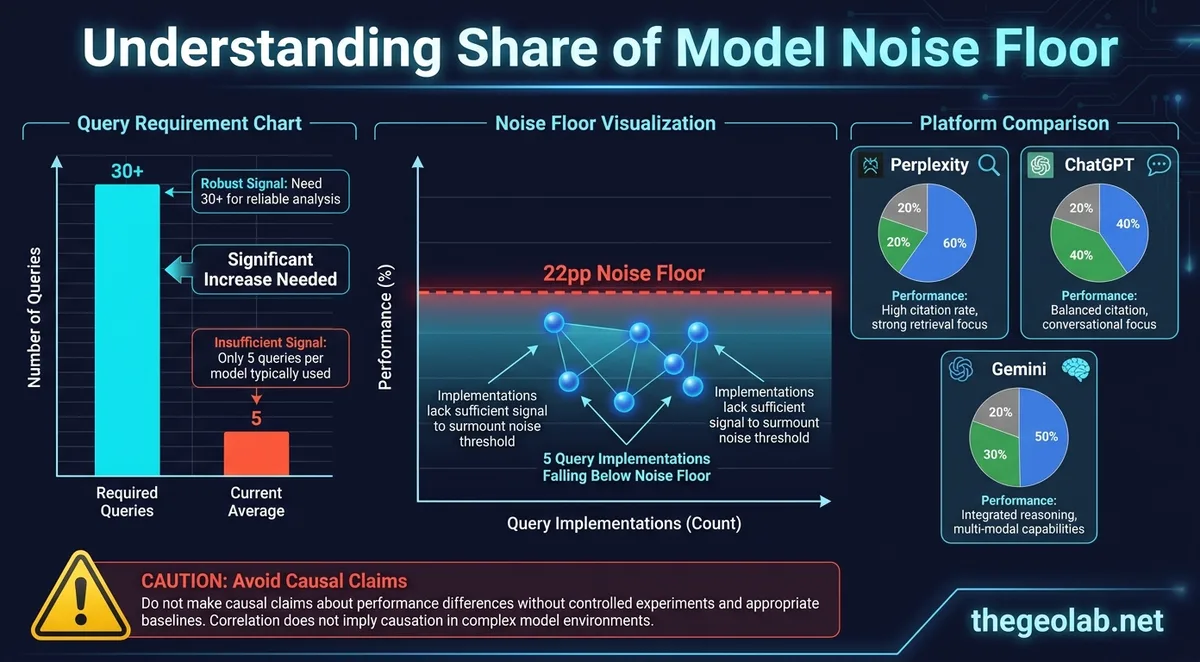
Share of Model measures how often a brand appears against competitors across AI queries. The concept is the same one the GEO Lab publishes as the GEO Brand Citation Index. The problem is calibration: most implementations use five queries across blended platforms, which sits well below the 22-percentage-point noise floor measured in E016. A citation-share number run below its noise floor cannot distinguish signal from variance. The fix: 30+ queries, per-platform reporting, and no causal claims without a control.
Small samples sit below the noise floor
Your citation share went from 40% to 50%. That sounds like progress. On a small query set it is probably noise. Share of Model is a useful idea, and it is the same thing the GEO Lab’s citation-rate protocol measures under a different name, but the way it is usually calculated skips the one step that makes the number interpretable: establishing the noise floor first.
The metric is normally defined as how often your brand appears against competitors across a set of queries, run through ChatGPT, Perplexity and Google AI, counting appearances. The concept is sound. The reporting around it tends to have three problems, and all three are measurement-design problems rather than content problems.
The GEO Lab’s E016 experiment measured a noise floor of 22 percentage points for AI citation measurement. Below that threshold, a change is indistinguishable from day-to-day platform variance. A typical Share of Model setup runs five queries across ten sessions, which is fifty data points spread thin across multiple platforms. On a sample that size, a swing from 40% to 50% is ten points, well inside the 22-point band where you cannot tell signal from variance.
The practical floor for an interpretable result is a 30-query set, which is why the 30-check citation protocol uses that figure rather than a handful of prompts. Five queries is not a smaller version of a valid measurement. It is a measurement that cannot clear its own noise floor, so the number it produces should not be read as a trend in either direction.
Going deeper? The Citation Share of Voice guide covers how citation-share metrics work, per-platform measurement, and what separates a usable metric from a misleading one.
Averaging three platforms hides the signal
ChatGPT, Perplexity and Gemini have structurally different retrieval mechanisms. Perplexity retrieves on nearly every query. ChatGPT decides whether to search at all before it retrieves anything. Gemini fires Google Search frequently but converts those retrievals into visible citations at a very different rate. Collapsing all three into a single Share of Model percentage treats three different systems as one, which buries the information that would actually let you act.
A single blended score cannot tell you whether your gain came from Perplexity, where citation is achievable for the right query tier, or from a platform where the movement was noise. The fix is to report per platform and never average across architectures. The aggregate hides which lever moved, and the lever is the only thing worth knowing.
| Platform | Retrieval behaviour | Citation character | Share of Model implication |
|---|---|---|---|
| Perplexity | Retrieves on nearly every query | High citation rate, deterministic on proprietary queries | Most actionable platform for citation-share gains |
| ChatGPT | Decides whether to search before retrieving | Stochastic, web search not always triggered | Volatile, drives noise in blended metrics |
| Gemini | Fires Google Search frequently | High retrieval, low visible citation conversion | Mention vs citation gap inflates apparent share |
Lead volume is correlated, not caused
A common framing pairs a citation-share rise with a jump in leads and presents the first as the cause of the second. With no control, no documented query set and no platform breakdown, that pairing is correlation asserted as causation. Lead volume moves for many reasons over a 60-day window, and a citation metric measured below its noise floor cannot carry the weight of a causal claim about revenue.
This matters because the metric is becoming popular faster than the calibration discipline around it. A number that looks like a KPI but behaves like noise produces confident decisions built on variance, which is worse than having no metric, because it feels like evidence.
Share of Model is citation share, measured properly
None of this means the metric is wrong. Share of Model is citation share of voice, which the GEO Lab has measured for some time and published as the GEO Brand Citation Index (Zenodo DOI 10.5281/zenodo.19218295). The concept is valid and worth tracking. What separates a usable version from a misleading one is whether the measurement clears the noise floor, reports per platform, and stops short of causal claims it cannot support.
How to run citation-share measurement so the number means something
Use at least 30 queries, not five. Run them per platform and report ChatGPT, Perplexity and Gemini separately rather than as a blend. Treat any movement under 22 percentage points as inside the noise band until repeated measurement says otherwise. Document the query set so the result is reproducible. And keep lead or revenue claims separate from citation-share movement unless you have a control to connect them. Do that, and the measurement becomes a real signal. Skip it, and the percentage is decoration.
- Share of Model is citation share of voice. The concept is valid. The GEO Lab publishes the same measurement as the GEO Brand Citation Index (Zenodo DOI 10.5281/zenodo.19218295).
- The noise floor is 22 percentage points. Below that threshold, movement is indistinguishable from platform variance. Most Share of Model setups use five queries, which cannot clear the floor.
- Never average across platforms. ChatGPT, Perplexity and Gemini retrieve and cite through different mechanisms. A blended score hides which platform moved.
- Minimum 30 queries, per platform, documented. That is the threshold for an interpretable result. Five queries across ten sessions produces noise, not a trend.
Want to measure citation share properly? The E016 noise floor paper documents the 22pp threshold. The GEO Lab citation protocol walks through query selection, per-platform measurement, and noise floor calibration step by step.
Questions? Contact The GEO Lab.
Frequently asked questions
What is Share of Model?
It measures how often your brand appears against competitors across a set of queries run through AI systems such as ChatGPT, Perplexity and Google AI, counted as a share of total appearances. It is a citation-share-of-voice metric. The concept is the same one the GEO Lab publishes as the GEO Brand Citation Index.
Why is a noise floor needed for Share of Model?
AI citation measurement has a noise floor of 22 percentage points, measured in the GEO Lab E016 experiment. Below that threshold, a change cannot be separated from day-to-day platform variance. Without a noise floor, a citation-share swing on a small query set looks like progress when it is statistical noise.
How many queries does Share of Model need?
At least 30. A common setup of five queries across ten sessions produces fifty thinly spread data points that cannot clear the 22-point noise floor. Thirty queries is the practical minimum for an interpretable result, which is why the GEO Lab citation protocol uses that figure.
Can I average Share of Model across platforms?
No. ChatGPT, Perplexity and Gemini retrieve and cite through different mechanisms, so a single blended percentage hides which platform drove the change. Report each platform separately. The blended number cannot tell you which lever moved, and the lever is the actionable part.
Is this the same metric as the GEO Brand Citation Index?
Yes, conceptually. Both measure citation share of voice across AI platforms. The GEO Brand Citation Index uses a calibrated 30-check protocol with per-platform reporting and a documented noise floor (E016, 22 percentage points). Share of Model is the same idea; the difference is whether the implementation meets those measurement standards.