
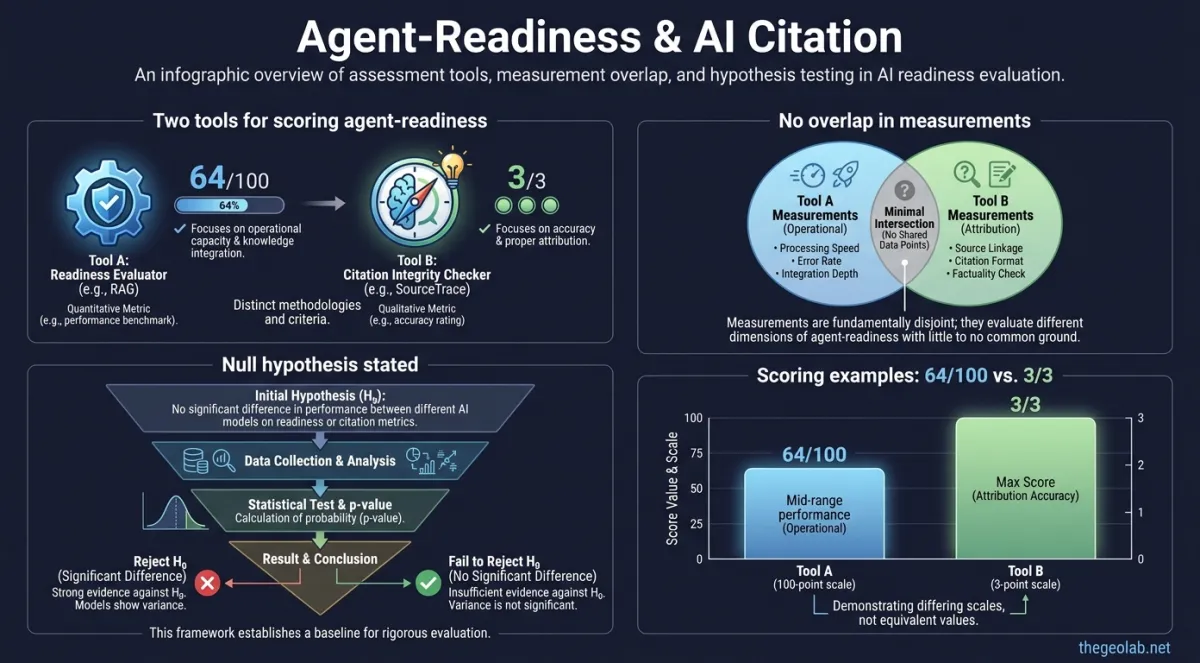
Two tools score “agent-readiness” and disagree on what it means. This pre-registration tests whether either score predicts AI citation, with a stated prior that the result will be null.
Agent-readiness conformance has no demonstrated link to AI citation. Two instruments, isitagentready.com and Google PageSpeed’s agentic panel, score the same site with near-zero overlap in what they check. This pre-registration tests whether a retrieval-relevant conformance index predicts citation, controlling for domain authority, with a variance-gated placebo index as a secondary check. The stated prior is null: if two instruments cannot agree on what agent-readiness is, a clean signal is unlikely. The design is frozen and deposited before either variable is collected: both the citation measurement and the conformance scan run only after deposit. The result is now in, deposited as v2.0 under the same DOI: the null held. Conformance does not predict citation after controlling for domain authority.
Agent-Readiness and AI Citation: Two Instruments, Almost No Overlap
Agent-readiness conformance is now scored by two tools that disagree about what it means, and neither has shown the score predicts anything that matters. This is the pre-registration of a test before either variable is collected, including the prior that the result will be null.
isitagentready.com scored thegeolab.net at 64/100. Google’s new PageSpeed Insights “Agentic browsing” panel scored the same site at 3/3. The two numbers are not measuring the same thing in different units. They are reading different signals.
isitagentready checks discovery files and protocol plumbing: robots.txt, sitemap, Link headers, AI-bot rules, DNS-AID records, OAuth and MCP discovery, an agent-skills index, Web Bot Auth, WebMCP.
PageSpeed’s agentic panel checks three things: whether the accessibility tree is well-formed, Cumulative Layout Shift, and whether llms.txt contains at least one heading. Its WebMCP checks were not-applicable on a site without a WebMCP integration.
The overlap between the two check sets is close to zero. One grades discovery files, the other grades an accessibility metric, a recycled layout-shift number, and a structural llms.txt test. When two instruments both branded “agent-readiness” cannot agree on what to count, the construct they claim to measure is not yet stable. That is the starting observation, and it shapes the prior below. The same instrument-divergence pattern appeared in the E042 cross-platform mechanism map, where Perplexity, ChatGPT, and Gemini retrieved entirely different sets for the same query.
The Question
Does conformance to emerging agent-readiness standards predict whether a site is cited in AI search, after controlling for the obvious confound that larger, better-resourced organisations do more of everything?
Instrument
The measuring instrument is a purpose-built conformance checker, not either badge tool. It hits each well-known endpoint directly and records pass or fail per check per domain. This removes dependence on any third-party composite with opaque weighting, and removes the edge-versus-origin contamination that affects scraped scores by resolving to origins under our own control. The resolved IP per scan is logged. The two badge tools appear here only as the motivating “instruments disagree” observation.
Design
This is an observational (Path B) study with a placebo-control design.
Cohort: the 36 brands in the GEO Brand Citation Index. Each brand is frozen to one canonical domain before scanning; where a brand runs multiple domains, the primary is chosen and recorded.
Dependent variable: AI-citation rate per brand, measured fresh on 21 June 2026 using the BCI protocol (standard platform set: ChatGPT, Perplexity, Gemini), collected after this deposit. The previously published June 2026 BCI dataset is not used as the DV. The DV is brand-level and may aggregate citation across surfaces other than the scanned domain, while the IV covers one surface only. This unit mismatch is stated as a limitation, not assumed away.
Independent variables: two indices, with every check assigned to one group before any correlation is computed, each assignment carrying a recorded a priori rationale. A check is Relevant if there is a plausible mechanism by which it affects whether an AI system can retrieve and extract the page’s content into an answer. It is Placebo if there is no conceivable path from the check to the page being cited, because it governs agent actions, authentication, or service discovery rather than content retrieval.
Relevant index: robots.txt validity, AI-bot rules present, sitemap present, valid Link headers, llms.txt valid, markdown negotiation. (llms.txt is flagged as the weakest member: its mechanism is content-facing but retrieval-system adoption is unproven.)
Placebo index: DNS-AID, WebMCP, auth.md, OAuth/OIDC discovery, OAuth protected resource, MCP server card, Web Bot Auth, API catalog. All are agent-action, authentication, or service-discovery plumbing with no content-retrieval path.
Excluded a priori: Content Signals. The Content-Signal directive declares ai-train, search, and ai-input preferences, so unlike the rest of the placebo set it does have a conceivable retrieval path, which disqualifies it from placebo. But its sign is ambiguous and it is unenforced and barely adopted, so it is not a clean relevant lever either. It is excluded from analysis and reported descriptively only.
Each index is scored as checks passed divided by checks applicable, over surviving checks (see the variance screen). Not-applicable checks are excluded from the denominator, never scored as fails.
Control: domain authority, proxied by DataForSEO domain rank, entered as a pre-registered partial-correlation control.
Pre-Analysis: The Variance Screen
Marginal variance in a check is independent of whether that check predicts citation, so screening checks on their pass-rate alone does not compromise registration. The checker was run on all 36 domains after deposit, the per-check pass-rate and variance table computed and deposited with the results in v2.0, and the following frozen rule applied:
- Any binary check whose minority class is fewer than 4 of 36 brands (about 11 percent) is dropped from its index, because below roughly a 10 percent minority a check is near-constant and only dilutes the index.
- Surviving checks within an index are equal-weighted.
- If an index retains fewer than 2 surviving checks, it is flagged inconclusive and no correlation is reported from it.
The citation data is not consulted at any point in this screen. This is what keeps the frozen design honest while protecting it from a silent null caused by checks no brand implements.
Confirmatory Test
Primary: partial Spearman correlation of the relevant index against citation rate, controlling for domain authority. One confirmatory test. It is always estimable, does not depend on the placebo index having variance, and natively handles the skewed bounded citation rate and the ordinal authority rank.
Minimum effect of interest: partial rho = 0.40, approximately the 80 percent-power floor at n = 36 with one control. The result is reported as informative against effects at or above 0.40 and inconclusive below it. Statistical significance alone is not treated as the finding; the effect must clear the stated floor to count as support for H1. The statistical approach mirrors the controls used in the T1/T2 citation gap analysis.
Secondary, precondition-gated: if and only if the placebo index clears the variance screen, the relevant and placebo partial correlations are compared descriptively. If the placebo index does not clear the screen, the report states “placebo arm uninformative: the speculative standards are implemented too rarely in this cohort to act as a capability proxy.” The placebo comparison is never the primary inference, because a near-constant placebo index would make a difference test pass trivially. This is a deliberate change from an earlier draft of this design, which used a difference-of-correlations test as primary; that test was demoted precisely because it can pass for the wrong reason.
Hypotheses
H1: the relevant index predicts citation at partial rho of at least 0.40 after controlling for domain authority. Retrieval-relevant conformance has signal of its own.
H0: the relevant-index partial correlation falls below 0.40 or is non-significant. Any apparent link between conformance and citation runs through organisational capability, not the standards themselves.
Stated Prior
The null is expected. If two instruments cannot agree on what agent-readiness is, a clean retrieval-relevant signal is unlikely, and the most probable outcome is that conformance tracks citation only through domain authority, if at all.
Power and Limits
At n = 36 the single partial correlation is powered for moderate effects and underpowered for weak ones; the 0.40 floor encodes this. The DA proxy is imperfect; one declared sensitivity check using referring-domain count is held in reserve for a borderline primary result. The cohort is GEO and SEO brands, the population most likely to implement agent-readiness deliberately, so any relationship found may not generalise to the open web. The noise-floor measurement established the variance baseline that makes this effect-size interpretation possible.
Decision Rule
If the relevant index does not clear the 0.40 floor after the control, the result is the null plus the instrument-incoherence finding, and it is published as such. If the relevant index clears the floor and is significant, the study graduates to an interventional follow-up on this site: flip the retrieval-relevant checks on real pages, hold the rest constant, and measure the citation response with a difference-in-differences design. Only at that point does any specific agent-readiness fix earn a place on a content brief.
What This Is Not
This is not a claim that agent-readiness work is wasted. Several of the relevant-index checks are settled good practice on independent grounds. The narrow claim under test is whether a conformance score predicts citation, and whether the retrieval-relevant checks carry weight beyond domain authority. The answer is a number, and the number is now in: the null held, deposited as v2.0 under the same concept DOI. The E027 zero-variance replication demonstrated that pre-registration and transparent reporting hold regardless of the outcome direction.
Key GEO Lab Takeaway
Two “agent-readiness” tools score the same site with near-zero overlap in what they check. This pre-registration tests whether a retrieval-relevant subset predicts AI citation after controlling for domain authority, with the speculative checks held back as a variance-gated placebo. The stated prior is null. If the relevant index carries no signal beyond authority, the score is measuring organisational capability, not a standard that earns citations. The result is now in: the null held. Conformance does not predict citation after controlling for domain authority, deposited as v2.0 under the same concept DOI.
Result (added 22 June 2026)
The null held. The full design, data, and analysis are deposited as version 2.0 under the same concept DOI: 10.5281/zenodo.20788222.
Across the 36 brands, retrieval-relevant agent-readiness conformance showed no association with AI citation once domain authority was controlled for. The primary test, a partial Spearman of the relevant index against citation rate controlling for Moz Domain Authority, returned rho = -0.193 (p = 0.27, n = 36). That is below the pre-registered 0.40 effect-size floor, not significant, and if anything faintly negative. The stated prior was the null, and the null is what the data showed.
The placebo arm could not be tested at all, and that is the more interesting result. Every one of the eight speculative checks failed the variance screen, because almost no brand implements them: auth.md on none of the 36, Web Bot Auth on one, WebMCP detectable on two, the rest on three. There was no variance for a placebo correlation to exist.
The relevant checks nearly went the same way for the opposite reason. Valid robots.txt was near-universal (33 of 36) and dropped from the index for having almost no variance. So the conformance signal is squeezed from both sides: the retrieval-relevant checks are either things everyone already does or things almost no one does, and the speculative checks are simply absent. A score built from checks that are either everyone or no one cannot measure a graded property. That is the instrument-incoherence point the study opened with, now shown rather than asserted.
Two honest limits. The cohort is high-authority (median Moz DA 70) and conformance-compressed, which is the population where any retrieval-relevant signal is hardest to separate from authority. This is a null in the least favourable cohort for finding an effect, not proof the relationship is zero everywhere. And the pre-registered sensitivity check, re-running the primary on the 17 non-edge domains, came back inconclusive: too few checks retained variance in that subset to form an index. The primary null holds on all 36, but the sensitivity check did not corroborate it, and is reported as uninformative rather than supportive.
One pre-registered control was substituted. The named DataForSEO domain rank was not available on the active plan, so domain authority was proxied with Moz Domain Authority instead, a decision logged as Amendment 1 and made before any correlation was computed. The full amendment, the per-check conformance table, the five data files, and the deterministic analysis script are all in the v2.0 deposit. Two independent runs of the pre-committed script returned identical statistics.
What does not follow: this is not evidence that agent-readiness work is pointless. Several of the relevant checks are settled good practice for their own reasons. It is evidence that a composite agent-readiness score does not predict AI citation beyond domain authority in this cohort, and that the speculative half of such scores is implemented too rarely to carry any information at all.
Frequently Asked Questions
Does agent-readiness conformance affect AI citation rates?
This study tested exactly that, and the answer is no. Across 36 high-authority brands, agent-readiness conformance showed no association with AI citation after controlling for domain authority (partial Spearman rho = -0.193, p = 0.27, n = 36, below the pre-registered 0.40 effect-size floor). The pre-registered null held. Full results and data are in the v2.0 deposit (DOI 10.5281/zenodo.20788222).
What is the difference between isitagentready and Google’s agentic browsing panel?
isitagentready checks discovery files and protocol plumbing: robots.txt, sitemap, Link headers, AI-bot rules, DNS-AID, OAuth and MCP discovery, WebMCP. Google’s PageSpeed agentic panel checks three things: accessibility tree quality, Cumulative Layout Shift, and whether llms.txt contains a heading. The overlap between the two check sets is close to zero.
Why pre-register a study with a null prior?
Pre-registration prevents the result from being shaped by what the data shows. Stating a null prior in advance makes clear the null was not discovered after seeing the numbers. If the relevant index does clear the effect-size floor, the pre-registered design means the positive result is also credible, because the analysis was locked, deposited, and timestamped before either variable was collected.