
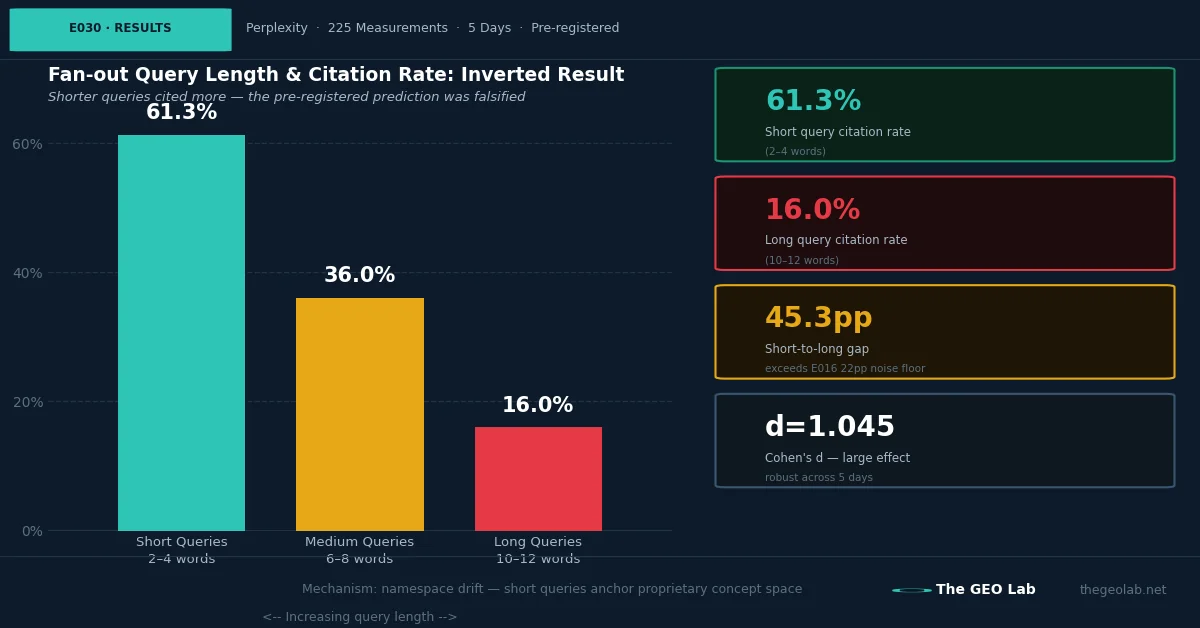
We predicted longer queries would produce a higher citation rate. They cited at less than a quarter of the rate. The pre-registered null was on record since 10 May 2026, before we measured anything.
Query length is an inverse predictor of Perplexity citation rate. 225 measurements across 5 days on three T1 proprietary-concept pages. Short queries (2-4 words): 61.3% citation rate. Medium queries (6-8 words): 36.0%. Long queries (10-12 words): 16.0%. The spread between short and long tiers is 45.3 percentage points, with Cohen’s d = 1.045.
Pre-registered hypothesis (H1) was falsified. The direction of the effect is the opposite of what the fan-out length model predicted. The mechanism is namespace drift: short queries anchor within proprietary concept space because the proprietary term has no competing corpus. Long queries compositionally expand beyond that space into generic GEO topic territory, where competitive chunk density determines selection regardless of page quality. Research on corpus-level signal stability (Maquet, 2026, Signal Inference Optimization) maps the same mechanism at corpus level: a proprietary concept with stable cross-page naming creates a namespace anchor; compositional queries that move outside that anchor enter a space where the corpus has no semantic mass to pull it back. See also: \u{2018}The Three Horizons of AI Fidelity\u{2019} (Maquet, 2026, Medium) for the accessible treatment of the same framework.
The Prediction We Got Wrong
The fan-out length model, developed by Pete Meyers for BrightonSEO 2026, describes how AI search systems expand from a root query into sub-queries of increasing specificity. The model uses a length pyramid: 2-4 word root queries at the top, 6-8 word mid-tier queries in the middle, 10-12 word long-tail queries at the base.
The reasonable inference from that model is that longer queries are more specific and therefore better matched to specific pages. If your page covers a topic in depth, a precise long-form query should land on it more reliably than a short root query competing with dozens of other pages.
We pre-registered that prediction on 10 May 2026. H1 stated: citation rate increases monotonically with query length across all three fan-out tiers. The pre-registration defined four falsification criteria, including the inverted-gradient criterion: citation rate at 2-4 words exceeds citation rate at 10-12 words by more than 22.0 percentage points.
The data falsified H1 on every measure. The inverted-gradient criterion was confirmed on day one and held for all five days without drift.
Method
E030 ran 45 queries per day across five consecutive days (19-23 May 2026), using the Perplexity Sonar Pro API. The measurement window was pre-registered and locked before any data collection began.
Three T1 proprietary-concept pages with confirmed Perplexity citation history: /geo-stack/, /extractability/, /retrieval-probability/. Drawn from the E014 M2 stable-cited set.
45 total: 5 queries per tier (2-4w, 6-8w, 10-12w) per page. All queries from the Semantic fan-out category only (Pete Meyers BrightonSEO 2026 taxonomy). No entity or follow-up query types included.
Binary citation outcome: cited (thegeolab.net URL appears in Sonar Pro search_results) or not cited. Automated cron at 10:00 UTC daily. 225 total measurements.
E016 established a 22.0pp interpretability threshold for The GEO Lab measurement stack. Results below this threshold are directionally real but not conclusively separable from platform variance.
A content freeze was enforced on all three pages from 19 to 23 May to prevent page changes from contaminating the measurement. The freeze lifted on 23 May after the final measurement run.
Statistical analysis used Welch’s two-sample t-test and Cohen’s d for each tier pair, with Wilson score intervals for 95% confidence bounds on each proportion.
Citation Rate Results
| Length tier | Cited | Total | Rate | 95% CI (Wilson) | vs 22pp noise floor |
|---|---|---|---|---|---|
| 2-4 words | 46 | 75 | 61.3% | [50.0%–71.5%] | — |
| 6-8 words | 27 | 75 | 36.0% | [26.1%–47.3%] | — |
| 10-12 words | 12 | 75 | 16.0% | [9.4%–25.9%] | — |
| Combined | 85 | 225 | 37.8% | — | — |
Table 1. Citation rate by fan-out query length tier. Perplexity Sonar Pro API, 5 days, 19-23 May 2026.
Statistical tests
| Comparison | Difference | t-stat | p-value | Cohen’s d | Effect | vs noise floor |
|---|---|---|---|---|---|---|
| 2-4w vs 6-8w | 25.3pp | 3.187 | 0.0018 | 0.520 | Medium | Above 22.0pp |
| 6-8w vs 10-12w | 20.0pp | 2.849 | 0.0051 | 0.465 | Small | Below 22.0pp |
| 2-4w vs 10-12w | 45.3pp | 6.398 | <0.0001 | 1.045 | Large | Above 22.0pp |
Table 2. Welch’s two-sample t-test and Cohen’s d for each tier pair. Noise floor threshold: 22.0pp (E016, Zenodo 10.5281/zenodo.19869156).
Note on the 6-8w vs 10-12w comparison. The 20.0pp delta is statistically significant (p = 0.0051) but sits just below the 22.0pp E016 interpretability threshold. The direction of the effect is reliable. The magnitude is not conclusively separable from platform variance at this sample size. The medium-to-long step should be treated as directional evidence, not a fully interpretable experimental result. The short-to-long comparison (45.3pp, d = 1.045) is unambiguous.
Day-over-day stability
Day totals across the five-day window: 17, 18, 16, 17, 17 citations per 45 queries (38%, 40%, 36%, 38%, 38%). Chi-square test: χ² = 0.118, df = 4, p = 0.9983. No day-over-day drift. The measurement environment was stable throughout. This rules out platform updates, re-crawl events, or content changes as confounds.
Page-Level Breakdown
The three pages showed consistent tier-level gradients with one notable exception: /extractability/ produced zero citations across all 25 long-query measurements. That is not a day-level fluctuation. It held for all five days.
| Page | 2-4 words | 6-8 words | 10-12 words | Total |
|---|---|---|---|---|
| /retrieval-probability/ | 20/25 (80%) | 12/25 (48%) | 7/25 (28%) | 39/75 (52%) |
| /geo-stack/ | 12/25 (48%) | 10/25 (40%) | 5/25 (20%) | 27/75 (36%) |
| /extractability/ | 14/25 (56%) | 5/25 (20%) | 0/25 (0%) | 19/75 (25%) |
Table 3. Citation rate by page and length tier. Each cell = cited / 25 possible measurements (5 queries × 5 days). /extractability/ 10-12w highlighted: 0/25 across all five days.
The /extractability/ floor effect
The passage extractability page cites at 56% on short queries and drops to zero at the long-tail tier. Every other page maintains some citation rate at 10-12 words. This is a structurally different outcome, not a noisy variant of the same pattern.
The likely mechanism: “extractability” is a generic English word. At short query lengths (2-4 words), the query includes enough proprietary context from the GEO Stack namespace to anchor retrieval to thegeolab.net. At 10-12 words, the compositional query moves into generic writing-quality or content-structure territory, where thegeolab.net has no retrieval advantage over more established sources. The Gemini GEO acronym disambiguation failure (GEO = geography on short query tiers) may compound this at the long-tail end.
The SIO framework (Maquet, M., 2026, Signal Inference Optimization: Doctrine Canonique) predicts exactly this at the corpus level through its interpretive sedimentation concept: when a generic term has already been used across thousands of pages in its conventional meaning, a retrieval system encountering it in a long compositional query has no reason to surface a specialist research page over more established general sources. The sedimentation is not caused by the query. It pre-exists in the competitive landscape. The query length just determines whether the retrieval set stays inside the proprietary namespace (short tier, sedimentation irrelevant) or expands into the sediment layer (long tier, sedimentation decisive).
core retrieval variable performs best across all tiers, including a 28% citation rate at 10-12 words where /extractability/ scores zero. The likely reason: “retrieval probability” is an unusual phrase with almost no prior usage outside the GEO Lab corpus. Even at long query lengths, the phrase anchors retrieval to thegeolab.net because no competing source has built a comparable retrieval signal for it.GEO Lab research guides
Free ebooks covering citation measurement, the GEO Stack framework, and AI search optimisation for practitioners. Browse the library →
What Is Actually Happening
The inverted gradient is not a content quality finding. Updating or expanding the pages in the dataset would not change the citation rate outcome. The mechanism operates one step before content quality becomes relevant.
When Perplexity receives a short query like “GEO Stack”, it retrieves from a namespace where thegeolab.net is the primary source. The competitive density in that namespace is low. Citation probability is high not because the content is good, but because there are few alternatives.
When the query becomes “how does the GEO Stack five-layer measurement framework compare to other AI optimisation approaches”, Perplexity retrieves from a broader topic namespace. ThatWare, everything-pr.com, and other content-heavy competitors enter the retrieval set. At that point, the selection mechanism moves from namespace exclusivity to competitive chunk density. Content with higher word count produces more candidate chunks, which increases selection probability regardless of precision or quality.
Anthony Lee, in an unpublished internal analysis shared privately, reports that Perplexity reads only a small part of each candidate page before deciding whether to cite it, far less than Google AI Mode. Those figures come from an internal study and are not public, so they are not reproduced here. The directional implication fits E030: a short query anchored in a proprietary namespace reaches the relevant passage immediately, while a long compositional query spreads a limited reading budget across a wider, more competitive retrieval set.
The SIO framework (Maquet, M., 2026, Signal Inference Optimization: Doctrine Canonique) frames the same finding. A proprietary concept that is named consistently across a corpus — same term, same scope, no synonym variation — creates a gravitational anchor: every page in the corpus reinforces the same semantic signal, so retrieval systems converge on the source regardless of query phrasing variation. “Extractability” lacks this anchor because it is a generic English word used across thousands of pages with no consistent proprietary meaning. At short query tiers, surrounding GEO Stack context provides enough namespace signal to anchor retrieval. At long-tail tiers, the compositional query moves outside the anchor field entirely. There is no semantic mass to pull it back. The /extractability/ floor effect is not an anomaly. It is terminological gravity at zero.
Why this matters for E047
E047 tests whether expanding topical footprint to cover Perplexity fan-out sub-queries increases citation rate on primary queries. The E030 result reframes that question. Covering sub-queries at the 10-12 word tier will not produce reliable citation rate improvements if the pages enter a generic competitive set where chunk density determines selection. The intervention most likely to work is anchoring more short-query variants within the proprietary namespace, not expanding into compositional long-tail queries.
Routing Anomalies
Three queries produced consistent routing to pages other than the intended target. Two are hard misbindings (the wrong page retrieved instead of the target). One is a co-retrieval (the correct page retrieved alongside an additional page).
| Query ID | Expected | Retrieved | Days | Cited | Type |
|---|---|---|---|---|---|
geostack_6_5 |
/geo-stack/ | /geo-brand-citation-index/ | 1, 2, 4, 5 | 0/5 | Hard misbinding |
extract_6_2 |
/extractability/ | /geo-stack/ | 1, 2, 3, 4, 5 | 0/5 | Hard misbinding. Unlogged pre-experiment. |
retprob_6_1 |
/retrieval-probability/ | /geo-stack/ co-retrieved | 3, 4, 5 | 5/5 | Co-retrieval |
Table 4. Routing anomalies across 5-day measurement window. Hard misbinding = expected page absent from retrieval set, wrong page retrieved instead. Co-retrieval = expected page present and cited, additional page also retrieved.
extract_6_2 was not in the pre-experiment anomaly log. It was identified during statistical analysis on 24 May 2026. Both hard misbindings score cited = 0 across all days, so neither inflates any cell in Table 3. The retprob_6_1 anomaly was pre-logged as a routing miss but reclassified during analysis as a co-retrieval: /retrieval-probability/ was present and cited on all five days, with /geo-stack/ appearing as an addition rather than a substitute.
Limitations
- Single platform. E030 measures Perplexity Sonar Pro only. The ChatGPT arm (E056) and cross-platform comparisons are sequenced separately. The gradient may differ on ChatGPT, where a pre-retrieval intent gate (confirmed in E042) changes the citation mechanism entirely.
- Semantic fan-out category only. Queries used the Semantic category from Pete Meyers’ BrightonSEO 2026 fan-out taxonomy. Other categories (Entity, Attribute, Compare, Tutorial, etc.) may produce different length-gradient results. The interaction between fan-out category and query length is out of scope for E030 and is a candidate for E035.
- Three stably-cited pages. The page set was drawn from the E014 M2 stable-cited population. Pages that are not currently in Perplexity’s citation set were excluded. The gradient may differ for pages entering the cited set for the first time.
- 6-8w vs 10-12w comparison below noise floor. The 20.0pp delta between medium and long tiers is statistically significant (p = 0.0051) but sits below the 22.0pp E016 interpretability threshold. The direction is reliable; the magnitude should not be treated as a precise effect size estimate.
- Pre-measurement edit carry-over. An anchor text edit to /geo-stack/ was deployed on 18 May 2026, one day before the measurement window opened. The edit is documented and did not affect the frozen pages, but it may have influenced retprob_6_1 co-retrieval behaviour from day 3 onward.
- Single site and niche. All three pages are T1 proprietary-concept pages for a single domain in the GEO research niche. The namespace exclusivity mechanism may be more pronounced for niche research sites than for established multi-topic publishers.
7. API fan-out behaviour as outlier. E030 measurements used the Perplexity Sonar Pro API throughout. Lee (2026, Paper 2) measured fan-out string consistency across platforms and found the API produces a Jaccard similarity score of 0.012 — an extreme outlier compared to Perplexity UI (0.157), ChatGPT UI (0.213), and Gemini UI (0.167). API fan-out is near-random in its sub-query generation relative to the UI. The length gradient measured in E030 reflects API retrieval behaviour specifically. Whether the same gradient holds in Perplexity’s web interface — where fan-out sub-queries are more consistent and the reading window behaviour may differ — is outside E030’s scope and a candidate for a future UI-replication arm.
Implications
The E030 result changes how query length should be treated in GEO measurement design. Query length is a confound variable. Citation rate experiments that mix short and long queries without controlling for tier will produce results that reflect the tier composition of the query set, not the true citation rate of the page.
For content strategy, the practical implication is specific. Short proprietary-concept queries drive the majority of Perplexity citations on T1 pages. A page that cites at 80% on short queries may cite at 28% on long queries regardless of on-page quality improvements. Before investing in long-tail content expansion, confirm which short-query anchors your site owns in Perplexity’s namespace. That is the primary citation signal for T1 content.
At long-tail tiers the retrieval set widens. When a long compositional query drifts into the generic GEO competitive set, ThatWare, Hashmeta, and other content-heavy competitors enter the retrieval pool. These pages produce more candidate chunks by volume, which raises their selection probability once the retrieval set is large. A page that cites at 61% on short queries is not competing against those pages in the proprietary namespace: at 2-4 words they are absent from the retrieval set entirely. At 10-12 words they are present, and their chunk density advantage activates.
The /extractability/ floor effect points to a second implication. Generic terms that borrow meaning from their surrounding namespace are structurally different from proprietary terms with no prior usage. For pages built around generic terms, the short-to-long citation gradient will be steeper than for pages built around coined or proprietary phrases. The namespace exclusivity of the primary concept predicts how much the gradient will compress at long-tail tiers.A third implication is methodological and applies across all AI search measurement. Citation behaviour varies structurally across platforms rather than randomly, as E042 found when mapping cross-platform retrieval mechanisms. E030 measures Perplexity Sonar Pro only. The length gradient reported here is a Perplexity-specific finding. E056 (ChatGPT arm) is sequenced separately because Lee (2026, Paper 2, Zenodo 10.5281/zenodo.19554329) confirmed ChatGPT’s flagship model (gpt-5.4) searches only 29% of queries — the majority are answered from model weights without retrieval. At that search rate, a length gradient experiment on ChatGPT is measuring something structurally different: not retrieval competition but the boundary between weight-based recall and live retrieval. Any experiment that mixes platforms in a single citation rate measurement without controlling for this structural difference will produce results that reflect platform composition rather than the variable being tested.
FAQ
Does query length affect Perplexity citation rate?
Yes, and in the opposite direction from what most people assume. E030 measured 225 queries across three fan-out length tiers over five days. Short queries (2-4 words) produced a 61.3% citation rate. Medium queries (6-8 words) produced 36.0%. Long queries (10-12 words) produced 16.0%. The 45.3pp spread between short and long tiers is well above the 22.0pp E016 interpretability threshold (Zenodo DOI 10.5281/zenodo.19869156).
Why do shorter queries get cited more often in Perplexity?
Short queries anchor within proprietary concept namespaces where few competitors exist. A query like “GEO Stack” retrieves from a space where thegeolab.net has few alternatives. A long compositional query like “how does the GEO Stack five-layer framework measure citation rate” drifts into generic GEO topic space where ThatWare, everything-pr.com, and others enter the retrieval set. At that point, selection moves from namespace exclusivity to competitive chunk density.
What was the pre-registered prediction for E030?
H1 predicted a monotonic increase in citation rate with query length: longer, more specific queries would produce higher citation rates. The pre-registration was published on 10 May 2026 at thegeolab.net. Falsification criterion 2 defined the inverted-gradient result: citation rate at 2-4 words exceeds 10-12 words by more than 22pp. The result confirmed falsification criterion 2 on day one and held across all five days.
What is the extractability floor effect in E030?
/extractability/ produced 0 citations across all 25 long-query measurements over five days. “Extractability” is a generic English word that lacks a proprietary anchor. At short query tiers, surrounding context provides namespace anchoring. At long-tail tiers, the compositional query drifts into generic writing-quality territory where thegeolab.net has no selective advantage. /retrieval-probability/ cites at 28% at the same tier because “retrieval probability” is an unusual phrase with almost no usage outside the GEO Lab corpus.
What does E030 mean for content strategy?
Short proprietary-concept queries drive the majority of Perplexity citations on T1 pages. Before investing in long-tail content expansion, identify which short-query anchors your domain owns in Perplexity’s namespace. A page that cites at 80% on short queries may cite at 28% on long queries regardless of content depth improvements. Query length must be controlled as a variable in any citation rate experiment. Mixed-tier query sets produce tier-composition artefacts, not true citation rates.
- Query length is an inverse predictor of Perplexity citation rate on T1 proprietary-concept pages. Short queries (2-4 words) cited at 61.3%. Long queries (10-12 words) cited at 16.0%.
- The 45.3pp short-to-long gap exceeds the E016 22.0pp noise floor threshold and produces Cohen’s d = 1.045. The effect is large and robust across five days with no drift.
- The mechanism is namespace drift, not content quality. Short queries anchor in proprietary concept space where few alternatives exist. Long queries move into generic topic space where competitive chunk density determines selection.
- /extractability/ produced 0/25 citations at the 10-12 word tier across all five days. Generic terms without proprietary anchoring experience a complete floor effect at long-tail query lengths.
- Query length must be controlled as a confound variable in any future citation rate experiment. Mixed-tier query sets will produce citation rates that reflect tier composition rather than page-level performance.
E030 pre-registration and dataset. The pre-registered null hypothesis and falsification criteria were published on 10 May 2026 at thegeolab.net/e030-fan-out-length-citation-rate/. The replication dataset is available at github.com/arturseo-geo/geo-lab-experiments/tree/main/e030. The full statistical summary is archived on Zenodo: doi.org/10.5281/zenodo.20601081.
Questions about the methodology or dataset: contact The GEO Lab.