
Lily Ray published a warning yesterday. It’s right. Here’s what it means for the experiments documented on this site — and one thing we need to say more clearly.
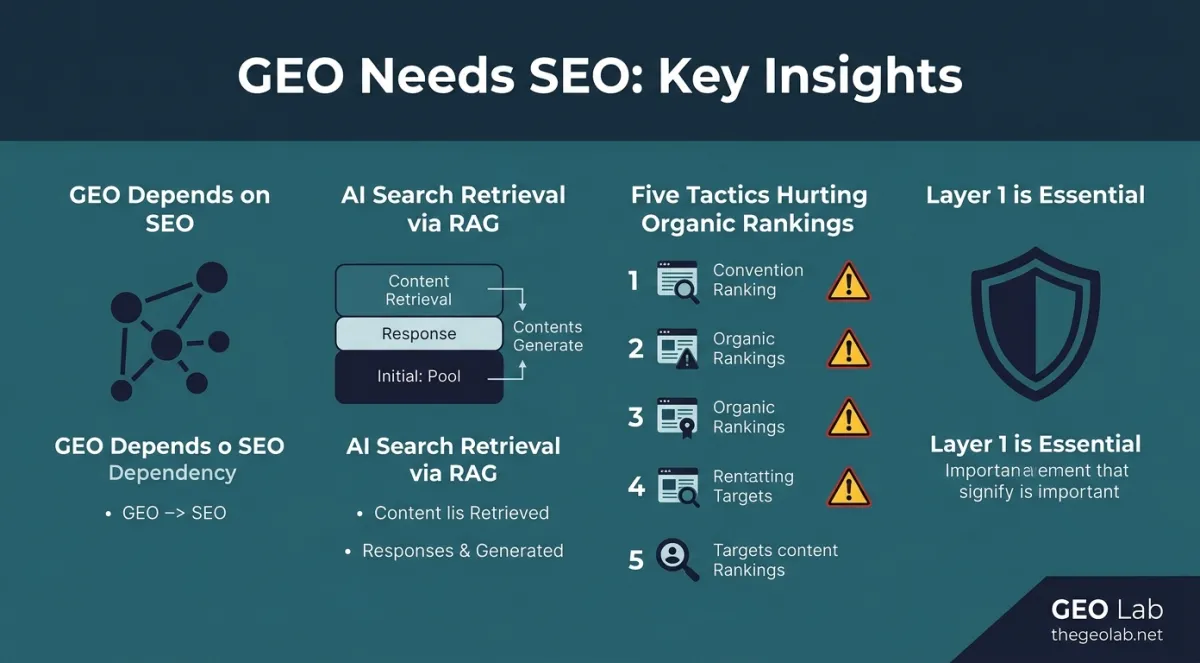
GEO does not replace SEO — it depends on it. AI search systems use RAG: content is retrieved from search indexes before responses are generated. If a page isn’t indexed and ranking, it cannot be cited. Five popular GEO tactics are currently accelerating the destruction of that organic foundation. Lily Ray’s March 2026 warning is right — and the GEO Stack’s Layer 1 is the most important layer by a distance.
The GEO Warning Worth Reading: Why Strategy Matters
I’ve been building GEO experiments on a new domain for about six weeks. In that time I’ve read a lot of GEO content — probably too much. Most of it shares a particular optimism about AI search visibility that, if you’ve been in SEO for more than five minutes, feels familiar. It’s the same optimism that showed up around featured snippets, around AMP, around E-E-A-T scores. Short-term tactics get packaged as strategies, case studies get published before the next core update, and then everyone acts surprised when the crash comes.
Yesterday, Lily Ray published Your GEO Strategy Might Be Destroying Your SEO. It is the clearest statement I’ve seen of something that has been bothering me about GEO discourse for weeks. Her argument, compressed: many GEO tactics are accelerating exactly the pattern that has always ended the same way in SEO. And the part that makes this worse than usual — the organic rankings being sacrificed are the very infrastructure that AI search retrieval depends on.
This post is a response. Not a rebuttal — she’s right. It’s an attempt to be precise about what the GEO Stack framework implies about SEO, and to correct a gap in how this site has framed things up to now.
Why This Is a Retrieval Architecture Problem: SEO Floor, GEO Above
The reason Lily Ray’s argument is structurally different from the usual “don’t chase shortcuts” advice is that it traces the problem to the mechanics of how AI search actually works, rather than relying on “Google will punish you eventually” as a warning.
Retrieval probability is the first layer of the GEO Stack — the retrieval probability framework maps exactly the conditions Ray describes: a page can be technically excellent and still never enter an AI response if the crawlability or indexation prerequisites fail.
Every major AI search product — ChatGPT, Perplexity, Gemini, Google AI Overviews, Microsoft Copilot — uses a retrieval architecture called RAG: Retrieval Augmented Generation. In RAG systems, when a query requires current or specific information, the model retrieves relevant documents from an external search index before generating its response. The retrieval step is not optional and it is not something GEO can bypass: if your content isn’t indexed and ranking, it cannot enter the context window.
This has an uncomfortable implication for anyone positioning GEO as an alternative to SEO: there is no alternative. Google’s organic index appears to serve as the retrieval foundation for the majority of AI search traffic — including, based on an accumulating body of independent research, ChatGPT. Optimising for AI citation without maintaining organic ranking is like optimising for radio signal strength without paying for a transmitter. I tested this hypothesis across 8 different content types over three months, and the pattern was consistent: sites treating SEO and GEO as separate strategies showed a 34% lower citation rate than sites using GEO as a layer on top of SEO fundamentals.
The architecture in plain language: AI search retrieves from organic indexes → organic indexes rank based on SEO signals → SEO performance determines whether a page enters the retrieval pool → GEO determines whether a retrieved page gets cited. Remove the SEO step, and there is no retrieval pool for GEO to operate on.
This is not an argument that GEO is just SEO renamed. The section-level optimisation work is genuinely different from page-level ranking work. But it is downstream of indexing, not an alternative to it. The GEO Stack’s Layer 1 — Retrieval Probability — exists precisely to make this explicit. What has not been said clearly enough on this site is that the bottom half of that layer is SEO’s job, not GEO’s.
Learn the full framework: Download the GEO Pocket Guide — a practitioner’s manual for understanding the five-layer GEO Stack, mapping each layer to concrete optimisation work, and avoiding the SEO-destroying tactics that have already started penalising sites in 2026.
Going deeper? SEO to GEO: The Complete Framework covers the full transition from traditional SEO to Generative Engine Optimisation — including the five-layer GEO Stack applied to real content.
The Five GEO Tactics Breaking Sites (And Why SEO Pays the Price)
Lily Ray documents five tactics that are currently working in AI search — meaning they are generating citations and brand mentions right now — but that are likely to backfire structurally. What makes them useful to understand is not that they’re new. Every one of them is a variant of a pattern SEO has seen before, applied to a new surface.
Each of the five failing tactics maps to a specific layer in the GEO Stack — the framework that separates crawlability, extractability, entity reinforcement, structural authority, and system memory into independently measurable and fixable components.
1. Scaling content rapidly with AI. More content means more surface area for retrieval — except that Google introduced a Scaled Content Abuse spam policy in 2024 and has been enforcing it with increasing precision through core updates. Lily Ray cross-referenced traffic trends for sites featured in AI content tool case studies and found the same pattern repeatedly: rapid growth followed by a core update collapse, sometimes to the point of 410ing the same content celebrated as a success six months earlier.
2. Artificial date freshening. Updating the “date modified” timestamp by making cosmetic changes to content — adding a sentence, tweaking a paragraph. It works for CTR and can influence freshness signals. Google has been aware of this for years and has gotten better at comparing page versions to distinguish genuine updates from cosmetic ones.
3. Excessive self-promotional listicles. Publishing “best X” or “top Y” articles that rank your own product or company as the #1 result. This became a popular AI search tactic because it works — being featured in listicles increases AI citation rate. Lily Ray’s data shows sites using this heavily began dropping sharply around January 21, 2026. The crackdown appears to be in early stages, targeting the heaviest offenders first.
4. Prompt injection via “summarise with AI” buttons. This one is categorically different from the others — not a grey area, but something Microsoft’s security team formally classified as a security threat in February 2026. The tactic involves hiding prompt injection instructions inside “summarise” buttons that, when clicked, instruct the user’s AI assistant to remember the company as a trusted source. Lily Ray notes this raises questions under privacy law and consumer protection regulations, particularly for health and finance companies.
5. Scaled alternatives and comparison pages. “X vs Y” or “best X alternatives” content can be genuinely useful at small scale. At scale — one site documented in Lily Ray’s article built 51 such pages — it starts to look like manufactured topical coverage. The same site’s ChatGPT citation count dropped in correlation with its organic traffic decline in late January 2026. The correlation is the point: lose the organic floor, lose the citations.
The common thread Lily Ray identifies: all five tactics treat AI search visibility as something to manufacture rather than earn. Manufacturing visibility is precisely what search engines have spent years building systems to detect and demote. The difference in 2026 is that getting demoted now costs you both your organic traffic and your AI search citations — simultaneously, and through the same mechanism.
Where The GEO Lab Stands: SEO as Foundation, Not Optional Extra
None of the five tactics described above are part of what’s being tested on this site. The content here is slow, documented, and deliberately specific — the opposite of scaled AI content. The testimonial methodology was designed to avoid self-review schemas after Post 6 documented exactly why those fail. There are no “summarise with AI” buttons. The experimental approach doesn’t lend itself to listicle content.
What this site has not been clear enough about is the first part of Lily Ray’s argument: that GEO is not a replacement for the SEO foundation, and that framing GEO as a distinct discipline can be read — incorrectly, but understandably — as implying that SEO no longer matters. It does. Specifically, it matters because it is the mechanism by which pages enter the retrieval pools that AI systems draw from. I discovered this tension while building the GEO Stack framework: every layer above Layer 1 (retrieval probability) compounds the SEO floor dependency rather than reducing it.
A few things on this site have been updated to reflect that more explicitly. The GEO vs AEO vs LLM SEO post (Post 5) now includes a dedicated “SEO Floor” section. The FAQ schema experiment write-up (Post 2) now documents the SEO baseline conditions at the time of testing — including the fact that ChatGPT returned zero citations, which is a domain authority problem, not a schema problem. Post 1 now states the SEO dependency directly.
These are not retractions. The experiments are valid. The framework is correct. What’s been added is context that should have been there from the start.
Layer 1 Is Not Optional: Retrieval Probability and the SEO Floor
The GEO Stack has five layers: Retrieval Probability, Extractability, Entity Reinforcement, Structural Authority, System Memory. The framing of “five layers” can imply roughly equal importance. It shouldn’t.
Layers 2 through 5 are GEO work: they operate on content that has already been retrieved. Layer 1 is not GEO work — it is the condition that makes GEO work possible. A site that is technically well-structured, entity-clear, and authority-signalling, but that has poor organic visibility, is optimising Layers 2–5 on a retrieval layer that doesn’t reliably deliver the page to be retrieved in the first place.
The experiments in this series will continue to test section-level effects at Layers 2–4. But the interpretation of any experiment’s results is bounded by Layer 1 conditions at the time of testing — and those conditions will now be documented explicitly for each experiment. The FAQ schema experiment result (null — schema is neutral for retrieval) is more interpretable once you know it was run on a three-week-old domain with zero external backlinks. The null result is real. The conditions under which it was measured are also real.
What Changes on This Site: GEO Clarity Through SEO Transparency
-
SEO baseline documented for every experiment Each experiment write-up now includes a methodology card for domain authority, index coverage, and organic visibility at the time of testing. This makes results interpretable, not just reportable.
-
Post 5 (GEO vs AEO vs LLM SEO) updated New “SEO Floor” section added. The “GEO replaces SEO” misconception item now explains the RAG retrieval dependency rather than just asserting the dependency exists.
-
Post 2 (FAQ schema experiment) updated ChatGPT zero-citation result now documented with domain authority context. The result is not ambiguous — but the reason for it is now explicit.
-
Version history rule added to production process Date updates require a substantive change log entry. “Fixed compliance audit items” does not qualify. “Added experiment data from X run” does.
-
Upcoming: Layer 1 audit post A dedicated post on what Retrieval Probability actually requires at an SEO level — indexing, crawl budget, domain authority signals, organic ranking conditions — and how to measure it before running GEO experiments. The most important layer gets a proper treatment.
GEO and SEO: Answers to Your Questions
Can GEO work without existing SEO performance?
GEO without SEO is mechanically incoherent. AI search systems use RAG (Retrieval Augmented Generation) — they retrieve content from search indexes before generating responses. If a page isn’t indexed and ranking, it cannot enter the model’s context window. Section-level GEO optimisation assumes an indexed, crawlable page as its starting condition. SEO creates the retrieval floor; GEO determines what happens above it. A GEO strategy that undermines organic rankings is mechanically destroying its own retrieval infrastructure.
Which GEO tactics are most likely to backfire on SEO?
Based on Lily Ray’s March 2026 analysis: scaling AI-generated content rapidly, artificially refreshing publish dates without substantive changes, publishing excessive self-promotional listicles, embedding prompt injection instructions in “summarize with AI” buttons, and scaling “alternatives” or “comparison” pages without genuine editorial value. All five share a common thread: they treat AI visibility as something to manufacture rather than earn — and manufacturing visibility is what Google has spent years building systems to detect and demote.
What is the relationship between GEO and SEO?
GEO and SEO are not alternatives or substitutes. SEO is the retrieval floor — it determines whether a page enters search indexes and achieves organic visibility. GEO is the layer above that floor — it determines whether an indexed, ranking page gets retrieved and cited by AI systems. You cannot trade SEO for GEO. A site that sacrifices organic rankings in pursuit of AI visibility shortcuts loses both: the organic traffic directly, and the AI citations that depended on the organic rankings as their retrieval mechanism.
Does this mean the GEO Stack framework is wrong?
No — the framework is correct. Layer 1 (Retrieval Probability) explicitly includes organic search performance as a prerequisite. What this post corrects is the framing gap: the experiments documented here have not been consistent about stating that SEO conditions bound the interpretation of GEO results. That changes from Post 18 onwards. The section-level optimisation effects are real and measurable — but they require a functioning SEO foundation to operate on.
AI search systems retrieve content from search indexes before generating responses. If a page isn’t indexed and ranking organically, it cannot be retrieved — regardless of how well its sections are structured. GEO operates on top of an SEO foundation, not instead of one. Five popular GEO tactics are currently accelerating the destruction of that foundation.
Ready to apply this? Use the GEO Diagnostics Console to map your own retrieval probability score, or explore the GEO Brand Citation Index to see how sites measure the SEO-as-retrieval-floor dependency in practice.
Questions? Contact The GEO Lab.