
{
“@context”: “https://schema.org”,
“@graph”: [
{
“@type”: “Article”,
“@id”: “https://thegeolab.net/geo-vs-aeo-vs-llm-seo/#article”,
“headline”: “GEO vs AEO vs LLM SEO: What’s the Difference?”,
“description”: “Three terms for the same shift in search — but they represent different mental models. AEO is output-focused. LLM SEO is channel-focused. GEO is pipeline-focused. Only one maps to how retrieval systems actually work.”,
“datePublished”: “2026-03-12”,
“dateModified”: “2026-04-02”,
“version”: “1.2”,
“author”: {
“@type”: “Person”,
“@id”: “https://thegeolab.net/about/”,
“sameAs”: [
“https://orcid.org/0009-0004-4072-9741”,
“https://www.linkedin.com/in/arturgeo”,
“https://github.com/arturseo-geo”
]
},
“publisher”: {
“@type”: “Organization”,
“@id”: “https://thegeolab.net/#organization”,
“sameAs”: [
“https://x.com/TheGEO_Lab”,
“https://www.facebook.com/thegeolab”,
“https://www.linkedin.com/company/thegeolab-net”
]
},
“mainEntityOfPage”: {
“@type”: “WebPage”,
“@id”: “https://thegeolab.net/geo-vs-aeo-vs-llm-seo/”
},
“about”: [
{
“@type”: “Thing”,
“name”: “Generative Engine Optimization”,
“sameAs”: “https://en.wikipedia.org/wiki/Generative_engine_optimization”
},
{
“@type”: “Thing”,
“name”: “Answer Engine Optimization”
},
{
“@type”: “Thing”,
“name”: “GEO Stack”
}
],
“keywords”: [
“GEO vs AEO”,
“LLM SEO”,
“generative engine optimisation”,
“answer engine optimisation”,
“GEO Stack”,
“AI search”
],
“digitalSourceType”: “https://cv.iptc.org/newscodes/digitalsourcetype/humanOriginated”
},
{
“@type”: “Organization”,
“@id”: “https://thegeolab.net/#organization”,
“name”: “The GEO Lab”,
“url”: “https://thegeolab.net”,
“logo”: “https://thegeolab.net/wp-content/uploads/2026/02/geo-lab-logo.png”,
“sameAs”: [
“https://x.com/TheGEO_Lab”,
“https://www.facebook.com/thegeolab”,
“https://www.linkedin.com/company/thegeolab-net”
]
},
{
“@type”: “BreadcrumbList”,
“itemListElement”: [
{
“@type”: “ListItem”,
“position”: 1,
“name”: “Home”,
“item”: “https://thegeolab.net/”
},
{
“@type”: “ListItem”,
“position”: 2,
“name”: “GEO vs AEO vs LLM SEO”,
“item”: “https://thegeolab.net/geo-vs-aeo-vs-llm-seo/”
}
]
}
]
}
{
“@context”: “https://schema.org”,
“@type”: “FAQPage”,
“mainEntity”: [
{
“@type”: “Question”,
“name”: “What is the difference between GEO, AEO, and LLM SEO?”,
“acceptedAnswer”: {
“@type”: “Answer”,
“text”: “AEO (Answer Engine Optimisation) is output-focused — it asks how to get selected as the answer. LLM SEO is channel-focused — it treats AI search as a new target for the same SEO playbook. GEO (Generative Engine Optimisation) is pipeline-focused — it asks how content survives the retrieval, extraction, and compression process before an answer is generated. The three terms are not synonyms. They represent different mental models of the same shift.”
}
},
{
“@type”: “Question”,
“name”: “Is GEO just SEO with a new name?”,
“acceptedAnswer”: {
“@type”: “Answer”,
“text”: “No. The optimisation unit is different. SEO optimises entire pages for position in a ranked list. GEO optimises individual content sections for retrieval by AI systems. Backlinks and domain authority are the primary signals in SEO. Extractability and entity clarity are the primary signals in GEO. GEO does not replace SEO infrastructure — it extends it. But the optimisation discipline is fundamentally different.”
}
},
{
“@type”: “Question”,
“name”: “What does pipeline-focused mean in GEO?”,
“acceptedAnswer”: {
“@type”: “Answer”,
“text”: “AI search systems run content through a pipeline: retrieval (which sections are fetched), extraction (which parts are parsed), compression (how meaning is condensed), and citation (whether the source is named). Pipeline-focused optimisation means engineering content to survive each stage of that process, not just to appear at the output. AEO targets the output. GEO targets the pipeline.”
}
},
{
“@type”: “Question”,
“name”: “Why does the optimisation unit matter — pages vs sections?”,
“acceptedAnswer”: {
“@type”: “Answer”,
“text”: “SEO ranks pages. AI systems retrieve sections. A page that ranks first but has no clearly extractable sections gives the retrieval system nothing to work with. It ranks. It does not participate in the answer. The shift from page-level to section-level optimisation is the structural change that makes GEO a different discipline, not just a renamed one.”
}
}
]
}
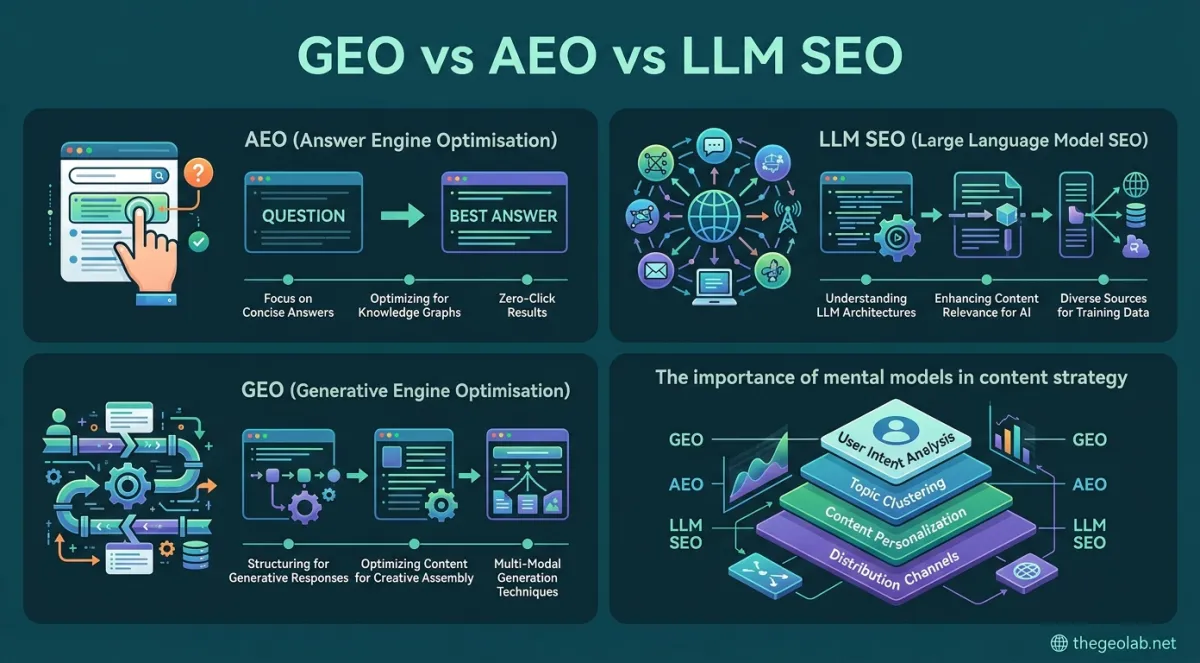
Generative Engine Optimisation (GEO), Answer Engine Optimisation (AEO), and LLM SEO are three terms for the same shift in search — but they represent different mental models, and only one maps to how retrieval systems actually work.
AEO (Answer Engine Optimisation) is output-focused: how do I get selected as the answer? LLM SEO is channel-focused: how do I do SEO but for LLMs? GEO (Generative Engine Optimisation) is pipeline-focused: how does my content survive retrieval, extraction, and compression before an answer is even generated?
The three terms are not synonyms. They represent different mental models of the same shift — and the model you use determines what you optimise for.
What Are the Three Mental Models for AI Search?
All three terms — Generative Engine Optimisation (GEO), Answer Engine Optimisation (AEO), and LLM SEO — emerged from the same observation: AI search systems have changed how content gets discovered and used. But the terms encode different assumptions about what that change means for content strategy.
Answer Engine Optimisation
Output-focused
Frames AI search as a selection system. The goal is to become the chosen answer. Optimises for the endpoint — what the AI presents — rather than the process that produces it.
Large Language Model SEO
Channel-focused
Frames AI search as a new channel for an existing discipline. SEO techniques, applied to LLMs instead of Google. Same playbook, different target.
Generative Engine Optimisation
Pipeline-focused
Frames AI search as a pipeline — retrieval, extraction, compression, citation. Optimises for how content survives each stage, not just whether it appears at the output.
The distinction is not terminological preference. It determines what you end up optimising when you adopt each model. I initially used AEO myself — it felt intuitive. I switched to GEO after realising the AEO framing led me to optimise for the wrong stage of the pipeline.
Why Does the Pipeline Model Change Everything?
AI search systems do not select an answer from a ranked list. They run content through a sequence of operations before an answer exists at all:
Which sections get fetched?
→
Which parts get parsed?
→
How is meaning condensed?
→
Is the source named?
AEO targets the final stage — citation. Getting named as the source. But content that does not survive retrieval never reaches citation. Content that survives retrieval but is not cleanly extractable gets paraphrased into something unrecognisable. Content that extracts cleanly but compresses poorly loses its core claim in synthesis.
In Experiment 001, I measured this directly: declarative content structure was cited in 18 of 30 queries (60.0%) versus 11 of 30 (36.7%) for narrative, a 23.3-percentage-point gap (z = 1.81, p = 0.07) from addressing the extraction stage alone, with no changes to content quality or authority. The AEO framing would not have identified this fix, because the problem was not at the citation stage. It was at extraction.
AEO asks: how do I become the answer?
GEO asks: how does my content survive the pipeline that produces the answer?
These are different questions. They lead to different content decisions.
What Is the Unit of Optimisation?
The most consequential difference between LLM SEO, Answer Engine Optimisation (AEO), and Generative Engine Optimisation (GEO) is not the target system — it is what gets optimised.
| SEO | AEO / LLM SEO | GEO | |
|---|---|---|---|
| Unit | Entire pages | Entire pages | Individual sections |
| Goal | Rankings and CTR | Selected as the answer | Retrieval and citation rate |
| Key signals | Backlinks, authority | Topical relevance | designing for machine retrieval, entity clarity |
| Success metric | Position, traffic | Featured in AI answer | Citation rate per section |
| Orientation | Document-centric | Document-centric | Retrieval-centric |
AEO and LLM SEO both optimise entire pages — the same unit as traditional SEO. GEO optimises individual sections, because that is what AI retrieval systems actually operate on. According to Ahrefs’ December 2025 analysis, Google AI Overviews reduce organic CTR by 58% for top-ranking pages that are not cited within the summary. A page that ranks first but has no clearly extractable sections gives the retrieval system nothing to work with. It ranks. It does not participate in the answer.
What Do These Distinctions Rule Out?
Adopting the Generative Engine Optimisation (GEO) model means rejecting several framings that follow naturally from the Answer Engine Optimisation (AEO) and LLM SEO models:
-
“Ranking in ChatGPT”
There are no positions in generative search. The AEO model implies a ranking system where you can move up or down. The pipeline model makes this framing incoherent — you are either retrieved or you are not, and rank is not the operative variable. -
“GEO is rebranded SEO”
LLM SEO treats AI search as a new channel for the same playbook. The optimisation unit has not changed in that framing — it is still pages, still authority signals, still document-centric thinking. GEO treats the optimisation unit itself as having changed: from documents to sections, from position to retrieval, from authority to what AI search extracts. -
“GEO replaces SEO”
GEO does not replace SEO infrastructure — it extends it. Technical health, crawlability, and domain authority still matter. They are prerequisites, not substitutes. The GEO vs SEO comparison maps where the overlap holds and where it breaks down. GEO adds section-level optimisation on top of a functioning SEO foundation, not instead of one. -
“Optimise for the AI, not the reader”
Content that is genuinely extractable — declarative, structured, clear — is also content that is easier for humans to read. The GEO requirements and the readability requirements point in the same direction. There is no tension between optimising for retrieval and writing well.
The Channels Are Converging — But Not Completely
A 2026 survey of 1,000 users found that question-based queries on Google grew 163% between 2023 and 2026 — roughly one in five Google searches is now phrased as a full natural-language question. Users are not abandoning Google. They are changing how they use it, adopting the query patterns they learned from ChatGPT and applying them to traditional search.
This convergence has a practical implication: content structured to survive AI retrieval — declarative sentences, clear question-answer pairs, explicit heading structure — also performs better in Google’s AI Overviews, which run the same extraction logic. The infrastructure requirement is the same. What works for one increasingly works for the other.
The convergence is real but partial. Content execution overlaps almost completely. Platform influence — how you build long-term visibility in AI systems versus search engines — diverges significantly. Treating the two disciplines as identical is a mistake. Treating them as completely separate is also a mistake.
The GEO Stack maps where the overlap holds and where it breaks down. designing for machine retrieval and Entity Clarity help both Google and AI platforms — same signal, same fix. Retrieval Probability overlaps partially: domain authority matters for AI systems that use live web search (Perplexity, ChatGPT with search), but not for systems that draw from training data. System Memory has no SEO analogue at all — training data representation and entity salience in pre-training corpora are GEO-specific signals with no equivalent in Google’s ranking model.
The practical conclusion: a shared content execution standard (declarative, structured, question-answering) is now the correct default for both channels. Platform-specific strategy diverges above that baseline, and the divergence is where most of the work is. The audience using AI search is not marginal.
Which Term Should You Use?
All three terms are in active use in 2026. None of them is wrong as a shorthand for “optimising content for AI search.” The choice of term matters because it signals which mental model you are working from.
If you are thinking about getting featured in AI answers — AEO is accurate to your goal. If you are thinking about applying existing SEO knowledge to a new surface — LLM SEO describes that work. If you are thinking about how content survives the retrieval pipeline at the section level, and you want a framework that maps to the mechanics of how the systems work — that is GEO.
The GEO Lab uses GEO because the experiments here are about the pipeline: retrieval probability, what AI search extracts, entity clarity, compression resistance. The results would look the same whatever you called the discipline. But the framework shapes what gets tested.
Go deeper: The GEO Field Manual covers section-level auditing and the full five-layer framework. The Pocket Guide to GEO provides the quick-start reference.
Key Takeaways
- Three models, not three synonyms. AEO is output-focused. LLM SEO is channel-focused. GEO is pipeline-focused. The model you adopt determines what you optimise for.
- The pipeline is the mechanism. Content passes through retrieval, extraction, compression, and citation. Failure at any stage breaks the chain. AEO targets the final stage; GEO targets all four.
- Sections, not pages. GEO shifts the optimisation unit from entire pages to individual sections — because that is what AI retrieval systems actually operate on.
- GEO extends SEO; it does not replace it. Domain authority, crawlability, and backlinks remain prerequisites. GEO adds section-level extractability on top of that foundation.
Frequently Asked Questions
What is the difference between GEO, AEO, and LLM SEO?
AEO (Answer Engine Optimisation) is output-focused — it asks how to get selected as the answer. LLM SEO is channel-focused — it treats AI search as a new target for the same SEO playbook. GEO (Generative Engine Optimisation) is pipeline-focused — it asks how content survives the retrieval, extraction, and compression process before an answer is generated. The three terms are not synonyms. They represent different mental models of the same shift.
Is GEO just SEO with a new name?
No. The optimisation unit is different. SEO optimises entire pages for position in a ranked list. GEO optimises individual content sections for retrieval by AI systems. Backlinks and domain authority are the primary signals in SEO. designing for machine retrieval and entity clarity are the primary signals in GEO. GEO does not replace SEO infrastructure — it extends it. But the optimisation discipline is fundamentally different.
What does “pipeline-focused” mean in GEO?
AI search systems run content through a pipeline before generating an answer: retrieval (which sections are fetched), extraction (which parts are parsed), compression (how meaning is condensed), and citation (whether the source is named). Pipeline-focused optimisation means engineering content to survive each stage of that process, not just to appear at the output. AEO targets the output. GEO targets the pipeline.
Why does the optimisation unit matter — pages vs sections?
SEO ranks pages. AI systems retrieve sections. A page that ranks first but has no clearly extractable sections — no declarative openings, no consistent heading structure, no isolated question-answer pairs — gives the retrieval system nothing to work with. It ranks. It does not participate in the answer. The shift from page-level to section-level optimisation is the structural change that makes GEO a different discipline, not just a renamed one.