
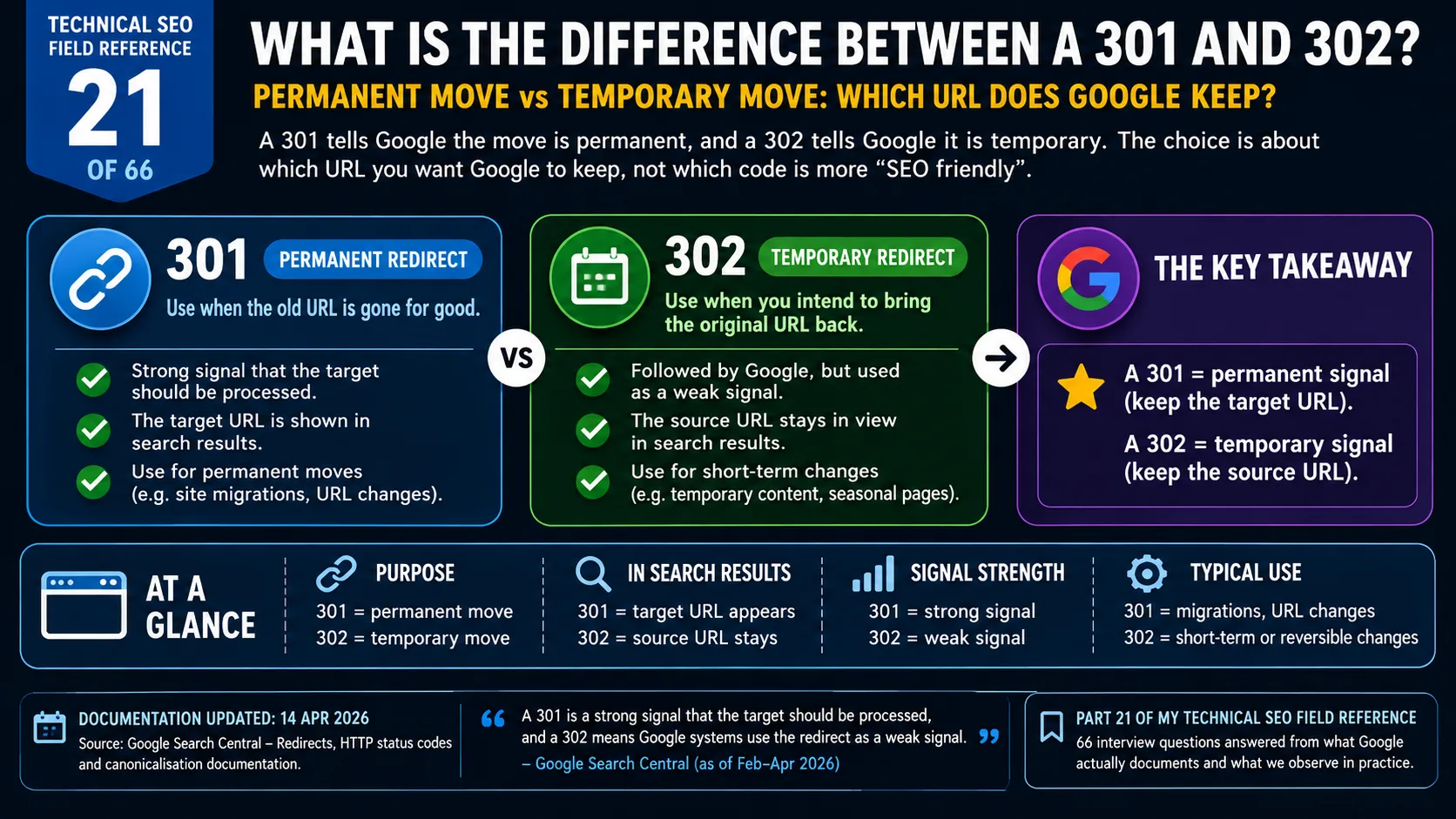
Technical SEO Field Reference, Question 21 of 66. The interview answer, checked against what Google currently documents.
A 301 tells Google the move is permanent, and a 302 tells Google it is temporary. In Google’s documentation, permanent redirects show the new target in search results, temporary redirects show the source page, and a 301 is a strong signal that the target should be processed while a 302 is a weak one. The 301 vs 302 redirect choice is therefore about which URL you want Google to keep, not about which code is more “SEO friendly”.
Two redirects can look identical in a browser. The visitor lands on the new page either way.
Google does not treat them the same. One is a statement that the old URL is finished. The other is a statement that it is coming back. Get the statement wrong and the symptom is rarely an error. It is the wrong URL sitting in search results for weeks.
Why the 301 vs 302 redirect choice matters
A redirect rule that works for visitors will pass every manual test. Nobody opens Google a month later to see which URL it chose.
That is why this choice fails quietly. A migration goes live with the wrong type, the old URLs keep appearing, and the first theory is usually something far more complicated than a status code.
The interview question tests whether you reach for the status code early. It is the cheapest thing to check and one of the most common causes.
What Google says about a 301 vs 302 redirect
Google’s redirects documentation ties the choice to what you want shown. A permanent redirect is a signal that the target should be canonical, so the target is what appears. A temporary redirect is followed, but the indexing pipeline does not read it as a canonical signal, so the source stays in view, although the target might still be indexed if other canonicalisation signals are present (page last updated 14 April 2026).
Google also keeps track of both URLs. The one that is not chosen as canonical becomes an alternate name, and Google says alternate names may still appear in results when a query suggests people trust the old URL more.
The HTTP status code documentation gives the signal strength: a 301 is a strong signal that the target should be processed, and a 302 means Google systems “use the redirect as a weak signal”. The page is dated 4 February 2026, and it covers the 307 and 308 equivalents that the previous question on HTTP redirects explains. The canonical documentation lists redirects as a strong canonical signal and says to use them when deprecating a duplicate. How that sits with the other signals is covered in the canonical hint question.
The interview answer for 301 vs 302 redirect
A 301 is a permanent redirect. Google uses it as a strong signal that the target should be processed and shown. A 302 is temporary. Google follows it, uses it as a weak signal, and the source URL is the one that stays in view. I would use a 301 when the old URL is gone for good, and a 302 only when I intend to bring the original back. The mistake to avoid is a 302 on a permanent move, because the old URL may keep appearing in results.
301 vs 302 redirect at a glance
An Apache example of a 301 vs 302 redirect
Say a service page moves from /services-old/ to /services/. The developer writes the rule in Apache as a plain RewriteRule with the redirect flag and no status code.
That detail matters. Google’s own redirects page shows the plain flag as the temporary version and R=301 as the permanent one. So the rule works for visitors, the migration ticket is closed, and Google has been told the move is temporary.
I would catch it with a header check. curl -I on the old URL shows the status line, and the answer should be 301, not 302. Weeks later I would search for the old page in Google. If the old URL is still showing where I expected the new one, I would look at the response code before looking at anything else.
The reverse case is a short promotional page that replaces a category page for ten days. A 301 there tells Google the category page is retired. A 302 keeps it in view for when the promotion ends. The cases where that choice is right are the subject of the next question.
How Google weighs a 301 vs 302 redirect with other signals
The documented difference is about which URL Google processes and shows. That is narrower than what is often claimed. Google’s site move guide says permanent redirects “don’t cause a loss in PageRank” (page last updated 20 August 2026). I found nothing in the pages I read that compares how ranking value passes through a 301 and a 302, so I treat that comparison as undocumented and would not use it as the reason for a choice.
A 302 is not harmless just because it is called temporary. Google’s wording is that the target “might still be indexed if other canonicalization signals are present”. That means a 302 does not guarantee the source stays and the target stays out. It means Google is not treating the redirect itself as the deciding signal. Internal links, sitemaps and canonical annotations still count.
Some people say Google eventually treats a long-running 302 as a 301. I have not found that in the documentation I read, so I would call it folklore and not build a migration plan on it.
What to check after a 301 vs 302 redirect change
I would check the status code on the old URL with curl, then the destination with a second request, so the chain is one hop. Then I would update internal links, the sitemap and canonicals so they all name the new URL, because a redirect that disagrees with the other signals is a weaker statement.
After a few weeks I would inspect the old URL in Search Console. If it is reported as a redirect and the new URL is indexed, the statement landed. For removed pages with no replacement, remember that a 404 can be the correct answer, as covered in the post on 404 errors and SEO.
The interview trap on the 301 vs 302 redirect
The trap is the sentence “a 301 passes link equity and a 302 does not”. It sounds precise. Google does say permanent redirects do not cause a loss in PageRank, but nothing I read says a 302 loses it, so the sentence claims a contrast the documentation does not draw. The documented difference is a different one: which URL is processed and shown. A candidate who leads with equity has answered a different question from the one Google documents.
The second trap is the reflex that 301 is always right. It is right for retired URLs. For a page that will return, it is the wrong statement, and it can be slow to undo in practice because Google may already have chosen the new URL as canonical. That last point is my interpretation of how canonical selection works, not a documented timeline.
Takeaway
Decide whether you are telling Google the old URL is finished or that it is coming back, then choose the redirect that says so.
Check the status code the server actually returns, not the page the browser shows.
Have questions about this topic? Contact The GEO Lab · Return to homepage