
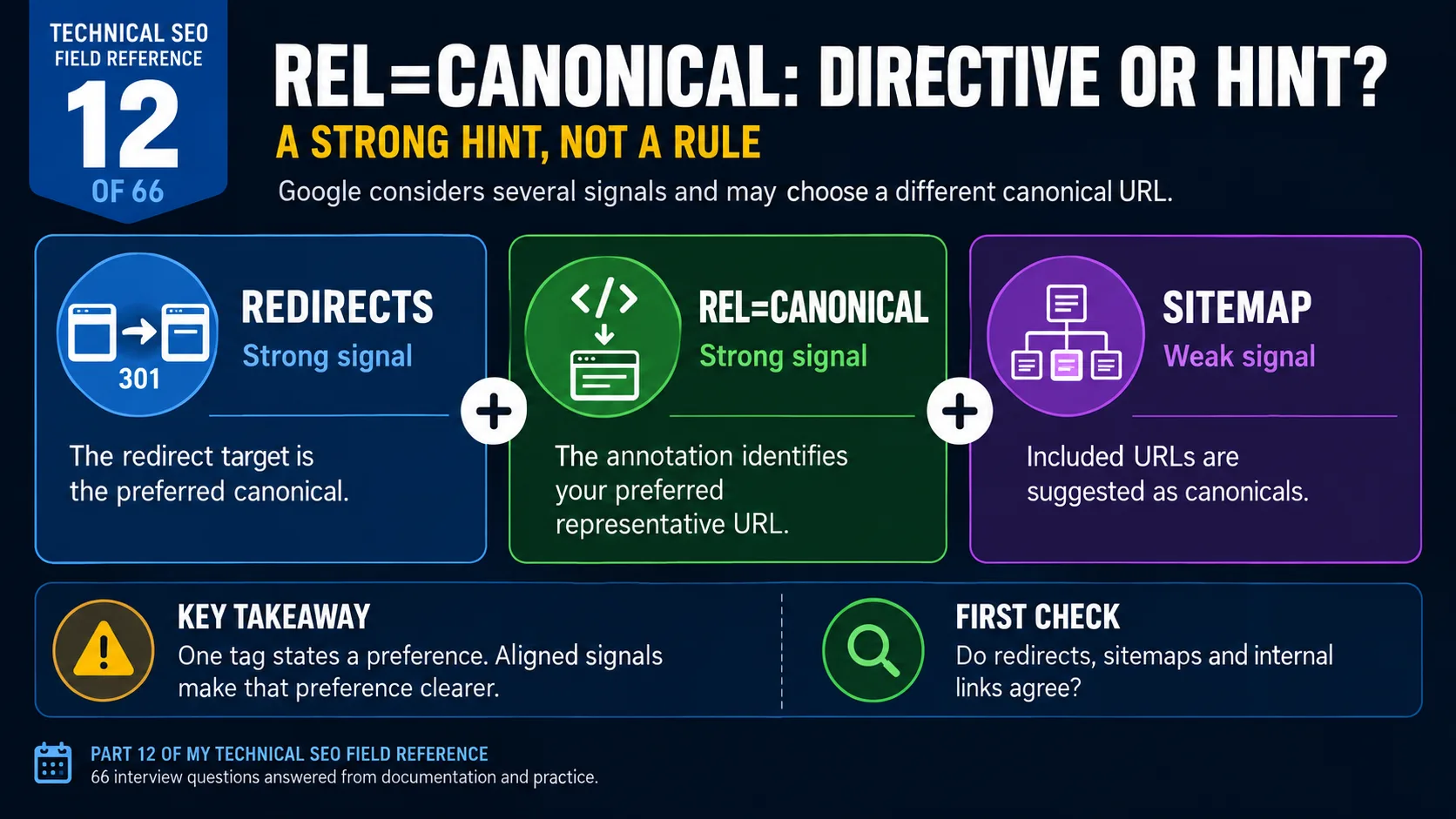
Technical SEO Field Reference, Question 12 of 66. The canonical hint question, checked against what Google currently documents.
A hint, not a directive. Google treats rel="canonical" as a canonical hint – a strong signal it considers alongside redirects, sitemap inclusion and internal linking patterns before choosing its own canonical for a set of duplicate pages. In most cases Google follows the declared preference, but it can and does pick a different URL when other signals disagree or when it judges another version more complete (Google Search Central, as of September 2026).
This is one of the most commonly misunderstood distinctions in technical SEO, and one of the easiest to get right if you have read the current documentation. A lot of practitioners still talk about canonical tags as though setting one guarantees the outcome. It does not, and the gap between “signal” and “guarantee” is exactly what this question is testing.
Why the canonical hint matters
Setting a canonical tag does not guarantee that Google will choose the URL inside it. The tag expresses your preference, but Google makes the final choice after looking at the wider set of canonicalisation signals.
The canonical hint distinction is what this interview question tests: whether you understand the gap between a strong signal and a binding instruction. Candidates who say “the canonical tag tells Google what to index” fail the question on that single sentence.
This opens the canonicals, duplication and URL management cluster. Where the previous eleven questions dealt with crawl budget, crawl traps and indexing statuses like Discovered – currently not indexed, the next five focus on how Google selects which version of a page to keep and show.
What Google says about the canonical hint
Google’s canonicalisation documentation states plainly that indicating a canonical preference is a hint, not a rule. Google weighs several signals when picking the canonical URL for a set of duplicate or near-duplicate pages: redirects (a strong signal), rel="canonical" annotations (a strong signal), and sitemap inclusion (a weaker signal). These signals can stack, and combining them increases the chance the preferred URL is the one Google shows.
Google’s implementation guidance also distinguishes between the strength of the main methods. A redirect is a strong signal that the target should become canonical. A declared rel="canonical" annotation is also a strong signal. Sitemap inclusion is explicitly weaker.
None of these methods is required. Google says a site will likely do fine without specifying a canonical preference at all, because it will pick what it judges the objectively best version to show users.
The interview answer
A canonical hint, not a directive. Google takes a declared rel="canonical" into account alongside other signals – redirects, sitemap inclusion, internal linking patterns – and picks its own canonical for a set of duplicate pages. In most cases Google respects the declared canonical, but it can and does choose a different URL when other signals disagree with it or when it judges another version more authoritative or complete.
A real-world example
A retailer’s category pages are reachable both at the clean URL and at a version decorated with a tracking parameter, ?ref=email. The clean URL carries a self-referencing canonical. The parameter version has a canonical pointing to the clean URL too – so far, consistent.
But internal navigation and the XML sitemap both link almost exclusively to a third variant, an uppercase-slug legacy URL that 301-redirects to the clean URL. In this case the redirect and the canonical agree, so Google settles on the clean URL without drama.
Where I have seen canonicals get overridden is the opposite setup: the canonical hint pointing one way while internal links, the sitemap and inbound backlinks all point somewhere else. That is when Google’s own pick can diverge from what the tag says, and URL Inspection is where you find out.
This connects directly to why pages end up Crawled – currently not indexed in Search Console. If Google decides a different URL is the canonical, the version you intended may be dropped from the index entirely – not because of a quality problem, but because Google consolidated it into a URL you did not expect.
How the canonical hint works with other signals
Google’s own phrasing distinguishes signal strength: a redirect is treated as a strong signal that the redirect’s target should become canonical, and a declared rel="canonical" is treated as a strong signal too, while sitemap inclusion is explicitly a weaker signal.
I think of the main canonicalisation methods as a signal ladder. That is my explanation, not Google’s terminology, but it makes the practical point clear: several methods agreeing is stronger than getting any one of them right in isolation.
Where canonical tags commonly break: pointing different canonicalisation methods at different URLs for the same page. The sitemap says one URL, the rel="canonical" says another, and a permanent redirect points to a third. Google’s guidance calls this out directly as something to avoid, because contradictory signals give it less to work with, not more.
Contrast this with directives that Google does treat as binding. A noindex meta tag is a directive – Google must honour it. A robots.txt block is also a directive at the crawling stage. The canonical hint sits in a different category: Google considers it strongly, but reserves the right to override it. Understanding which instructions are directives and which are hints is one of the clearest dividing lines in technical SEO.
The interview trap
The main trap is saying that a canonical tag tells Google what to index as though the instruction were binding. Treating a canonical hint as a directive is the fastest way to fail this question.
A second mistake is assuming the tag alone can consolidate signals when internal links, sitemaps and redirects are all still pointing at the non-preferred URL. The tag is one vote among several, and it can be outvoted.
The nofollow-adjacent trap is thinking “hint” is a recent downgrade unique to canonicals. It is not. The documentation has used “hint, not a rule” language for canonicals for some time, distinct from the 2019 change that made nofollow a hint for ranking purposes. The two should not be confused.
A subtler version of the trap: answering “hint” correctly but then describing a workflow that treats the canonical hint as if it were binding. If your entire canonicalisation strategy is “set the tag and move on” without checking whether redirects, sitemaps and internal links agree, you have given the right definition but shown the wrong practice.
Takeaway
The wrong question is “Did I set the canonical tag?” The better question is “Do my redirects, sitemap and internal links all agree with what my canonical tag says?” A canonical hint working alone is a request. A canonical hint backed by consistent signals is close to a guarantee.
Have questions about this topic? Contact The GEO Lab · Return to homepage
Have questions about this topic? Contact The GEO Lab · Return to homepage