
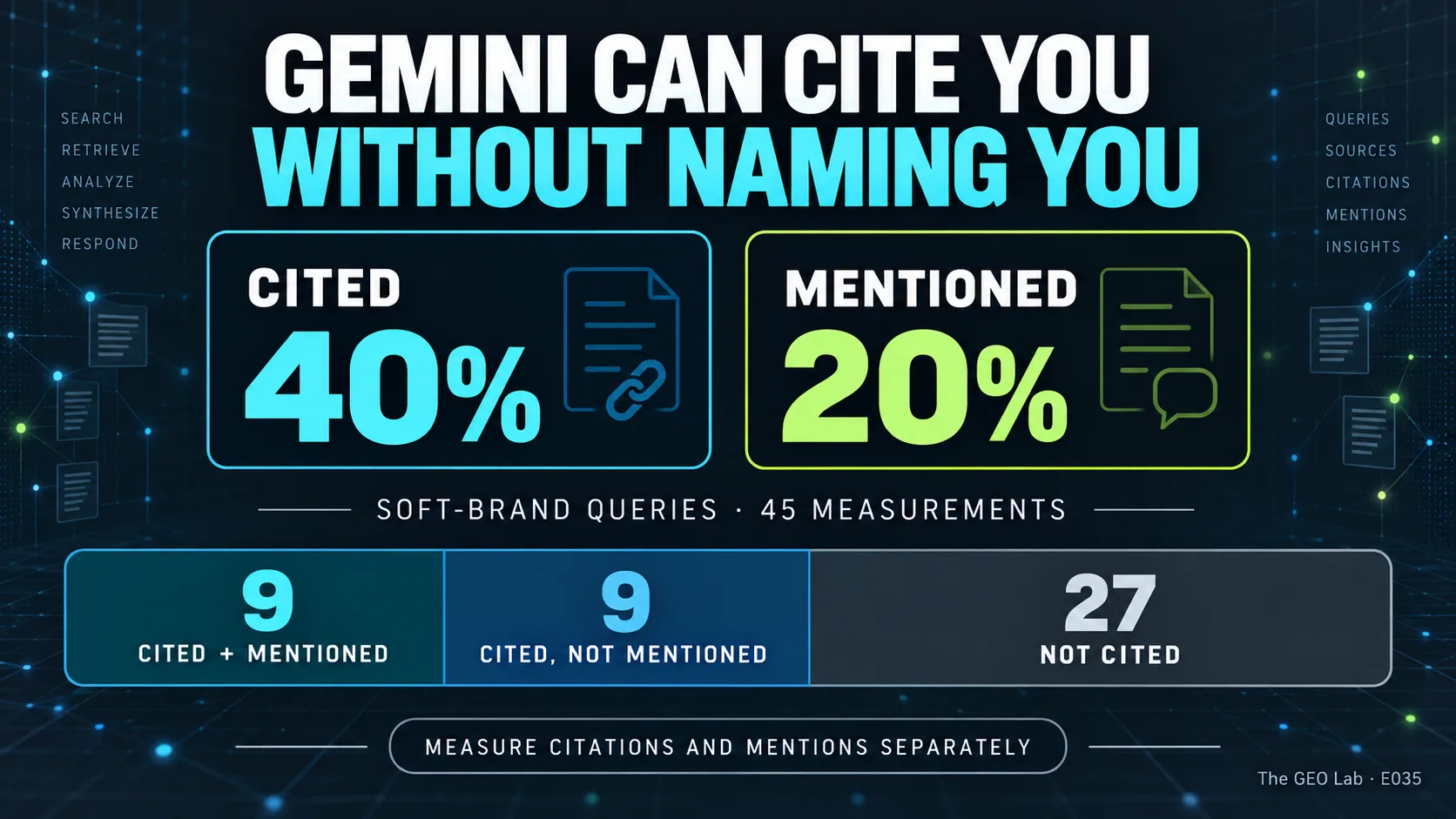
Gemini citations appeared without any brand mention.
In E035, it cited The GEO Lab in 40% of the soft-brand tests. Yet the site, brand or author appeared in the answer only 20% of the time.
That gap is the finding.
This is the Gemini counterpart to E031, where Perplexity cited soft-brand queries 51% of the time and generic queries 0% of the time. E035 used the same frozen query set and the same five-day window.
Gemini reproduced the citation gap. It also separated two signals that GEO tools often roll into one: being cited and being mentioned.
What is a soft-brand query?
A branded query names the concept or the source directly. "What is the GEO Stack?" is a branded query.
A soft-brand query asks about the layered framework in the user's own words. It never mentions The GEO Lab, but the page is still a relevant answer. The wording does not hand the engine the source.
The comparison arm used generic category queries covering the same topic space, with no coined concept or clear connection to one source.
The E035 Gemini setup
- Engine:
gemini-2.5-flashthrough the API, with Google Search grounding enabled. - Window: 14 to 18 June 2026, with each query run once per day for five days.
- Queries: nine soft-brand queries at tier T1.5 and five generic category queries at tier T2.
- Measurements: 45 soft-brand and 25 generic, giving 70 calls in total.
- Model version: captured from the API metadata for every row. It was identical across all 70 calls, so there was no model-version drift during the test.
I scored two outcomes separately:
- Mentioned: the site, brand or author appeared in Gemini's answer.
- Cited: a grounding chunk resolved to a
thegeolab.netURL.
One technical detail made a real difference. Gemini wraps grounding URLs in Vertex redirects, so the citation detector unwraps them before matching the destination domain.
Without that step, some genuine citations would be missed. This detection problem has affected earlier work in the research programme, so the fix is part of the methodological record.
Going deeper? The GEO Experiments: Design, Measure, Learn ebook covers how to design AI citation experiments with proper controls and falsification criteria.
The Gemini mention prediction failed
The prediction was that soft-brand queries would raise the mention rate into the 40% to 70% range.
They didn't.
Gemini named the site, brand or author in 9 of 45 soft-brand measurements, or 20.0%.
The historical generic baseline was 21.2%. A difference of 1.2 percentage points is effectively no difference here.
Under the falsification tree fixed before the measurement window, this lands on criterion 3. For mentions, soft-brand queries behaved like generic queries. The predicted middle band never appeared.
Soft-brand mentions matched the generic baseline
Mention rate, percentage of measurements
Gemini citations told a very different story
Gemini cited The GEO Lab in:
- 18 of 45 soft-brand measurements: 40.0%
- 0 of 25 generic measurements: 0%
The direction matches E031 on Perplexity, where the same comparison produced citation rates of 51.1% versus 0%.
Across both engines, soft-brand queries produced citations while generic queries did not.
The actual E035 finding: cited does not mean named
Every response that named The GEO Lab also cited it.
But Gemini produced another nine responses that cited the site without mentioning the site, brand or author anywhere in the answer.
The manual spot-check found the same pattern. Gemini retrieved and used the content, but gave no in-text attribution.
What happened in the 45 soft-brand measurements
A mention-only tracker would report that Gemini used the site in 20% of the tests.
The grounding data shows 40%.
Same queries. Same five days. Two very different visibility numbers.
E035 Gemini results summary
| Metric | Soft-brand (n=45) | Generic (n=25) | Difference |
|---|---|---|---|
| Citation rate | 40.0% | 0% | +40 pp (p = 0.00024) |
| Mention rate | 20.0% | 21.2% (baseline) | -1.2 pp (null) |
| Cited + mentioned | 9 of 45 | - | - |
| Cited but NOT mentioned | 9 of 45 | - | 50% of Gemini citations had no brand mention |
What I would change in Gemini measurement
Do not use Gemini's mention rate as a complete visibility metric.
In this test, half of the responses grounded in The GEO Lab never named the site, brand or author. A tracker looking only at answer text would have missed them.
Citations need to be measured at the grounding-chunk level. The Vertex redirect URLs also need to be unwrapped before matching them to the destination domain.
Mentions and citations belong in separate columns. Combining them into a single "visible" result hides the difference E035 found.
E035 limits
- This study was not publicly pre-registered. The design and falsification criteria were committed internally, and the query file was frozen as read-only ten days before measurement. There was no public pre-registration post or Git anchor. This is the same provenance limitation disclosed for E031.
- The arms were small. The test used nine soft-brand queries and five generic queries, so the confidence intervals are wide. The defensible results are the mention null and the direction of the citation gap, not the exact percentages.
- The scope was narrow. One model, one site and five days.
service_tierwas not recorded for each row.model_versionwas.- The manual spot-check was post-hoc. The spot-check file specified in the protocol was not created during the measurement window. The check included in the deposited analysis was completed afterwards and is labelled accordingly.
thegeolab_in_chunksis derived from the citation scan. It is not an independent measurement and should not be treated as one.
E031 found that Perplexity cites soft-brand queries. E035 found the same pattern on Gemini, with one extra warning: Gemini can use your page without ever saying your name. If you only count mentions, you may miss half the evidence. The distinction between retrieval surfaces matters for any GEO measurement framework.
Key GEO Lab Takeaway
Gemini citations and Gemini mentions are different measurements. In E035, half of Gemini's citations carried no brand mention in the answer text.
Any tool that counts only mentions will undercount Gemini visibility by up to 50%. Grounding-chunk URLs are the reliable signal.
Measure both. Report them in separate columns. The retrieval probability of your page is higher than the mention rate suggests.
Ready to apply this? Start with the 10 Probe Queries to test your own Gemini citation behaviour, then check your citation rates by query type.