
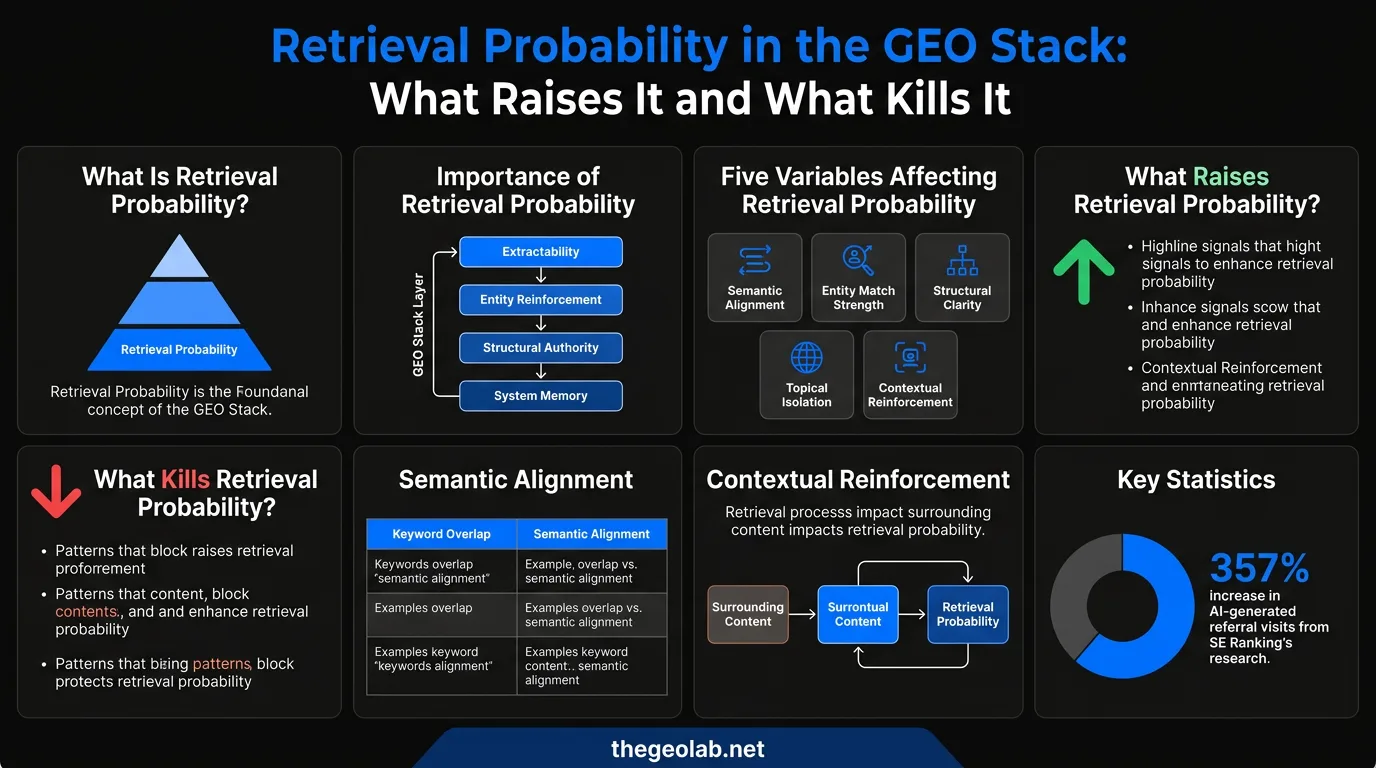
Retrieval probability is the estimated likelihood that an AI search system selects your content during vector retrieval. It is the first layer of the GEO Stack and the prerequisite for citation.
TL;DR
Retrieval probability is the estimated likelihood that an AI search system selects your content during the retrieval step, before ranking and before the answer is composed. If your page is not retrieved, nothing downstream matters. The GEO Lab’s E027 replication ran ten queries through Perplexity daily for 14 days: zero variance across 140 checks. The Retrieval Probability, GEO Stack, and Extractability queries each returned the same citation every day. What raises retrieval probability is compound: crawlability, topical depth, domain authority, and schema accuracy each gates retrieval, and a single gate failing is enough to kill it.
What is Retrieval Probability?
Retrieval Probability is the likelihood that your content will be retrieved and displayed by search engines when a user enters a query. It sits at the heart of the GEO Stack, operating at the intersection of technical compliance, content relevance, and algorithmic trust.
In practical terms, Retrieval Probability answers this question: When the search engine decides to answer this query, how likely is it to retrieve your page from its index to satisfy it?
This is different from ranking. Ranking happens after retrieval. You cannot rank for a query you are not retrieved for.
Going deeper? The GEO Authority Playbook covers advanced citation strategy, entity reinforcement, structural authority, and the long-term signals that compound AI visibility over months.
Technical Factors That Raise Retrieval Probability
Crawlability and Indexability
Your pages must be crawlable and indexable. This means:
- No noindex tags on pages you want ranked
- No robots.txt rules blocking relevant paths
- XML sitemaps submitted to Google Search Console
- Proper internal linking structure guiding crawlers to important pages
- Fast page load times (Core Web Vitals matter)
If Googlebot cannot reach, crawl, or index your page, Retrieval Probability is zero.
Schema Markup and Semantic Structure
Schema markup tells search engines what your content is about. When you implement the correct schema for your content type, Article, FAQPage, HowTo, BreadcrumbList, and others, you increase the likelihood that search engines understand the content well enough to retrieve it for relevant queries.
Proper heading hierarchies (H1, H2, H3) and semantic HTML also signal to search engines the structure and intent of your content.
Mobile-First Indexing
Google now crawls and indexes the mobile version of your site first. If your mobile version is missing content, broken, or slow, Retrieval Probability suffers. Make sure your mobile experience is solid.
Content Quality Factors
Topical Relevance and Coverage
Your page must comprehensively cover the query topic. Search engines use NLP and entity recognition to understand what topics and subtopics your page addresses. The more thoroughly and accurately you cover the user’s intent, the more likely you will be retrieved.
This is where topical clusters and pillar content matter. Pages that demonstrate deep, structured knowledge of a topic are retrieved more often for queries within that topical space.
Content Freshness
For queries where freshness matters, news, trends, algorithm updates, product releases, newer content is retrieved more often. Evergreen content can remain relevant indefinitely, but periodic updates signal that the content is current and maintained.
Content Length and Depth
Longer, more comprehensive content is generally retrieved more often for competitive queries. This is not about padding; it is about addressing the query thoroughly. Short, superficial pages are retrieved less often because they do not satisfy the full intent.
Site Authority and Trust
Domain Authority and Link Profile
Pages on domains with higher authority, measured by quality backlinks, brand signals, and historical performance, are retrieved more often. A new domain on a competitive topic will have lower Retrieval Probability than an established domain covering the same topic, all else being equal.
E-E-A-T Signals
For YMYL (Your Money, Your Life) queries, Google looks for Experience, Expertise, Authoritativeness, and Trustworthiness. Author credentials, publication history, transparent sourcing, and editorial review all increase Retrieval Probability for sensitive topics.
Site Reputation
Sites that are frequently returned for queries and have positive user engagement signals build reputation. This reputation increases the likelihood that new pages on the site are retrieved for relevant queries, even before they accumulate their own authority.
User Signals That Drive Retrieval
Click-Through Rate (CTR)
When your page appears in search results and users click on it frequently, Google interprets this as a signal that your page is relevant and satisfying. Over time, this increases Retrieval Probability. Low CTR signals the opposite, your page may not be matching the query intent as well as competitors.
Dwell Time and Engagement
When users click on your page and stay on it, reading, scrolling, and engaging, Google sees this as a positive signal. Pages with high engagement are retrieved more often because they satisfy user intent. Bounce rates matter in reverse: high bounces reduce Retrieval Probability.
Return Visitor Signals
Users who return to your content, bookmark it, or share it signal that the content is valuable. Search engines may interpret repeat visits and shares as reasons to retrieve the page more often for related queries.
What Kills Retrieval Probability
Technical Problems
- Indexing issues: Pages blocked by noindex tags, robots.txt, or authentication cannot be retrieved if they are not in the index.
- Canonicalization errors: Pointing to the wrong canonical URL confuses search engines about which page to retrieve.
- Duplicate content: If multiple versions of the same content exist, search engines may not retrieve the one you want.
- Broken internal links: Pages that are not well linked internally may not be crawled or retrieved frequently.
- Slow page speed: Pages that fail Core Web Vitals are retrieved less often.
Content Problems
- Thin or shallow content: Pages that do not thoroughly address the query intent are retrieved less often.
- Keyword stuffing or unnatural language: Search engines penalize content that looks manipulated. This reduces Retrieval Probability.
- Outdated information: Pages with stale, incorrect, or contradicted information are retrieved less often.
- Poor user experience: Content that is hard to read, poorly formatted, or confusing is retrieved less often because it has low engagement.
Authority and Trust Problems
- Low domain authority: New domains and domains with few quality backlinks are retrieved less often, especially for competitive queries.
- Negative site signals: If a site is known for spam, misinformation, or poor user experience, new pages on that site start with lower Retrieval Probability.
- Lack of E-E-A-T: For YMYL queries, pages without clear expertise, author credentials, or editorial review are retrieved less often.
Algorithmic Penalties
- Manual penalties: If Google manually penalizes a site for violating quality guidelines, Retrieval Probability across the entire site drops.
- Algorithmic penalties: Broad core updates and spam updates reduce Retrieval Probability for pages that do not meet quality thresholds.
The Retrieval Probability Flywheel
High Retrieval Probability creates a positive feedback loop:
- Your page is retrieved for relevant queries
- Users click on it (good CTR)
- Users engage with it (low bounce, high dwell time)
- Engagement signals increase your site’s authority
- Higher authority increases Retrieval Probability for related queries
- More retrievals, more engagement, more authority
The opposite is also true. Low Retrieval Probability creates a death spiral: no retrievals, no engagement, no authority, even lower Retrieval Probability.
Your job is to design content and technical foundations that enter and stay in the positive flywheel.
How the GEO Stack Addresses Retrieval Probability
The GEO Stack organizes Retrieval Probability into five layers:
- Discoverability: Can search engines find and crawl your content?
- Relevance: Does your content comprehensively address the query?
- Authority: Does your domain and content have the trust needed to be retrieved for this query?
- Retrieval Probability: All of the above working together to ensure your page is retrieved.
- Amplification: Once retrieved and ranking, how do you maximize visibility and engagement?
By systematically auditing and improving each layer, you raise Retrieval Probability and break into the positive flywheel.
Key GEO Lab Takeaway
Retrieval probability is not one signal. It is the compound result of crawlability, schema accuracy, topical depth, domain trust, and user engagement acting together. Fix one and the others still gate you. The flywheel works because each factor reinforces the next: better content earns links, links raise authority, authority earns retrieval, retrieval earns citations, citations drive engagement, engagement signals feed back into retrieval. Start with the technical layer (crawl, index, schema) because everything downstream depends on it.
Related Reading
- The GEO Stack: How the Five-Layer Framework Diagnoses Visibility Problems
- Discoverability in SEO: Why It Matters More Than You Think
- Content Relevance in SEO: The Silent Algorithm
- Site Authority in SEO: How to Build and Maintain It
- Amplification in SEO: The Missing Piece
- AI SEO OS: Building Autonomous AI Search Visibility Infrastructure
Ready to apply this? Run the 30-check protocol against your highest-traffic informational pages using the AI Visibility Diagnostics Console, it generates a baseline citation rate in under 10 minutes.
Questions? Contact The GEO Lab.
Version History
- Version 1.0 — 20 August 2026: Initial publication.
Have questions about this topic? Contact The GEO Lab · Return to homepage