
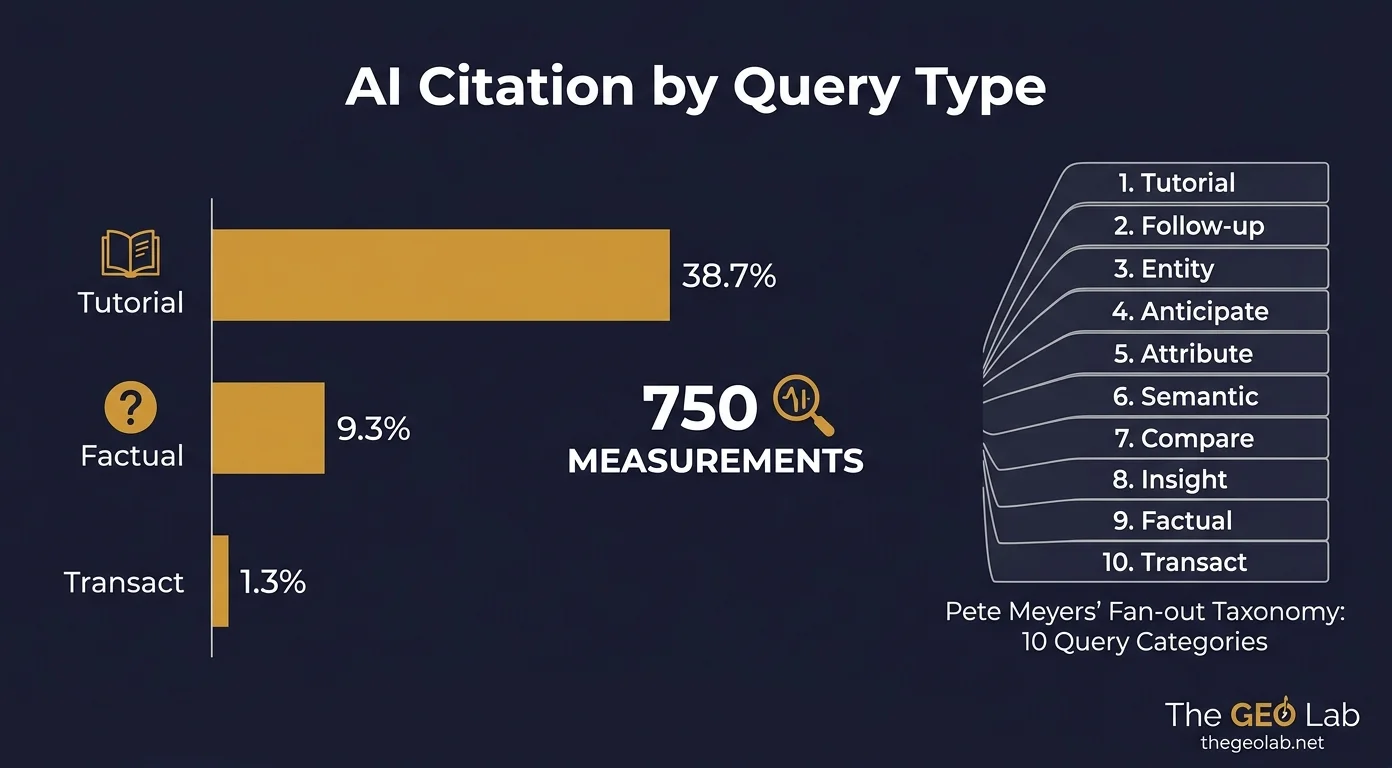
AI citation by query type is not what most GEO advice assumes. Across 750 measurements on Perplexity sonar-pro, the same five pages were cited 38.7% of the time for how-to queries and just 9.3% for direct factual queries. The pages did not change. The way the question was asked did.
That’s the main result from E026, a controlled experiment I pre-registered on 9 June 2026 and ran from 10 to 14 June. The full query set, raw data and analysis are deposited on Zenodo (DOI: 10.5281/zenodo.22230285).
Here’s what happened.
Methods at a glance
E026 tested whether AI citation rates change when the page stays the same but the query type changes.
The experiment used five fixed pages on The GEO Lab and ten query categories from Pete Meyers’ fan-out taxonomy: Semantic, Entity, Follow-up, Anticipate, Attribute, Factual, Tutorial, Compare, Insight and Transact.
Each page was tested with three queries per category, giving 150 queries in total. Those 150 queries were run once per day for five days, from 10 to 14 June 2026, on Perplexity sonar-pro via API.
That produced 750 measurements.
Every query was 6 to 12 words, contained no brand name, and used a single scoring rule: did Perplexity cite the target URL, yes or no?
Before running the experiment, I set a pre-registered interpretability threshold of 22 percentage points for treating category differences as interpretable. That threshold came from the noise floor measured in E016, so smaller differences were treated cautiously rather than as firm findings.
The experiment was pre-registered on 9 June 2026. The frozen query set, raw data and analysis are deposited on Zenodo: DOI 10.5281/zenodo.22230285.
What I tested
The question behind E026 was pretty simple: if I keep the pages fixed and change the type of query, does AI citation by query type actually shift?
I used five pages on thegeolab.net and ten categories from Pete Meyers’ fan-out taxonomy, presented at BrightonSEO in April 2026:
Semantic, Entity, Follow-up, Anticipate, Attribute, Factual, Tutorial, Compare, Insight and Transact.
Each page got three queries per category, giving me 150 queries. I ran all 150 once a day for five days.
That’s 750 measurements in total.
Every query was 6 to 12 words, contained no brand name, and had one very boring scoring rule: did Perplexity cite the target URL, yes or no?
I’d also set the bar before running the test. A difference between categories needed to clear 22 percentage points, based on the noise floor measured in E016, before I’d treat it as interpretable rather than ordinary run-to-run wobble.
How AI citation by query type played out
Tutorial queries had the highest AI citation rate at 38.7%.
Factual queries were way down at 9.3%.
Only Transact queries, basically buying or hiring intent, came in lower at 1.3%.
Here’s the full spread, with 75 measurements per category:
| Query category | Citation rate |
|---|---|
| Tutorial | 38.7% |
| Follow-up | 26.7% |
| Entity | 24.0% |
| Anticipate | 17.3% |
| Attribute | 17.3% |
| Semantic | 17.3% |
| Compare | 14.7% |
| Insight | 14.7% |
| Factual | 9.3% |
| Transact | 1.3% |
Across all 750 measurements, the overall AI citation rate was 18.1%.
And this wasn’t just a nice-looking spread in a table.
Six category pairs were separated by at least the pre-registered 22-point threshold. All six were significant on Welch’s t-test at p<0.05 with Cohen’s d ≥0.5, and a two-proportion z-test agreed on all six.
So C1 was met: AI citation by query type was not flat.
There’s an important boundary here, though.
I changed the queries. I did not change the content format of the pages.
All five pages kept the same declarative structure throughout the experiment.
So please don’t turn this into “write tutorials and AI will cite you more”. E026 doesn’t show that.
What it shows is that how-to phrased queries produced more citations for these fixed pages on this experiment.
Different question.
The prediction I got backwards
This was probably my favourite part of the experiment because my original prediction was wrong.
I expected Factual and Entity queries to sit near the top. It seemed reasonable: if someone asks for a fact, surely that’s exactly where a citation engine should want supporting evidence.
Nope.
Factual queries landed at 9.3%, near the bottom.
Tutorial queries, which I’d expected somewhere around the middle, came out highest at 38.7%.
That triggered C3, the pre-registered inversion criterion.
I have a hunch about what might be happening.
How-to and follow-up queries may generate more specific sub-questions during fan-out, giving a page more opportunities to match something useful. A bare factual query might instead throw the page into a much more crowded source pool.
But that’s a hypothesis for another experiment. E026 measured the pattern, not the mechanism behind it.
That distinction matters.
Two caveats worth keeping attached
First, AI citation history showed an interesting split, but it didn’t clear my threshold.
Pages with previous citation history came in at 25.1%, compared with 7.7% for pages that had never been cited before.
That’s a 17.4-point gap, and the confidence intervals don’t overlap.
Interesting? Yep.
A finding under the rules I registered before seeing the data? Nope.
My bar was 22 points, so I’m keeping this one labelled directional only.
Second, E026 can’t tell us what happened at retrieval.
The original design was meant to distinguish pages that were retrieved but not cited from pages that never made retrieval at all. The Perplexity endpoint I used didn’t return an independent list of retrieved sources.
That means the retrieval field collapsed onto citation and gives me no separate signal.
So I can tell you whether the page was cited. I cannot use E026 to tell you whether an uncited page was retrieved, considered and rejected, or never retrieved in the first place.
That limitation is documented in the deposit.
What this result does and does not prove
E026 shows that citation rates varied with query phrasing for the same fixed pages in this test.
Tutorial-style queries produced the highest citation rate at 38.7%. Factual queries were much lower at 9.3%. The page content did not change, so the measured difference came from the way the question was asked, not from changing the pages into tutorials, fact blocks or comparison pages.
That distinction matters.
This experiment does not prove that tutorial-formatted content gets cited more often. It also does not prove that factual content performs badly in general. The tested pages all kept the same declarative structure throughout the experiment.
The safest interpretation is narrower: on Perplexity sonar-pro, across these five pages and 750 measurements, how-to phrased queries were more likely to produce citations than direct factual queries.
Testing whether tutorial-format pages outperform factual-format pages would require a separate experiment where content format is the variable.
Why this matters
Most GEO advice talks about page optimisation as if citation behaviour mainly depends on what is written on the page.
E026 points to a different variable: the question being asked.
If two users ask about the same underlying topic in different ways, the AI system may cite different sources, even when the available pages are unchanged. In this experiment, how-to and follow-up phrasing produced higher citation rates than bare factual phrasing.
One possible explanation is fan-out. How-to queries may generate more specific sub-questions, giving a page more chances to match a useful part of the answer. Factual queries may enter a more crowded source pool, where many pages can satisfy the same narrow answer.
That is only a hypothesis. E026 measured the pattern, not the mechanism behind it.
So what do we actually do with this?
AI citation by query type is ultimately about the questions your pages can answer.
In this test, how-to and follow-up phrasing produced more AI citation than bare factual phrasing for the same fixed pages.
That makes me much more interested in whether a page can cleanly answer the next question a user is likely to ask, rather than just whether it contains a neat definition or fact block.
But I wouldn’t stretch it further than that.
This is one engine, five pages, one page structure and five days of measurement.
We still need to know whether the pattern survives on ChatGPT, Google AI, other page structures and much larger page sets.
That’s the next bit.
The full experiment record is in the GEO Lab log, and the frozen query set, raw measurements and analysis are on Zenodo for anyone who wants to check the numbers or run the experiment again.
Does the type of query affect whether AI search cites your page?
Yes. In E026, the same five pages cited at 38.7% for how-to phrased queries and 9.3% for direct fact queries, with the page content held constant. The variable was query phrasing, not page quality. Six category pairs differed by more than 22 percentage points at statistical significance. Query type is a measurable driver of AI citation, at least on Perplexity.
Do fact-based queries get cited more often in AI search?
No, and this inverts common advice. E026 predicted fact and entity queries would cite highest and measured the opposite. Factual queries cited at 9.3%, near the floor, while Tutorial queries cited at 38.7%, the highest of any category. The prior that fact-seeking queries are the best citation target is falsified in this dataset. This was a pre-registered prediction, not a post-hoc read.
Does writing content as a tutorial get you cited more by AI?
E026 cannot answer that. It varied how queries were phrased, not how pages were written. Every page tested used the same declarative structure. The finding is that how-to phrased queries produced the highest citation rate for these pages, not that tutorial-formatted content wins citations. Testing content format as a variable would need a separate experiment.
How many measurements is this based on, and on which AI engine?
E026 is 750 measurements: 150 queries run once daily across five days, 10 to 14 June 2026, on Perplexity sonar-pro via API. It covers five pages on thegeolab.net and ten query categories from Pete Meyers’ fan-out taxonomy. The data and pre-registration are deposited on Zenodo. It is a single-platform result and has not yet been replicated elsewhere.