
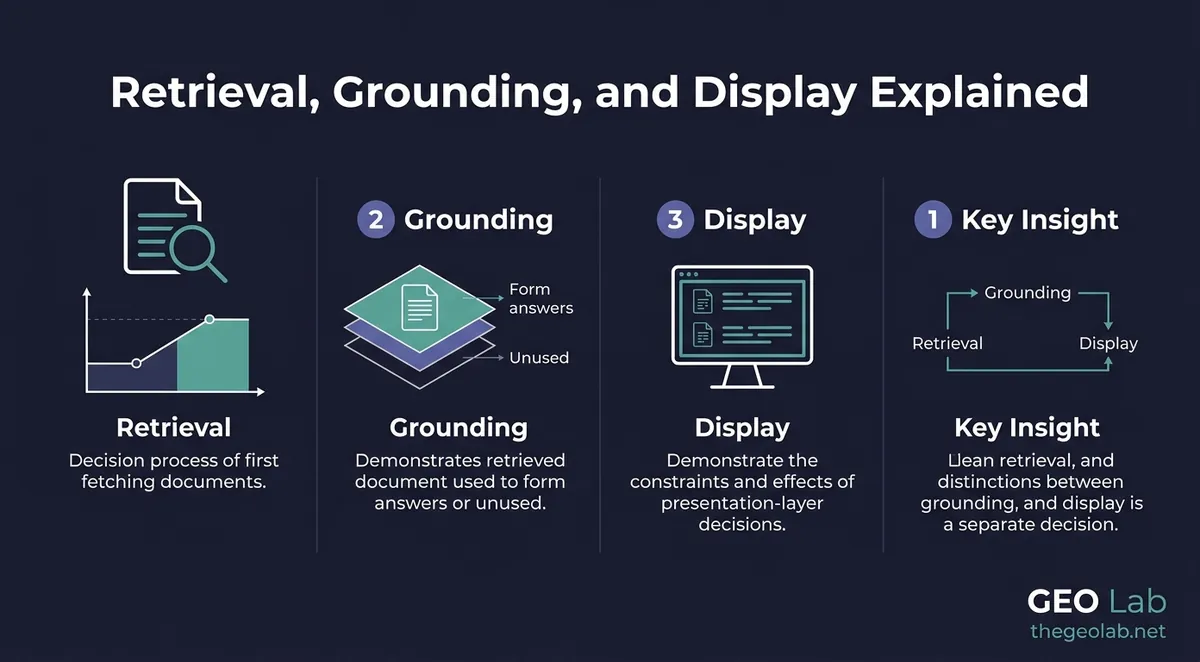
Three surfaces govern AI citation: retrieval, grounding and display. An AI engine reads far more sources than it shows you. That is not a bug in the citation list. It is the expected behaviour of a pipeline in which those three surfaces are separate decisions.
TL;DR
The three surfaces of AI search citation are retrieval (fetching a document into the candidate set), grounding (using it to compose the answer), and display (showing it as a visible citation). These three surfaces are governed by different parts of the pipeline and respond to different interventions. AI search engines retrieve broadly and cite narrowly: a page can clear retrieval, contribute to grounding, and still never appear in the citation list. The citation list is a lossy projection of the first two surfaces, and treating it as a complete record leads to optimising the wrong one.
The three surfaces
The three surfaces of AI search correspond to three pipeline stages, each with a distinct failure mode. Retrieval is the decision to fetch a document into the candidate set. It is governed by the search backend, the query the engine actually issued (rarely the one the user typed), and whatever ranking the retrieval layer applies. A page can clear retrieval on relevance and ranking alone.
Grounding is the decision to use a retrieved document to compose part of the answer. This is where extractability lives. If the passage will not lift cleanly into an answer, the document sits in the candidate set unused. It was retrieved. It contributed nothing.
Display is the decision to show a source to the user as a citation. This is a presentation-layer decision, subject to interface constraints that have nothing to do with the quality of your page.
These surfaces don’t share a view of each other. A page can pass the first and fail the second. A page can pass the second and never appear in the third. The observable output, the citation list, is a lossy projection of two decisions you cannot see.
Going deeper? The GEO Experiments ebook covers how to design and measure AI citation tests, including the retrieval-side checks that make citation tracking actionable.
What the literature says the gap is made of
This is not a novel framing. It is what the primary documents describe, once you read them for mechanism rather than for tactics.
The evaluation literature on generative search engines has consistently found that engines retrieve broadly and use narrowly, and that the ratio between documents fetched and documents actually drawn upon is not close to one. That finding is old on this field’s timescale, and its specific figures should be treated as historical rather than current, but the structural claim has not been overturned.
Statement-level attribution is the second constraint, and it is a hard technical problem. Mapping an individual sentence in a generated answer back to the exact source that licensed it is meaningfully harder than deciding that a document was relevant to the question. When the mapping is ambiguous, the link is dropped or the source is gathered into a generic list at the end of the answer rather than attached to the claim it supported.
Third, and most directly relevant to anyone writing content: a model’s parametric knowledge competes with the retrieved document. If a statement comes from what the model already knew, and the retrieved document only partially matches it, the document can go uncited even though it was fetched and read. Google’s patent filings on dynamic attribution in retrieval-augmented generation describe a matching-segment comparison, in which a source is credited only where response segments correspond to source segments to a sufficient degree, either verbatim or semantically.
Fourth, providers cap the number of visible citations for readability. Nothing about your page determines that cap.
A caveat that has to travel with all of this. A patent describes a method a company has protected. It does not establish that the method is running in production, or running unmodified, on the surface you are measuring. The mechanism literature tells you what is plausible and what is possible. It does not tell you what happened to your page. Treat it as a prior, not as a finding, and be suspicious of anyone who reads a patent to you as though it were a changelog.
Why the three surfaces change what you do
If retrieval, grounding and display are separate, then several popular moves are aimed at the wrong layer.
Optimising authority signals to fix a citation problem assumes the failure was at retrieval. Often it was not. A strong brand whose passage will not lift gets fetched and skipped. Conversely, an unknown page that is structured to extract can get cited on a query where nobody expected it, because the grounding layer does not check your domain rating before it takes a sentence.
Writing more comprehensively to fix an extraction problem makes it worse. The matching-segment logic rewards a passage that corresponds closely to the claim the answer needs to make. A long, hedged, narrative treatment of the same fact gives the grounding layer nothing clean to align to. The document is relevant. The passage is unusable.
Reading zero citations as zero visibility is the most expensive error. You cannot distinguish, from the citation list alone, between a page that was never retrieved, a page that was retrieved and unused, and a page that was used and not displayed. Those three states have entirely different remedies, and the surface you can see does not tell you which one you are in.
What the three surfaces let you measure
The honest position is that most practitioners can observe display, infer grounding, and only occasionally verify retrieval.
Retrieval is verifiable at the origin. Your server logs record whether the engine’s fetcher requested the page, and when. This is the one surface where you hold first-party evidence rather than an inference, which is why log analysis is not an optional adjunct to citation tracking but the only thing anchoring it to reality. On thegeolab, every citation read is paired with a crawl-log check for exactly this reason. A page that was never fetched cannot have failed at grounding.
Grounding is inferable from the gap. If the logs show the fetch and the answer shows no citation, the failure is downstream of retrieval. That does not tell you whether the passage was unusable or the display was capped, but it narrows the question considerably, and it rules out the entire class of fixes aimed at getting found.
Display is what everyone reports and nobody controls.
The practical consequence is that citation rate, measured alone, is a compound metric. It is the product of three probabilities you have collapsed into one number. When it moves, you do not know which term moved. This is why a citation-rate result without a retrieval-side check is difficult to act on, and why any intervention that could plausibly touch more than one surface needs to be reasoned about surface by surface before you attribute the change to it.
The three surfaces claim, stated plainly
Being read is not being used, and being used is not being shown.
Every practical recommendation in generative engine optimisation implicitly targets one of those three transitions. Most of them do not say which. When you next read advice about how to get cited, the useful question is not whether the advice is true, but which surface it is about, and whether the person giving it has any way of observing that surface at all.
If they are measuring citations and prescribing authority, they are reasoning across a gap they cannot see.
Retrieval, grounding and display are three separate surfaces made by three different parts of the AI search pipeline. The citation list is a lossy projection of the first two.
A zero-citation result does not tell you whether the page was never fetched. AI crawler logs are the diagnostic starting point, fetched and unused, or used and not shown. Each state maps to a different surface, and each surface has a different remedy.
Server logs are the only first-party evidence. The measurement variables guide explains why of retrieval. Without them, citation tracking is inference built on inference.
Ready to apply this? The AI Visibility Diagnostics Console surfaces retrieval-side signals alongside citation data. See the GEO Brand Citation Index for cross-platform citation tracking.
Questions? Contact The GEO Lab.
Three Surfaces: Frequently Asked Questions
What is the difference between retrieval and citation in AI search?
Retrieval is the decision to fetch a document into the candidate set. Citation is the decision to display a source link in the answer. A page can be retrieved without being cited, used to compose part of the answer without appearing in the source list, or cited without the user seeing which specific claim it supported. They are separate pipeline stages with separate failure modes.
Can a page be used by an AI engine without being cited?
Yes. The grounding layer can draw on a retrieved document to compose part of the answer and then not display it as a citation. This happens when the matching-segment comparison falls below the attribution threshold, when the model’s parametric knowledge partially overlaps with the retrieved content, or when the display layer caps the number of visible sources.
How do you tell if your page was retrieved but not cited?
Server logs are the primary evidence. If your logs show a fetch from the engine’s crawler (GPTBot, PerplexityBot, ClaudeBot) and your citation checks show no citation for the same query, the failure is downstream of retrieval. You cannot distinguish between a grounding failure and a display cap from the citation list alone, but you can rule out retrieval as the problem.
Why does writing more content sometimes reduce citation rate?
The grounding layer rewards passages that correspond closely to the claim the answer needs to make. A longer, more hedged, more narrative treatment of the same fact can make the passage harder to align to a specific response segment. The document remains relevant at the retrieval level but becomes unusable at the grounding level.
What is the difference between grounding and extractability?
Extractability is the structural property of content that determines whether a passage can be lifted cleanly into an AI-generated answer. Grounding is the pipeline stage where that determination is made. Extractability is what you control. Grounding is the decision the engine makes, partly based on extractability and partly based on how well the passage matches the specific claim the answer needs to support.