
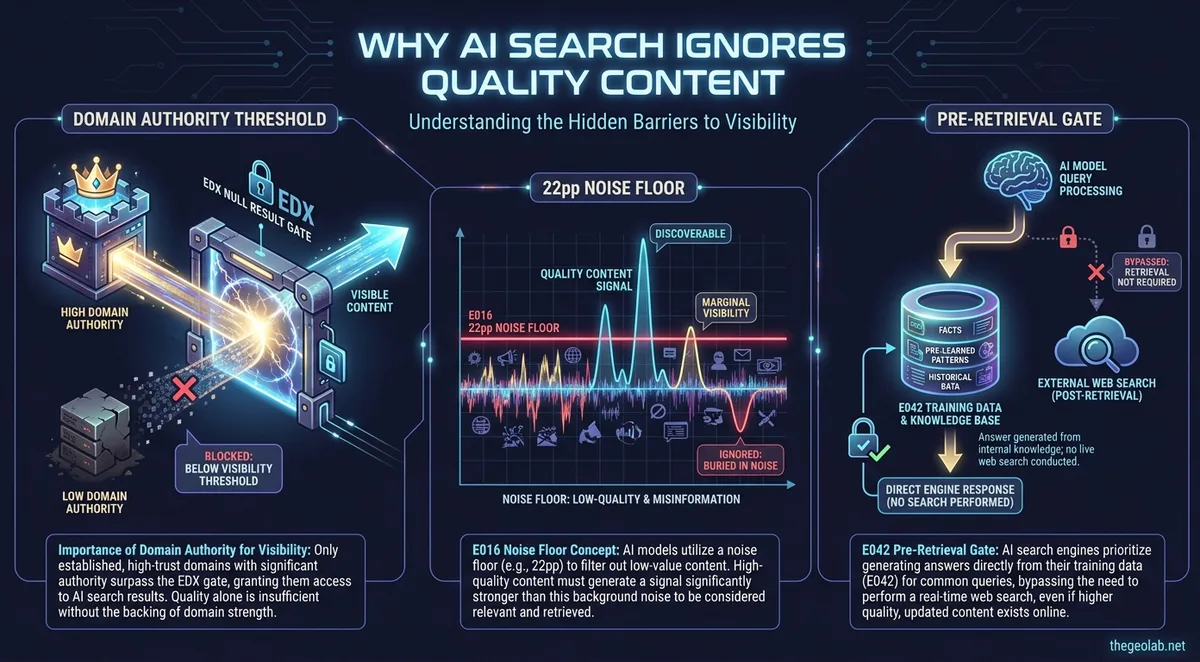
AI search ignoring high-quality content is rarely about the content. Three gates sit before quality matters: a domain authority threshold (the GEO Lab EDX experiment returned a null result below it), a 22-percentage-point noise floor (E016) that swallows small improvements, and a pre-retrieval gate (E042) where the engine answers from training data without searching at all. Quality is necessary to win once all three are cleared. It cannot substitute for any of them, and treating it as the only lever is what makes AI search feel arbitrary.
Gate one: the domain authority threshold
Your content is better than the page Perplexity cited. You know it. Perplexity does not. AI search ignoring high-quality content is the most common frustration in GEO, and the reason is rarely quality at all. Three separate gates sit between a good page and a citation, and content quality only matters once a page has cleared all three. Miss any one of them and the best writing on the topic still gets nothing.
Below a certain domain authority level, content quality does not move citation rate on category queries. The GEO Lab’s entity-density experiment (EDX) tested whether denser, higher-quality entity coverage raised citation rate and returned a null result on the queries that mattered. The finding was not that quality is worthless. It was that quality is gated: until a domain clears an authority threshold, improving the content does not change whether it gets cited, because the page was never in contention.
This is the gate most practitioners hit without knowing it. They improve a page, see no movement, and conclude the content was not good enough. The real explanation is that the domain had not earned eligibility, so the quality work had nothing to act on.
Going deeper? The GEO Authority Playbook covers advanced authority-threshold diagnostics, citation strategy, and the signals that move a domain past the eligibility gate.
Gate two: the noise floor
Even above the authority gate, small changes disappear into measurement noise. The GEO Lab E016 experiment measured a noise floor of 22 percentage points for AI citation measurement. A page can genuinely improve, and the improvement can be real, but if it moves citation rate by less than that threshold on a typical sample you cannot distinguish it from day-to-day platform variance.
This produces a specific illusion: you make a quality change, run a check, see no clear lift, and decide AI search ignored it. The change may have worked. The measurement just could not see it, because the sample was too small to clear the noise floor. Quality is not being ignored here. It is being measured below the resolution of the instrument.
| Gate | GEO Lab experiment | What it blocks | Diagnostic question |
|---|---|---|---|
| Authority threshold | EDX (entity density) | Pages on domains below eligibility | Do quality changes move citation on category queries? |
| Noise floor | E016 (22pp threshold) | Changes too small to measure | Was the change > 22pp on a 30+ query sample? |
| Pre-retrieval | E042 (cross-platform) | Queries answered without searching | Did the engine actually run a search for this query? |
Gate three: the pre-retrieval gate
The third gate is the one most people never consider: the engine may never have searched at all. The GEO Lab E042 experiment found that ChatGPT decides whether to retrieve before it retrieves anything. On many queries it answers from training data without running a search, which means no page, however good, was ever a candidate. The quality of your content is irrelevant to a query the engine answered without looking.
This is why the same question, asked two different ways, produces a citation one time and a training-data answer the next. The difference is in whether the query triggered retrieval, not in the pages available to cite. A page can be the best answer on the web and still be ignored on a query that never reached the retrieval stage.
Why quality feels ignored when it is gated
Put the three gates together and the frustration makes sense. A high-quality page on a domain below the authority threshold, changed by an amount under the noise floor, on a query that did not trigger retrieval, will earn nothing. Each gate alone is enough to produce a zero. The page owner sees the zero and blames quality, because quality is the variable they control and the one every generic guide tells them to improve.
Quality is necessary. It is the thing that wins once a page is eligible, the change is large enough to measure, and the engine actually searched. It is just not sufficient on its own, and treating it as the only lever is what makes AI search feel arbitrary when it is in fact gated in a predictable order.
What to check before blaming your content
Work the gates in order. First, has the domain cleared an authority threshold, or are you trying to outwrite a precondition? Second, was the change you made large enough to clear a 22-point noise floor on a sample big enough to detect it? Third, did the query you tested actually trigger retrieval, or did the engine answer from training data? Only after all three are satisfied — what the GEO Stack maps as layers one through three — is content quality the variable worth tuning. Skip the order and you will keep improving pages that were never going to be cited for reasons that have nothing to do with how well they are written.
- Three gates sit before quality matters. Domain authority threshold (EDX), 22pp noise floor (E016), and pre-retrieval gate (E042). Each alone can produce a zero.
- Quality is necessary, not sufficient. It wins once a page is eligible, the change is measurable, and the engine searched. It cannot substitute for any of the three preconditions.
- Work the gates in order. Authority first, then measurement scale, then retrieval confirmation. Only after all three are cleared is content the variable worth tuning.
- The frustration is predictable. AI search feels arbitrary because practitioners tune quality when the failure is eligibility, measurement, or retrieval. The order is the fix.
Want to diagnose which gate is blocking your page? The 30-check citation protocol walks through authority diagnostics, noise floor calibration, and per-platform retrieval confirmation.
Questions? Contact The GEO Lab.
Frequently asked questions
Why does AI search ignore my high-quality content?
Usually because of a gate before quality matters: your domain is below an authority threshold, your change is smaller than the 22-point measurement noise floor, or the engine answered from training data without retrieving at all. Content quality only affects citation once a page is eligible, the change is measurable, and the engine actually searched.
Does content quality affect AI citation rate?
Yes, but only after three gates are cleared. The GEO Lab entity-density experiment found that on a domain below the authority threshold, higher quality did not move citation rate on category queries. Quality is necessary to win once a page is in contention, but it cannot substitute for eligibility, measurable change, or retrieval.
Why does the same question get cited one time and not the next?
Because the query may not have triggered retrieval. The GEO Lab E042 experiment found that ChatGPT decides whether to search before retrieving, so some phrasings get a live search and others get a training-data answer. When the engine does not search, no page is a citation candidate regardless of its quality.
How do I know if my domain has cleared the authority gate?
If quality improvements consistently fail to move citation rate on category queries, the domain is likely below the threshold. The authority gate is a precondition, not a factor you can outwrite, so the fix is independent authority signals rather than further content tuning on a page that was never eligible.
What is the 22-point noise floor?
The GEO Lab E016 experiment measured a noise floor of 22 percentage points for AI citation measurement. Below that threshold, a change in citation rate is indistinguishable from day-to-day platform variance. To detect a real change you need a sample of at least 30 queries and a movement that clears 22 points.