
Joint research with Marwa Rashed Saleh · E097 and E100 · ChatGPT and Perplexity · Captured 26 October 2026
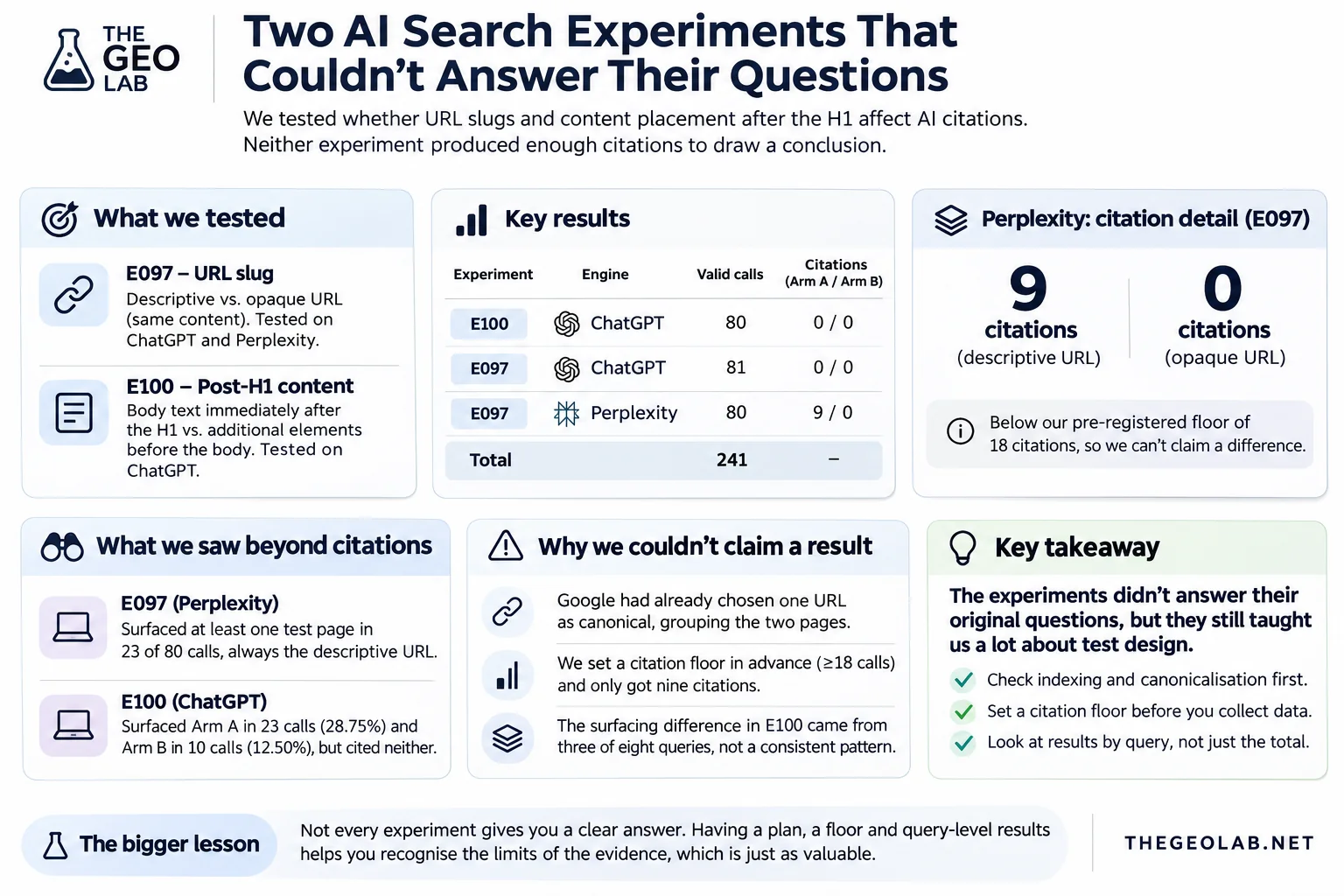
Two pre-registered AI search experiments, E097 and E100, tested whether descriptive URL slugs and content placement after the H1 affect AI citations. Neither produced enough citations to answer its original question.
Across 161 valid ChatGPT calls, neither experiment received a target-page citation. Perplexity cited the descriptive URL nine times and its identical counterpart zero times, but that fell below our pre-registered minimum of 18. Google had also already treated the two URLs as duplicates.
The lesson wasn’t about which page performed better. It was about knowing when the evidence isn’t strong enough to support a conclusion.
The result I wanted to publish
Nine citations for one URL. Zero for the other.
That was the result staring back at me after Marwa Rashed Saleh and I finished one of our latest AI search experiments.
We’d created two identical pages about hreflang. Same content, same HTML, byte for byte. The only difference was the URL.
One had a descriptive slug:
/guides/hreflang-and-ai-search-explained/
The other had an opaque one:
/guides/p48213/
Across 80 Perplexity calls, the descriptive URL received nine citations. The opaque URL received none.
It looked like a finding worth sharing.
Except we had two problems.
The first was Google.
Back in September, Google had already selected the descriptive URL as the canonical version of the opaque one. Search Console reported the latter as “Duplicate, Google chose different canonical than user.”
When I checked again on 26 October, that was still the recorded state. The opaque page’s last recorded crawl was 11 September.
So although we’d built two separate pages, Google had effectively grouped them together.
Did Perplexity follow Google’s canonical selection? We don’t know. We didn’t measure that.
The second problem was our own protocol.
Before collecting the results, we’d agreed that at least 18 calls needed to cite one or both pages before we could claim a citation difference.
We got nine.
And that was where the interpretation had to stop.
What we were trying to find out
This was a joint study with Marwa Rashed Saleh, founder of LeapOne, an AI visibility platform for Canadian businesses.
We wanted to test two questions that regularly come up in technical SEO and GEO discussions.
E097: Does a descriptive URL slug influence AI citations?
We created two byte-identical pages about hreflang. One had a descriptive URL, the other an opaque identifier.
We tested both pages using ChatGPT and Perplexity.
E100: Does the content between the H1 and the main body affect ChatGPT citations?
For this experiment, we created two identical pages about paywalls.
On Arm A, the main body text started immediately after the H1.
On Arm B, visitors encountered a category label, date, table of contents, image and widget before reaching the body.
The question was whether clearing that space after the H1 would change which page ChatGPT cited.
Both protocols were deposited on Zenodo on 21 October 2026, before the browsing pre-check and the capture.
Each experiment used eight queries.
Marwa ran the capture on 26 October using her harness, with ChatGPT gpt-6-luna at medium effort and Perplexity perplexity/sonar.
We made 250 calls in total.
| Experiment | Engine | Calls | Valid observations |
|---|---|---|---|
| E100 | ChatGPT | 88 | 80 |
| E097 | ChatGPT | 82 | 81 |
| E097 | Perplexity | 80 | 80 |
| Total | 250 | 241 |
Calls that didn’t browse were excluded.
Every test page returned HTTP 200 and declared itself canonical before and after capture.
Those checks told us the live pages met the conditions in our protocols.
What they didn’t tell us was whether Google had indexed the pages independently.
That distinction turned out to matter quite a lot.
The rule that kept us from claiming a winner
One of the most useful decisions we made happened before the results existed.
We registered a minimum citation floor.
At least 22% of valid observations had to cite one or both test pages before we’d interpret a citation difference.
For 80 or 81 observations, that meant 18 calls.
We also defined the difference between the two arms as:
D = pA − pB
For the confidence interval, we agreed on 29 October, before either scorer had been run against the captured data, to use Newcombe’s paired hybrid score method with Wilson intervals and no continuity correction.
But the citation floor was the rule that mattered most.
When Perplexity returned nine citations for Arm A and none for Arm B, I wanted to lead with that difference.
It was tempting.
If we hadn’t registered the floor beforehand, we could have decided afterwards that nine citations were enough.
That’s exactly the kind of flexibility that makes experiments difficult to trust.
For E100, missing the floor meant the primary result was uninformative. For E097, it meant the result remained neither-heavy, without enough citations to support a difference.
The rules didn’t change because the numbers looked interesting.
What ChatGPT and Perplexity actually cited
Let’s start with ChatGPT.
Across both experiments, we had 161 valid observations.
In E100, neither paywall page was cited across 80 valid calls.
In E097, neither hreflang URL was cited across 81 valid calls. We also checked the first 80 separately and got the same result.
My E100 scorer produced a confidence interval from −4.58 to +4.58 percentage points around a zero difference.
That doesn’t establish that the two layouts perform equally.
There were no citations to compare.
Perplexity gave us more to examine, but still not enough to answer the original question.
Of its 80 valid E097 observations, nine cited Arm A, none cited Arm B, and 71 cited neither.
Here’s how those nine citations were distributed:
| Query | Arm A citations |
|---|---|
| 1 | 1 |
| 2 | 4 |
| 3 | 1 |
| 6 | 1 |
| 7 | 1 |
| 8 | 1 |
| Total | 9 |
All nine citations went to the descriptive URL, across six of the eight queries.
That’s an observation we can report.
But with only nine citations against our required 18, and the unresolved canonicalisation issue, we can’t attribute the difference to the URL slug.
What happened before the citation stage
This is where the study became more interesting to me.
A page can appear in an AI system’s retrieved or surfaced results without becoming a citation in the final answer.
Those aren’t the same event.
Our protocols included secondary retrieval observations for precisely this reason.
In E097, Perplexity surfaced at least one test page in 23 of its 80 valid observations.
Every one of those 23 observations involved Arm A alone.
It never surfaced both URLs together, and it never surfaced Arm B on its own.
ChatGPT surfaced neither E097 page in any valid observation.
Again, we can’t tell whether that happened because of canonicalisation, URL wording or something else.
We can only describe what the captured results showed.
E100 produced a different pattern.
Although ChatGPT cited neither page, it surfaced the two layouts at different rates.
| E100 surfacing measure | Arm A | Arm B |
|---|---|---|
| Surfaced without citation | 23 | 10 |
| Share of 80 valid observations | 28.75% | 12.50% |
That’s a difference of 16.25 percentage points, with an interval from +2.74 to +29.07.
The paired observations were:
- Both pages surfaced: 1
- Arm A only: 22
- Arm B only: 9
- Neither page: 48
At first glance, the difference looks promising.
But then we looked at the results query by query.
| Query | Arm A minus Arm B surfaced count |
|---|---|
| 1 | +4 |
| 2 | −1 |
| 3 | 0 |
| 4 | +6 |
| 5 | 0 |
| 6 | +4 |
| 7 | −1 |
| 8 | +1 |
Queries 1, 4 and 6 contributed +14 observations between them.
The other five queries reduced that advantage by one, leaving a net difference of +13.
In other words, three queries accounted for all of the net difference, with the remaining queries slightly offsetting it.
That’s a very different picture from simply reporting a 16.25-point advantage.
And none of those surfaced pages became a citation.
The pooled percentage was real. It just wasn’t telling the whole story.
How we checked our scoring
Marwa and I developed our scoring scripts independently, although we both used Claude as a coding assistant and worked from the same registered protocols.
We committed the code and each ran our scorer once per experiment against the frozen raw capture files.
My scoring commit was e664eaf.
Marwa’s was c066195.
The two scorers agreed on all 250 calls, including every cell count, citation floor and interval.
I also checked my git history, session transcripts and shell history for evidence of any earlier scoring run against the captured data.
I found none.
That’s what the available record supports. It doesn’t prove that no run occurred somewhere outside those records.
We also found two problems worth documenting.
The first was a confidence interval option I’d mislabelled.
My original --ci newcombe option calculated an interval for independent samples, rather than the paired observations we’d agreed to use.
I corrected that in commit 6e472ef, renaming the original option newcombe_independent and adding newcombe_paired.
The committed scoring run used the paired version.
The second was an E100 measurement we couldn’t reproduce.
The method behind the Phase 0 values in E100 v1.4 hadn’t been saved, including a reported character offset of 728.
When we applied the method pinned on 29 September, the opening sentence began at offset 0 for Arm A and offset 520 for Arm B.
That preserved the intended distinction: Arm A’s body started within the roughly 200-character window after the H1, while Arm B’s started outside it.
But the earlier measurement wasn’t reproducible, so E100 v1.5 replaced those values.
Neither issue is something I’d want hidden in a footnote.
If we’re going to publish experiments about AI visibility, the methods and corrections need to be visible too.
What I’d change in an AI visibility audit
These are my interpretations of the study, not experimental findings.
The first change is to measure surfacing and citations separately.
In E100, ChatGPT surfaced at least one test page in 32 of 80 observations.
It cited neither page in any of them.
If we’d recorded only whether a page was cited, we’d have missed the surfacing behaviour entirely.
I’d also check Google’s indexing and canonicalisation state before testing two similar URLs.
Both E097 pages passed our HTTP checks. Both declared themselves canonical.
Yet Google had already selected one as the canonical version of the other.
A valid HTTP response doesn’t mean search engines treat two URLs as independent documents.
The third change is to register a citation floor before collecting data.
Without that rule, our nine Perplexity citations could easily have become a headline about descriptive URLs outperforming opaque ones.
And finally, I’d always inspect the results by query before interpreting a pooled percentage.
Our E100 surfacing difference looked substantial until we found that three queries accounted for the entire net advantage.
Would I recommend rewriting URL slugs or rearranging content after the H1 to improve AI citations based on these experiments?
No.
There may be perfectly good usability or SEO reasons to make those changes.
But these tests don’t establish an AI citation benefit.
What these experiments couldn’t tell us
There are several limitations I wouldn’t want readers to overlook.
Our calls weren’t independent.
They were grouped within eight queries per experiment, while our confidence intervals treated calls as independent observations.
That matters particularly for the E100 surfacing difference.
Our scorers shared methodological inputs.
Although Marwa and I developed and committed the scripts independently, we both used Claude and worked from the same registered texts.
Agreement across all 250 calls is useful evidence that the scripts produced consistent results.
It isn’t proof that every methodological decision was correct.
We didn’t verify the interval against the original statistical paper.
We checked our paired interval against two worked examples supplied by Marwa: a 30.0-point difference with an interval of 16.2 to 42.4, and an 18.8-point difference with an interval of 6.7 to 30.2.
Marwa also compared the formula against the source code of the ratesci R package.
Neither of us checked it directly against the original 1998 paper.
And one capture is still one capture.
We tested on one date, using two engines and eight queries per experiment.
The pages happened to cover hreflang and paywalls.
We can’t generalise these observations to either topic, or to descriptive slugs and H1 spacing more broadly.
Key GEO Lab takeaway
We made 250 calls to investigate two fairly straightforward questions.
Does a descriptive URL slug help a page earn AI citations?
Does placing the main content immediately after the H1 improve its chances of being cited?
After all that testing, neither question has a supported answer.
Perplexity’s nine-to-zero citation difference fell below the floor we’d registered, and Google had already grouped the two URLs.
ChatGPT’s E100 surfacing difference came from three queries, and not one surfaced test page became a citation.
I would have preferred a clearer result. Of course I would.
But the most useful part of this study may be what stopped us from making claims the data couldn’t support.
We had a frozen capture, a minimum citation threshold, query-level results and two independently developed scorers.
Those checks didn’t rescue the experiments.
They helped us recognise their limits.
And I’d rather publish a test that couldn’t answer its question than turn an interesting number into a finding it doesn’t support.
Frequently asked questions
Does a descriptive URL slug help AI citations?
We don’t know from this experiment.
ChatGPT cited neither of the two identical hreflang pages in 81 valid observations. Perplexity cited the descriptive URL nine times in 80 observations and the opaque URL zero times.
That was below our pre-registered floor of 18 citation-bearing observations.
Google had also already treated the opaque URL as a duplicate of the descriptive one, so the pages may not have been independent in search.
Does content placement after the H1 affect ChatGPT citations?
Our E100 experiment couldn’t establish that.
ChatGPT cited neither paywall page across 80 valid observations.
The page with body text immediately after the H1 surfaced 23 times, compared with 10 for the page containing additional elements before the body.
But three of eight queries accounted for the entire net surfacing difference, and neither page received a citation.
Why is E100 uninformative rather than a null result?
Because we didn’t reach the minimum citation count registered in advance.
We needed at least 18 observations citing one or both pages.
We got zero.
That doesn’t demonstrate equal citation performance. It means we didn’t collect enough citation evidence to compare the layouts under our protocol.
Can AI search retrieve a page without citing it?
Yes.
In E100, ChatGPT surfaced at least one test page in 32 of 80 valid observations but cited neither page in any of them.
That’s why retrieval or surfacing and final-answer citations should be recorded as separate outcomes.
Where can I check the experiment data?
The published results report and deposit package are available on Zenodo.
They include the raw API responses, per-call logs, both scoring scripts and their outputs, methodological addenda and the erratum.
The code is also available in The GEO Lab’s GitHub experiment repository.
Have questions about this topic? Contact The GEO Lab · Return to homepage