
Experiment write-up · Joint study with Irina Saprykina · GPT-6 Medium · 12–22 October 2026
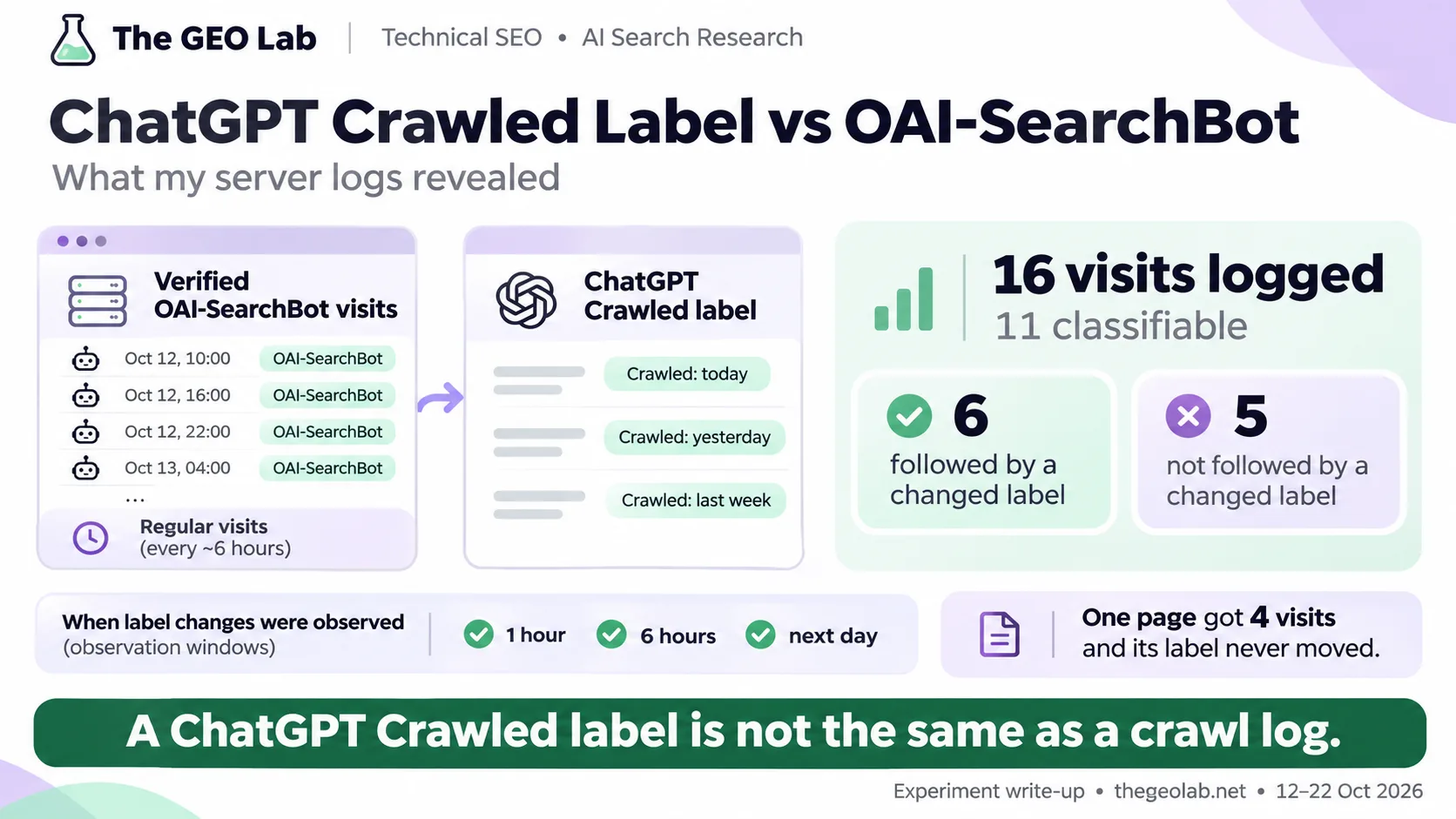
ChatGPT’s “Crawled” label does not reliably reflect the latest OAI-SearchBot visit. In a pre-registered study with Irina Saprykina, I tracked 16 verified crawler visits to three pages on thegeolab.net between 12 and 17 October 2026. Of the 11 visits I could classify, six were followed by a changed label: one by the one-hour check, two by the six-hour check and three by the next daily check. On a third page, the label never updated despite four verified visits. I also examined 3,551 ChatGPT capture files and found no separate Crawled data field. The label appeared in ChatGPT’s answer text. These results describe my site’s observations, not a general rule about OpenAI crawling.
The bot kept arriving at almost exactly the same time
On 13 October, OAI-SearchBot visited my /geo-vs-seo/ page at 09:23:03 UTC.
The following day, it came back at 09:23. Then again the next day. And the next. For five consecutive days, the crawler arrived during the same minute.
Another page, /crawled-currently-not-indexed/, showed a similar pattern. It received a visit at 14:16 UTC every day from 12 to 17 October.
I noticed the regular timing when looking back at the visit times. I don’t know why the visits happened so consistently, and the experiment wasn’t designed to investigate the crawler’s schedule.
But the timing gave me something useful: a verified record of when OAI-SearchBot requested each page.
That meant I could compare those visits with something ChatGPT displays in search results.
You’ve probably seen labels such as “Crawled: today” or “Crawled: last week” beside a result.
It’s tempting to read those labels as a direct reflection of when OpenAI last fetched the page. If the bot visits at 09:23, perhaps the label should say “today” shortly afterwards.
I wanted to find out whether that was actually happening.
The results weren’t as straightforward as I expected.
What I tested
This was Test 2 of a joint study I conducted with Irina Saprykina from datairi.com.
We signed the pre-registration on 11 October 2026, ran the experiments between 12 and 22 October, and published the joint report on Zenodo on 7 November.
The full report covers both websites. Here I’m concentrating on what I observed on thegeolab.net.
I monitored three pages, but I didn’t check them all at the same frequency.
For /geo-vs-seo/, I checked ChatGPT approximately one hour and six hours after the verified crawler visits.
For /crawled-currently-not-indexed/ and /what-is-generative-engine-optimisation/, I used daily checks at around 10:00 UTC.
Each visit counted only when my server logs verified the requester as OAI-SearchBot. I recorded the Crawled label shown in ChatGPT’s answer, using one account with GPT-6 Medium.
We classified the outcomes according to when the label changed.
| Classification | Meaning |
|---|---|
| REPLACED-1H | The label had changed by the one-hour check |
| REPLACED-6H | The label had changed by the six-hour check |
| REPLACED-DAILY | The label had changed by the next daily check |
| NOT-REPLACED | The label still showed the earlier crawl information |
This was a descriptive experiment. We counted what happened rather than running hypothesis tests.
One distinction is important throughout the results: a label changing after a bot visit doesn’t establish that the visit caused the change. It tells us the two events occurred in that order.
What happened across the three pages
OAI-SearchBot made 16 verified visits across the three monitored pages.
I could classify 11 of them. The other five couldn’t be assigned confidently because a check was missed, the visit occurred after the last relevant check, or another fetch could explain the observed label just as well.
Here’s how the results broke down.
| Outcome | Visits | Where |
|---|---|---|
| REPLACED-1H | 1 | /geo-vs-seo/, 17 October |
| REPLACED-6H | 2 | /geo-vs-seo/, 13 and 16 October |
| REPLACED-DAILY | 3 | /crawled-currently-not-indexed/, 12, 14 and 15 October |
| NOT-REPLACED | 5 | /crawled-currently-not-indexed/ on 16 October, plus all four secondary-page visits |
| Not classified | 5 | /geo-vs-seo/ on 12, 14 and 15 October; /crawled-currently-not-indexed/ on 13 and 17 October |
Six of the eleven classifiable visits were followed by a changed Crawled label. Five were not.
That overall count is useful, but it hides an important difference between the pages.
Two pages showed delayed label changes
On /geo-vs-seo/, the timing varied between checks.
On 13 October, my first check ran later than planned, at 86 minutes after the crawler visit. ChatGPT still displayed “yesterday”. By the six-hour check, the label had changed to “today”.
On 16 October, the one-hour check again showed “yesterday”. I ran an additional check at 121 minutes, and by then ChatGPT was displaying “today”.
The following day, 17 October, the label had already changed by the one-hour check.
So even on the same page, I didn’t see a consistent delay.
The other page, /crawled-currently-not-indexed/, behaved differently. After three of its four classifiable visits, the label had changed by the following morning’s check.
Those daily observations are less precise. They establish that the label had changed by the next check, but they cannot tell me whether the change happened ten minutes after the visit or many hours later.
The third page behaved differently
The secondary page, /what-is-generative-engine-optimisation/, received four verified OAI-SearchBot visits.
All four happened between 06:27 and 07:28 UTC.
Yet the Crawled label didn’t become fresher at the following daily checks.
Instead, it displayed “last week” twice, followed by “2 weeks ago” twice.
That caught my attention because the server logs showed the bot continuing to visit while the date presented in ChatGPT’s answer was getting older.
The experiment doesn’t explain why.
It might be tempting to interpret that as evidence of a separate stored copy, a different retrieval path or delayed metadata. But none of those mechanisms was established by this test.
What I can say is that four verified visits were not followed by a refreshed label on that page.
Across my three pages, nine of the sixteen recorded label observations matched the date of the latest verified OAI-SearchBot visit. Seven did not. Those seven consisted of two one-hour checks before a later label change, the 17 October daily check and the four secondary-page checks.
The behaviour varied across pages, even though the same account and model were used for the checks.
I couldn’t find a Crawled field in the capture data
This was another part of the investigation I found particularly useful.
I captured the raw data behind 37 ChatGPT sessions between 9 and 22 October. Together, those sessions produced 3,551 files.
I wanted to know whether the Crawled label existed as a separate structured field or whether it was simply text presented by ChatGPT.
The search result entries contained several identifiable fields, including the result type, URL, title, snippet, reference ID, publication date and attribution. Some entries also contained thumbnail-related fields.
But I didn’t find a field named Crawled.
The word “crawl” appeared inside values, including the labels written in ChatGPT’s answers and the title of my /crawled-currently-not-indexed/ page.
It never appeared as a field name in the capture files I examined.
That’s an important distinction.
It doesn’t prove that OpenAI has no internal crawl timestamp or metadata. I cannot inspect all of OpenAI’s internal systems.
It does mean that, in the capture data available to me, the Crawled label was answer text rather than a separately exposed field.
If you’re building an AI visibility tracker, that’s worth knowing. Recording what ChatGPT says is not the same as reading a verified timestamp directly from a crawler log. This is one instance of the broader question explored in API versus browser citation audits.
The experiment I couldn’t complete
The joint study included another test that asked whether opening a page through ChatGPT would refresh its Crawled label.
I wasn’t able to complete that test on my website.
The test page, /e043-zero-variance-mechanism-capture/, failed to appear in ten searches.
Because ChatGPT didn’t retrieve the page in those searches, all three open rounds and both control rounds were invalid.
There was no valid way to measure whether opening the page refreshed the label when I couldn’t first get the page into the search results.
The control page, /e016-noise-floor-measurement/, was retrieved more often. It appeared in eight of nine searches, and four of those searches involved a live fetch.
On those four occasions, the label in the answer still showed the older date. At the next search, it read “today”.
That was an interesting sequence, but it came from rounds that were invalid under the registered protocol. I wouldn’t present it as an experimental result.
The joint report includes the datairi.com results for this open-refresh question.
We also ran a third test looking at ChatGPT-User homepage requests within two seconds of fetching another page. On my site, that happened in one of 98 included observations.
It’s a small descriptive result, and I don’t think it changes what practitioners should do. The full details are available in the report.
What I’d change in an AI visibility audit
These are my practical interpretations of the results, not additional findings tested by the study.
The first is that I’d stop treating a verified bot visit as confirmation that ChatGPT has updated whatever copy or metadata it uses when answering a query.
A server log can establish that a particular requester accessed a page. It doesn’t tell us what happened to the content afterwards.
In this experiment, six of eleven classifiable OAI-SearchBot visits were followed by a refreshed label, while five were not.
I’d also store the Crawled label exactly as ChatGPT displayed it, together with the answer capture and the time of the check.
If the label says “last week”, I’d record “last week”. I wouldn’t silently convert it into a specific crawl date without documenting the inference.
The timing of checks matters too. I missed several scheduled observations during the experiment, and five of the sixteen visits couldn’t be classified. Fixing the observation schedule in advance is useful, but recording deviations from it is just as important.
I’d also confirm that a page can actually be retrieved before using it in an experiment that depends on retrieval. My first test failed at that stage. Ten searches without the test page meant I never reached the point where the intended intervention could be evaluated.
Finally, I’d distinguish between verifying the identity of a crawler and attributing a visit to a particular prompt.
My verification checks established that the requests came from OAI-SearchBot. The AI citation tracking guide covers what different collection methods can and cannot detect. They didn’t establish why the bot visited or whether an individual search caused the visit.
The two Test 1 pages also received approximately nine outside fetch events across 66 days of logs, roughly one per week.
That’s a crude background rate, but it illustrates the attribution problem. Even a relatively quiet page can receive requests unrelated to the experiment you’re running.
Going deeper? The GEO Field Manual covers the practitioner workflow for auditing, measuring and reporting AI visibility outcomes across platforms.
Limits
There are several reasons I wouldn’t generalise these observations beyond this study.
The sample is small. Test 2 covered three pages on one website, one ChatGPT account and six days of crawler visits. The study recorded what happened in those runs, not how ChatGPT behaves across the web.
Some checks were missed or delayed. I missed all scheduled checks on 12 October, as well as three later one-hour or six-hour checks on 13, 15 and 17 October. Several daily checks also ran late. Six of the eleven classified visits received their final classifications during the write-up.
Daily observations don’t establish exact update times. When a label changes between two checks, we know only that it changed by the later observation.
The labels are self-reported text. We recorded what ChatGPT displayed, not a directly exposed internal crawl timestamp.
A control setting changed during the study. I last used the Unpersonalized control on 18 October and found that it was no longer available on 20 October. After that, I manually disabled memory and personalisation.
The pages weren’t fully frozen. I didn’t apply a freeze-gate or independently audit their edit histories. Logged response sizes remained constant, but an edit that preserved the response size could have gone unnoticed.
Some search-system classifications relied on wording. For certain steps on 13, 18, 20 and 22 October, I identified which search mode ChatGPT used from the answer wording, including cases where the stream wasn’t captured.
Some log verification was script-based. Several extractions were checked against the script’s summaries rather than having every extracted line reviewed manually.
There’s also a boundary around the interpretation. This experiment didn’t test whether the Crawled label affects rankings, retrieval probability or citation rates.
None of those outcomes can be inferred from a label changing or failing to change.
Key GEO Lab Takeaway
ChatGPT’s Crawled label does not reliably reflect the latest OAI-SearchBot visit. On thegeolab.net, six of eleven classifiable visits were followed by a changed label. A third page received four verified visits without a refreshed label.
The label appeared as answer text in the capture data, not as a separate structured field. Treat it as something ChatGPT reports, not as a substitute for your server logs.
A verified fetch confirms a crawler requested a page. A changed label confirms what ChatGPT displayed afterwards. They are related observations, but they are not the same measurement.
Frequently asked questions
What is the Crawled label in ChatGPT?
The Crawled label is date-related text ChatGPT sometimes displays beside search results, such as “Crawled: today” or “Crawled: last week”. In my 37 captured sessions, containing 3,551 files, the label appeared in ChatGPT’s answer text rather than as a separate structured Crawled field.
Does an OAI-SearchBot visit update ChatGPT’s Crawled label?
Not reliably in my experiment. I recorded 16 verified OAI-SearchBot visits to three pages. Of the eleven visits I could classify, six were followed by a changed label and five were not. Four of the unchanged outcomes came from a page that continued receiving crawler visits while its label grew older.
How quickly does ChatGPT update the Crawled label?
The timing varied in this study. One label had changed by the one-hour check, two by the six-hour check and three by the next daily check. These are observation windows, not exact update times. The experiment doesn’t establish a standard refresh delay.
Why didn’t ChatGPT update the label for one page?
The experiment couldn’t determine why. The secondary page received four verified OAI-SearchBot visits, but its label moved from “last week” to “2 weeks ago” across the subsequent daily checks. The data establishes the mismatch, not the mechanism behind it.
Does the Crawled label affect whether ChatGPT cites a page?
This study didn’t test that relationship. It compared verified crawler visits with the dates ChatGPT displayed in its Crawled labels. It provides no evidence that the label itself changes citation probability or search rankings.
Ready to apply this? Use the GEO experiments guide to design measurement protocols that separate what you can verify from what the system reports.