
Ten structural patterns that make content easier for AI systems to quote cleanly — the practitioner reference for Layer 2 of the GEO Stack
TL;DR
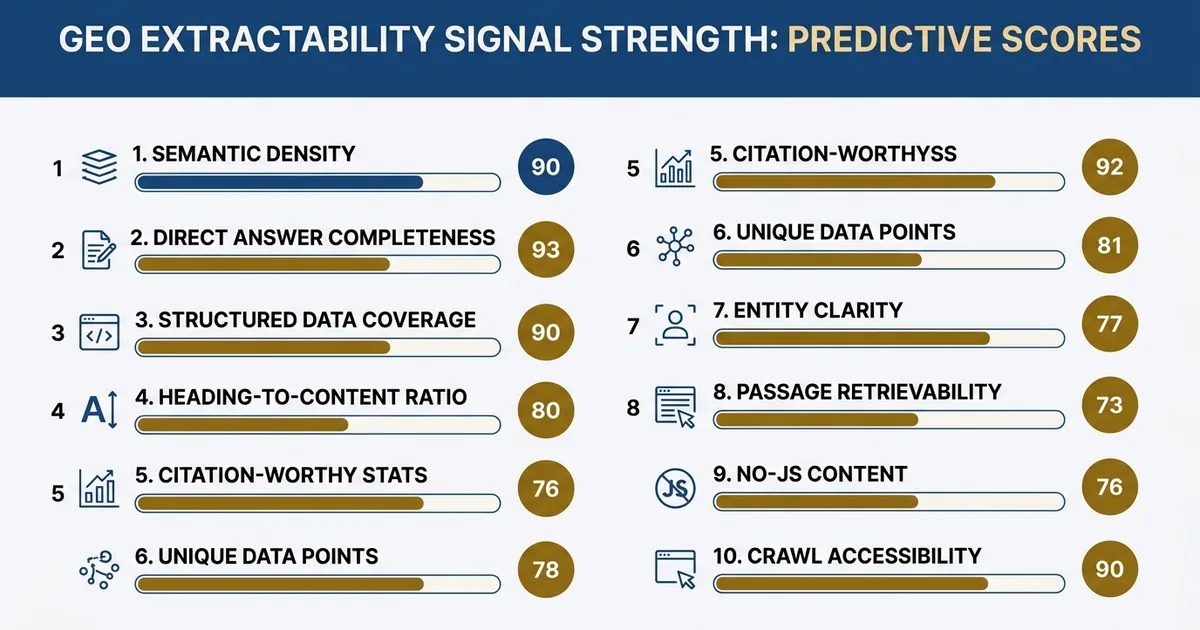
A page that an AI system retrieves but can’t extract a clean answer from gets skipped in favour of one it can. Ten structural patterns correlate with high extractability: declarative opening, heading-as-question, short answer before long answer, paragraph length discipline, early source attribution, entity density, schema-content alignment, explicit numbers and units, single canonical answer per section, and machine-readable markup.
Each signal is a pattern you can see in the HTML, not a content quality judgement. That’s what makes them testable, fixable, and measurable.
Being crawled is not the same as being cited: AI systems retrieve thousands of pages and quote a fraction of them. Extractability — the structural property that makes a passage quotable — is the gap between those two numbers, and it is measurable across ten specific signals before a single query is run.
Retrieved but Not Cited
The first time I saw a GPTBot access log entry on a page that had never been cited in a ChatGPT answer, I assumed the crawler just hadn’t gotten around to indexing the content yet. Then I watched it happen eleven more times over the following weeks — same page, repeated fetches, zero citations. The page was in the retrieval index. It was being read. It wasn’t being quoted.
Extractability is Layer 2 of the GEO Stack — the layer between crawlability (Layer 1) and structural authority (Layer 3) that determines whether a retrieved page produces a quotable passage.
That gap — between retrieval and citation — is what Layer 2 of the GEO Stack is named for. The AI system found the page. It just couldn’t find a clean sentence to quote from it. So it quoted somebody else’s page, which had the same information but structured in a more extractable shape.
The uncomfortable version of this: the page I lost the citation on was better researched than the page that won it. Extractability is not a quality signal. It’s a shape signal. The AI can’t tell which page is better. It can only tell which page gives it a quotable answer without having to synthesise one from disconnected fragments.
The ten signals below are what separates an extractable page from an unextractable one. All of them are patterns in the HTML, which means all of them are measurable, and all of them are things you can change.
Where Extraction Happens
Extraction runs in three sub-layers inside Layer 2 of the GEO Stack. Knowing which sub-layer a signal targets tells you which kind of fix to apply.
Each sub-layer has specific, testable failure modes — the ten GEO audit checks operationalise extraction diagnostics into pass/fail tests that can be run programmatically before deployment.
Sub-layer 1
Answer location
Signals 01, 02, 03
Sub-layer 2
Answer isolation
Signals 04, 05, 09
Sub-layer 3
Answer reinforcement
Signals 06, 07, 08, 10
A page can fail at any sub-layer. A page with a declarative opening (good location signal) but five-sentence paragraphs (bad isolation signal) gets found but not cleanly chunked. A page with clean chunks but no source attribution (bad reinforcement signal) gets chunked but quoted as “according to a source” without the link. Citation requires all three sub-layers to clear.
The Ten Extractability Signals
Ordered by observed impact on extraction behaviour in the Lab’s experiments. The first four are the ones that swing the outcome. The last six are structural polish — smaller effects individually, substantial in combination.
Which signals matter most depends on the query type being probed — the ten content formats mapped to query intent shows which format choices naturally improve signal scores for different query types.
01
Declarative opening sentence
High
What it is
The first sentence of content states a definitional fact, typically in “X is Y” form, within the first 200 characters.
Why it works
AI systems extracting a clean answer look near the top of the content first. A declarative opening is a sentence already shaped like an answer. A narrative hook is not.
Examples
Extractable
“Citation rate is the proportion of AI query iterations in which a given URL appears as a named source link.”
Not extractable
“Let’s talk about citation rate. It’s one of those metrics that everyone agrees matters, but nobody quite defines the same way.”
02
Heading phrased as the question
High
What it is
Section headings use the same phrasing a user would type into an AI system to ask about the topic the section covers.
Why it works
Heading-level matches between user queries and content give the retrieval system a direct query-to-section pointer. The section under the matching heading is then the natural extraction target.
Examples
Extractable
“How do I block GPTBot in robots.txt?”
Not extractable
“Bot management considerations”
03
Short answer before long answer
High
What it is
The first paragraph under a heading gives the complete answer in one or two sentences. Subsequent paragraphs expand, nuance, or justify — but the answer itself is extractable from the opening.
Why it works
AI systems generating a concise response prefer a self-contained opening paragraph they can quote without modification. Long answers that build up to a conclusion leave the AI either quoting the build-up (wrong) or synthesising a summary (which it then doesn’t cite to the source).
Pattern
Short answer → long answer. Not the other way around.
04
Paragraph length discipline
High
What it is
Body paragraphs are two to four sentences long. Single-sentence paragraphs are used sparingly for emphasis. Five-plus-sentence paragraphs are avoided.
Why it works
AI systems chunk content at paragraph boundaries. Paragraphs longer than five sentences produce chunks too large to fit into a generated response without truncation. Truncated chunks are either not used or used with a “…” that reduces citation trust.
Target range
Two to four sentences per paragraph for body content. Longer is permissible only when the content is explicitly a single connected argument that can’t be split.
05
Single canonical answer per section
Medium
What it is
Each section of the page answers exactly one question. Sections do not contain multiple competing answers, alternative positions, or conditional phrasings that the AI would have to choose between.
Why it works
AI systems extracting an answer want a section where the answer is unambiguous. A section with three conditional answers (“it depends on…”) forces the AI to either quote one condition without context or synthesise across them. Both reduce citation likelihood.
Pattern
One question, one section, one canonical answer. Nuances and exceptions go in their own sections — not inside the primary answer section.
06
Early source attribution
Medium
What it is
Claims made in the first few paragraphs of a page are attributed to named sources — publications, studies, or specific experts — rather than left as anonymous assertions.
Why it works
AI systems trained on academic and journalistic content strongly prefer to cite sources that themselves cite sources. A page with “according to [X study]” near the top reads as authoritative; a page with “it’s widely known that…” reads as unsourced.
Pattern
Named source within the first 400 characters. Hyperlink to the source. Year of the source where applicable.
07
Entity density
Medium
What it is
The content contains multiple named entities — specific products, people, companies, frameworks — within each section, not just one general topic mentioned throughout.
Why it works
AI retrieval systems use entity co-occurrence as a topical signal. A section that names five entities in context carries more retrieval weight than a section that names one entity repeatedly. Entity density also sharpens the match between user queries and content.
Pattern
At least three distinct named entities per major section, with at least one entity appearing in the section heading or opening sentence.
08
Explicit numbers and units
Medium
What it is
Quantitative claims in the content state specific numbers with units, rather than relying on qualitative terms like “significant”, “many”, or “a large percentage”.
Why it works
The research literature on GEO shows that content with embedded statistics is cited more often than content without. AI systems responding to questions that ask for numbers need content with numbers in it — qualitative content forces them to either skip the question or generate a number without citation.
Examples
Extractable
“Citation rate shifted by 11 percentage points between the two conditions.”
Not extractable
“Citation rate shifted significantly between the two conditions.”
09
Schema-content alignment
Supporting
What it is
Structured data declarations on the page accurately describe the content. FAQPage schema only on pages with clear Q&A structure. HowTo schema only on pages with ordered steps. Article schema only on pages with a single coherent article.
Why it works
Schema is an extractability amplifier when aligned and a liability when not. FAQPage schema on narrative prose creates a mismatch that AI systems detect, which reduces trust in both the schema and the surrounding content.
Common failure
FAQPage schema generated by a plugin on pages without a real FAQ section. The signal is worse than no schema, because the AI expected structured Q&A and got something else.
10
Machine-readable markup
Supporting
What it is
Lists are marked up as <ul> or <ol>, not as line breaks. Code is in <code> or <pre>. Tables are real tables. Emphasis uses <strong> and <em>, not just CSS styling.
Why it works
AI systems parsing HTML use structural tags to identify content types. A bulleted list that’s actually an unordered list is extractable as a list. A “list” that’s actually a series of paragraphs with bullet characters is extractable only as prose.
Test
View the page source. If the structural intent of your content isn’t visible in the tags, the AI doesn’t see it either.
The Ten at a Glance
One reference table. The signals combine multiplicatively, not additively — missing one of the high-impact signals is usually not recoverable by stacking the supporting ones.
| # | Signal | Sub-layer | Impact | Quick check |
|---|---|---|---|---|
| 01 | Declarative opening | Location | High | Does the first sentence state “X is Y”? |
| 02 | Heading as question | Location | High | Do H2 headings match user query phrasing? |
| 03 | Short answer before long | Location | High | Is the complete answer in the first paragraph under each heading? |
| 04 | Paragraph length discipline | Isolation | High | Are body paragraphs 2–4 sentences? |
| 05 | Single canonical answer | Isolation | Medium | Does each section answer exactly one question? |
| 06 | Early source attribution | Reinforcement | Medium | Named source within first 400 characters? |
| 07 | Entity density | Reinforcement | Medium | 3+ distinct entities per major section? |
| 08 | Explicit numbers and units | Reinforcement | Medium | Are quantitative claims stated with specific numbers? |
| 09 | Schema-content alignment | Isolation | Support | Does structured data match content structure? |
| 10 | Machine-readable markup | Reinforcement | Support | Lists as <ul>, code as <code>, etc? |
Diagnosing an Unextractable Page
When a page is being retrieved but not cited, the diagnosis runs in the order of the three sub-layers. Start with location signals, because a page that fails location doesn’t benefit from improvements to isolation or reinforcement.
After fixing extractability failures, the standard probe query set provides a systematic way to test whether citation rate has improved — run at least one probe per extraction sub-layer.
First: open the page in a browser and read the first 400 characters. If they don’t contain a declarative sentence that directly answers what the page is about, the page is failing Signal 01 — nothing else matters until that’s fixed. This is the most common single failure mode in the Lab’s observations.
Second: scan the H2 headings. Are they phrased as the questions a user would type? Or are they editorial descriptors like “Overview”, “Considerations”, “Background”? Editorial headings fail Signal 02 because they don’t create a query-to-section pointer.
Third: check paragraph length across the body content. Count the sentences per paragraph across a random sample. If the mean is above five, extractability is being degraded by Signal 04. The fix is mechanical — split paragraphs — but it has to be done carefully to preserve argument flow.
Below this stage, the diagnosis branches based on what specifically the AI is failing to do. An AI that names your brand without linking is typically failing Signal 06. An AI that gives qualitative answers where quantitative ones would be expected is failing Signal 08.
A practical diagnostic mapping:
| Observed failure | Probable signal | Fix direction |
|---|---|---|
| Retrieved but never cited | 01 or 02 | Add declarative opening; rewrite H2s as questions |
| Mentioned without source link | 06 | Add early source attribution with links |
| Partially quoted, truncated with “…” | 04 | Shorten paragraphs to 2–4 sentences |
| Quoted but with wrong nuance | 05 | Split conditional sections; one canonical answer per section |
| AI gives qualitative where numbers expected | 08 | Replace qualitative phrases with specific numbers |
On the limits of structural optimisation. All ten signals improve extractability. None of them improve retrieval. A page with perfect extractability signals that isn’t in the retrieval index is still invisible. Extractability is Layer 2 of the GEO Stack — if Layer 1 (retrieval probability) is failing, Layer 2 work produces no citation lift. Diagnose the retrieval layer first; the signals above are what you apply once retrieval is confirmed working.
Frequently Asked Questions
What is extractability in the GEO Stack?
Extractability is Layer 2 of the GEO Stack. It measures how easily an AI system can isolate a discrete answer from a page once retrieval has selected it. High extractability correlates with declarative opening sentences, section-level answer isolation, schema-content alignment, and short paragraphs. A page with strong retrieval but poor extractability gets fetched but not cited — the AI reads it, then quotes a competitor that answered the question more cleanly.
How is an extractability signal different from a ranking signal?
Ranking signals determine whether your page appears on a search engine results page. Extractability signals determine whether an AI system can pull a clean, quotable answer from the page once it’s been retrieved. A page can rank highly on Google and still have low extractability — it appears in results, but the AI system can’t find a self-contained answer to quote, so it quotes a competitor instead. The two are measured independently and respond to different interventions.
Why do declarative opening sentences matter?
A declarative opening sentence states a definitional fact in the form “X is Y” within the first 200 characters of content. AI systems performing section-level extraction look for clean, self-contained answer sentences near the top of a page. A page that opens with a narrative hook, rhetorical question, or long setup gives them nothing to quote. A page that opens declaratively hands them the exact sentence they need, which is then more likely to be reproduced verbatim in the AI response.
How long should paragraphs be for AI extractability?
Two to four sentences is the working range observed in the GEO Lab’s content. Paragraphs longer than five sentences reduce extractability because AI systems chunking content at paragraph boundaries end up with chunks too large to fit cleanly into a generated answer. Very short single-sentence paragraphs also reduce extractability by fragmenting the context needed to interpret the statement. The target is paragraphs long enough to carry one complete idea and short enough to be quoted without truncation.
Do structured data signals like schema affect extractability?
Yes, but only when the schema matches the content. FAQPage schema on a page with clear question-answer structure strengthens the extraction signal. FAQPage schema on a page with narrative prose does not — the AI system detects the mismatch between the structured data and the content, which weakens trust in both. Schema is an extractability amplifier when aligned and an extractability liability when misaligned.