
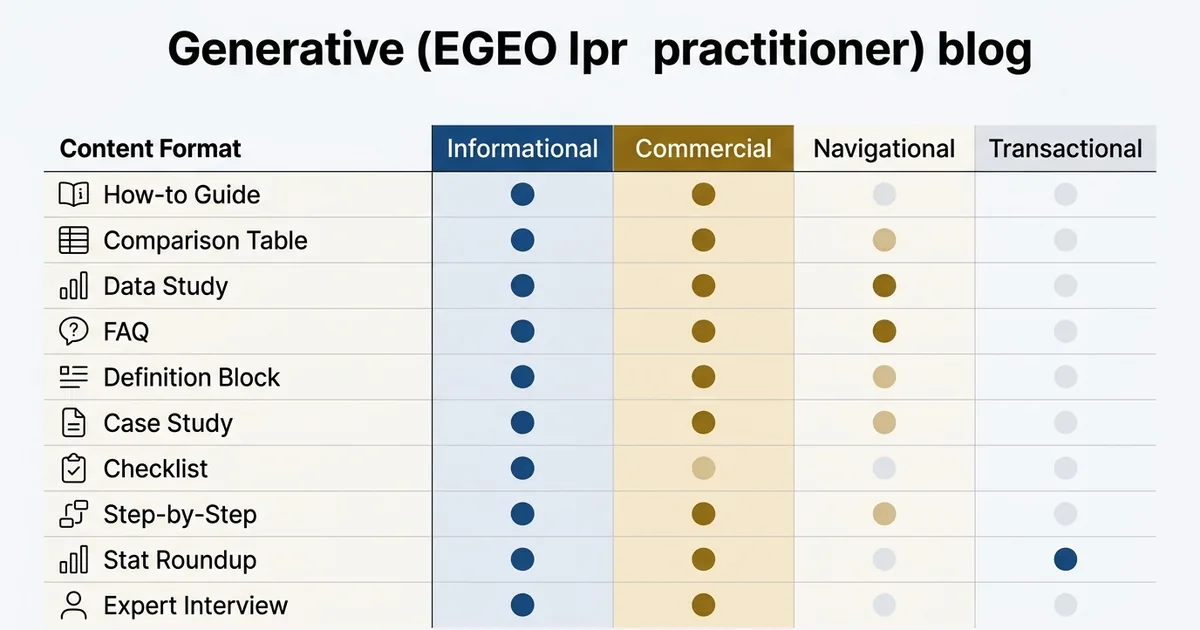
Ten structural templates, one query intent each — the practitioner’s format-to-intent pattern language that sits under every well-cited page
TL;DR
An AI system deciding which source to cite first matches the shape of the user’s query to the shape of the content. “What is X?” wants a definitional page. “How do I…?” wants an ordered how-to. “X vs Y” wants a comparison table. When the shapes align, the page gets cited. When they don’t, a competitor with the right shape wins.
Ten formats cover most of the intent space: definitional page, how-to guide, comparison table, listicle, troubleshooting registry, case study, glossary entry, reference/spec, explainer, and FAQ page. Each has a primary intent, a secondary intent it also serves, and a set of intents it will fail on.
AI retrieval systems evaluate format before they evaluate content: a well-structured how-to page beats a better-written wall of prose for procedural queries every time. Matching format to query intent is the structural decision that determines whether a page is retrievable before any keyword or schema work begins.
The AI Reads Shape Before It Reads Content
I wrote a very good post on FAQPage schema. It had the right information, the right sources, the right structure. It got retrieved. It did not get cited — because the query that would have pulled it in was phrased as a how-to (“how do I fix the duplicate FAQPage error”) and the page was structured as an explainer. The AI system fetched the page, looked for an ordered sequence of steps to quote, found prose paragraphs instead, and went to quote someone else who had the exact same information in a numbered list.
Format optimisation is Layer 2 work in the GEO Stack — specifically the Extractability sub-layer that determines whether a retrieved passage is quotable, independent of whether the page ranked in traditional search.
The information was the same. The shape was different. Shape won.
This is the thing I find practitioners underestimate most consistently in 2026. There’s a tendency to think of content quality as a single dimension — well-researched, well-written, well-structured content will be cited. It won’t, if the structure is wrong for the query. AI systems have format preferences per intent, and those preferences are sharp enough to override content quality within the same topic.
The ten formats below are the structural templates that fit the common intents cleanly. Each one is a pattern you can see in the HTML — headings, layout, schema — not a vibe-based judgement about writing style. Pick the format first. Write the content second. Reversing that order is how thoroughly-researched posts lose citations to shallower ones.
Query Intents and the Formats That Serve Them
Before the ten format cards, the matrix that drives everything else. Six common query intents, and the formats that win each one.
Testing how well a format serves a specific intent type requires a structured probe set — the ten probe query types are the Lab’s instrument for measuring format-to-citation relationships empirically.
Definitional
“What is X?” — Definitional page, glossary entry
Procedural
“How do I…?” — How-to guide, reference/spec
Comparative
“X vs Y” — Comparison table, listicle
Commercial/category
“Best X” — Listicle, comparison table
Troubleshooting
“Fix [error]” — Troubleshooting registry, FAQ page
Evidence-seeking
“Does X work?” — Case study, explainer
The mapping is not one-to-one. Some formats — the listicle, for example — serve two intents well (comparative and commercial) because their shape accommodates both. Some intents — troubleshooting — are served by more than one format, but with different strengths. The format cards below specify each format’s primary intent, its secondary use, and the intents where it fails.
The Ten Formats
Each format card has the structural pattern, primary and secondary intent, the schema type that reinforces it, and a failure mode to watch for.
Each format has a different extractability profile — the ten extractability signals document which structural properties make a given format easier or harder for AI systems to quote cleanly.
01
Definitional page
Article
Pattern
Opens with “X is Y” in the first sentence. Structured as: what it is, why it exists, how it works, related concepts. One canonical definition per page.
Primary intent
Definitional. “What is X?” queries where the user wants the term defined unambiguously.
Example query
“What is citation rate in AI search?”
Failure mode
Narrative opening. Any setup before the definition costs the page the extraction slot — AI systems looking for “X is Y” at the top find a story instead.
02
How-to guide
HowTo
Pattern
Numbered steps with action-oriented verbs at the start of each. Code blocks or concrete examples where applicable. Result or verification step at the end.
Primary intent
Procedural. Any query starting with “how do I” or “how to”.
Example query
“How do I check my robots.txt for AI crawler rules?”
Failure mode
Prose descriptions of steps instead of an ordered list. AI systems cannot extract a numbered procedure from a paragraph that describes the procedure in free text.
03
Comparison table
Article
Pattern
Explicit table element comparing two or more named entities across consistent criteria. Row per attribute, column per entity. Short summary of when each choice wins.
Primary intent
Comparative. “X vs Y” or “X compared to Y” queries.
Example query
“GEO Stack vs Answer Engine Optimization — what’s the difference?”
Failure mode
Prose comparison without a table. A well-written comparison in three paragraphs loses to an average comparison in a clean table, because the table is directly extractable as structured output.
04
Listicle
ItemList
Pattern
Numbered list of discrete items, each with a consistent internal structure. Named entities prominent. Section-per-item format preserves extractability for each item individually.
Primary intent
Commercial/category. “Best X”, “top Y”, “top 10” queries.
Example query
“Best AI visibility monitoring tools in 2026”
Failure mode
Uneven item structure — some items with three sub-sections, others with one paragraph. AI systems extracting a list of items expect the same shape for each, and inconsistency forces them to skip items or flatten the list.
05
Troubleshooting registry
Article
Pattern
Entries structured as symptom → root cause → fix. The exact error string or error message appears verbatim in the entry. Often organised as a registry of multiple entries on one page or one entry per page.
Primary intent
Troubleshooting. Queries that include a specific error string or describe a specific failure.
Example query
“Google Search Console ‘Duplicate field: FAQPage’ error — how to fix”
Failure mode
Paraphrasing the error message instead of quoting it verbatim. AI troubleshooting retrieval does string-level matching against the reported error before anything else — paraphrasing breaks that match.
06
Case study
Article
Pattern
Structured around: context, problem, intervention, measurement, result. Named actors (company, team, named individual). Specific numbers for before and after. Timeline present.
Primary intent
Evidence-seeking. Queries asking whether a technique works, what results others got, or how to judge an approach.
Example query
“Has anyone measured citation rate improvement from adding schema?”
Failure mode
No numbers, no timeline, no named actors. A case study in name only — narrative reads well, produces no extractable evidence. AI systems evaluating evidence cite case studies with data, not case studies with stories.
07
Glossary entry
DefinedTerm
Pattern
Short, focused definition (50–200 words) of a single term. Often part of a larger glossary collection. No narrative, no expansion — just the term and the canonical definition.
Primary intent
Definitional. Identical primary intent to the definitional page, but at smaller scale and higher density.
Example query
“Define C-SOV in GEO measurement”
Failure mode
Treating the glossary entry as a stub that redirects to a longer page. A glossary entry should be complete on its own — redirecting the reader to a different page to find the actual definition is how glossary entries stop being cited.
08
Reference/spec
TechArticle
Pattern
Comprehensive, flat documentation of a system, API, schema, or protocol. Organised by component or endpoint rather than by narrative. Every item has a consistent structure — name, description, parameters, example, notes.
Primary intent
Procedural (secondary) and definitional (secondary). Queries that look up a specific parameter, flag, field, or configuration option.
Example query
“What does the user-agent parameter do in Perplexity API requests?”
Failure mode
Narrative reference. Trying to explain a reference document in prose rather than as a flat lookup. References need to be scan-and-extract, not read-from-start-to-finish.
09
Explainer
Article
Pattern
Prose-heavy, narrative-driven content that walks through a concept with examples, analogies, and gradual buildup. Designed to be read linearly.
Primary intent
Evidence-seeking (secondary) and broad educational intent. Queries phrased as “why does X happen” or “what’s the intuition behind Y”.
Example query
“Why do AI systems cite some sources more than others?”
Failure mode
Using explainer format for definitional or procedural queries. An explainer is the right choice for a handful of intents — for most queries, a definitional page or how-to would win. Default to explainer format is the single most common format-to-intent mismatch.
10
FAQ page
FAQPage
Pattern
Explicit question-answer pairs. Each question phrased as a user would ask it. Each answer self-contained and short. FAQPage schema directly mirrors the visible content.
Primary intent
Troubleshooting (secondary) and “common questions” queries. FAQ pages win when users are asking directly and concisely.
Example query
“Do AI crawlers execute JavaScript?”
Failure mode
Stretching the FAQ format into a primary content format. FAQ works as a secondary section on a longer page, or as a dedicated FAQ landing page for support use cases. Trying to make FAQ the primary structure of the entire site turns every topic into fragmented Q&A with no connective tissue.
The Ten at a Glance
Reference table. Use when you’re about to write a page: identify the primary query intent first, then match to the format row.
| # | Format | Schema | Primary intent | Also serves |
|---|---|---|---|---|
| 01 | Definitional page | Article |
Definitional | Evidence-seeking |
| 02 | How-to guide | HowTo |
Procedural | Troubleshooting |
| 03 | Comparison table | Article |
Comparative | Commercial |
| 04 | Listicle | ItemList |
Commercial | Comparative |
| 05 | Troubleshooting registry | Article |
Troubleshooting | Procedural |
| 06 | Case study | Article |
Evidence-seeking | Comparative |
| 07 | Glossary entry | DefinedTerm |
Definitional | — |
| 08 | Reference/spec | TechArticle |
Procedural | Definitional |
| 09 | Explainer | Article |
Evidence-seeking | Definitional |
| 10 | FAQ page | FAQPage |
Troubleshooting | Definitional |
When to Combine and When to Split
The temptation to combine formats — one page covering definitional, comparative, and procedural intent for the same topic — is the single most common structural mistake in content strategy. It produces pages that read as “thorough” to a human and as “unfocused” to an AI retrieval system.
The citation evidence on format performance by intent type comes from Tier 1 vs Tier 2 experiments — the citation gap post shows how query type and format interact to produce citation rate differences of 60 percentage points or more.
Three principles make the combine-vs-split decision tractable.
First: one primary intent per page. A page can reference other intents through links, but the page itself needs to be unambiguous about what it is. A definitional page that also tries to be a how-to ends up failing both — the opening isn’t declarative enough for the definitional intent, and the how-to steps are interrupted by definitional context.
Second: pair formats only when they share structural shape. A listicle and a comparison table share shape — enumerated items with consistent attributes — and combine well. A definitional page and a troubleshooting registry do not — one is narrative-driven, the other is lookup-driven, and forcing them onto the same page breaks both patterns.
Third: cross-link instead of combining. The right response to “this topic has three intents” is three pages, each in the right format for its intent, with explicit cross-links between them. The AI system then has three clean extraction targets instead of one confused one. Practitioners used to SEO often resist this because it feels like “thin content” — but thin content is content with nothing to say, not content that says one thing well.
A working pattern applied on thegeolab.net:
| Topic | Split into | Cross-linked through |
|---|---|---|
| Citation rate | Definitional page + glossary entry + case study | Definitional page links to glossary and case study; case study links back to definitional |
| FAQPage duplicate error | Troubleshooting registry entry + how-to guide + FAQ entry | Registry entry links to how-to; how-to has short FAQ block at end |
| GEO vs AEO vs LLM SEO | Comparison table page + three separate definitional pages, one per term | Each definitional page linked from the comparison row for that term |
On schema-format alignment. Every row in the table above aligns the schema type to the format. Article on definitional, HowTo on the how-to guide, FAQPage only where there is actual question-answer structure. Misaligned schema — FAQPage schema on a definitional page, HowTo on a troubleshooting registry — is worse than no schema. The AI system detects the mismatch between what the schema promises and what the content delivers, and discounts both.
Frequently Asked Questions
What is a content format in GEO?
A content format is a structural template that organises information in a specific way — a definitional page, a how-to guide, a comparison table, a troubleshooting registry. The format is distinct from the topic. Two pages on the same topic can be structured in different formats, and each format serves a different set of query intents. Choosing the right format for the query intent is often the difference between a page that gets cited and one that doesn’t.
How do I know which content format matches a query intent?
Match the structural shape of the query to the structural shape of the format. “What is X?” queries are definitional — they want a definitional page opening with “X is Y”. “How do I…” queries are procedural — they want an ordered how-to with numbered steps. “X vs Y” queries are comparative — they want a side-by-side comparison table. When the query shape and format shape align, the AI system extracts a clean answer. When they don’t, the page loses to a competitor whose format matches better.
Can one page serve multiple query intents?
Yes, but with diminishing returns. A page that tries to be a definitional page, a how-to, and a comparison all at once usually fails at all three — the structural patterns required by each format conflict. The better approach is separate pages for separate intents, cross-linked, with each page optimised for its primary format. Trying to cover three intents on one page is how “comprehensive” posts end up citation-less despite being topically thorough.
What format works best for commercial or category queries?
Commercial and category queries (“best X tools”, “X vs Y alternatives”, “top Y providers”) favour list pages with named entities, brief descriptions, and explicit criteria. AI systems responding to category queries strongly prefer content that names competitors, structures them as a list, and gives comparable data points for each. Category queries almost never cite pure narrative content, regardless of quality.
Does schema type need to match the content format?
Yes. HowTo schema on a how-to page reinforces the extraction signal; HowTo schema on a narrative page creates a mismatch that weakens trust in both. FAQPage schema works on pages with clear question-answer structure and nowhere else. The rule is simple: the schema type should describe what the content actually is, not what you wish it were. Misaligned schema is worse than no schema.