
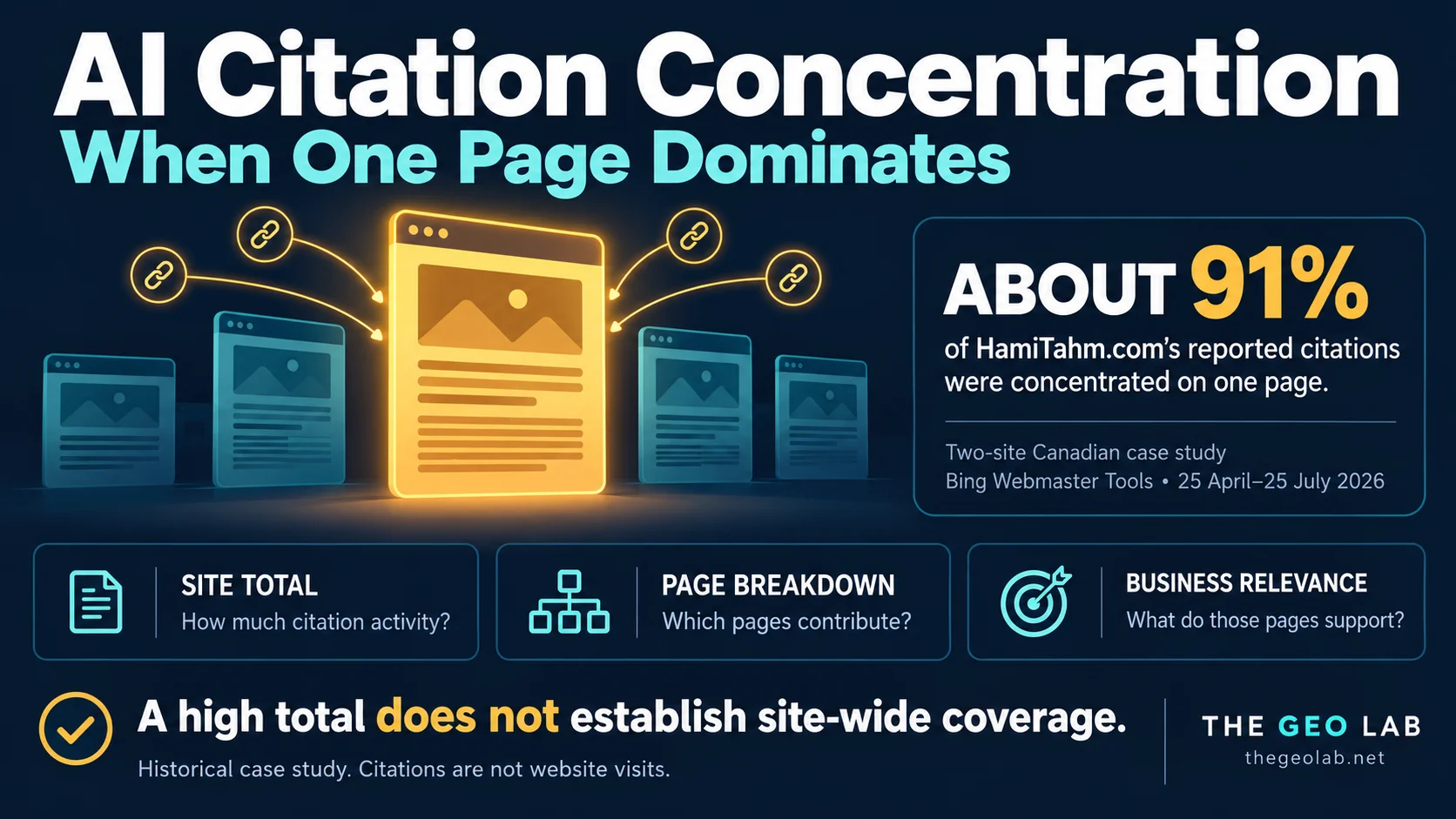
Research review of a two-site case study. AI citation concentration describes how recorded citations distribute across pages, and why the page breakdown belongs beside the headline count.
TL;DR
AI citation concentration describes how a site’s recorded citations are distributed across its pages. In Hami Tahm’s two-site Canadian case study, HamiTahm.com had 7,100+ platform-reported citations across 6+ pages, with about 91% concentrated on one page. The comparison site, HomeCalc.ca, had 14,600+ citations across 25+ pages. These historical Bing Webmaster Tools figures support inspecting page-level distribution alongside the total; they do not establish a successful content tactic, traffic gains or current cross-platform visibility.
Contents
- What the two-site case reported
- Citation volume and page distribution answer different questions about AI citation concentration
- A dominant page can be useful
- What the study does not establish
- How I’d add AI citation concentration to a report
- What would make the evidence stronger
- Frequently asked questions
If a report said my website had thousands of AI citations, I’d open the page breakdown before deciding what to do next.
I’d want to know which pages were being used. If most of the activity came from one article, that would tell me something different from citations spread across the services I am trying to sell.
The total would still be worth recording. It just would not describe how much of the website was contributing to it. That gap between site total and page-level AI citation concentration is what this article examines.
Hami Tahm’s two-site case study gives that question a concrete example. One site accumulated thousands of reported citations, with most concentrated on a single page.
What the two-site case reported
Tahm compared HomeCalc.ca and HamiTahm.com over 25 April to 25 July 2026. Both sites had the same owner and operated in the Canadian market.
The deposited study used Bing Webmaster Tools AI Performance reporting. Its stated citation coverage concerned Microsoft Copilot and partners. Google Search Console supplied a separate search-performance cross-check.
| Site | Reported citations | Reported cited pages | AI citation concentration detail |
|---|---|---|---|
| HomeCalc.ca | 14,600+ | 25+ | The verified summary does not give a comparable leading-page share |
| HamiTahm.com | 7,100+ | 6+ | About 91% on one page |
These are rounded dashboard values. I have retained the plus signs and the approximate percentage rather than treating them as exact event counts.
The author contrasts a purpose-built calculator site with a mixed personal and consultancy site. That describes the cases. It does not isolate content format as the cause of the difference.
Citation volume and page distribution answer different questions about AI citation concentration
The site total tells us how much citation activity the reporting surface attributed to the site within its coverage and window.
The page breakdown tells us where that activity was concentrated. AI citation concentration is the distribution that the total alone obscures.
| View | Question it helps answer |
|---|---|
| Site total | How much citation activity was recorded for this site? |
| Cited-page count | How many pages contributed recorded citations? |
| Leading-page share | How much of the recorded activity came from the most-cited page? |
| Page-to-offer mapping | Which parts of the business do those pages represent? |
The last row is my proposed business review, not an outcome tested by the study.
For HamiTahm.com, the approximate 91% figure changes how I’d describe the result. I’d call it substantial recorded citation activity concentrated on one page. I would not describe it as broad citation coverage across the website.
For HomeCalc.ca, the larger cited-page count establishes that more pages contributed. Without a comparable distribution, I would not assume its citations were evenly spread across those pages.
Going deeper? The GEO Field Manual covers practitioner audit workflows including page-level citation analysis.
Page count alone does not establish breadth
A site can have several cited pages while one supplies most of the total. That degree of AI citation concentration is invisible in a page count.
That is why I’d look at the counts for individual pages, rather than use the number of cited URLs as a substitute for their distribution.
I’d also keep the site’s full page inventory separate. “Six pages received citations” does not tell us what proportion of the site was cited unless we know the relevant inventory and its boundaries.
A dominant page can be useful
I would not treat concentration as a fault by itself.
A calculator, reference page or service guide might be the page the business most wants people to encounter. Concentrated citation activity could align with that aim.
It could also centre on a topic that has little connection to the business’s current offer.
Those possibilities call for different decisions. I’d read the page and map it to the business objective before recommending more pages, a rewrite or a new content format.
Check what the cited page represents
| Review question | What I’d inspect |
|---|---|
| Is this a topic the business wants to be known for? | The page’s subject and its place in the current offer |
| Does the page describe that offer accurately? | The content and any qualifications attached to it |
| Can a reader reach a relevant next step? | The page’s existing navigation and service links |
| Is there evidence of visits or enquiries? | Separately collected traffic and conversion records |
| Are other important pages contributing? | The remaining page-level citation records |
This is a proposed review procedure for understanding AI citation concentration. The two-site study did not test whether following it produces more citations or revenue.
The practical benefit is a more specific decision. If the dominant page already serves the business well, its concentration may simply be worth monitoring. If it represents an outdated service, the content needs attention for that reason.
What the study does not establish
The two sites shared an owner, but they were not controlled versions of the same website.
Their topics, histories and page inventories could differ. The deposited case does not isolate the effect of calculators, authority, site age or another GEO tactic. Its content-production method was not disclosed.
I’d therefore avoid turning the comparison into “build calculators to double your citations”. The study reports different outcomes between two selected sites; it does not establish a repeatable intervention.
Citations are not a traffic measure
The reporting surface’s citations concern grounding-source uses under its definition. They are not recorded visits to the website.
Google Search Console figures concern a different reporting system. A Google click count cannot be divided by a Microsoft citation count to establish an AI referral conversion rate.
To investigate visits or enquiries, I’d use evidence designed for that question, such as the AI referral traffic measurement guide. AI citation concentration can guide that investigation, but it does not supply the outcome.
The evidence remains a small case study
This is one author group’s account of two same-owner sites in one market. The author owns the properties, so that relationship belongs with the interpretation.
The deposited evidence contains selected summaries rather than a complete event export. The rounded figures do not support precise reconstructions of every page’s contribution.
The finding is useful as a descriptive case. It does not tell us how common this degree of AI citation concentration is across websites.
How I’d add AI citation concentration to a report
I’d keep the page breakdown beside the site total for the same reporting window and product coverage.
Before calculating a leading-page share, I’d confirm that the page counts and total use compatible counting rules. If the rows do not reconcile with the total, I’d investigate that mismatch instead of presenting a precise percentage.
| Report field | What I’d retain |
|---|---|
| Reporting surface | The product and its stated coverage |
| Date window | The period used for both site and page counts |
| Site total | The reported count, with rounding preserved |
| Page-level counts | The URL and its recorded citation activity |
| Leading-page share | A reported or validly calculated share, with its denominator stated |
| Page purpose | What the page contributes to the business |
| Evidence limits | Missing exports, rounding or unresolved definitions |
This concerns AI citation concentration within one site. Comparing citation share between competing brands is a different task, covered in the citation share-of-voice guide.
For questions about the tracking instrument itself, the AI citation tracking guide covers scope and validation.
What would make the evidence stronger
A complete same-window export would make the page distribution easier to inspect and reproduce.
A broader collection across independently owned sites would help establish whether the pattern extends beyond this case. Testing a content tactic would require a separate design that addresses competing explanations.
For a current report, I’d also check the reporting product’s current definitions and coverage. The figures here belong to the April to July 2026 window; they are not a statement about what either site receives today.
Until then, the case supports a modest addition to the report: show which pages account for the citations before drawing a site-wide conclusion about AI citation concentration.
The GEO Lab Takeaway
Open the page breakdown before calling a citation total a site-wide success.
If one page accounts for most of the activity, report that concentration and explain what the page does for the business. Keep any claim about traffic or enquiries tied to the records that measure those outcomes.
Frequently asked questions
What is AI citation concentration?
AI citation concentration describes how a site’s recorded citations are distributed across its pages. One useful view is the share attributed to the most-cited page within a defined window and reporting surface.
Is it bad if one page receives most AI citations?
Not necessarily. I’d check whether that page supports the business’s goals before treating its concentration as a problem.
Does a high site total mean most pages are being cited?
No. The two-site case included a site where about 91% of recorded citations were concentrated on one page. Page-level records are needed to assess AI citation concentration.
Does the case prove calculator content earns more AI citations?
No. It compares two different sites without isolating content format or the other differences between them.
Is AI citation concentration the same as citation share of voice?
No. Concentration concerns the distribution across pages within one site. Share of voice concerns a site or brand’s share within a wider comparison.
Can I infer visits from the citation total?
No. Visits and business outcomes need their own evidence. The citation count does not establish how many people clicked through.
Source
Hami Tahm, AI Citation Study: Two Sites, One Owner, Three Months. Published 28 July 2026. Observation window: 25 April to 25 July 2026.
The deposit contains the reported summaries, methodology and limitations. It is one work family, not a collection of independent studies.
Ready to apply this? Start with the citation share-of-voice guide for between-brand comparisons, or the AI citation tracking guide for instrument scope.
Have questions about this topic? Contact The GEO Lab · Return to homepage