
Research review · Graphite · Nine AI model versions ·
TL;DR
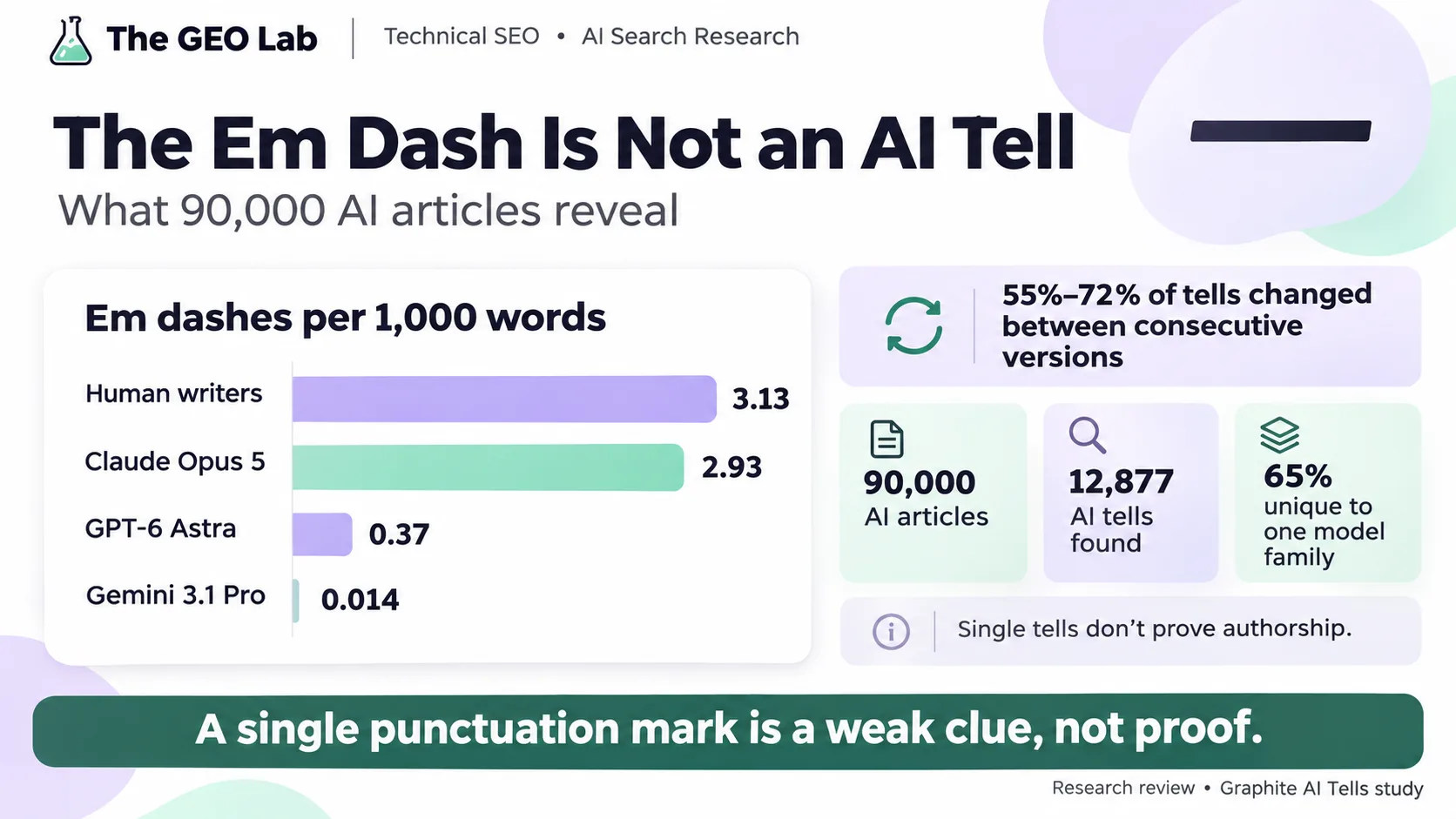
The em dash is not a reliable sign of AI-generated writing. Graphite’s 2026 study compared 90,000 AI-written articles with 10,000 older human-written articles. Humans used 3.13 em dashes per 1,000 words, compared with 2.93 for Claude Opus 5, 0.37 for GPT-6 Astra and just 0.014 for Gemini 3.1 Pro. The researchers identified 12,877 AI writing patterns, with 65% unique to one model family. Their findings show that writing patterns change between models and versions, making a single punctuation mark or phrase insufficient evidence of AI authorship.
Is the em dash AI tell real? Graphite’s 2026 study of 100,000 articles suggests the answer is more complicated than a social-media accusation.
The em dash became an AI accusation
You’ve probably seen it on LinkedIn.
Someone publishes a post, uses an em dash, and somebody in the comments points it out as evidence that ChatGPT wrote the whole thing.
At some point, a punctuation mark became an AI detector.
And to be fair, the suspicion didn’t come from nowhere. Earlier GPT models really did use em dashes more frequently than human writers. The problem is that people kept repeating the rule while the models were changing.
Graphite, an SEO and growth agency, published a study in September 2026 that puts some numbers behind this.
The researchers compared 90,000 AI-generated articles with 10,000 articles written before ChatGPT became publicly available.
What caught my attention wasn’t simply that the em dash had become a poor indicator of AI writing. It was how differently the models behaved, and how quickly their writing habits changed between versions.
Some of the latest models barely use em dashes at all. Others use them at almost the same rate as humans.
So if you’re still judging whether someone used AI because of a dash, you’re relying on a pattern that may no longer apply to the model you’re trying to identify.
What Graphite actually tested
Graphite started with 10,000 web articles published before 30 November 2022, the day ChatGPT launched.
The researchers treated these as a predominantly human-written reference set. They then used GPT-4.1 to summarise each article and gave those summaries to nine different AI models, asking each to write a new article on the same topic.
That produced 90,000 AI-written articles, with 10,000 generated by each model. For the word-level comparisons, Graphite used the 9,984 topics where all ten versions were available.
| Item | Study details |
|---|---|
| Human reference set | 10,000 articles published before ChatGPT |
| AI articles | 90,000, with 10,000 per model |
| Models | GPT-4.1, GPT-5, GPT-5.6 Sol, GPT-6 Astra, Claude Opus 4, Opus 4.6, Opus 5, Gemini 2.5 Pro and Gemini 3.1 Pro |
| Access | Developer APIs |
| Instructions | One fixed system and user prompt across models |
| Content | Professional web articles in plain text, with word counts matched to the originals |
| Definition of a tell | A word, phrase or gap pattern appearing at least twice the human rate, subject to minimum article counts |
| Total tells | 12,877 across nine models |
| Publication | 16 September 2026 |
I like that Graphite made the articles and the detected patterns available for download. That makes the work easier to inspect than research where we only get a few charts and a conclusion.
But there’s a methodological detail worth keeping in mind.
The models all received the same writing instructions. The human authors didn’t. Their articles were written years earlier, for different purposes and without the same prompt.
That makes comparisons between AI models more controlled than comparisons between the AI articles and the human set.
The numbers behind the em dash
This is where the familiar AI-writing accusation starts to fall apart.
Graphite measured em dash usage per 1,000 words. The results for three of the latest models were striking.
| Writer | Em dashes per 1,000 words | Relative to humans |
|---|---|---|
| Human articles | 3.13 | 1.00x |
| Claude Opus 5 | 2.93 | 0.93x |
| GPT-6 Astra | 0.37 | 0.12x |
| Gemini 3.1 Pro | 0.014 | Under 0.01x |
Claude Opus 5 was close to the human rate. GPT-6 Astra used em dashes about eight times less frequently than the human writers, while Gemini 3.1 Pro used almost none.
That doesn’t fit the popular assumption that AI writing is full of em dashes.
But the history across model versions is even more revealing.
| Model family | Earlier versions | Latest version |
|---|---|---|
| GPT | GPT-4.1: 2.28x; GPT-5: 2.21x; GPT-5.6 Sol: 0.10x | GPT-6 Astra: 0.12x |
| Claude | Opus 4: 0.21x; Opus 4.6: 0.07x | Opus 5: 0.93x |
| Gemini | Gemini 2.5 Pro: 0.46x | Gemini 3.1 Pro: Under 0.01x |
Earlier GPT models did overuse the punctuation. GPT-4.1 and GPT-5 produced em dashes at more than twice the human rate.
Then GPT-5.6 Sol dropped to roughly a tenth of the human rate, and GPT-6 Astra remained close to that level.
Claude moved in the opposite direction. Opus 4.6 used very few em dashes, but Opus 5 brought the rate much closer to human writing.
Graphite suggests that GPT and Gemini may have adjusted their behaviour in response to public attention around obvious AI tells.
That’s a plausible explanation, but it’s still an interpretation. The study measured changes in writing patterns. It didn’t establish why those changes happened.
What the data does establish is that the same punctuation mark can behave very differently across model families and releases.
AI writing tells aren’t universal
The em dash is only one of the 12,877 patterns Graphite identified.
And there’s another finding I think matters more for anyone using a list of supposed AI words.
About 65% of the tells were unique to one model family.
In other words, a pattern that appears frequently in GPT-generated text may be uncommon in Claude or Gemini output.
Graphite gives some fairly extreme examples.
| Model | Example writing pattern | Relative to human rate |
|---|---|---|
| GPT-6 Astra | “not simply” | 157x |
| Claude Opus 5 | “less like a _ and more like” | 105x |
| Gemini 3.1 Pro | “furthermore the” | 43x |
Those are large differences. But they are frequency comparisons across a collection of articles, not proof that an individual sentence came from a particular model.
A human can write “not simply”. A human can also use “furthermore”.
One appearance of a phrase tells us very little.
What makes these patterns interesting is their frequency across thousands of outputs, not their presence in one paragraph.
The patterns also change between versions
Graphite found that between the two latest versions in each model family, 55% to 72% of writing tells were unique to one version.
GPT-6 Astra had roughly 3,700 tells, slightly more than GPT-5.6 Sol, but only 45% were shared between them.
Think about what that means for an AI detection checklist.
You could spend months collecting expressions that appear frequently in a model’s output. Then a new version arrives, and a substantial part of your list no longer describes the same behaviour.
This is why I wouldn’t build an authorship judgement around a handful of phrases copied from social media.
The patterns are model-specific, version-specific and likely to keep changing.
The obvious AI phrases are disappearing
Graphite also looked at several of the expressions people have come to associate with AI writing.
Words such as “delve”, phrases like “it is important to note”, and familiar ways of wrapping up an article have all become common targets for criticism.
The researchers tracked 11 well-known tells. Across the nine measured by frequency per 1,000 words, their combined use fell between 41% and 86% from the earliest to the latest model in each family.
At first glance, you might interpret that as evidence that AI writing is becoming more human.
But Graphite’s broader analysis doesn’t support such a simple conclusion.
On its word-distribution measure, only Claude moved closer to the human article set. GPT and Gemini actually moved further away.
Every model’s writing was also closer to at least one other model than to the human reference articles.
So while some familiar AI expressions are becoming less common, the overall statistical differences haven’t necessarily disappeared.
The models are changing their habits. That isn’t the same as proving they’ve learned to write indistinguishably from people.
Can you identify AI writing from a single tell?
Graphite’s own recommendation is clear: don’t use individual tells to classify authorship.
That’s a sensible conclusion from the data.
| Question | What the study supports |
|---|---|
| Do the latest models overuse em dashes? | Not consistently. GPT-6 Astra and Gemini 3.1 Pro use them far less often than the human articles, while Claude Opus 5 is close to the human rate. |
| Can one writing tell identify a model? | No. Patterns differ between model families and change between versions. |
| Are AI and human articles different as groups? | Yes, across multiple measured features in this particular article-writing setup. |
| Does an AI writing tell affect search rankings or citations? | Not tested. |
| How accurately can individual tells identify AI authorship? | Not reported. The study didn’t build or evaluate an authorship classifier. |
It’s worth separating statistical differences from identification.
If a phrase appears 100 times more often in one model’s output than in human writing, that may be a useful population-level observation.
It doesn’t mean the phrase is unique to that model.
To make a reliable authorship claim, we’d need to know how often a detection method gets the answer right, how often it falsely accuses human writers, and how well it performs on material outside the original dataset.
Graphite didn’t test that.
AI detectors have their own limitations
Graphite suggests using a dedicated AI detector rather than judging authorship from individual writing patterns.
That may be a better approach, but detectors deserve scrutiny too.
In their research on AI-generated sources appearing in generative search, Allaham and Diakopoulos tested Pangram and GPTZero. (Their research on AI-generated sources in AI search covers the broader context.)
They first used a curated dataset containing 200 human-written and 200 AI-generated texts. Both detectors achieved 100% accuracy on that set.
That sounds impressive.
But the results changed when the researchers tested material collected from actual websites.
They examined 105 articles from sites that journalists had identified as publishing AI-generated content. Pangram labelled 72 as AI after the researchers combined its “mixed” and “AI” classifications.
If all 105 articles really were AI-written, that would mean the detector missed 31.4% of them.
The researchers couldn’t independently establish that every article in the group was AI-generated, so that percentage is conditional, not a confirmed real-world false-negative rate.
Still, the contrast is worth paying attention to.
A detector can perform extremely well on a controlled test set and behave differently on material collected from the web. I explored a related question in whether AI detection scores affect Google indexing.
Neither Graphite nor Allaham and Diakopoulos directly compared a tell-based checklist with a detector on the same evaluation set.
So we shouldn’t claim that one approach has a proven accuracy advantage based on these two studies alone.
And we certainly shouldn’t treat a detector score as conclusive proof of who wrote a document.
What this means for GEO and content editing
I want to separate two questions here, because they’re often mixed together.
Graphite studied writing patterns. It didn’t study Google rankings, AI Overviews, ChatGPT citations or whether an AI system prefers human-written content.
We cannot take these findings and conclude that removing em dashes improves SEO or GEO performance.
There is no evidence for that in this experiment.
What the study does offer is a useful perspective on how we edit content, particularly when AI has been involved in drafting.
Removing em dashes doesn’t make writing human
I’ve seen the advice to remove every em dash from an AI-generated article before publishing it.
I understand where it comes from. Earlier models overused them, and repetitive punctuation can make writing feel mechanical.
But deleting one punctuation mark doesn’t change the underlying writing.
Graphite identified thousands of other patterns, and many of those differ between model families.
If a paragraph is repetitive, vague or unnecessarily complicated, removing a dash won’t solve the problem.
I’d rather edit the reasoning, clarify the claims and make the writing sound natural than spend time hunting for one character.
Good editing should improve the article for the reader, not merely remove whatever social media currently considers an AI tell.
Human writing had its own distinctive patterns
Graphite also examined features that appeared more often in the human reference articles.
Those writers were more likely to use the first person, address the reader directly, include small anecdotes and qualify statements conversationally.
The researchers also measured differences in punctuation and sentence length.
| Feature | Human articles | Latest models |
|---|---|---|
| Exclamation marks per 1,000 words | 2.81 | 0.019 to 0.024 |
| Sentence-length standard deviation, words | 16.96 | 5.83 to 8.40 |
The human articles showed considerably more variation in sentence length.
That fits something I’ve noticed when editing machine-generated drafts. The sentences can be perfectly grammatical, but the rhythm is often too consistent. Every paragraph seems to receive the same amount of attention, and every section follows a familiar structure.
Human writing doesn’t always work that way.
Sometimes we explain a point in one sentence. Sometimes it takes a paragraph. Sometimes we qualify a claim because the evidence doesn’t support anything stronger.
But I wouldn’t turn Graphite’s results into another checklist.
The human articles came from an earlier period, and they weren’t written under the same conditions as the AI articles. Some differences could reflect editorial conventions or the age of the material rather than human authorship itself.
The numbers describe this corpus. They aren’t instructions for how every human should write.
Stop treating writing habits as accusations
This is the part of the discussion that bothers me most.
Someone uses an em dash, a familiar phrase or a tidy list, and another person decides that must mean they used AI.
Even when a pattern is statistically more common in AI output, that doesn’t make it exclusive to AI.
People have been using these words and punctuation marks for decades.
Graphite’s results make the problem with those accusations fairly obvious. A supposed AI tell can be common in one model, rare in another and completely different after the next release.
That’s not a reliable basis for judging an individual writer.
If the content is inaccurate, challenge the facts. If the argument is weak, challenge the reasoning. If the writing is poor, explain why.
A punctuation mark isn’t evidence of authorship.
Going deeper? The GEO Field Manual covers the practitioner workflow for auditing, measuring and reporting AI visibility outcomes across platforms.
What the study cannot establish
Graphite provides a substantial dataset, but several limitations matter when interpreting its findings.
First, the human reference articles were published before November 2022, while the AI articles were generated in 2026. Writing conventions can change over time, and the study cannot fully separate those changes from differences between human and machine authorship.
Second, all nine models received one fixed prompt to produce professional web articles. That’s useful for comparing the models under consistent conditions, but it doesn’t tell us how the same models would behave in casual conversations, technical documentation, fiction or heavily edited drafts.
Third, Graphite used Claude Opus 5 to assess mannered prose across the articles, including articles produced by Claude models. The evaluator wasn’t told which model wrote each article, but that doesn’t eliminate the possibility of evaluator bias.
Fourth, the study identified writing patterns without measuring classification accuracy. There are no reported false-positive or false-negative rates for using individual tells to identify AI authorship.
Finally, the results are a snapshot of nine model versions. Graphite has already published a follow-up involving Claude Opus 5.5, which isn’t included in this review.
The research also comes from a commercial growth agency. That context is worth acknowledging, although Graphite’s decision to publish the underlying data makes independent inspection possible.
These limitations don’t make the findings useless. They tell us how far we can reasonably take them.
Key GEO Lab Takeaway
The em dash is not a reliable AI writing tell. Earlier GPT models overused it; the latest versions use fewer than human writers. Claude Opus 5 matches the human rate. Gemini barely uses them at all.
A writing pattern can describe statistical differences across large corpora. It cannot establish who wrote a particular paragraph.
If you edit AI-assisted content, focus on accuracy, clarity and natural writing. Removing a punctuation mark does not make a paragraph human.
Frequently asked questions about the em dash as an AI tell
Is the em dash a sign of AI writing?
An em dash is not a reliable indicator of AI-generated writing. Graphite’s 2026 study found that human articles used 3.13 em dashes per 1,000 words, compared with 2.93 for Claude Opus 5, 0.37 for GPT-6 Astra and 0.014 for Gemini 3.1 Pro. One punctuation mark cannot establish authorship.
Did AI models previously overuse em dashes?
Yes, some did. In Graphite’s study, GPT-4.1 and GPT-5 used em dashes at more than twice the rate of the human reference articles. Later GPT versions dropped substantially below that rate, showing how quickly a supposed AI writing tell can change.
Can you identify AI-generated writing from a list of tells?
Not reliably from individual patterns. Graphite identified 12,877 writing tells across nine AI models, with 65% unique to one model family. Between consecutive versions, 55% to 72% of tells were unique to one version. The study did not establish the accuracy of an authorship classifier built from those patterns.
Are AI detectors more reliable than checking for AI phrases?
AI detectors may offer a more systematic approach, but their performance depends on the evaluation material. Allaham and Diakopoulos found perfect results on one curated dataset, while Pangram identified 72 of 105 articles from documented AI-generated sites under a broader AI-or-mixed classification. The actual authorship of all 105 articles wasn’t independently confirmed, and the studies did not directly compare detectors with tell-based checklists.
Does Google or ChatGPT penalise content for using AI writing patterns?
Graphite’s study doesn’t answer that question. It measured writing patterns, not search rankings, AI retrieval or citations. The findings provide no evidence that em dashes, particular phrases or other AI tells directly affect SEO or GEO performance.
Ready to apply this? Use the GEO experiments guide to design measurement protocols that test what matters, not what social media says to look for.