
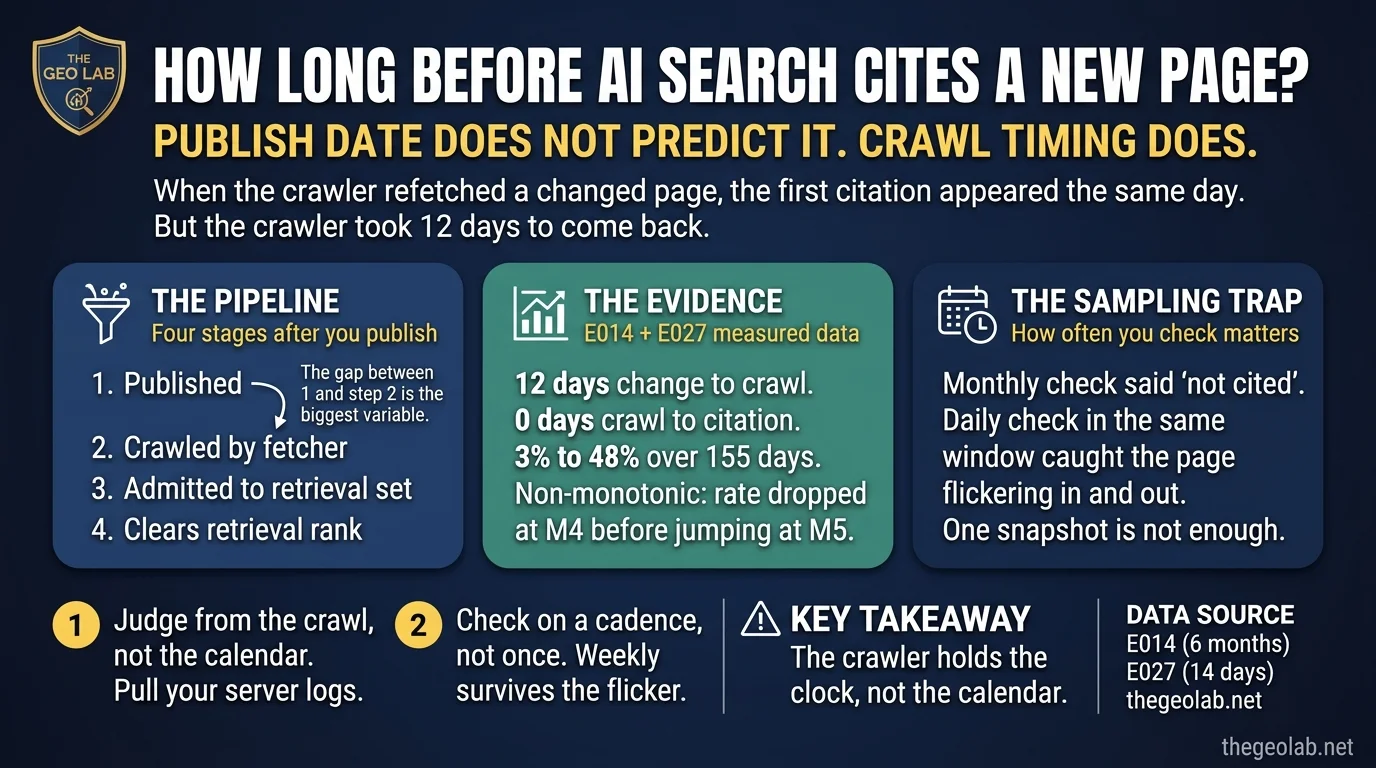
How long before AI search cites a page you just published? In our own measurement at The GEO Lab, the publish date does not predict the AI citation lag. Crawl timing does. When an AI engine’s crawler refetched a changed page on our site, the first citation appeared the same day it was crawled, but the crawler took about twelve days to come back after the change went live (one observed case, PerplexityBot, 30 April 2026). Across the whole site, the share of ten fixed test queries that cite us rose over roughly five months, and it did not rise in a straight line: it climbed, plateaued, fell, then jumped. So the practical answer to “how long” is “as long as it takes the crawler to return and then clear retrieval rank,” a range measured in weeks, not a fixed number of days.
Why the AI citation lag is not what you think
Most people check the wrong clock. They publish a page, query Perplexity the next morning, see nothing, and read that as the page failing.
The pipeline has four stages, and the publish date only starts the first one. A page has to be discovered and crawled by the engine’s fetcher, admitted to the retrieval set, then climb retrieval rank against the pages that already answer the query, before a citation is possible. Publication and crawl are not the same event, and the biggest, most variable gap sits between “the page is live” and “the crawler comes back for it.” That gap is where the AI citation lag you feel actually lives.
What we measured: the AI citation lag is the crawl, not the engine
The cleanest temporal evidence we have comes from one page, /llm-readability/, tracked daily in E027.
We deployed a heading-format change to that page on 18 April 2026. PerplexityBot did not refetch it until 30 April 2026, at 10:00:26 UTC, confirmed from our Nginx logs. The E027 query for that page returned its first ever Perplexity citation the same morning. Twelve days from the change to the crawl. Zero days from the crawl to the citation.
Read that carefully, because it is the whole point: the wait was not the engine deciding whether to cite. The wait was the crawler coming back. Once the page was fetched, citation was immediate.
Three honest limits on that number, none of which I am going to hide:
- It is one data point. n = 1. We have not reproduced the same-day crawl-to-citation pattern across a set of pages yet, so treat it as a strong signal, not a law.
- /llm-readability/ was an existing page that received an intervention, not a brand-new page. So this is a crawl-to-citation lag, not a publish-to-citation lag.
- We do not have that page’s original publish date on record. Which brings us to the part most posts on this topic quietly skip.
Why we can’t give you a clean “cited by day N”
The honest answer is that the publish dates of our earliest pages were not recorded at the time, so we cannot convert any of this into a “published on day zero, first cited on day N” figure. The number everyone wants does not exist in our data.
What we can stand behind is the mechanism: the first thing that moves after you publish is the crawl, and until the crawler returns, nothing downstream can happen. Anyone quoting you a fixed “pages get cited within X days of publishing” is describing their crawl schedule, not a property of your page.
At the site level, the citation rate is a slow, bumpy ramp
Zoom out from one page to the whole site and the picture is a curve, not a step. Our combined citation rate across ten fixed test queries on three engines, measured at monthly milestones over roughly 155 days:
| Milestone | Date | Combined rate | n (checks) |
|---|---|---|---|
| Baseline | Feb 2026 | 3% (1/30) | 30 |
| M1 | 28 Mar 2026 | 6.7% (2/30) | 30 |
| M2 | 24 Apr 2026 | 12.9% (9/70) | 70 |
| M3 | 28 May 2026 | 12.0% (6/50) | 50 |
| M4 | 28 Jun 2026 | 6.0% (3/50) | 50 |
| M5 | 2 Aug 2026 | 48% (24/50) | 50 |
Two things in that table matter more than the headline climb.
First, it is non-monotonic. The rate rose, flattened between M2 and M3, then dropped by half between M3 and M4. Accumulation is not a ratchet. A page cited one month can be uncited the next, with nothing changed on your side, driven by a competitor page or an organic-rank wobble upstream.
Second, and this is the one I would flag hardest: the largest move in the whole dataset, M4 to M5, is the move we trust least. We changed the measurement instrument at that milestone at the same time as the apparent jump, so the 6% to 48% swing cannot be attributed to accumulation on its own. When the biggest number in your data lands exactly on the boundary where you changed how you measure, you report it with the asterisk, not without it.
One more read from the same data: the five category queries that were never going to clear the topic-authority gate stayed at roughly 0% for the entire five months. Accumulation is not uniform. Some pages climb; some never get off the floor, and no amount of waiting changes that.
The AI citation lag sampling trap: how often you check matters
There is a sampling trap hiding in all of this. Our monthly milestone snapshots recorded /llm-readability/ as uncited (0 of 3) right up until M5. Our daily E027 tracking of the same page, in the window between those milestone checks (late April into May), caught it being cited intermittently: in on day 7 after the crawl, out on days 8 to 10, back in on days 11 to 14.
Same page, overlapping weeks, two different verdicts, purely because of how often we looked. A once-a-month check told us “not cited” during a stretch when a daily check showed the page flickering in and out of citation. If you check a new page once and conclude it failed, you have measured your own timing, not the page’s.
The index lag compounds this. A 301 redirect we deployed on 30 April did not propagate cleanly inside 14 days; the old and canonical URLs both kept surfacing in Perplexity’s annotations across the window. Being crawled is not the same as being cleanly indexed, and neither is instant.
What to do about AI citation lag in the post-publish window
- Judge from the crawl, not the calendar. Pull your server logs and confirm the engine’s fetcher actually hit the URL. No crawl, no verdict. Your logs show this; GA4 does not.
- Check on a cadence, not once. Intermittent citation looks identical to failure through a single snapshot. A weekly rhythm survives the flicker; a one-off check does not.
- Expect the line to move both ways. Read any early wobble against a noise floor before you call it a trend, or you will narrate randomness as progress.
- If the page is crawled and still uncited past your window, it is a rank and authority problem, not a patience problem. The category queries that sat at 0% for five months are what that looks like.
FAQ
How long does it take for AI search to cite a new page?
There is no fixed number of days. In our measurement, the AI citation lag was driven by how long the crawler took to refetch the page, not by a timer inside the engine. Once PerplexityBot crawled one of our pages, the first citation appeared the same day. But the crawler took twelve days to come back after the content changed. The practical range is weeks, not days, and it varies by engine and by how often the crawler visits your site.
Why is my new page not showing up in Perplexity or ChatGPT?
The most common reason is that the engine’s crawler has not fetched the page yet. Check your server logs for the engine’s bot (PerplexityBot, ChatGPT-User, Googlebot for AI Overviews). If there is no crawl entry, the engine does not know the page exists in its current form. No crawl means no citation is possible, regardless of content quality.
Does publishing more often speed up AI citation?
Publishing frequency may increase how often crawlers visit your site, which shortens the AI citation lag between a page going live and being fetched. But it does not guarantee citation. In our E014 data, category queries stayed at 0% citation for five months of consistent publishing. Frequency helps with crawl timing; whether the page gets cited depends on retrieval rank and topic authority.
Should I keep requesting indexing if my page is not cited by AI?
Google’s Request Indexing affects Google’s index, not Perplexity’s or ChatGPT’s retrieval sets. Each engine has its own crawler and its own schedule. If the page is already crawled by the AI engine’s bot (check your logs), resubmitting will not help. The problem at that point is retrieval rank or content authority, not discovery.
Publishing a page starts a clock you do not control. The crawler holds it. Measure that, and most of what looked like mysterious AI citation lag turns back into crawl timing. The AI citation lag is the crawl, not the calendar.
Have questions about this topic? Contact The GEO Lab · Return to homepage