
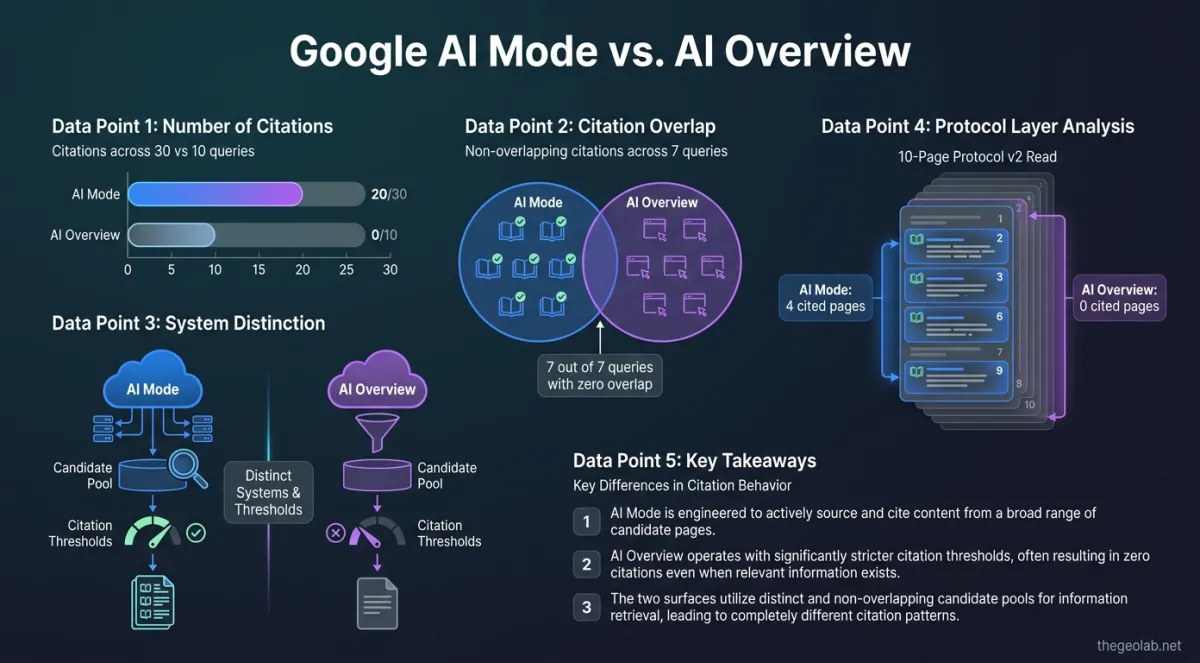
In a 30-query measurement, AI Mode cited thegeolab.net on 20 checks where AI Overview cited it on zero. The two surfaces never agreed on a single query.
Google AI Mode and AI Overview are separate citation surfaces. In the GEOSTACK-CONCEPT-R0 baseline (1 June 2026), AI Mode cited thegeolab.net on 20 of 30 checks (67%) while the inline AI Overview block cited it on 0 of 10. Across 7 cited queries, zero overlapped. A measurement reading only the AIO block reports a false zero for the surface where a site is strongest. The unit of measurement is the surface, not “Google.”
Google AI Mode and AI Overview: What We Measured
Google AI Mode and AI Overview cite different sources for the same query. In a fixed 30-query measurement run by The GEO Lab, AI Mode cited thegeolab.net on 20 of 30 checks while the inline AI Overview block cited it on 0 of 10. The two surfaces never agreed on a single cited query – 7 out of 7 cited queries showed zero overlap. They are not two windows onto one judgment; they are two systems with separate candidate pools and separate citation thresholds.
The GEO Lab ran the GEOSTACK-CONCEPT-R0 query set across two Google surfaces on 1 June 2026. AI Mode was queried at the serp/google/ai_mode/live/advanced DataForSEO endpoint; the AI Overview block was read from the standard SERP endpoint. AI Mode returned a usable response on 30 of 30 checks – full availability, no fallbacks or empty states.
The target was thegeolab.net’s concept pages – the GEO Stack layer pages the site is built around. The question was narrow and mechanical: for the same query, does Google’s chat-style AI Mode cite the same pages as the inline AI Overview that appears above classic search results? If the two surfaces shared one underlying citation decision, their cited sets would broadly intersect. The same cross-platform divergence pattern was first documented in the E042 cross-platform retrieval mechanism map, which established that each platform retrieves and cites independently.
The Result: 7/7 Non-Overlap
AI Mode cited the site on 20 of 30 checks (67%). AI Overview cited it on 0 of 10 (0%). Across every query where AI Mode produced a citation, the AI Overview block did not – 7 of 7 cited queries, zero intersection. There was no query where both surfaces cited, and no query where AIO cited but AI Mode did not.
A re-confirmation run on 14 June 2026 held the pattern. On a 10-page Protocol v2 read, AI Mode cited four pages – the GEO Stack hub page, the retrieval-probability page, the structural-authority page, and the system-memory page – where the AI Overview endpoint returned nothing readable for the same queries. The structural-authority page is a zero-citation page on Perplexity, yet AI Mode cited it. On the AI Mode surface, the same pages perform measurably better than a Perplexity-only or AIO-only view would ever report. This kind of surface-specific divergence is consistent with the T1/T2 citation gap documented across other platforms.
Why AIO-Only Measurement Reports a False Zero
A protocol that reads only the AI Overview block reports a false zero for the surface where a site is strongest. If The GEO Lab had measured AIO alone, it would have recorded 0% Google citation and concluded the GEO Stack pages were invisible to Google’s generative layer. AI Mode – citing those same pages at a 67% baseline rate – would have been entirely outside the measurement.
This generalises past one site. Any GEO measurement that treats “Google’s AI citations” as a single number, read from the AI Overview block, is blind to AI Mode. The two surfaces draw candidates and apply thresholds independently, so collapsing them into one metric averages away the surface that may be doing the citing. The correct unit of measurement is the surface, not “Google.” The same lesson was established for Perplexity vs ChatGPT in the noise-floor experiments, where platform-level variance made combined rates uninterpretable.
Key GEO Lab Takeaway
AI Mode and AI Overview are separate citation surfaces with zero overlap on 7 of 7 cited queries. A measurement reading only AIO would have reported 0% Google citation while AI Mode cited the same pages at 67%. The unit of measurement is the surface, not the platform. Any protocol that folds AI Mode into “Google AIO” is averaging signal into noise.
How to Measure Both Surfaces Correctly
Stamp surface identity from the endpoint you called, not from the response label. AI Mode self-reports its response as type="ai_overview" – the same label the inline AIO block uses. Trusting that field silently merges two distinct surfaces into one and reintroduces exactly the blindness the split was meant to remove. The endpoint is ground truth; the self-label is not.
The GEO Lab’s citation-check Protocol v2, effective 1 June 2026, adds AI Mode as a permanent, separately-reported surface and freezes the legacy combined score for backward comparability. Each surface is reported on its own line – Perplexity, AI Mode, AI Overview, ChatGPT – and never folded into a single rate. One practical caveat from the toolchain: the DataForSEO AIO endpoint frequently returns its citation payload asynchronously (asynchronous_ai_overview: true), so a blank AIO result should be logged as uninstrumented, not as a confirmed zero. The E030 fan-out results provide the per-query structure this protocol was built on.
Want to see how your site performs across AI Mode, AIO, and Perplexity? The GEO Lab’s 30-check citation protocol runs all surfaces and reports each separately.
What This Finding Does and Does Not Claim
The proven part is the divergence itself: AI Mode and AI Overview are independent citation surfaces, and AIO-only measurement is blind to AI Mode. That holds across the 1 June baseline and the 14 June re-confirmation. The 67% AI Mode citation rate is a single-baseline figure (R0), not yet a stable rate – magnitude needs replication across more dates before it should be quoted as a benchmark. The structural conclusion is solid; the specific percentage is provisional.
Frequently Asked Questions
Google AI Mode and AI Overview – are they the same system?
No. They are separate citation surfaces. In The GEO Lab’s GEOSTACK-CONCEPT-R0 run, the two surfaces cited zero queries in common – 7 of 7 cited queries showed no overlap. They draw candidate pages and apply citation thresholds independently, so a source cited in AI Mode is routinely absent from the AI Overview block for the identical query.
Why does measuring only AI Overview give a misleading result?
Because it ignores the surface where a site may be strongest. The GEO Lab measured 0% citation on AI Overview and 67% on AI Mode for the same pages. An AIO-only protocol would have reported the site as invisible to Google’s AI layer, when in fact AI Mode was citing it on two-thirds of checks.
How should AI Mode citations be tracked?
As their own reported surface, identified by the endpoint called. AI Mode self-labels its response as type="ai_overview", so identity must be stamped from the request endpoint, not the response field. The GEO Lab’s Protocol v2 reports AI Mode separately from AI Overview and keeps the two rates distinct rather than averaging them into one Google number.