
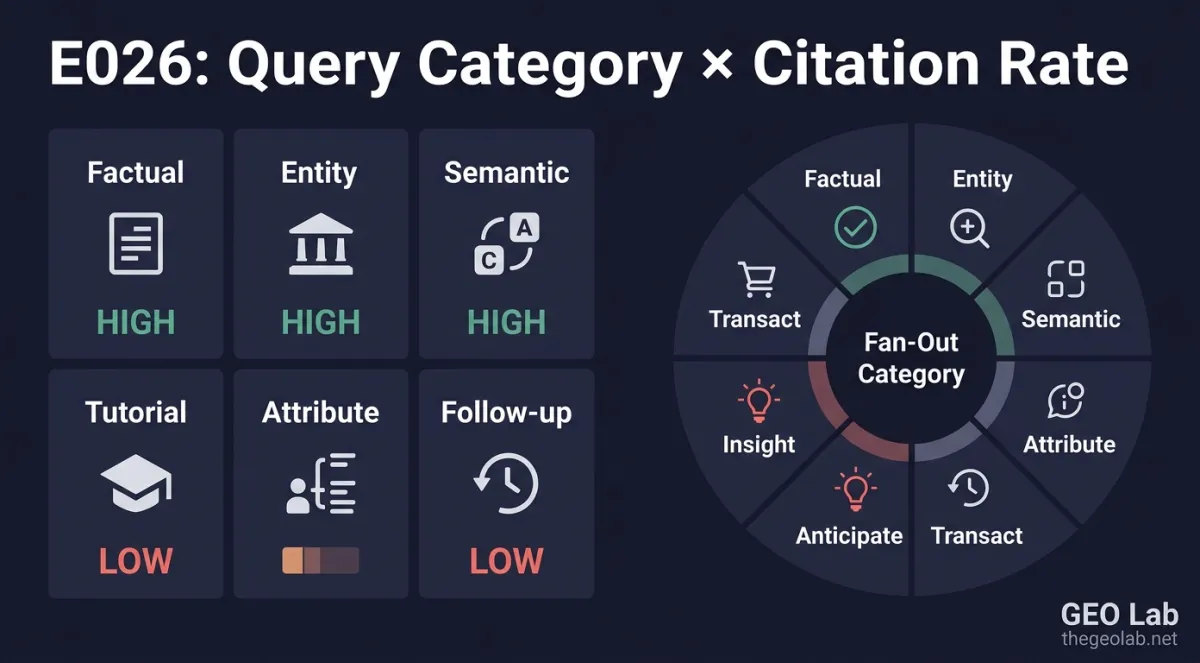
E026 tests whether query phrasing moves citation rate on a fixed page set. Five pages on thegeolab.net, frozen throughout. Ten fan-out categories from Pete Meyers’ BrightonSEO 2026 taxonomy, three queries each, 150 per day. Five consecutive days on Perplexity sonar-pro = 750 measurements. Prediction: Factual and Entity queries cite high; Insight and Anticipate queries cite at the noise floor. The gap maps which intent types reach the page set. If no pair clears 22.0pp, query phrasing is not a retrieval lever.
The question: does query phrasing move Perplexity citation rate?
I have spent a year changing pages and watching what AI search does next. Rewrite an opening. Add a schema block. Tighten an entity. Measure the citation rate, log it, move on. Every experiment so far has varied the page and held the question fixed.
E026 turns that around. The page set stays frozen and the question changes instead. The thing under test is whether the way someone phrases a query moves the citation outcome, when the page behind it does not change at all.
This is a pre-registration. The hypothesis, the null, the falsification criteria, and the full query set are committed here before the measurement window opens. Whatever the data says on the other side, this post is the record of what was predicted.
Pete Meyers’ fan-out taxonomy and how E026 uses it
AI search rarely answers the literal query you type. It expands a prompt into a small set of related sub-queries, runs retrieval against those, then synthesises. Dr Pete Meyers set out a public account of this at BrightonSEO in April 2026, in a talk called “The Infinite Tail”. His taxonomy sorts query expansion into ten intent categories: Semantic, Entity, Follow-up, Anticipate, Attribute, Factual, Tutorial, Compare, Insight, and Transact.
That taxonomy is a map of how a question can be framed. What it does not tell you is whether the framing changes the answer. If I ask a factual question and an interpretive question about the same page, does one get cited far more than the other? Or does the engine resolve both to the same underlying intent and cite at the same rate regardless?
E026 measures that gap on a fixed set of pages, using Pete’s ten categories as the structure.
GEO Lab research guides
Free ebooks covering citation measurement, the GEO Stack framework, and AI search optimisation for practitioners. Browse the library →
Five GEO Stack pages, two with zero citation history
Five pages on this site, all sharing the same declarative structure and comparable entity density:
- The GEO Stack: Five-Layer Framework
- Extractability — Designing Content for Machine Retrieval
- Retrieval Probability — The Core Variable of GEO
- Entity Reinforcement — Building Semantic Gravity in AI Search
- Structural Authority — Architecture That Signals Expertise
Three of these have a confirmed Perplexity citation history from an earlier baseline (E014, Month 2). The other two have never been cited. Including the uncited pages is deliberate. It lets E026 ask a second question alongside the first: can the right query category lift a page that has never been cited onto the cited list, or does a page either clear the authority bar or it does not, whatever the phrasing?
For each page, three queries per category across all ten categories. That gives 150 queries. Each one runs once a day for five consecutive days against the Perplexity sonar-pro API, which produces 750 measurements. The outcome for each is binary: the target page is cited, or it is not. A citation counts only when the response cites that exact page, with no partial credit.
Hypothesis: Factual and Entity queries cite high, Insight and Anticipate cite low
Citation rate on the fixed page set varies systematically by query category. Some categories cite near the ceiling this site reaches on proprietary-concept queries, around 80% in prior baselines. Others sit down at the E016 noise floor.
The pre-committed predictions:
- Factual and Entity queries cite high. They pull on direct attribute and identity matches, which these pages are built to answer.
- Insight and Anticipate queries cite low, near the noise floor. They ask for interpretive synthesis, which maps poorly onto declarative passage structure.
- The remaining six categories sit somewhere between, predicted in the 30 to 60% band before measurement.
There is a separate prediction for the two uncited pages. They are expected to stay near zero across every category. If a category lifts either one above the interpretability threshold, that is the headline finding: query intent alone can move a page that the authority gate has been keeping out.
Null (H0): all categories within the 22.0pp noise floor
All ten categories produce citation rates within 22.0 percentage points of each other. That threshold comes from E016, the noise floor study, which established that a result on this domain has to clear 22.0pp before it counts as signal rather than platform variance.
If the null holds, query category is not a retrieval lever here. The page gets retrieved or it does not, and shaping intent at the query level does nothing to the outcome.
Tests are Welch’s t per category pair at α = 0.05, with a Cohen’s d threshold of 0.5 for a medium effect.
Falsification criteria for E026
These are fixed now so the result cannot be reinterpreted later to fit whatever lands.
- Differential citation map. At least two categories separated by 22.0pp or more from at least two others. This confirms H1 and produces an interpretable map of which intent types reach the page set.
- Bimodal split. Categories cluster into a high band and a low band, the gap between bands clears 22.0pp, and the spread inside each band stays under it. This points to a binary retrievable-or-not boundary rather than a smooth gradient.
- Inverse pattern. Insight or Anticipate cite higher than Factual or Entity. This falsifies the assumption that declarative pages favour direct-match queries, and would suggest interpretive queries travel a different retrieval path.
- All-null. No category pair separated by 22.0pp. Reported as a null result. Query phrasing on its own is not a retrieval lever for this page set on Perplexity.
Query construction: 150 queries, no brand, 6–12 words
The 150 queries were authored against a fixed set of construction rules, then frozen before this post went live:
- Each query contains at least one concept distinctive to its target page.
- No brand is named in any query. Brand-aware phrasing is held back for a later experiment.
- Length is held between six and twelve words across the whole set, so query length cannot leak in as a hidden variable. Length is studied on its own in E030.
- Each query is assigned to one category at authoring time, and that assignment is locked. No query gets reclassified once the data is in.
The full frozen query set is published in the replication package: github.com/arturseo-geo/geo-lab-experiments/tree/main/e026.
A note on the record
E026 was first scheduled for late May and was never deployed. No runner, no output, no measurements. That window is void, and I have logged it as such rather than quietly reusing the date. The design did not change, but the freeze had never been written to a file, so there was nothing to carry forward. This pre-registration, and the query set frozen with it, are dated to now. The measurement window opens the day after publication and runs five consecutive days, targeting 9 to 13 June 2026.
I would rather publish the honest version a few days late than pretend a freeze happened when it did not. The whole point of pre-registration is that the prediction comes first.
What comes after E026
The result post publishes once the window closes, whichever way the data falls. Positive, null, or somewhere odd in between, it goes up. The dataset lands on Zenodo with a DOI, matching how the other experiments here are archived.
The taxonomy that frames this work is Pete Meyers’ from BrightonSEO 2026. The contribution here is the measurement against it: per-page, per-category citation rates on a fixed page set, with the prediction committed in advance and a noise floor to judge it against.
- E026 is the first prompt-side variable test in the GEO Lab portfolio. All prior experiments varied the page; this one varies the query.
- 150 queries across ten fan-out categories (Pete Meyers, BrightonSEO 2026), three per category per page, five pages, five days = 750 Perplexity measurements.
- Prediction: Factual and Entity cite high; Insight and Anticipate cite at the noise floor. The two never-cited pages stay at zero unless a category can overcome the authority gate.
- Falsification threshold: 22.0pp (E016). If no category pair clears it, query phrasing is not a retrieval lever on this page set.
Frozen query set and replication package. The full 150-query taxonomy is published at github.com/arturseo-geo/geo-lab-experiments/e026. The measurement window runs five consecutive days on Perplexity sonar-pro. Results post follows regardless of outcome.
Questions about the methodology or design? Contact The GEO Lab.