
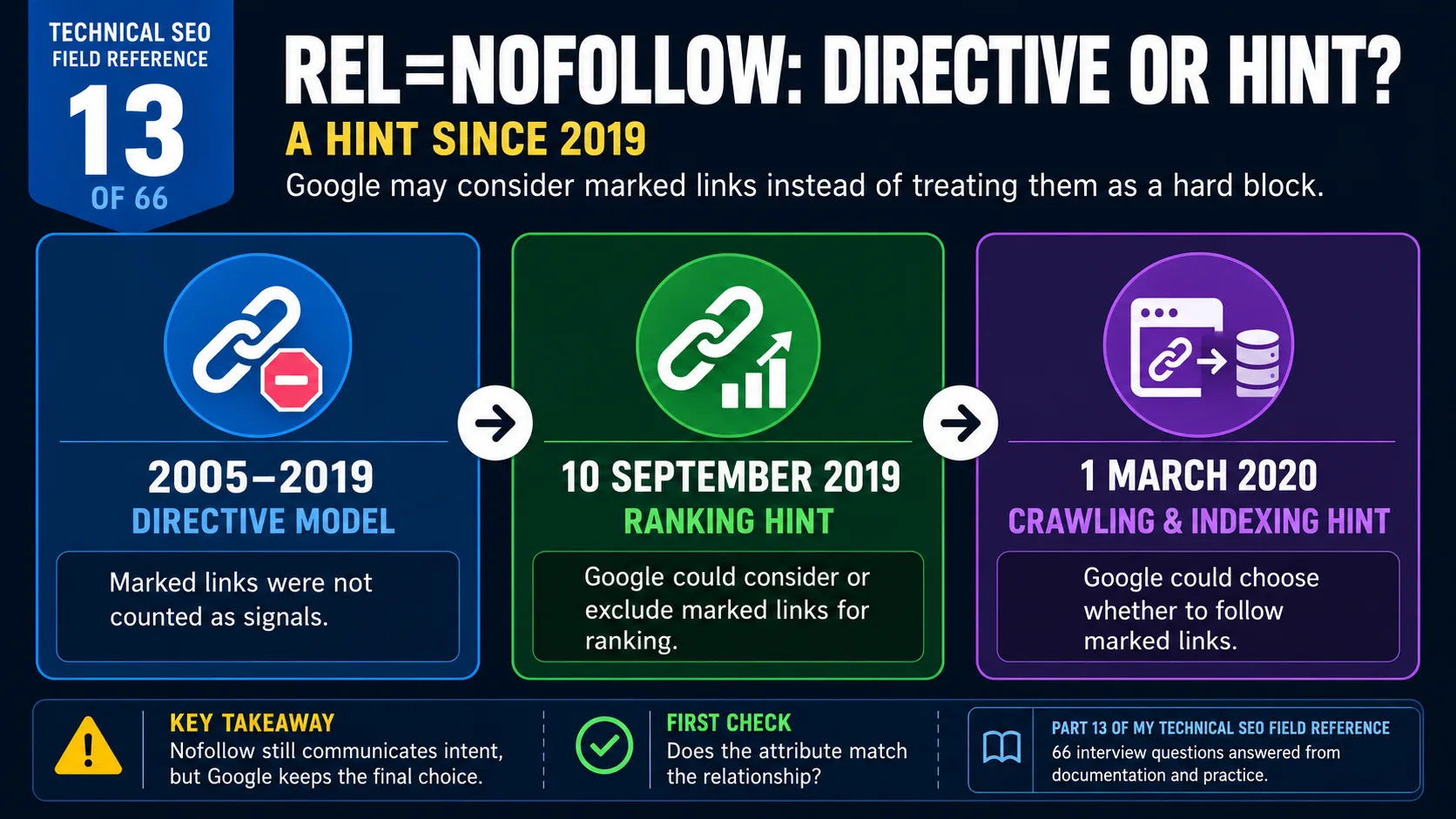
Technical SEO Field Reference, Question 13 of 66. The nofollow hint question, checked against what Google currently documents.
A hint since September 2019, not a directive. For 14 years, nofollow instructed Google not to count a link as a ranking signal at all. Since 2019, nofollow, sponsored and ugc are all treated as hints Google may use when deciding which links to consider for ranking, crawling and indexing. The nofollow hint model means Google generally continues to treat marked links as before, but now reserves the option to use them when its systems find that useful (Google Search Central Blog, 10 September 2019).
This is the older cousin of the canonical hint question, and the two get confused constantly. Where canonicals have long been described as a preference, nofollow genuinely changed status: it was a hard directive, then Google changed it. Candidates who learned SEO before 2019, or who learned it from material written before 2019, often still answer this one wrong without realising the ground moved under them.
Why the nofollow hint change matters
nofollow used to be a directive, which is why so many experienced SEOs still answer this question incorrectly. Google introduced the attribute in 2005 and, for roughly 14 years, did not count marked links as signals in its search algorithms.
That changed in 2019. Anyone who learned the old rule and never revisited it is working from a definition Google no longer uses. This is also where nofollow gets confused with canonicalisation. Canonicals have long been treated as preferences; nofollow went through a documented change from directive to nofollow hint.
What Google says about the nofollow hint
Google’s Search Central Blog announcement from 10 September 2019 changed how the nofollow attribute, alongside the newer sponsored and ugc attributes, is treated. In Google’s own words: “All the link attributes – sponsored, ugc, and nofollow – are treated as hints about which links to consider or exclude within Search.”
Before that change, a link marked nofollow was not counted as a signal at all in Google’s algorithms. After it, nofollow (and sponsored, and ugc) became something Google may still take into account, alongside other signals, when it decides how to analyse and use links.
The rollout had two dates. The nofollow hint treatment for ranking purposes applied from the announcement itself on 10 September 2019. The hint treatment for crawling and indexing purposes – meaning Google could choose to crawl a nofollowed link it previously would not have touched – took effect from 1 March 2020.
The interview answer
A nofollow hint, not a directive. Google changed nofollow to a hint for ranking in September 2019 and extended the hint treatment to crawling and indexing on 1 March 2020. For 14 years before that, nofollow instructed Google not to count a marked link as a ranking signal at all. Google has said the practical impact on most existing nofollow links is small, but the underlying mechanism changed.
A real-world example
A publisher’s comment section auto-applies rel="nofollow" to every outbound link users post, a standard anti-spam pattern going back to when nofollow was introduced for exactly that purpose.
Under the old directive model, none of those links passed any signal, full stop. Under the nofollow hint model, Google could, in principle, still crawl one of those comment links and factor it into how it understands the linked page or detects unnatural linking patterns, even though it is very unlikely to hand it ranking weight as an endorsement.
The practical takeaway I give clients: nofollow is still the right tool for flagging comment spam, paid links, or content you do not want to vouch for. It has not stopped doing its main job. What changed is that Google reserves the ability to look past it in specific cases, rather than never being able to see the link at all.
This connects to how directives and hints differ across technical SEO more broadly. A noindex meta tag is a directive – Google must honour it. A robots.txt block is also a directive at the crawling stage. But nofollow and canonical tags sit in the hint category: Google considers them strongly but reserves the right to override.
How the nofollow hint works with sponsored and ugc
The three attributes – nofollow, sponsored, ugc – are combinable. Google explicitly supports stacking them, for example rel="ugc sponsored" for a link that is both user-generated and paid, or rel="nofollow ugc" for backwards compatibility with systems that only understand the older attribute. None of this requires retrofitting existing nofollow markup; Google’s own outbound link qualification guidance states there is no need to change nofollow links already in place.
The reasoning Google gave for the change: links carry information beyond pure endorsement, including how surrounding words describe the linked content, and seeing the full link graph (rather than discarding nofollowed links entirely) helps Google understand unnatural linking patterns. Discarding the links outright meant losing that information.
Existing nofollow markup does not need to be replaced. Google still accepts it for paid links, although sponsored is preferred, and it remains valid for user-generated links where ugc could also be used. This matters for large sites with years of legacy markup: the nofollow hint change does not create a migration requirement.
The interview trap
The first trap is answering “directive” from memory because that was true for most of nofollow‘s history, and it is still the version taught in a lot of older SEO material. The 2019 change is now several years old, but it still catches candidates who learned the concept before the change and never updated the answer.
A second-order trap: assuming the nofollow hint means marked links now pass full ranking value like a normal link. They do not. Google has said it generally continues to treat nofollowed links as it did before for ranking purposes – the difference is Google now retains the option to use them as a signal in specific cases (crawling, indexing, spam pattern detection), not that nofollow has become decorative.
The final trap is treating nofollow as an indexing control. If you need to keep a page out of Google, use noindex on a crawlable page. If you need to stop crawling on your own site, use robots.txt. The nofollow hint qualifies a link relationship; it does not control whether the destination gets indexed.
Takeaway
The wrong question is “Does nofollow block all value?” The better question is “Does the attribute still communicate what I intend?” For paid links, user-generated content and links you do not want to vouch for, the answer is yes. The nofollow hint model changed the mechanism, not the practical guidance.
Have questions about this topic? Contact The GEO Lab · Return to homepage
Have questions about this topic? Contact The GEO Lab · Return to homepage