
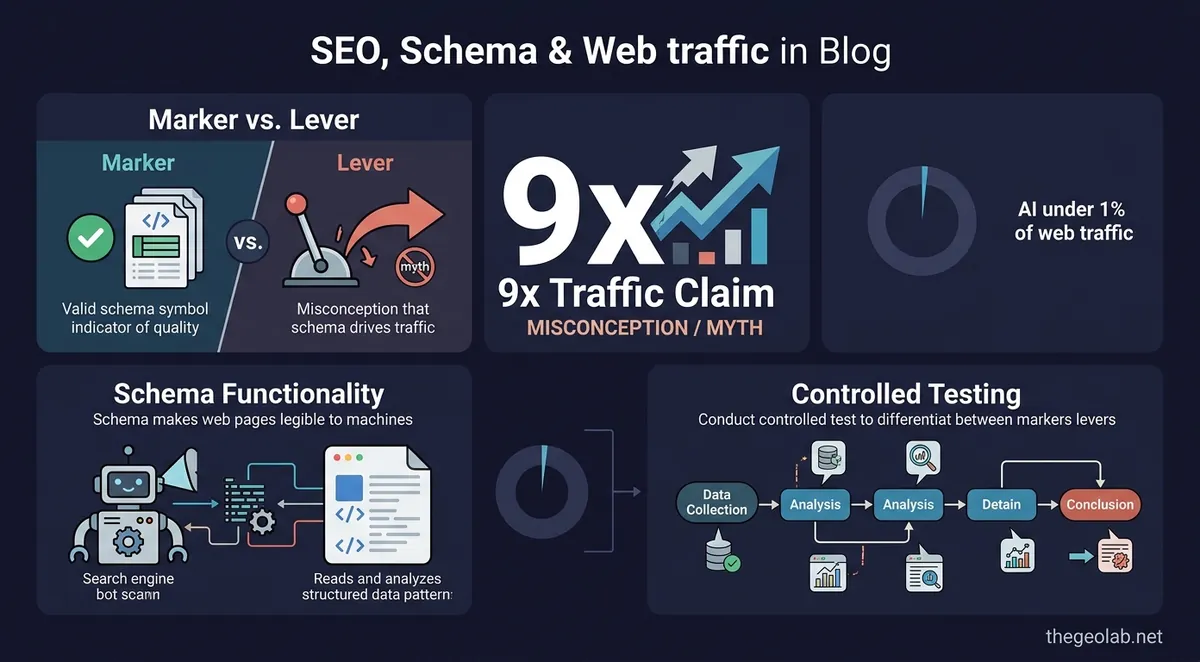
The marker not lever distinction: Wix reports that sites with valid structured data get 9x more traffic. The number is probably real. The causal claim underneath it is not, and the report contradicts itself two sections later.
TL;DR
The marker-not-lever distinction is the difference between a variable that predicts an outcome and a variable that causes it. Valid structured data is a marker of a competently maintained site, not a lever that produces traffic. The widely quoted 9x figure from Wix’s State of Websites report is an uncontrolled comparison: sites with passing schema also have budgets, developers, internal linking, and dozens of other variables that independently predict traffic. The same report states that AI engines account for under 1% of traffic. The measurement variables guide explains what citation rate actually measures in its sample, so the statistic cannot be evidence that schema drives AI visibility. Schema makes pages legible to machines, which is a real benefit. It is a different benefit from traffic, and it operates on a different surface from the one where the citation decision gets made.
The marker not lever distinction
The marker-not-lever distinction applies directly to the most quoted statistic in the structured data debate, and the marker not lever frame applies directly. Sites with structured data that passes Google’s rich-results inspection get nine times more traffic than sites without it. That figure comes from Wix’s State of Websites report, drawn from a user base of more than 300 million. It is almost certainly an accurate description of what Wix found in its own data.
It is also not evidence that structured data causes traffic. Valid schema is a marker of a competent operator, not a lever that operators pull. Strip out a single control variable and most of that ratio disappears, because the kind of site that ships passing structured data is also the kind of site that has a budget, a process, and forty other things going right at the same time.
This post is not a criticism of Wix’s data collection. It is a criticism of what the number gets used to argue, including by people with no commercial stake in it at all.
A marker is a variable that reliably co-occurs with an outcome without producing it. A lever is a variable that, when you move it, moves the outcome. Markers are enormously useful for prediction and useless for intervention. If you want to guess which sites in a sample get the most traffic, “has passing structured data” is a strong predictor. If you want to get more traffic, the question is entirely different: what happens when a site that would not otherwise have deployed valid schema deploys it?
The report cannot answer that question, and it does not claim to. Its readers do.
The distinction matters because almost every popular statistic in this field is a marker presented in the grammar of a lever. The sentence “sites with X get more Y” is a correlational statement. The sentence readers hear is “do X, get Y.” The gap between those two is where an entire consulting practice lives.
Going deeper? The GEO Experiments ebook covers how to design controlled tests that distinguish markers from levers, including the noise floor that determines when an effect is real.
What the marker not lever test requires for 9x to be causal
Consider what a site must have in place for its structured data to pass Google’s rich-results inspection.
Someone had to know that rich results exist. Someone had to identify the correct schema type, implement it, and validate it against a testing tool. On most platforms that means either a developer, an SEO specialist, or a paid plugin, and on all platforms it means someone was paying attention to technical search performance in the first place.
Now ask what else is true of a site that cleared that bar. It has an owner who invests in the site rather than abandoning it after launch. It probably has a custom domain, published content, working analytics, and internal linking. It has been around long enough for someone to get to the schema.
Every one of those is independently associated with traffic. None of them is controlled for. The comparison is not “site with schema versus identical site without schema.” It is “actively maintained site versus neglected site,” and schema is one of the more visible ways to tell those two apart from the outside.
Nine times is not the effect of the markup. It is roughly the size of the gap between a site someone works on and a site someone does not.
The report contradicts the marker not lever reading two sections later
Here is the part that should stop anyone from quoting the figure as a GEO argument.
The same report states that large language models account for under 1% of traffic to sites in its sample. Search accounts for around 42% and direct for around 40%.
So the structured-data statistic, whatever it measures, is overwhelmingly measuring traffic that did not come from an AI engine. It cannot be evidence that schema drives AI visibility, because AI is not where the traffic in the number came from. It is a claim about rich results in classic search, which is what “passes Google’s rich-results inspection” was always about.
The llms.txt statistic has a narrower version of the same problem. It is reported for eCommerce sites specifically, which is a segment with its own confounds, and it credits a file with a fourfold traffic difference in a dataset where the traffic that file could plausibly affect is under one percent of the total. Whatever produced that ratio, it was not the machine-readable summary steering AI agents, because the AI agents are not sending the traffic.
Both numbers are being cited in GEO discussions as proof that GEO tactics work. The document they come from says, in its own words, that AI is not yet sending meaningful traffic.
The marker not lever incentive problem, including mine
Wix generates llms.txt files automatically and sells structured-data tooling. That is not a scandal, and it does not make the data false. Vendor research is often the only research that exists at this scale, and a company with 300 million users has a dataset no independent researcher can replicate. Read it, and discount knowingly.
The harder version of this test is closer to home. I build websites for trades businesses. Schema is part of what I deploy, and “structured data gets you nine times the traffic” is a sentence that would sell that service extremely well. It is sitting right there, sourced to a household-name platform, ready to drop into a proposal.
Declining to use it is the point of this post. A number that flatters you is exactly the number you should check hardest, and if I would not accept this study design from someone arguing against my interests, I cannot cite it when it argues for them.
What the marker not lever frame preserves
Structured data makes a page legible to machines. That claim is well supported and worth acting on. It is the difference between a machine parsing your business as an entity with properties and a machine parsing a wall of text.
Legibility is a real benefit. It is a different benefit from traffic, and it operates on a different surface from the one where the citation decision gets made. A page can be parsed perfectly and cited nowhere.
The defensible claim is that schema makes you legible. The indefensible one is that schema multiplies your traffic. The first is a mechanism you can reason about. The second is a marker wearing a lever’s clothes.
If you want to know whether structured data moves your traffic, the only design that will tell you is a controlled one: comparable pages, one variable changed, an effect large enough to clear the noise in your own measurements. That study is easy to run. It is merely harder than quoting someone else’s ratio.
Valid structured data is a marker of a competent operator, not a lever that produces traffic. The GEO framework treats schema as legibility, not ranking signal. The 9x figure is an uncontrolled comparison that confounds schema with every other property of a maintained site.
The marker not lever reading of the same report shows AI engines account for under 1% of traffic. The measurement variables guide explains what citation rate actually measures. The marker not lever distinction is why the statistic cannot be evidence for GEO when the traffic it measures did not come from AI.
Schema makes pages legible to machines. That is a real, defensible benefit. It is not the same benefit as traffic, and the only way to know whether it moves your numbers is a controlled test on your own site. The probe query taxonomy shows how to design one.
Ready to test this? The controlled testing framework shows how to isolate a single variable and measure whether it clears the noise floor. See the AI Visibility Diagnostics Console for retrieval-side signals.
Questions? Contact The GEO Lab.
Marker Not Lever: Frequently Asked Questions
Does structured data increase website traffic?
There is no controlled evidence that adding structured data to an otherwise unchanged page increases its traffic. Reported associations between valid schema and higher traffic come from uncontrolled comparisons in which the schema is a marker of an actively maintained site rather than the cause of the traffic.
Is the Wix 9x structured data statistic reliable?
The figure is a real description of Wix’s own dataset and there is no reason to doubt the measurement. It does not support a causal claim, because sites with valid rich-results markup differ from sites without it on many other variables that independently predict traffic, none of which are controlled for.
Does llms.txt improve AI visibility?
No controlled test has demonstrated that it does. The frequently quoted association between llms.txt and higher traffic is drawn from eCommerce sites in a dataset where AI engines account for under 1% of all traffic, so the traffic difference is not attributable to AI agents reading the file.
What is the difference between a marker and a lever?
A marker is a variable that predicts an outcome without causing it. A lever is a variable that changes the outcome when you change it. Most quoted statistics in search and AI visibility describe markers while being read as levers. The marker-not-lever distinction is the test that separates correlation from intervention.
Should I add schema to my website?
Yes, because structured data makes your content legible to machines and removes ambiguity about what your business is. Expect legibility rather than a traffic multiplier, and treat any promised ratio from an uncontrolled study as a description of who deploys schema rather than what schema does.