
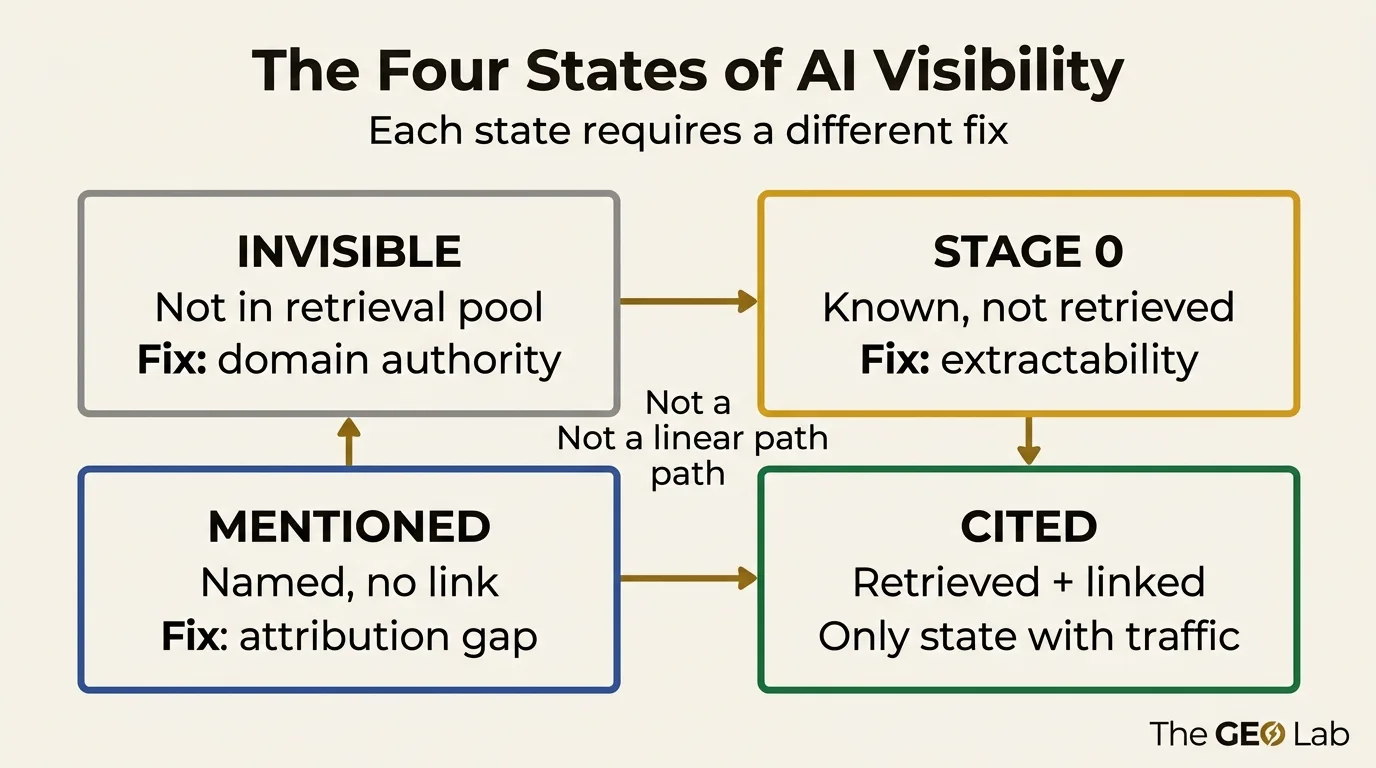
Most sites think they have one AI visibility problem. They actually have four — each with a different cause and a different fix. Here is how to tell which one you have.
TL;DR
AI visibility is not a single metric. A site can be invisible to AI platforms, known but not retrieved, referenced by name without a link, or cited with a clickable source. These are four distinct states — not a spectrum. Each requires a different diagnostic and a different response.
As of May 2026, most GEO dashboards conflate mention rate and citation rate into one number. That number is not useful. This post gives you the framework to separate them.
Why One “AI Visibility” Metric Fails
When I started running citation checks across Perplexity, Gemini, and ChatGPT, I assumed I was measuring one thing. A site was either visible to AI platforms or it wasn’t.
The data said otherwise. In the E002 experiment, Gemini referenced thegeolab.net in 21.2% of responses across 160 queries. Citation rate: 0%. Perplexity cited the site in 20–25% of queries and mentioned it zero times. ChatGPT surfaced neither a citation nor a mention. Same site, same content, same queries — three completely different outcomes on the same day.
This mirrors the platform divergence that Search Engine Land documented in their GEO analysis. If you aggregate those into a single visibility score, you get a number that is impossible to act on. The problem causing a 0% Gemini citation rate is not the same problem causing a 0% ChatGPT citation rate. Treating them as equivalent means every fix attempt is aimed at the wrong target.
The four-state model exists because the evidence demands it. Each state has a different observable signal, a different underlying mechanism, and a different set of interventions that can move it.
The Four States, Defined
The four AI visibility states are defined by what AI platforms do — or don’t do — when processing queries relevant to your content. They are observable, measurable, and distinct. As of May 2026, no GEO tool tracks all four separately by platform; most track only citation rate, and some conflate citation and mention.
State 1 — Invisible
Signal: Zero citations, zero mentions across all queries.
The platform’s retrieval process does not surface the domain in any form. The site is either absent from the web index the platform draws from, below the authority threshold for retrieval, or structurally inaccessible to AI crawlers.
State 2 — Stage 0
Signal: Domain known, pages not retrieved. No mentions, no citations, but the domain appears in platform knowledge base checks.
The platform is aware the site exists but does not retrieve specific pages in response to queries. Google AIO surfacing a brand name without passage-level retrieval is a Stage 0 signal.
State 3 — Mentioned
Signal: Brand or domain name appears in AI response, no clickable source link.
Content is being processed as a background knowledge signal. The platform synthesises from it but does not attribute with a link. Generates no referral traffic. Gemini is the primary producer of this state.
State 4 — Cited
Signal: Named source link to a specific page in the AI response.
The platform retrieved the page and attributed the content with a direct link. The only state that generates referral traffic from AI platforms. Perplexity is currently the most reliable producer of this state.
These states are not a progression — a site does not move through them in order. A site can reach the Cited state on Perplexity while remaining Invisible on ChatGPT. Platform architecture determines which states are reachable, not content quality alone.
State 1 — Invisible: The Retrieval Pool Problem
Invisible means the platform returned no signal of any kind. Not a mention, not a citation, not a background reference. The site did not participate in the AI response in any detectable form.
This is a retrieval pool problem, not a content quality problem. AI platforms draw from a web index when generating responses — for Perplexity and ChatGPT, this is a live web search; for Gemini, it is a grounding index. If a domain is not in that pool, no amount of content optimisation changes the outcome. The platform cannot cite a page it cannot retrieve.
In the E002 experiment, ChatGPT returned zero citations and zero mentions across 160 queries targeting content thegeolab.net had published on those exact topics. This was not a schema problem or a structural problem. A site with a limited backlink profile and fewer than six months of domain age was simply not in ChatGPT’s web search retrieval pool at that point.
The diagnostic for an Invisible site is not “what content am I missing?” It is “why is this domain not surfacing in the web search results the platform draws from?” Those are different questions with different answers.
Diagnostic: Is your site Invisible?
Run 10–20 queries on your exact proprietary terminology — terms nobody else uses — across ChatGPT, Perplexity, and Gemini. If your brand name and unique concepts produce zero responses mentioning your domain, the site is in the Invisible state on that platform.
Cross-reference with: backlink profile, domain age, crawl coverage in Nginx logs, and whether AI crawlers (GPTBot, PerplexityBot, ClaudeBot) appear in your server logs at all.
What moves this state: domain authority accumulation (backlinks from established domains), crawl access (no robots.txt blocks on AI crawlers), and time — new domains require index inclusion before any other optimisation matters.
State 2 — Stage 0: Known but Not Retrieved
Stage 0 is the least discussed state and the hardest to detect. The platform is aware the site exists — it appears in the platform’s knowledge base — but specific pages are not being retrieved and included in responses to relevant queries.
The clearest signal of Stage 0 is Google AI Overviews surfacing a brand name in the “mentioned sources” section without linking to a specific page or using passage-level content. The platform knows the brand exists and associates it with the topic. It is not pulling from the content.
Stage 0 is the transition zone between invisible and visible. A site exits the Invisible state when AI crawlers begin indexing it. It exits Stage 0 when the platform begins retrieving specific pages — not just recognising the domain — in response to relevant queries.
Stage 0 is important to track separately because it tells you the retrieval pool problem is solved — the domain is known — but a different problem exists. The bottleneck has shifted from indexing to retrieval signal strength: topical authority, extractability, entity clarity, or structural authority within the GEO Stack.
A site publishing its first GEO-optimised content will often pass through Stage 0 before reaching Mentioned or Cited. The Month 0 baseline methodology exists partly to document the Stage 0 starting condition so that subsequent movement has a measured reference point.
What moves this state: topical depth (multiple pages on the same concept cluster), extractability improvements (declarative sentence structure, consistent component patterns), and entity reinforcement (consistent entity naming across pages).
State 3 — Mentioned: The Attribution Gap
The Mentioned state is where most GEO measurement frameworks break down. A site in the Mentioned state is producing visible AI responses — its brand name appears, its concepts are referenced — but no link is generated. A reader seeing the AI response has no path back to the original content.
Gemini is the primary producer of the Mentioned state as of 2026. Its grounding mechanism processes content as a knowledge signal and synthesises answers from that signal without necessarily surfacing the source page as a citation. In the E002 experiment, Gemini mentioned thegeolab.net in 21.2% of responses while producing zero citations — the most extreme example of the Mentioned state in the GEO Lab dataset.
The Mentioned state is an attribution problem, not a retrieval problem. The content has already crossed the retrieval threshold — it is being used. The failure is in the attribution step: the platform is not crediting the source with a link.
The GEO Workbook: 30-Day AI Visibility Action Plan
Covers how to audit your current visibility state across platforms, track movement between states, and prioritise the right interventions at each stage. Download free →
This distinction matters because the standard GEO advice — improve content structure, add entity schema, increase extractability — addresses the retrieval problem. It does not address the attribution problem. A site in the Mentioned state on Gemini is not failing at content quality. Applying content quality improvements to a Mentioned site targeting Gemini citations will produce no measurable change in citation rate.
What moves this state: on Gemini, there is currently no reliable on-page fix for moving from Mentioned to Cited. Gemini’s grounding redirect mechanism returns unresolvable URLs rather than direct source links even when attribution does occur. On other platforms, moving from Mentioned to Cited responds to backlink authority and domain age — the same signals that drive web search ranking.
State 4 — Cited: The Only State That Drives Traffic
The Cited state is when a platform retrieves a specific page and includes it as a named source link in the AI response. The source is visible, clickable, and attributable. This is the only AI visibility state that generates referral traffic.
Perplexity is the most reliable producer of citations as of May 2026. Its retrieval architecture runs a live web search and surfaces source links directly — when it retrieves a page, it cites it. In the E002 experiment, Perplexity produced citation rates of 20–25% on GEO-specific queries against thegeolab.net, with zero background mention rate. Either it retrieved and cited, or it did not retrieve at all.
Google AI Overviews produce citations differently. The citation appears as a numbered source beneath the synthesised answer. According to recent SEO studies, pages cited in AI Overviews receive 35% more organic clicks than non-cited pages at the same ranking position — the citation amplifies click-through rate rather than replacing it.
ChatGPT produces citations via its web search tool, but the retrieval pool problem documented in E002 — new domains with limited authority not surfacing in ChatGPT’s web search — means ChatGPT citations are harder to earn on newer sites than Perplexity citations at equivalent content quality.
What moves this state: all GEO Stack layers contribute — retrieval probability, extractability, entity reinforcement, structural authority, and system memory. Of these, retrieval probability and extractability have the most direct evidence from GEO Lab experiments. The Retrieval Probability page covers the specific signals that raise the likelihood of reaching the Cited state on Perplexity and Google AIO.
The Four States Side by Side
The table below maps each state to its observable signal, the underlying mechanism that produces it, which AI platforms most commonly produce it, and the primary intervention that can move the site forward. As of May 2026, no single AI visibility tool tracks all four states separately across all platforms.
| State | Observable signal | Mechanism | Primary platform | Traffic | Primary fix |
|---|---|---|---|---|---|
| Invisible | Zero citations, zero mentions | Not in retrieval pool | ChatGPT (new domains) | None | Domain authority, crawl access, index inclusion |
| Stage 0 | Brand known, no page retrieval | In index, below retrieval threshold | Google AIO (early stage) | None | Topical depth, extractability, entity reinforcement |
| Mentioned | Brand/domain name in response, no link | Attribution gap — content used, not credited | Gemini | None | No reliable on-page fix (Gemini); backlinks elsewhere |
| Cited | Named source link in response | Retrieved and attributed | Perplexity, Google AIO | Yes | Full GEO Stack: retrieval probability + extractability first |
State definitions based on GEO Lab experimental data, May 2026. Platform assignments reflect dominant patterns — states can occur on any platform.
A second comparison that matters for measurement: how each state relates to the metrics GEO tools typically track.
| State | Counted as “AI visible”? | Counted in citation rate? | Counted in mention rate? | Drives traffic? |
|---|---|---|---|---|
| Invisible | No | No | No | No |
| Stage 0 | Sometimes | No | No | No |
| Mentioned | Often yes | No | Yes | No |
| Cited | Yes | Yes | Sometimes | Yes |
Tools that aggregate mention rate and citation rate into a single “AI visibility” score will show Mentioned sites as visible, with zero traffic to show for it.
How to Diagnose Your Current State
Diagnosing which state a site is in requires running structured citation checks across platforms and interpreting the results against each platform’s architecture. The 30-check citation protocol used at The GEO Lab runs 10 queries across three platforms and records citation, mention, and zero-response outcomes separately.
Step 1 — Run 10 queries per platform
Run your exact proprietary terminology across Perplexity, Gemini, and ChatGPT. Record whether each response produces a citation (source link), a mention (brand name, no link), or no signal.
No signal on any platform → Invisible. The retrieval pool problem is unsolved. Address domain authority and crawl access before any content optimisation.
Step 2 — Check for mentions (no link)
Mentions present, no source link → Mentioned (or Stage 0 if only a knowledge panel reference with no page retrieved). On Gemini, no reliable on-page fix currently converts mentions to citations. On Perplexity and ChatGPT, backlink authority is the primary lever.
Step 3 — Check for source links
Named source link in the response → Cited. This is the only state that generates referral traffic. Track consistency across five consecutive days — single-day platform variance is ±4–6 percentage points on Perplexity. A site can be in different states across platforms simultaneously.
Run this diagnostic per platform — the same site can be Invisible on ChatGPT, Mentioned on Gemini, and Cited on Perplexity simultaneously.
Three practical diagnostics, one per state transition:
Invisible → Stage 0: crawl access check
Run grep -i "GPTBot|PerplexityBot|ClaudeBot" /var/log/nginx/access.log | wc -l on your server logs. Zero results after 30 days of the site being live indicates AI crawlers are not accessing the site — robots.txt block, noindex, or crawl budget problem.
Stage 0 → Mentioned/Cited: entity recognition check
Query your proprietary terminology directly on each platform: “What is [your brand name]?”, “What is [your proprietary framework]?”. If the platform draws a blank or produces generic responses, entity recognition has not crossed the threshold — the domain is in the index but not associated with specific concepts in the retrieval layer.
Mentioned → Cited: platform routing check
If Gemini mentions without citing, no on-page action currently resolves this — it is an architectural limitation of Gemini’s grounding mechanism. If Perplexity or ChatGPT mentions without citing, this indicates the content is known but below the citation confidence threshold — backlink authority and page-level extractability are the primary levers.
What the GEO Lab Data Shows
The four-state model emerged from observing platform behaviour across multiple experiments. The cleanest illustration of the states is the E002 data, which captured three different states simultaneously on the same site on the same day.
Perplexity produced citations at 20–25% and zero mentions. ChatGPT produced zero citations and zero mentions. Gemini produced zero citations and 21.2% mentions. On a single site, three platforms, three different states: Cited (Perplexity), Invisible (ChatGPT), Mentioned (Gemini).
The E016 noise floor experiment established that citation rate on Perplexity varies by approximately ±4–6 percentage points across consecutive days with no content changes — which means state transitions need to be measured across multiple days before being treated as real movement. A single-day measurement cannot reliably distinguish a genuine state change from platform variance.
As of May 2026, the GEO Lab site is in the following states: Cited on Perplexity (consistent), Stage 0 / Mentioned on Gemini (mentions present, no citations), and Invisible on ChatGPT (no signals across any queries). The Month 0 baseline and subsequent measurements track movement across all three platforms separately — not as an aggregate.
Frequently Asked Questions
What are the four states of AI visibility?
The four states are Invisible (no signal of any kind from the platform), Stage 0 (the domain is known to the platform but specific pages are not being retrieved), Mentioned (the brand or domain name appears in AI responses without a source link), and Cited (a named source link to a specific page appears in the AI response). Only the Cited state drives referral traffic. Each state has a different cause and a different fix.
What is Stage 0 visibility in AI search?
Stage 0 is the state where an AI platform is aware a domain exists but does not retrieve specific pages in response to relevant queries. The clearest signal is Google AI Overviews surfacing a brand name in a “mentioned sources” or knowledge panel context without linking to a page or using passage-level content. Stage 0 indicates the retrieval pool problem is solved — the domain is indexed — but the content has not crossed the threshold for page-level retrieval. Topical depth, extractability, and entity reinforcement are the primary interventions for moving from Stage 0 to Mentioned or Cited.
Why does Gemini mention sites without citing them?
Gemini’s grounding mechanism processes content as a knowledge signal and synthesises answers from that signal without necessarily surfacing the source page as a named citation link. This is structurally different from Perplexity’s retrieval model, which runs a live web search and cites the pages it retrieves. In GEO Lab E002 data, Gemini produced a 21.2% mention rate and 0% citation rate across 160 queries on the same site. This is an attribution problem, not a retrieval problem — the content is being processed, not credited. There is currently no reliable on-page fix for converting Gemini mentions to citations.
Can a site be in different states on different AI platforms?
Yes — this is common and expected. Platform architecture determines which states are reachable. Perplexity produces citations from live web search; Gemini produces mentions via grounding; ChatGPT requires domain authority to enter its retrieval pool. The same site can be Cited on Perplexity, Mentioned on Gemini, and Invisible on ChatGPT simultaneously. This is why per-platform measurement is required — aggregate AI visibility scores conflate incompatible signals.
How do you measure which visibility state you are in?
Run 10–20 queries on your proprietary terminology across Perplexity, Gemini, and ChatGPT. Record whether each response returns a citation (named source link), a mention (brand name without a link), or no signal. A zero-signal result indicates Invisible. A mention-only result indicates Mentioned or Stage 0. A citation result confirms Cited. Repeat across five consecutive days before concluding on state, as platform variance (±4–6 percentage points on Perplexity per the E016 noise floor data) can produce false readings from single-day measurements.
Tracking your AI visibility state? The GEO Lab publishes monthly citation rate data and state-change observations across Perplexity, Gemini, and ChatGPT. See the Brand Citation Index →
Key Takeaway
AI visibility is four distinct problems, not one. Each state requires a different diagnostic and a different intervention.
- Invisible: fix retrieval pool access before optimising anything else
- Stage 0: fix topical depth and extractability to cross the retrieval threshold
- Mentioned: recognise the attribution gap — content quality improvements will not convert mentions to citations on Gemini
- Cited: maintain and extend with full GEO Stack optimisation — all five layers contribute
Track each state separately, per platform. Any measurement that aggregates them is measuring noise.