
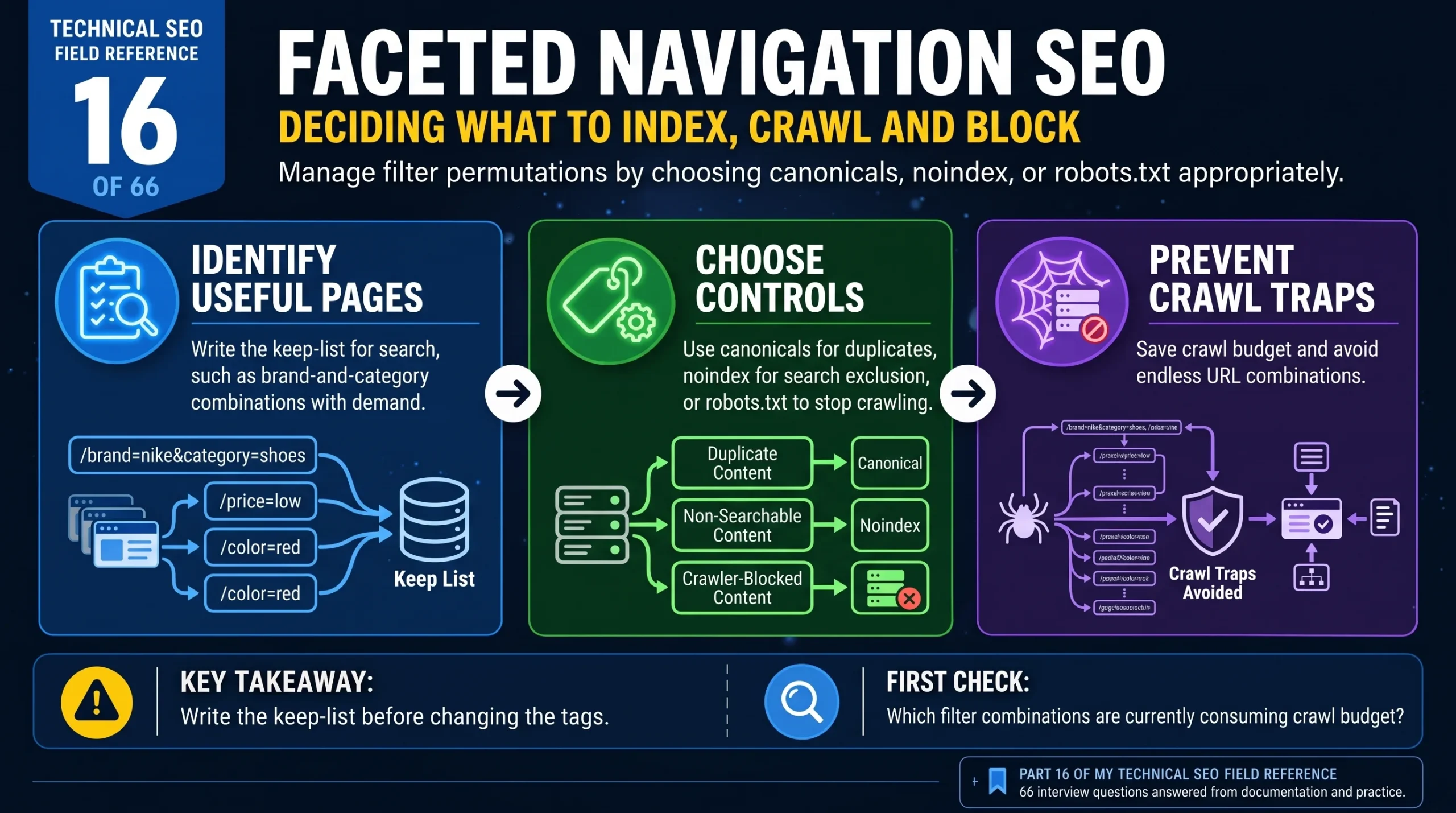
Technical SEO Field Reference, Question 16 of 66. The faceted navigation SEO question, checked against what Google currently documents.
Start by deciding which filtered pages you want in search. Give the pages you keep their own canonicals and internal links. For the rest, choose the control that fits your aim: canonicalisation for duplicate or equivalent variants, noindex to exclude a crawlable page from search, or robots.txt to prevent crawling. Google must be able to fetch a URL to read its canonical or noindex tag. Faceted navigation SEO starts with the keep-list, not the block-list.
A shopper filters a category by colour, size and price. That is a normal part of finding the right product.
For a crawler, each selection can create another URL. With three filters and five options each, there are already 125 combinations if one option is selected from every filter. Add sorting, optional filters or multiple selections, and the number grows.
This is how a crawl trap can develop. Question 3 covers that mechanism. Here, the question is which of those filtered pages you actually want Google to spend time on.
Why faceted navigation SEO matters
Unmanaged facets can give Google far more URLs than the site needs for search.
Some are useful landing pages. Others show almost the same products in a different order, or a narrow selection that few people would search for. Google has to fetch URLs to assess them, and that work uses server resources.
On a large site, crawl budget becomes part of the problem. Time spent fetching filter permutations can slow the discovery of new products and other useful pages. Duplicate variants can also spread links across several URLs when you would prefer one representative page.
A filtered page with one or two products is not automatically poor. It might answer a specific query well. Equally, generating a URL does not give it a reason to appear in search.
I would look at demand, the available products and whether the page gives a search visitor a useful destination.
Question 14, duplicate content on large sites, covers consolidation. Faceted navigation SEO adds an earlier decision: which combinations should be search landing pages in the first place?
What Google says about faceted navigation SEO
Google’s faceted navigation guidance distinguishes between URLs you want potentially indexed and URLs you do not need crawled. It recommends preventing unnecessary facet crawling and describes canonicals as a less effective long-term crawl control.
That leaves two decisions to make: whether a filtered page belongs in search, and whether Google needs to fetch it.
A robots.txt disallow prevents crawling. It does not guarantee removal from the index. Google may still list a blocked URL discovered through links, without having fetched its content.
Blocking also prevents Google from reading page-level instructions. If you add a noindex tag and then block the URL before Google fetches it, the tag cannot do its job. The same applies to a canonical you still need Google to read.
A canonical may reduce crawling of non-canonical variants over time. It remains a hint about the representative URL, so I would not rely on it to stop a large crawl trap quickly.
The interview answer for faceted navigation SEO
I would first identify the filtered pages we want as search landing pages. A brand-and-category combination might qualify if it has demand and a useful product selection. I would give those pages stable URLs, self-referencing canonicals and intentional internal links.
For the remaining URLs, I would separate consolidation from exclusion and crawl prevention. I would use a canonical for equivalent variants, noindex for pages we want crawled but excluded from search, and robots.txt for patterns we do not want fetched. If Google still needs to read a canonical or noindex tag, I would keep that URL crawlable.
The sequence depends on the site’s current state. Cleaning up already indexed URLs takes a different approach from preventing a new set of unwanted combinations from being crawled.
A fashion retailer example of faceted navigation SEO
Consider a fashion retailer whose filters generate colour, size, price and sort permutations.
The logs show most Googlebot requests going to those combinations. Organic visits to the filtered URLs are close to zero, apart from a handful of pages that already attract search traffic.
Blocking every facet URL would reduce crawling, but it would also block those useful landing pages. It would stop Google from fetching any canonical or noindex tags you had added to the others.
I would begin with a keep-list: the combinations worth maintaining as search pages. Give them stable URLs and link to them deliberately. Then classify the remaining patterns by what they do.
Sort-only duplicates might need consolidation. Other pages might need removal from search. High-volume patterns with no reason to be fetched could be blocked.
For URLs already indexed and needing noindex, leave crawling available and check that Google has processed the tag. A later robots.txt block needs care: it prevents Google from checking that the tag remains in place, and is not a permanent guarantee against indexing.
For unwanted patterns that do not need page-level instructions processed, crawl prevention can come first. There is no universal “tags first, robots.txt last” rule.
Choosing the right control for faceted navigation SEO
Self-referencing canonical
Use this on the curated facet pages you want as search destinations.
Make the URL stable and link to it from relevant pages. A self-referencing canonical expresses your preference; it does not guarantee indexing or rankings.
Canonical to a parent or preferred URL
Use this when the filtered URL is a duplicate or equivalent version of another page.
Sorting the same product list is different from narrowing it to a distinct selection. Do not assume the parent is an appropriate canonical for every filter simply because all the pages share a template.
Leave the variant crawlable while you need Google to read its canonical.
Noindex
Use this when a page should be excluded from search but remains available to crawl.
Google has to fetch the page to see the tag. Noindex controls indexing, so it does not solve crawl waste by itself. This connects to the same noindex and robots.txt conflict covered in Question 9.
I would avoid combining noindex with a canonical to another page as a routine cleanup method. The signals serve different aims, and their combined outcome is not a dependable shortcut for consolidation.
Robots.txt disallow
Use this for URL patterns you do not want Googlebot to fetch.
Test the rules against both the unwanted URLs and the pages you intend to keep. A broad parameter rule can catch useful combinations too.
Check tracking parameters separately. They may be handled through URL normalisation or canonicalisation; their presence does not automatically justify a crawl block.
How to check whether faceted navigation SEO controls are working
Use logs to compare crawl activity across categories, products and facet patterns. Then use Search Console’s Pages report and URL Inspection to check how representative URLs are being handled.
If facet crawling stays high, inspect the implementation before choosing another control. Google might not have revisited the pages yet. A canonical might be ignored, new combinations might still be generated, or a robots.txt rule might not match the URLs you expected.
High crawl activity alone does not prove the tags are unreadable.
Also check that products remain reachable through categories and other crawlable links. Reducing facet requests is a poor result if you have removed the main discovery route to the inventory.
The interview trap on faceted navigation SEO
“Block all the filters” skips the decision about which filtered pages deserve search traffic. It can also prevent Google from reading instructions needed for an existing cleanup.
“Canonical everything to the parent” skips the question of whether those pages are equivalent.
Explain what you want each URL group to do, then choose the control. If you mention sequencing, make it conditional on whether Google still needs to process a page-level signal.
Takeaway
Write the keep-list before changing the tags.
Then separate the remaining URLs into those you want consolidated, those you want excluded from search and those you do not want crawled. Check each group with sample URLs before applying rules across the whole catalogue.
Have questions about this topic? Contact The GEO Lab · Return to homepage