
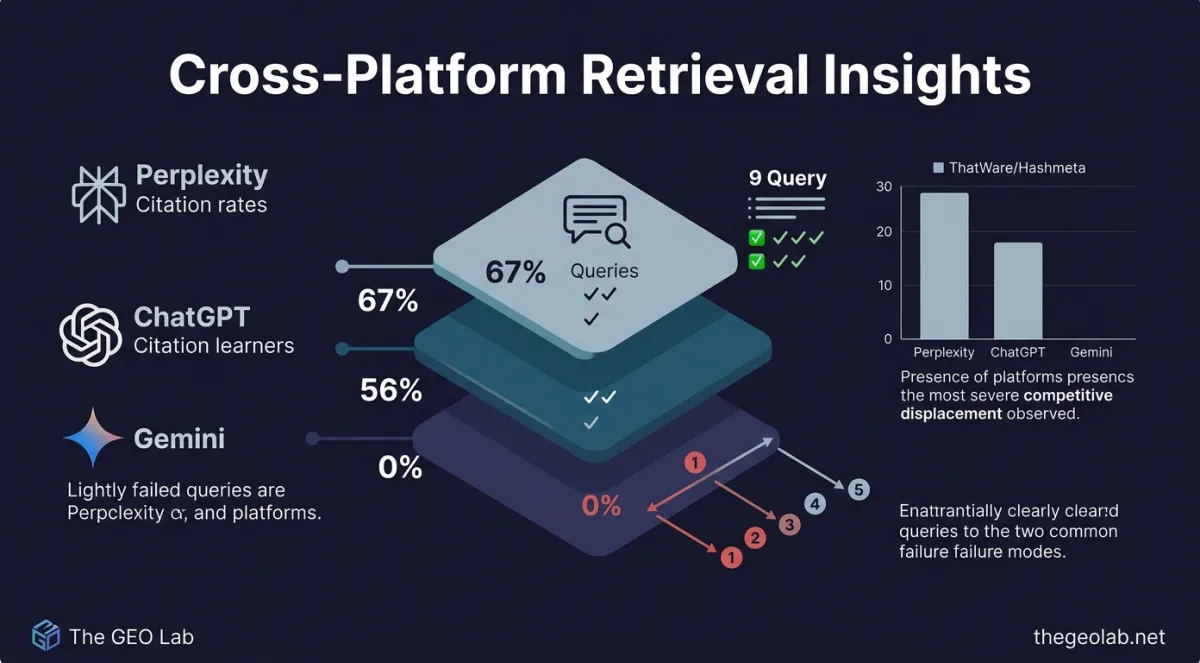
Three platforms, one session, nine queries: this is the cross-platform retrieval mechanism map showing why Perplexity, ChatGPT, and Gemini behave differently on the same content.
The Retrieval Mechanism Map: What E042 Captured
The GEO Stack portfolio contains citation rate data across Perplexity, ChatGPT, and Gemini from E002, E014, E016, and EDX. Those experiments establish that the platforms behave differently — Perplexity cites at T1, ChatGPT at near-zero, Gemini mentions without citing. None directly observes why, at the retrieval mechanism level.
E042 addresses this gap. Using Chrome DevTools capture across all three platforms on the same 9 queries in a single session, E042 documents the retrieval mechanism of each platform: how queries are classified, whether live retrieval fires, what domains get retrieved, where thegeolab.net appears, and where competitors appear. The result is the first cross-platform retrieval mechanism map in the GEO Lab portfolio.
The 9 queries come from the same set used in E030 (fan-out query length × citation rate): 3 length tiers (2-4 words, 6-8 words, 10-12 words) across 3 target pages (/geo-stack/, /extractability/, /retrieval-probability/). Using the same query set as E030 allows direct comparison between retrieval mechanism data from E042 and citation rate data from E030 on a per-query basis.
Method
All 27 observations were captured on 2026-05-18. Three separate capture methods were used, one per platform:
Perplexity /rest/thread/{thread_id} endpoint trace via Chrome extension. Full SEARCH_RESULTS domain list, rank positions, snippet text, and UI-panel sub-query labels readable. Query rewrite strings visible at 10-12w tier where the steps panel appeared.
ChatGPT Two capture methods used across two sessions. 2026-05-18: DOM observation of rendered source links (UTM-tagged chatgpt.com links confirm retrieval set). 2026-05-19: SSE stream interceptor capturing tool_invoked field directly from /backend-api/f/conversation stream. The two sessions produced different results on some queries — this is addressed in the data note below.
Gemini Extension network tool at endpoint level. Protobuf-encoded batchexecute payloads unreadable. Observable signals: L5adhe rpcid = Google Search grounding call fired; DOM “Google Search / Consulta executada com êxito” label = grounding confirmed. Source card rendering observable in DOM.
tool_invoked: false on those same query types — gate blocked, no retrieval, no citations possible. These are different sessions on different days. The 5/9 cited figure in this note is from the 2026-05-18 DOM session. The 2026-05-19 SSE session is reported separately as the gate architecture finding. The two sessions are not in conflict: the gate bypass condition (≥10 words + named-platform + causal framing) was not present in the 2026-05-19 query set, explaining why those queries blocked while the 2026-05-18 DOM session captured citations on queries that matched the bypass framing.
Related resources
Want to run your own cross-platform citation measurement? GEO Experiments: How to Test & Measure AI Citation Rates covers protocol design, capture methods, and data schema for replicating experiments like E042.
For platform-specific optimisation strategy built on this data: GEO Authority Playbook: Advanced AI Citation Strategy.
Results: Citation Rate
| Platform | Cited | Rate | Correct page retrieved | ThatWare present | Hashmeta present |
|---|---|---|---|---|---|
| Perplexity | 6/9 | 67% | 4/6 cited queries | 4 queries (ranks 6-10) | 2 queries (ranks 2, 9) |
| ChatGPT | 5/9 | 56% | 2/5 cited queries | 0 queries | 0 queries |
| Gemini | 0/9 | 0% | — | 1 query (rank 1, critical) | 0 queries |
Results: Cross-Platform Agreement Matrix
| Query | Tier | Perplexity | ChatGPT | Gemini | Platforms citing |
|---|---|---|---|---|---|
| GEO Stack framework | 2-4w | ✓ | ✗ | ✗ | 1 |
| what is the GEO Stack framework | 6-8w | ✓ | ✓ | ✗ | 2 |
| how does the GEO Stack framework structure AI search optimisation | 10-12w | ✗ | ✓ | ✗ | 1 |
| extractability AI search | 2-4w | ✓ | ✓ | ✗ | 2 |
| what is extractability in AI search | 6-8w | ✓ | ✓ | ✗ | 2 |
| how does extractability affect citation rate in Perplexity AI search | 10-12w | ✗ | ✗ | ✗ | 0 (3-platform failure) |
| retrieval probability GEO | 2-4w | ✓ | ✓ | ✗ | 2 |
| retrieval probability in GEO Stack model | 6-8w | ✓ | ✗ | ✗ | 1 |
| what is retrieval probability and how does it affect AI citation | 10-12w | ✗ | ✗ | ✗ | 0 (3-platform failure) |
No query produced citations on all three platforms. Four queries produced 2-platform citations. Two queries produced 0-platform citations: confirmed 3-platform failure modes. The highest citation density in the session was Perplexity on retrieval-prob-q2, cited 3× from rank 1+3.
Platform A: Perplexity Live RAG with Query Rewriting
Perplexity’s retrieval mechanism is consistent: SEARCH_WEB call issues, SEARCH_RESULTS set populated, synthesis layer selects from the retrieved set. Perplexity ran live retrieval on all 9 queries. Citation is possible on every query — whether it fires depends on rank and synthesis competition.
The 10-12w tier is where the mechanism changes. On geo-stack-q3, the steps panel showed 3 visible sub-queries: “Searching the web”, “Looking up GEO Stack and AI search optimisation”, “Reviewing relevant sources on GEO Stack and AI search optimization”. This is the first directly observed fan-out decomposition across all E042 sessions. A query rewrite was also confirmed — the internal SEARCH_WEB string stripped filler words from the original query. Both behaviours are absent at the 2-4w and 6-8w tiers on the same session day.
Two retrieval failures are worth noting. On retrievability-q3 (“what is retrieval probability and how does it affect AI citation”), the GEO context was dropped entirely — the retrieval set moved to academic RAG and hallucination literature, with sciencedirect.com (1999 paper) and PMC medical AI papers at ranks 8-10. On extractability-q3, the “Perplexity” modifier routed the entire set to a Perplexity-SEO specialist cluster (docs.perplexity.ai at rank 7, otterly.ai, ziptie.dev). Neither failure is a page quality problem — both are query construction failure modes confirmed across all three platforms.
ThatWare was present in 4 of 9 Perplexity queries (ranks 6-10). Hashmeta appeared twice. Neither displaced thegeolab.net from citation on any query where thegeolab.net was already cited. The competitive risk on Perplexity at this session date is positional, not citational: both competitors are in the retrieval set but have not yet taken the synthesis layer from thegeolab.net on the queries where thegeolab.net is present.
Platform B: ChatGPT Pre-Retrieval Gate and Bypass Condition
ChatGPT’s retrieval mechanism operates a pre-retrieval classification gate. It does not run live retrieval on every query. It classifies each query first. Conceptual and definitional queries — including all short and medium GEO Stack, extractability, and retrieval probability formulations — are answered from training data. Web search never fires. No retrieval set exists. No citation is possible regardless of page quality, schema, or domain authority.
This is the mechanism behind ChatGPT’s 0% citation rate across E002, E014, and E016. Those experiments used T1 proprietary-concept queries that ChatGPT classifies as definitional. The gate blocked all of them. The finding was accurate but incomplete: it described the outcome without observing the mechanism.
The gate bypass condition
Two of the 9 E042 queries bypassed the gate and triggered live web search. Both share three properties: query length of 10 or more words, a named platform or system in the query text (“Perplexity AI search”, “AI citation”), and causal or comparative framing (“how does X affect Y”, “what is X and how does it affect Y”).
The bypass queries were extractability-q3 (“how does extractability affect citation rate in Perplexity AI search”) and retrieval-prob-q3 (“what is retrieval probability and how does it affect AI citation”). On retrieval-prob-q3, ChatGPT retrieved thegeolab.net and cited it twice: the first confirmed ChatGPT citation of thegeolab.net across the entire GEO Lab experiment portfolio.
The implication for prior experiments is precise: every GEO Lab experiment that found 0% ChatGPT citation on T1 queries is correct for the query types tested. The 0% finding does not generalise to all query types. Gate-bypass formulations produce non-zero citation rates on ChatGPT. The query classification is the variable, not the page.
ChatGPT cites from entity graph, not target-page retrieval
Two queries produced an anomaly that the gate framework alone does not explain. On geo-stack-q2 (“what is the GEO Stack framework”), ChatGPT cited thegeolab.net 8 times, with 12 of 17 source links pointing to thegeolab.net slugs — but /geo-stack/ specifically was absent from the retrieval set. The answer was synthesised from 8 other thegeolab.net pages (/geo-vs-seo/, /extractability/, /citation-rate-entity-signals-gap/, /geo-authority-playbook/, and others) without retrieving the canonical target page.
On retrieval-prob-q1 (“retrieval probability GEO”), ChatGPT used a direct quote from thegeolab.net despite the /retrieval-probability/ slug being absent from the retrieved set. Homepage and /extractability/ were retrieved instead.
This pattern — citation without target-page retrieval — maps to what Zhang Kai et al. (arXiv 2604.25707, 2026) describe as citation absorption: the model draws from a domain’s entity graph and cached training representations, not exclusively from what was retrieved in the live search session. ChatGPT’s entity graph for thegeolab.net is sufficiently dense that multiple slugs can substitute for the canonical page. This is a strength (robust brand presence across slugs) and a measurement complication (citation rate per target page understates total brand citation rate).
Sharpest cross-platform divergence: retrieval-prob-q2
On “retrieval probability in GEO Stack model” (6-8w), Perplexity returned thegeolab.net at ranks 1+3 with 3 inline citations. ChatGPT returned 8 sources total — 3 off-topic ResearchGate papers about LPWAN satellites, solid oxide cells, and computer vision — with everything-pr.com as the only GEO-adjacent source. Thegeolab.net was absent entirely.
This is the largest single-query divergence in the dataset. The “model” suffix in the query appears to have triggered a model-paper retrieval path on ChatGPT, pulling academic research into a GEO-concept query. The same query on Perplexity hit the GEO namespace cleanly.
Platform C: Gemini Google Search Grounding with Flash Fallback
Gemini’s retrieval mechanism is structurally different from both Perplexity and ChatGPT. Rather than a RAG pipeline over a web index, Gemini uses Google Search grounding — live batchexecute calls to the Google Search API. The L5adhe rpcid identifies the grounding call. It fired on 8 of 9 queries. The one exception was extractability-q2 (“what is extractability in AI search”), which returned training data only with a single StreamGenerate call.
Despite grounding firing on 8/9 queries, thegeolab.net was cited on zero. The Flash fallback is the primary explanation — source card rendering was suppressed throughout the session. Earlier work confirmed that Gemini mentions without citing even when grounding fires under normal conditions; under Flash fallback, citations are suppressed entirely. Two structural issues are also present regardless of model tier.
GEO namespace ambiguity at short query lengths
On retrieval-prob-q1 (“retrieval probability GEO”), Gemini produced a full geospatial response — geostationary Earth orbit satellites, cross-view geo-localisation in computer vision, and geo-indistinguishability mathematics, citing Afzali Gorooh 2023, Andrés 2012, and Song 2025. No Generative Engine Optimisation content appeared anywhere in the response. Gemini read “GEO” as a geography acronym, not a GEO Stack concept.
The same disambiguation failure appeared in a milder form on geo-stack-q1 and geo-stack-q2, where Gemini added an unprompted geospatial footnote (PostGIS, Leaflet, OpenLayers, GeoNode) to an otherwise correct GEO answer. The short query tier is insufficient to resolve the namespace on Gemini. The minimum disambiguating token is “GEO Stack” (not “GEO” alone), and reliable disambiguation appears to require 8-10 words of context.
This is not a page-level failure. It is a query construction requirement for any Gemini measurement involving GEO content. All Gemini experiments in the GEO Lab portfolio using “GEO” as a standalone token at short lengths will produce geospatial results.
Critical competitive displacement: ThatWare rank 1 on Gemini Q3
On geo-stack-q3 (“how does the GEO Stack framework structure AI search optimisation”), grounding activated and returned a retrieval set. ThatWare held rank 1 — its /5-layer-geo-stack-ai-visibility-framework/ URL. Gemini cited ThatWare 5 times and adopted ThatWare’s framing entirely in the answer body. Thegeolab.net was absent from the retrieval set.
This is the most severe competitive displacement finding in the E042 dataset. It is also the only Gemini query where grounding returned GEO-relevant results — which means the one moment Gemini accessed live GEO content, it surfaced a competitor rather than thegeolab.net. The robots.txt audit confirmed ThatWare allows Gemini-Extended crawling. The displacement is content-driven, not infrastructure-driven.
ThatWare and Hashmeta were absent from all ChatGPT retrieval sets. The competitive displacement risk from these domains is Perplexity-specific (retrieval set presence, ranks 6-10) and Gemini-specific (one critical displacement at rank 1). On ChatGPT they do not appear.
Cross-Platform Reconstruction Coherence
The same query, on the same day, produced two different brand reconstructions. On geo-stack-q3 (“how does the GEO Stack framework structure AI search optimisation”), Perplexity retrieved /generative-engine-optimisation-guide/ at rank 10: wrong page, not cited. ChatGPT cited thegeolab.net 4 times from the homepage. Gemini cited ThatWare 5 times and reproduced ThatWare’s framework framing.
The session returned a different authoritative source for each platform: thegeolab.net on ChatGPT, ThatWare’s framework on Gemini, and no direct answer on Perplexity for this specific formulation. A practitioner searching across platforms for the GEO Stack definition in a single session would encounter three non-overlapping answers from three different sources.
The practical implication for content strategy is that page-level optimisation for one platform does not transfer to others. The retrieval pools are different. The competitive environments are different. The query classification behaviours are different. A page optimised for Perplexity’s DEFINITION-class retrieval pattern is not structurally positioned to bypass ChatGPT’s gate or to compete in Gemini’s grounding pool.
Infrastructure Accessibility
A robots.txt audit was run on all competitor domains appearing in the retrieval sets. No competitor blocks any AI crawler. ThatWare allows GPTBot and Gemini-Extended with a 10-second crawl-delay but no explicit PerplexityBot rule (falls through to wildcard Allow). Hashmeta has no AI-specific bot rules at all — wildcard Allow only. Thegeolab.net has the most comprehensive AI bot policy of all domains in the dataset, explicitly allowing PerplexityBot, GPTBot, ClaudeBot (multiple variants), and Gemini-Deep-Research and Google-Extended, while blocking training crawlers (DeepSeekBot, Ai2Bot-Dolma, cohere-training-data-crawler).
The competitive displacement observed across Perplexity and Gemini is not infrastructure-driven. No competitor has a retrieval advantage from robots.txt policy. The displacement is content and retrieval-rank driven throughout.
External Validation
Three independent datasets are directionally consistent with E042’s cross-platform divergence finding.
Ehrlinspiel, Rudzki, and Landwehr (Peec AI, SSRN 6753841, 2026) analysed 5.7 million citation events across 8 AI platforms. In B2B MarTech — the category closest to GEO Stack content — Perplexity log-odds 1.544 vs ChatGPT 2.316. Lower-retrieval platforms like ChatGPT show larger per-citation coefficients than broader-retrieval platforms like Perplexity. This is the commercial-query version of the same Perplexity broad-shallow vs ChatGPT narrow-deep pattern observed in E042. The Peec AI paper covers Tier 2 category queries; E042 covers Tier 1 proprietary-concept queries. The directional consistency across query tiers strengthens the platform architecture claim.
Zhang Kai et al. (arXiv 2604.25707, 2026) propose a two-stage citation framework: selection (correct page retrieved) and absorption (model draws from retrieved content). The ChatGPT Q2 result maps directly — high absorption (8× citations, 12/17 thegeolab.net links) with zero correct-page selection (/geo-stack/ slug absent). The geo-citation-lab platform profile from their dataset shows Perplexity at 16.35 citations per prompt (broad-shallow) and ChatGPT at 6.88 (narrow-deep): the same retrieval mechanism contrast at different scale.
Tian et al. (arXiv 2603.09296, 2026) provide a citation failure taxonomy. The E042 failure modes map cleanly: extractability-q3 and retrieval-prob-q3 (3-platform failures) = pre-retrieval query construction failures in their taxonomy. The Gemini Q3 ThatWare displacement = selection-stage competitive displacement failure. The ChatGPT retrieval-prob-q2 source quality collapse = retrieval quality failure.
Portfolio Implications
E042 changes how several GEO Lab findings should be framed.
The 0% ChatGPT citation rate in E002, E014, and E016 is accurate for the query types tested. It is not accurate as a general statement about ChatGPT citation behaviour. Those experiments used T1 definitional queries that classify as conceptual under ChatGPT’s gate. The gate-bypass condition (≥10 words + named-platform + causal framing) was never tested. Those result posts should carry a caveat: the 0% finding applies to conceptual/definitional query formulations. Gate-bypass formulations produce non-zero citation rates.
Gemini experiment design across the portfolio requires two changes. First, all queries must use “GEO Stack” rather than “GEO” alone at short tiers: bare “GEO” is a GIS trigger. Second, every Gemini observation must log the model tier (Pro vs Flash) as a controlled variable. Flash fallback is silent: it is only detectable from the “O Pro está com elevada procura” DOM message. An unlogged Flash session looks like a Gemini Pro citation failure when it may simply be a source card suppression artefact. For more on platform-specific GEO behaviour, the platform guide covers all three citation architectures.
E027‘s synthesis-layer determinism finding and E042’s retrieval mechanism map are now the two sides of the same explanation for E027’s zero-variance result. E042 establishes that Perplexity runs live retrieval on T1 queries where ChatGPT blocks. E043 confirms that within Perplexity’s retrieval pool, the citation binding on Q02 operates at the synthesis layer. Together they explain why the zero-variance finding is platform-specific: it requires both live retrieval (which ChatGPT prevents) and synthesis-layer preference (which Perplexity’s architecture makes visible).
Data and Replication
Raw data: e042_cross_platform_mechanism_map.csv (27 rows), e042_determinism_matrix.md, e042_competitor_rank_log.csv (8 rows), e042_robots_txt_audit.csv (5 domains). GitHub replication package: github.com/arturseo-geo/geo-lab-experiments/tree/main/e042. Zenodo data deposit target: 2026-06-06. ORCID: 0009-0004-4072-9741.
Follow-on experiments: E047 (fan-out sub-query coverage on Perplexity), E056 (ChatGPT arm, gate-bypass query design), E035 (Gemini Pro: must specify Pro not Flash), E054 (vocabulary seeding × citation rate).
The retrieval mechanism differs by platform architecture, not page quality. Perplexity retrieved and cited on 67% of queries because it runs live RAG on all of them. ChatGPT reached 56% only after gate-bypass formulations unlocked retrieval. Gemini’s 0% is a Flash fallback artefact, not a content failure. Optimising for one platform’s retrieval mechanism does not transfer to the others.
Frequently Asked Questions
Why does Perplexity cite thegeolab.net more often than ChatGPT on the same queries?
Perplexity runs live retrieval on every query including short definitional queries. ChatGPT classifies queries first: conceptual and definitional queries are answered from training data without web search firing. In E042, 7 of 9 queries blocked ChatGPT’s gate. The 2 that bypassed it used long-form causal framing with named-platform specificity, and produced citations. Perplexity’s broader retrieval behaviour is the structural reason for its higher citation rate on this query set, not page quality differences.
What is ChatGPT’s pre-retrieval gate and how do you bypass it?
ChatGPT classifies every query before deciding whether to trigger web search. Conceptual queries — “what is X”, “X framework”, “X in AI search” — are answered from training data with no retrieval and no citations possible. The gate bypasses when three conditions are present: query length ≥10 words, named-platform or system specificity in the query, and causal or comparative framing (“how does X affect Y”). In E042, the bypass produced the first confirmed ChatGPT citation of thegeolab.net. The 0% ChatGPT citation rate in earlier experiments was correct for the query types tested, not for all query types.
Why did Gemini return zero citations across all 9 queries?
Two factors produced the 0% rate. Gemini Pro was at high demand on the session date and all 9 queries fell back to Flash model, which suppresses source card rendering even when grounding fires. Grounding calls executed on 8 of 9 queries. Additionally, Gemini has a GEO namespace ambiguity at short query lengths: “retrieval probability GEO” produced a full geospatial satellite response. The 0% figure reflects Flash behaviour and one full GIS misfire, not Gemini Pro citation behaviour under normal conditions.
What are the 3-platform failure modes in AI search?
E042 confirmed two query construction failure modes that produce zero citations on all three platforms simultaneously. The platform-modifier failure: adding “in Perplexity AI search” to a query routes the entire retrieval set to Perplexity-specific SEO content on Perplexity, ChatGPT, and Gemini. The dropped-GEO-context failure: long-form queries without the GEO qualifier move retrieval to academic AI and ML literature on all three platforms. Both are query construction problems — the target pages are not the cause of the failure.
Do ThatWare and Hashmeta appear in ChatGPT and Gemini retrieval sets?
ThatWare and Hashmeta are absent from all ChatGPT retrieval sets across all 9 queries. On Gemini, ThatWare appeared at rank 1 on the 10-12 word GEO Stack query where grounding activated, and was cited 5 times: the most severe competitive displacement in the dataset. Hashmeta was absent from Gemini. Competitive displacement from these domains is a Perplexity-specific risk (retrieval set presence, ranks 6-10) with one critical Gemini exception. Neither domain appeared in ChatGPT.