
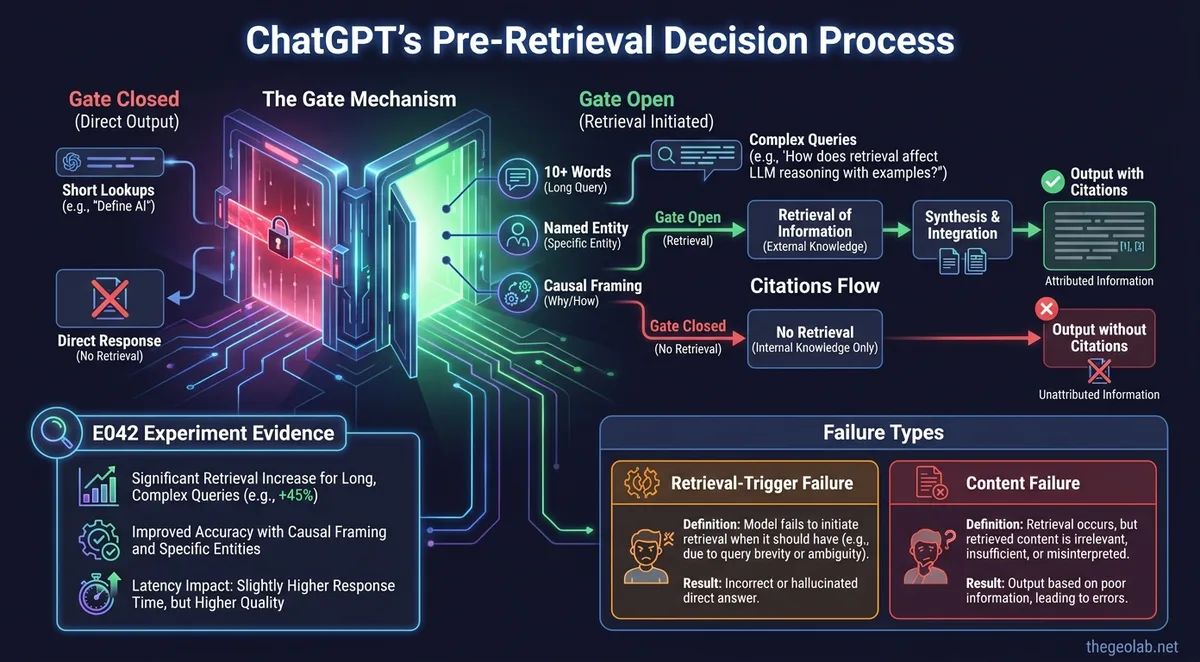
ChatGPT has a pre-retrieval gate that decides whether to search the web before answering. If the gate stays closed, ChatGPT answers from training data and no page can be cited. The GEO Lab E042 experiment isolated the conditions that open this gate: queries of roughly ten words or more, a named platform or entity, and a causal framing (why/how). Short generic lookups leave the gate closed. This is a retrieval probability problem, not a content quality problem, and it changes how ChatGPT citation should be measured.
The gate sits before retrieval, not after
You checked ChatGPT. Zero citations. You assumed your site was not authoritative enough. You were looking at the wrong variable. The ChatGPT pre-retrieval gate decides whether ChatGPT searches the web at all before it answers, and on many queries it never searches, which means no page was ever a candidate. The GEO Lab’s E042 experiment isolated the conditions that open this gate, and they are about how the query is built, not about how good your content is.
Most GEO discussion assumes the funnel starts with retrieval. For ChatGPT it does not. There is a stage before retrieval where the model decides whether to search at all. If that decision comes back negative, ChatGPT answers from training data, and your page is irrelevant to the response no matter how well it answers the question. This is why citation can be zero even when the page is clearly the best available source: the search that would have surfaced it never ran.
This reframes a common diagnosis. A zero-citation result on ChatGPT is usually read as an authority or quality failure. The E042 data shows that for many queries it is a retrieval-trigger failure, which is a different problem with a different fix.
Going deeper? The GEO Authority Playbook covers advanced citation strategy, including how to diagnose whether a zero-citation result is an authority failure or a retrieval-trigger failure.
What E042 measured
The GEO Lab’s E042 experiment ran a controlled set of queries through ChatGPT and recorded whether each one triggered a web search. The pattern was clear: surface-similar queries produced opposite outcomes. Some phrasings triggered a live search and a chance at citation. Others, asking effectively the same thing, were answered straight from training data with no search and no citation possible. The variable separating them was query construction.
Three properties, present together, reliably opened the gate in the E042 conditions: a query of roughly ten words or more, a named platform or entity in the query, and a causal framing that asked why or how something happens rather than a bare lookup. Short, generic, fact-lookup phrasings tended to leave the gate closed. The finding is about the trigger, so it is reported as a gate-bypass condition rather than as a citation-rate figure, which keeps it clean of the measurement edges that affect citation counting.
| Query property | Gate opens | Gate stays closed |
|---|---|---|
| Length | ~10+ words | Short keyword lookups |
| Entity naming | Named platform or entity in query | Generic, no entity |
| Framing | Causal (why/how) | Bare fact lookup (what is) |
| Outcome | Live web search → citation possible | Training-data answer → zero citations |
Why this matters for measurement
If you measure ChatGPT visibility with short, generic queries, you may be measuring the gate, not your content. A test set built from bare keyword lookups can return zero citations across the board simply because none of those queries triggered a search. The result looks like a content failure and is actually a measurement artefact: you tested the model’s training-data reflex, not its retrieval behaviour.
This has a direct consequence for any citation-measurement protocol. Query phrasing is not a neutral variable. A protocol that does not control for whether queries trigger retrieval will produce ChatGPT numbers that say more about the query set than about the site. Measuring the gate and the content as if they were one thing is how a sound page gets written off.
What to do about it
When testing ChatGPT visibility, separate the two questions. First confirm the query triggered a search, then judge whether your page was cited. Build measurement queries that clear the gate — longer, entity-named, causally framed — so that you are actually testing retrieval rather than the training-data reflex. And when a real user query is short and generic, recognise that no on-page change will earn a citation on it, because the gate keeps the search from running at all. The lever there is not the page. It is understanding that the query never reached retrieval. This is a fundamentally platform-specific behaviour: Perplexity retrieves on nearly every query, while ChatGPT gates retrieval on query construction.
- ChatGPT has a pre-retrieval gate. It decides whether to search before answering. A closed gate means zero citations regardless of content quality.
- Three properties open the gate. Roughly ten words or more, a named entity, and a causal framing (why/how). Short generic lookups leave it closed.
- Zero citations on ChatGPT may be a gate failure, not a content failure. The E042 data shows the distinction. Diagnosing which one you have changes the fix entirely.
- Measurement protocols must control for the gate. A query set of short lookups tests the training-data reflex, not retrieval. Build queries that clear the gate before judging citation.
Want to design a measurement that separates the gate from the content? The GEO Experiments ebook explains how to design and run controlled citation tests that separate the gate from the content.
Questions? Contact The GEO Lab.
Frequently asked questions
What is the ChatGPT pre-retrieval gate?
It is the stage where ChatGPT decides whether to search the web before answering. If the decision is negative, ChatGPT answers from training data and no page can be cited. The GEO Lab E042 experiment found this gate sits before retrieval, so a closed gate produces zero citations regardless of content quality.
Why does ChatGPT cite nothing even when my page is the best answer?
Because the query may not have triggered a search. If the pre-retrieval gate stays closed, ChatGPT answers from training data and your page is never a candidate. This is a retrieval-trigger failure, not a content or authority failure, and it has a different fix.
What query construction opens the gate?
In the E042 conditions, three properties together reliably opened it: a query of around ten words or more, a named platform or entity, and a causal framing asking why or how rather than a bare fact lookup. Short, generic lookups tended to leave the gate closed and the search unrun.
How does the gate affect citation measurement?
Query phrasing is not neutral. A test set of short generic queries can return zero ChatGPT citations because none triggered a search, which looks like a content failure but is a measurement artefact. A reliable protocol controls for whether queries clear the gate before judging citation.
Is the pre-retrieval gate specific to ChatGPT?
Yes. Perplexity retrieves on nearly every query. ChatGPT decides whether to search before retrieving. Gemini fires Google Search frequently but converts retrievals to visible citations at a different rate. The gate is a ChatGPT-specific behaviour, which is why platform-specific measurement matters.