
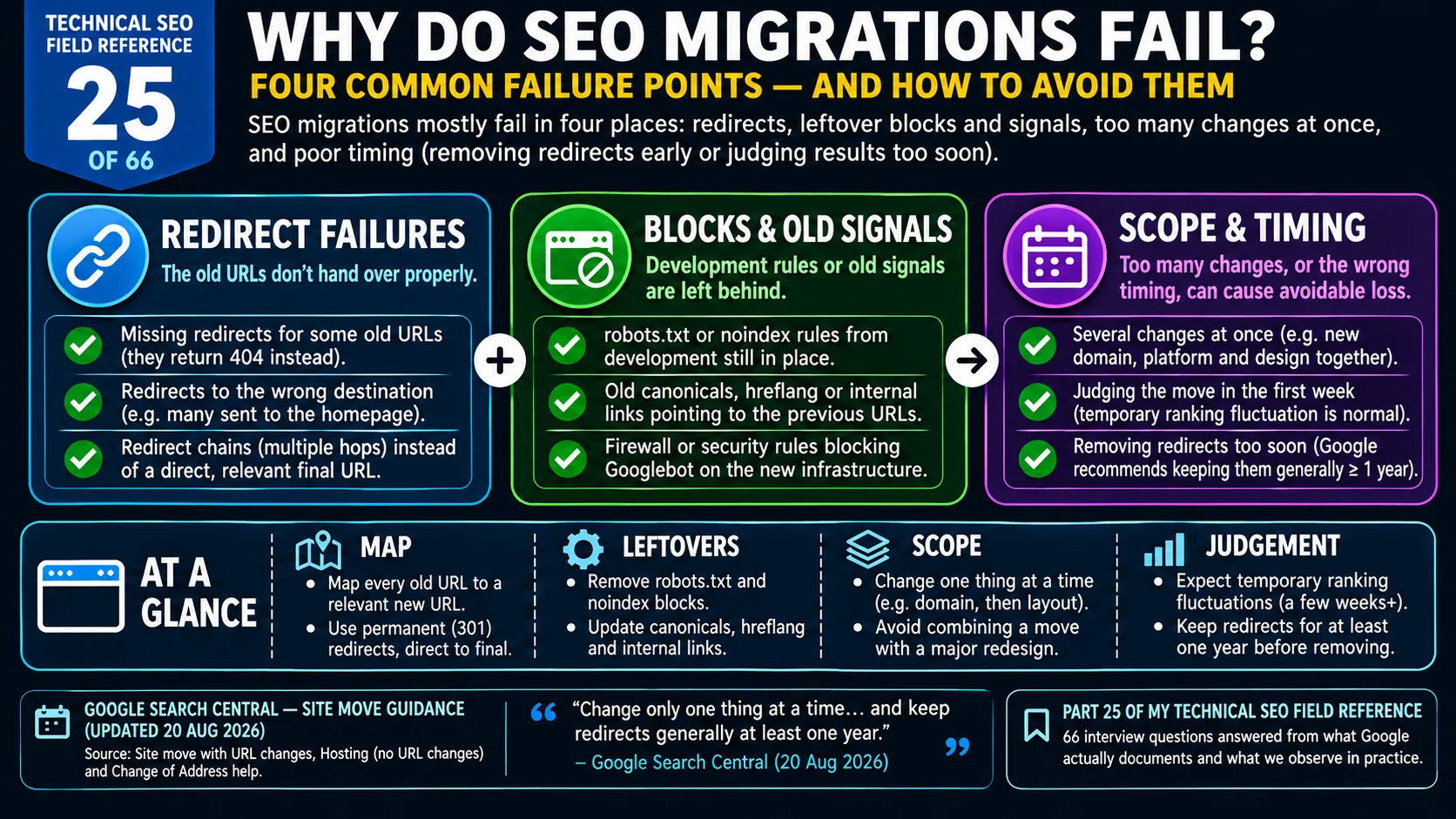
Technical SEO Field Reference, Question 25 of 66. The interview answer, checked against what Google currently documents.
SEO migrations fail mostly in four places: redirects that are missing, chained or pointed at the wrong page; development blocks and old signals left on the new site; too many changes made at once; and redirects removed or results judged too early. Google documents all four. Broken structured data is also a common casualty, but Google’s site move guides do not cover it, so it belongs under practice rather than documentation.
An interviewer asks why SEO migrations fail. The easy answer is “missing redirects”.
The better answer says which failures are documented, which are not, and why most of them are decisions made before launch.
Why SEO migrations fail
An SEO migration changes the address of pages Google already knows. Everything Google has learned about the old URLs has to be handed to the new ones, URL by URL.
That makes the failures predictable. They are rarely exotic. They are usually a gap in the map, a block nobody removed, or a project that tried to do too much in one release.
The interviewer is listening for whether you can sort failures into causes, not recite a list of symptoms such as “traffic dropped”.
What Google says about SEO migration problems
Google does not publish a list of why migrations fail. Its guides describe what to do, and the failures are the inverse of that advice.
The site move with URL changes guide (page last updated 20 August 2026) asks for server-side permanent redirects, direct to the final destination. It says Googlebot can follow up to 10 hops but suggests keeping chains short. It warns against redirecting many old URLs to one irrelevant page such as the new homepage, which might be treated as a soft 404. It says to change one thing at a time, to remove noindex and robots blocks left from development, and to keep redirects generally at least a year.
It also sets the expectation. Rankings can fluctuate during a move, and a move is complete only once Googlebot has visited every old and new URL at least once. For a medium-sized site that can take a few weeks or more.
The Change of Address tool help page adds two warnings. Combining a move with a redesign of content and URL structure will probably cost some traffic, and moves should not be chained. The hosting guide (page last updated 10 December 2025) adds a failure that does not involve URLs at all: a firewall or denial of service protection blocking Googlebot on the new infrastructure.
The interview answer for why SEO migrations fail
I would group the failures into four causes. The map: old URLs without a correct destination, chains, or everything sent to one page. The leftovers: robots.txt rules, noindex rules or old canonicals carried onto the new site. The scope: several changes in one release, so a drop has no clear cause. The judgement: redirects removed too early, or the result read in the first week.
Structured data and internal links are also on my list, but I would say plainly that Google’s guides document the internal links point and not the structured data one.
SEO migration failures at a glance
Redirect failures in an SEO migration
Redirect failures are the most common, so interviewers expect them. The useful part is naming the three kinds.
The first is the missing redirect. An old URL with traffic and links that is not in the map ends in a 404. If that URL was meant to be removed, a 404 or 410 is correct. If it was forgotten, it is a failure. This is why Google suggests building the old URL list from more than the sitemap.
The second is the wrong destination. Sending everything to the new homepage is easy to script and is what Google warns against. A redirect that returns the right status code and lands on the wrong page still fails the map.
The third is the chain. A move that sits on top of an earlier move can leave old URLs going through several hops. Google can follow them, but it asks for short chains, so I would fix the rule so each old URL goes straight to its final destination. The question on HTTP redirects covers the redirect types, and the one on 301 vs 302 covers why a permanent move needs a permanent redirect.
Blocks and signals left behind in an SEO migration
Development blocks are the quietest failure. Teams keep a site out of the index while it is built, which is sensible, and then the same robots.txt or noindex rules go live with the site.
Google’s guide asks for exactly this to be handled: prepare the final robots.txt and a list of URLs from which to remove noindex rules. After a hosting move, check that a firewall is not blocking Googlebot.
The same applies to signals. On the new site, canonicals should be self-referencing, hreflang should use the new URLs and internal links should point at the new URLs. If they still point at the old ones, the new site tells Google to keep the old addresses. The difference between blocking crawling and blocking indexing is covered in robots.txt versus meta robots.
Structured data is my practice, not Google’s. When a template is rebuilt, markup is easy to lose or to leave with old URLs in it. I would include a check that key templates still carry their markup, and I would not present that as a Google requirement.
Scope and timing failures in an SEO migration
Some SEO migrations fail before any rule is written. Google says to change one thing at a time. A project that moves domain, platform and design together has three possible causes for any drop and no clean way to separate them. That separation is my reasoning. The advice to change one thing at a time, and the warning about combining a move with a redesign, are Google’s.
Timing fails in two directions. Reading the first week as a verdict is one. Google says to expect fluctuation and that the move is not complete until Googlebot has visited every URL. The other is removing redirects once the dashboards look calm. Google suggests keeping them generally at least a year, and its Change of Address page gives 180 days as a minimum for that tool.
Capacity is the last one. Google says it crawls the new site more heavily after a move, so a server that cannot cope slows the handover. The crawl budget post covers how Google decides how much to crawl.
A failed SEO migration example
Say a publisher moves to a new domain. The redirect map covers every URL in the old sitemap, and launch is declared a success. This is a hypothetical.
Three weeks later, old URLs that were never in the sitemap, such as archived pages with external links, return 404. A second group redirects to the new homepage because a catch-all rule was left in place.
Neither failure shows up in a test run against the sitemap. Both would have shown up in a map built from server logs, analytics and the links report, which is what Google suggests. The fix is to add the missing mappings and replace the catch-all with specific destinations.
The interview trap on SEO migration failures
The trap is a symptom list. “Traffic drops, rankings fall, pages drop out of the index” describes what happens, not why.
The second trap is blaming Google. Google says fluctuation is expected, and that is different from failure. A failure is something that can be traced to a decision: a gap in the map, a block left on, a change too many.
The third is treating redirects as the whole answer. Most of the documented failures are about what surrounds the redirect.
Takeaway
Sort failures by cause: the map, the leftovers, the scope and the judgement.
Most of them are decided before launch. The ones Google documents are avoidable with the same steps it recommends, and the ones it does not, such as lost structured data, are yours to check.
Have questions about this topic? Contact The GEO Lab · Return to homepage