
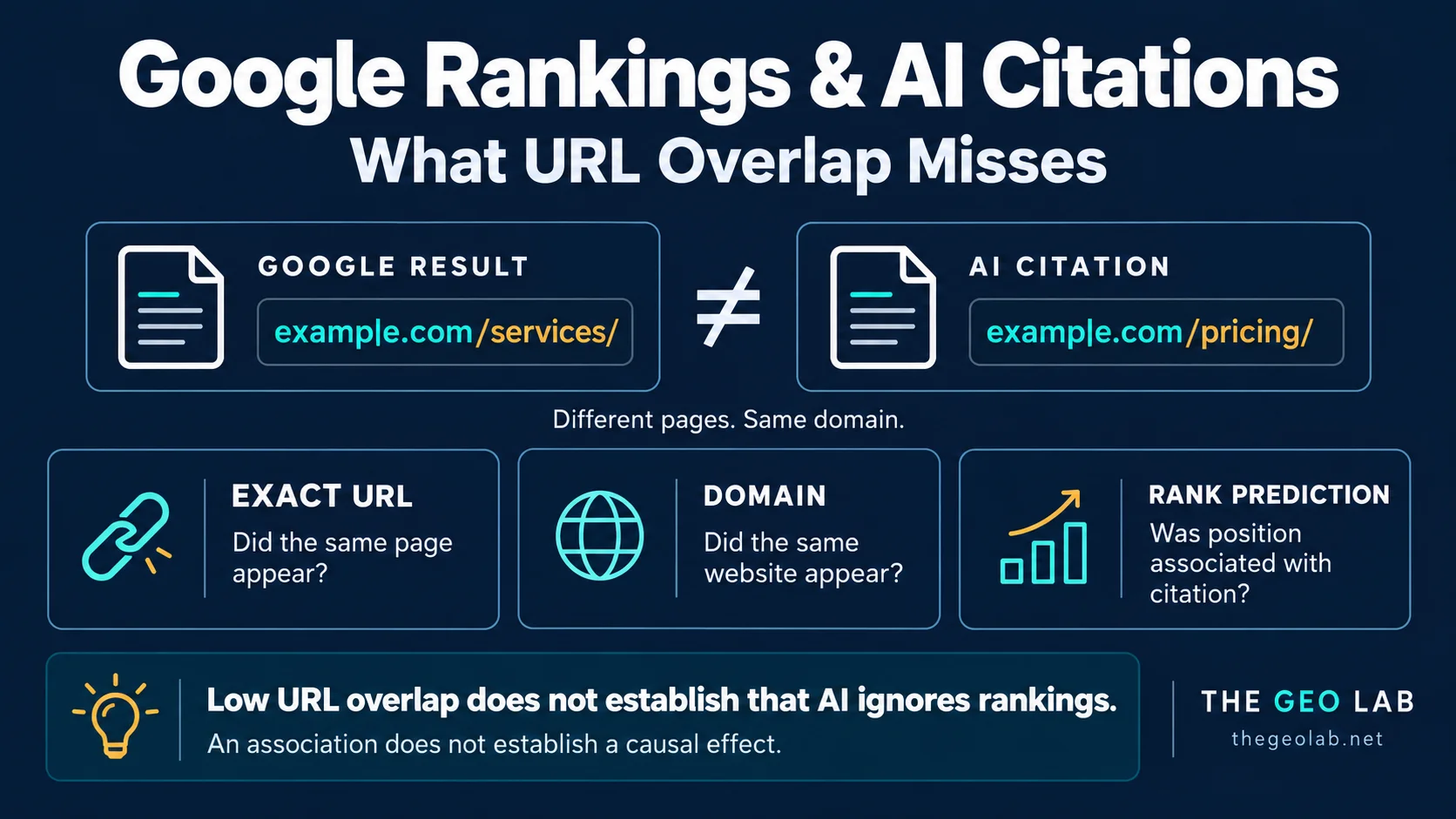
Research review separating exact-page matches, domain overlap and rank prediction. Google rankings and AI citations can be associated even when the cited URL differs.
TL;DR
Google rankings and AI citations can be associated even when an AI answer links to a different URL from Google’s Top 3. Exact-page overlap, domain overlap and rank-based prediction answer different questions. Anthony Lee’s observational preprint reports evidence at each level. None establishes that improving a Google position will cause an AI citation, and an overlap percentage must retain the denominator used to calculate it.
Contents
- Three comparisons that need separate answers
- What the paper reports about Google rankings and AI citations
- A denominator problem in the interpretation
- A page mismatch can still be a website match
- Prediction does not establish an optimisation effect
- How I’d read a Google rankings and AI citations overlap claim
- What remains open
- Frequently asked questions
I’d be careful with a report that says AI ignores Google rankings because it cites different pages.
The mismatch is worth recording. It could mean the answer cited another page on the same website, or a page that ranked below the three results being compared. Neither observation, on its own, tells us whether Google rank is associated with AI citation.
I’d be equally careful with the opposite claim: rank first and the AI will cite you.
The useful question sits between those conclusions. What relationship between Google rankings and AI citations was actually measured, and what can we reasonably infer from it?
Three comparisons that need separate answers
A Google ranking report and a list of AI citations can be compared in several ways. The relationship between Google rankings and AI citations looks different depending on which comparison you choose.
| Comparison | Question being asked | What it does not establish |
|---|---|---|
| Exact URL overlap | Did the same page appear in both sets? | Whether other pages from that domain appeared |
| Domain overlap | Did the same website appear in both sets? | Whether the same page was selected |
| Rank-based prediction | Was Google position associated with citation status in the sampled pages? | The effect of changing a page’s rank |
A result at one level does not replace the other two.
Suppose Google returns a company’s service page, while the AI answer cites that company’s pricing page. That is a page mismatch and a domain match. It gives us no direct evidence about what would happen if the service page moved up or down in Google.
That example is illustrative, not a case extracted from Lee’s dataset.
What the paper reports about Google rankings and AI citations
Anthony Lee’s Query Intent and Google Rank as Joint Predictors of AI Citation is an observational preprint, version 6, revised in April 2026. Its methods overview places the core studies in January to February 2026; the revision date is not the collection date.
The relevant results on Google rankings and AI citations come from different analyses:
| Analysis | Reported result | Locator |
|---|---|---|
| API comparison against 360 Google Top-3 results | ChatGPT matched 28/360 exact URLs, or 7.8% | Section 4.2, Table 2 |
| Consumer-interface comparison | ChatGPT Google URL match: 6.8%; domain match: 28.7% | Section 4.2b, Table 2b |
| Model fitted to 479 cited/non-cited pages | Google-position-only model: cross-validated AUC 0.802 | Section 4.6, Table 6 |
These are results from one research programme, not three independent replications. They also use different samples and access channels, so I would not place their percentages on one common scale.
The paper’s rank-model result supports an association between Google rankings and AI citations within the analysed sample. Its URL and domain results describe overlap under the respective comparison rules.
Going deeper? The AI SEO OS ebook covers systems for tracking both organic rankings and AI citation signals in one workflow.
A denominator problem in the interpretation
Table 2 makes the denominator explicit: 360 Google Top-3 results. Of those, 28 matched ChatGPT’s cited URLs.
The text below the table then describes the complement as the proportion of ChatGPT citations outside Google’s Top 3. That conclusion does not follow from this table alone.
To see why, consider a smaller invented example.
The direction of the comparison changes the percentage
Suppose a comparison contains:
- 30 Google result entries;
- 100 AI citation entries;
- 3 matching entries between the sets.
With those invented counts, 3 of 30 Google entries were also AI citations: 10%. Looking in the other direction, 3 of 100 AI citation entries matched the Google set: 3%.
The complement of the first percentage is 90%. The proportion of AI citations outside the Google set is 97%.
Those are different because the denominators differ. The example assumes compatible counting rules and clearly defined entries; real datasets also need to specify how repeated URLs are handled.
For Lee’s Table 2, I’d retain the reported 28/360 match result. I would not use its complement to describe all ChatGPT citations without the AI-citation denominator.
This is a criticism of that inference about Google rankings and AI citations. It does not erase the observed matches or, by itself, invalidate the separate rank model.
A page mismatch can still be a website match
Consider this invented comparison:
| Surface | URL |
|---|---|
| Google Top 3 | example.com/services/ |
| AI answer citation | example.com/pricing/ |
If I report exact URL overlap, this pair does not match. If I report domain overlap, it does.
Both classifications are useful when labelled properly. Someone investigating a particular service page needs the page-level result. Someone reviewing whether a website appears across both surfaces may also need the domain result.
The domain match does not establish why either system selected that website. Shared relevance, different pages answering different parts of a question and other explanations remain possible. The match alone cannot identify an index provider or an internal retrieval path.
I’d keep the URLs in the evidence so a later reviewer can move between the page and domain views without reconstructing the collection.
Prediction does not establish an optimisation effect
The position model asks whether rank helps distinguish cited from non-cited pages in its sample.
That is a different question from whether moving a particular page higher in Google will make an AI system cite it. The association between Google rankings and AI citations in observational data does not, by itself, establish a causal pathway.
A page might rank and receive citations because it is relevant to the topic. Other characteristics could contribute to both outcomes. An observational model does not separate every competing explanation simply by predicting the labels well.
The reported AUC is a discrimination metric. It is not the percentage of citations guaranteed, the share of correctly classified pages at a chosen threshold or an estimated return from SEO work.
For an intervention claim, I’d want a study designed to assess the change, with suitable comparisons and the timing recorded. A ranking association can help frame that investigation; it does not supply the causal result.
How I’d read a Google rankings and AI citations overlap claim
Before accepting a statement such as “only a small percentage of AI citations match Google”, I’d look for the definition behind it.
| Check | Detail I’d want recorded |
|---|---|
| Unit | Exact URL, root domain, brand or another entity |
| Direction | Google entries found in AI citations, or AI citations found in Google results |
| Denominator | The entries or observations counted in that percentage |
| Google range | Top 3, Top 10 or a deeper result set |
| Query baseline | Literal user wording or an observed/reconstructed reformulation |
| Access channel | API or named consumer product surface |
| Timing | When each side of the comparison was captured |
| Matching rules | How redirects, URL variants and repeated entries were treated |
This is my proposed review checklist for interpreting Google rankings and AI citations research. It is not a validated method for increasing citations.
Keep the comparison window visible
A current AI answer and an old Google result list do not establish a same-time mismatch.
I’d retain the timestamps and capture the two sides as close together as the design allows. Any gap belongs in the interpretation, especially where the query or topic is time-sensitive.
For the question sample, the query-set comparison guide covers maintaining comparability over time. Here, the additional check is whether the two sets were collected and matched in a way that answers the stated question.
Name the product surface
A model family, an API and a consumer search interface are not interchangeable labels.
I’d preserve the product named in each table. A consumer-interface finding should not be silently attached to an API result, or to another Google AI surface.
The same discipline applies when separating AI Mode and AI Overview observations. A broad “Google AI” heading can hide a change in what was actually tested.
What remains open
The paper establishes neither a universal ranking threshold nor a guarantee for a particular page. Its samples and historical product conditions limit generalisation.
I’d want independent collections that preserve page-level data and align the search and AI observations in time. For predictive models, I’d also want to inspect whether evaluation separates related queries and domains, so performance on closely related examples is not mistaken for generalisation to new settings.
That is a proposed validation question, not a finding that this paper’s cross-validation failed.
The earlier record in Notion uses the title “Query Intent, Not Google Rank”. I am reviewing the April revision’s stated analyses here, rather than treating contrasting titles from the same author as independent contradictory studies.
Fresh observations would be needed before using these figures to describe current relationships between Google rankings and AI citations.
The GEO Lab Takeaway
Keep the exact URL match, domain match and rank association as separate findings.
Before using any overlap percentage, write out what was counted above and below the fraction. That is the check I’d make before turning a mismatch into a claim about how an AI system works.
Frequently asked questions
Does low exact-URL overlap mean AI ignores Google rankings?
No. It describes a page-set comparison under its matching rules. It does not establish that rank has no association with AI citation.
Does a domain match count as a citation to my target page?
No. Keep the exact cited URL. A different page on the same website can match at domain level while missing the target page.
Does a predictive rank model prove better Google rankings cause more AI citations?
No. Prediction in observational data does not establish the effect of changing rank.
Can I subtract an overlap percentage from 100% to find the share of AI citations outside Google’s Top 3?
Only if the original denominator is the relevant AI citation set and the categories form the intended complete split. A percentage calculated from Google result entries cannot be reversed that way.
Should I stop tracking organic rankings?
I’d keep organic ranking and AI citation observations available for comparison, with their definitions and conditions attached. Neither is a substitute for observing the other.
Sources and evidence locators
Lee, A., Query Intent and Google Rank as Joint Predictors of AI Citation: A Multi-Platform Observational Study. Preprint v6, April 2026. Claude’s AI research contribution is acknowledged in the paper.
- Zenodo record
- Table 2 and accompanying interpretation: section 4.2, PDF page 9.
- Table 2b: section 4.2b, PDF page 11.
- Table 6: section 4.6, PDF page 15.
Ready to apply this? Use the query-set comparison guide to keep your Google and AI observations aligned, and the citation-rate measurement protocol for the AI side.
Have questions about this topic? Contact The GEO Lab · Return to homepage