
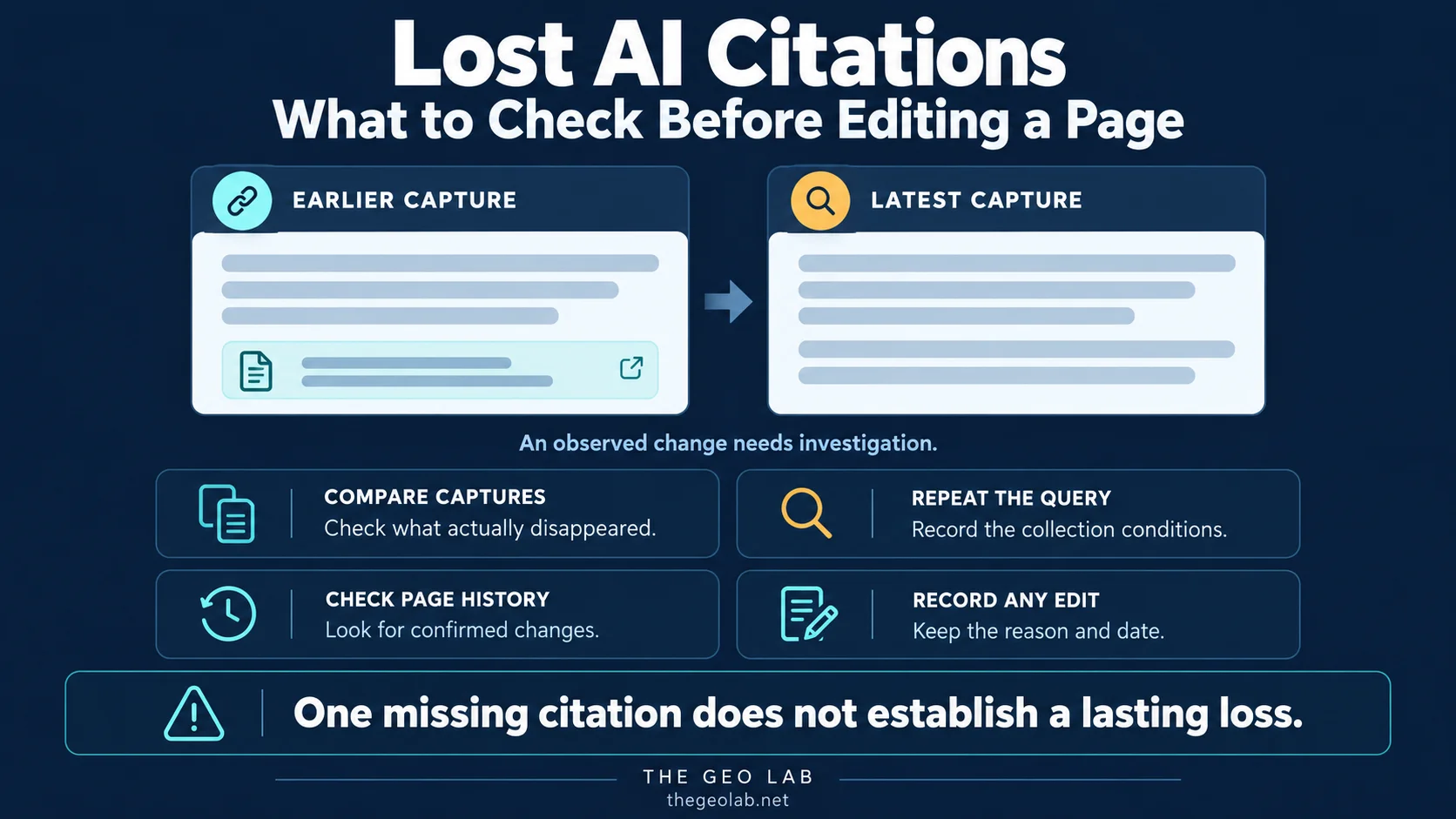
Research synthesis from E027 and E101. A lost AI citations diagnosis checklist, grounded in historical observations, not recovery promises.
TL;DR
A missing AI citation establishes absence in that captured answer, if the capture and classification are valid. It does not establish a lasting loss or explain its cause. Two GEO Lab studies found stable outcomes for some queries and changing outcomes for others. Before editing a page, compare the original and current captures, repeat the query under recorded conditions and check the page’s change history.
Contents
- First establish what has disappeared
- What repeated observations tell us about lost AI citations
- Repeat the observation before diagnosing a lasting citation loss
- Check the page history alongside the captures
- Describe a lost AI citation at the level the evidence supports
- What would strengthen the diagnosis
- Frequently asked questions
A page that was cited yesterday and missing today looks like a lost AI citation. I’d want to know what changed before rewriting it.
The missing link is worth investigating. But an edit made immediately afterwards can complicate the investigation: if the citation returns, was that because of the edit, or would it have returned anyway?
I’d keep the page as it stands while checking the observation, unless there’s an independently confirmed problem that needs fixing. A broken page or inaccurate offer already has its own reason for a correction.
For a lost citation alone, I’d start with the two answers.
First establish what has disappeared
Open the original capture and the new one side by side.
Check whether the earlier answer linked to the exact page, another URL on the same domain or a different business with a similar name. Then check what the current answer contains.
A missing page link, a missing business mention and a missing answer feature are different observations. They should not all become the same lost AI citation alert.
| What changed? | What I’d investigate first |
|---|---|
| The exact page link is absent | Whether another page on the same domain is cited |
| The business is named but unlinked | Whether visible attribution changed |
| The answer feature did not appear | Whether there is an answer available to assess |
| The capture did not complete | Whether the evidence is sufficient to classify it |
| The query or product surface changed | Whether the two observations are comparable |
This is a proposed diagnostic checklist for lost AI citations. It is not a tested repair procedure.
For the distinction between an unresolved capture and an observed absence, see the AI visibility denominator guide. I’d preserve that distinction before investigating the website.
What repeated observations tell us about lost AI citations
I would not assume citations are always stable. I also would not assume every lost citation is random variation.
Two studies in The GEO Lab’s evidence ledger show why both assumptions are too broad.
Going deeper? The GEO Experiments ebook covers how The GEO Lab designs, measures and reports citation experiments.
E027 had stable queries and exceptions
In E027’s deposited study, ten proprietary-concept queries were observed daily through the Perplexity Sonar Pro API from 24 April to 7 May 2026. Across 140 observations, eight queries retained the same citation or non-citation outcome throughout the 14 days. The other two were cited on 5 of 14 and 4 of 14 days.
The exceptions belong in the conclusion. “Eight queries stayed stable in this window” is supported; “one query is enough to establish citation status” is broader than the evidence.
Day 2 was reconstructed from session notes and lacked raw API responses. The study also concerned one site and a small proprietary-concept query set. It was not an independent replication by another team.
E101 observed both presence and absence
In E101’s AI Overview report, one page-query pair produced six cited and three absent outcomes across nine resolved observations on 5 August 2026. A tenth attempt remained unresolved.
The collection included declared browser and API access configurations. It was not a fully controlled sequence with every condition pinned: browser sentinel records were incomplete, and the page was not hashed at every capture.
That supports a narrow observation: this collection contained both citation outcomes for the same nominal page and query. It does not establish a universal rate of variation or identify the mechanism that produced the difference.
These are not contradictory platform verdicts
E027 and E101 used different products, queries, sites and time windows. One involved daily API observations; the other concerned repeated AI Overview observations within a day.
I can use them together to question a universal stability assumption. I cannot use them to conclude that Perplexity is stable and Google is unstable, or to estimate how often citations disappear across either platform today.
Repeat the observation before diagnosing a lasting citation loss
For an apparent lost citation, I’d retain the first capture and collect further observations under recorded conditions.
Keep the query wording fixed. Record the product surface and account state, along with the capture time. If a condition changes, note it so the next review can distinguish the observations.
The query-set comparison guide covers why rewritten questions can complicate a trend. Here, I’d want to know whether the same question continues to produce the lost citation.
Decide the repeat plan before seeing more results
I’d set the collection plan before rerunning the query. Otherwise, it is easy to stop when a reassuring citation appears or keep collecting until an absence looks convincing.
Neither study establishes a universal number of repeats that makes a diagnosis reliable. The plan needs to suit the claim and the collection conditions. A small follow-up can document changing outcomes; it cannot establish long-term stability.
For the collection steps, use the citation-rate measurement protocol. Keep the observations from this investigation identifiable rather than blending them into an unrelated reporting sample.
Check the page history alongside the captures
Once I have established what was observed, I’d compare it with the page’s change history.
| Check | Evidence I’d retain | What it can establish |
|---|---|---|
| Page availability | Response status and accessible content at the check time | Whether the page was available during that check |
| URL changes | Redirect destination and recorded URL history | Whether the cited URL moved |
| Access changes | Recorded crawl or access directives and their change dates | Whether access instructions changed |
| Content changes | Dated versions of the relevant passage | Whether meaning or qualifications changed |
| Verified fetches | Available server-log evidence and verification method | Whether a particular request was recorded |
These checks identify candidate explanations. A change that happened before a missing citation is not automatically its cause.
A verified fetch also does not establish that the page was later cited. Each observation needs to retain what it actually shows.
Fix a confirmed problem for its own reason
If the page is broken, I’d fix it because it is broken. If an offer is wrong, I’d correct the offer.
I’d record the change and continue the citation observations separately. That way, the repair does not become an unsupported claim that an edit “won back” the citation.
If there is no confirmed page problem, I’d avoid a speculative rewrite while collecting the initial evidence. It would add another change to a situation I am still trying to understand.
Describe a lost AI citation at the level the evidence supports
A useful incident note should let someone distinguish the missing observation from the explanation proposed for it.
| Evidence available | Wording I’d use |
|---|---|
| One valid capture without the earlier citation | “The page was not cited in this capture.” |
| Both outcomes across the recorded follow-up | “Citation presence varied across these observations.” |
| No citation across the follow-up window | “No citation was observed in the recorded follow-up.” |
| A page problem confirmed separately | “The page problem was verified and corrected; its effect on citation remains unestablished.” |
| A citation appears after an edit | “The citation appeared after the edit; the edit’s causal effect has not been established.” |
These statements leave room to investigate a lost AI citation without claiming permanent loss, deindexing or a platform penalty from absence alone.
I’d attach the captures and change log to the incident. That gives a later reviewer something more useful than a recollection that the page “used to be cited”.
What would strengthen the diagnosis
I’d want a longer record under comparable conditions before calling the loss persistent over that period.
To investigate a specific edit, I’d need a design that can separate its effect from other changes. A before-and-after screenshot pair will not do that on its own.
The historical studies also need current-platform revalidation before their findings can support claims about present behaviour. E027’s stable queries do not guarantee future stability, and E101’s mixed outcomes do not guarantee future variation.
For this article, their value is the caution they bring to diagnosing a lost citation. The missing link is an observation to explain, rather than an instruction to change the page.
The GEO Lab Takeaway
Keep the earlier answer, save the missing-citation capture and check the page history before making a speculative edit.
If you do change the page, record what changed and why. A citation returning later is another observation; the explanation still needs evidence.
Frequently asked questions
Does one missing AI citation mean my page has lost visibility permanently?
No. It establishes absence in that valid capture. A claim about a longer period needs observations covering that period.
Should I rewrite the page straight away?
I’d first compare the captures and check for a confirmed page problem. If the only issue is a missing citation, a speculative edit adds another change before the diagnosis is clear.
How many repeats do I need?
These studies do not establish a universal minimum. Choose the plan before collection and keep the final claim within what the observations can support.
Can a citation returning after an edit prove that the edit worked?
The sequence shows that the citation appeared afterwards. Establishing the edit’s effect requires a design that addresses competing explanations.
Do the studies show that all AI citations are unstable?
No. E027 contained eight stable queries and two variable ones. E101 recorded both outcomes in one bounded collection. Neither result establishes a rule for every query or platform.
Sources
- E027 dataset: Zenodo DOI 10.5281/zenodo.20085754. Same work family as the paper linked above.
- E101 evidence packet: Zenodo DOI 10.5281/zenodo.21970135.
Ready to apply this? Start with the citation-rate measurement protocol and use the denominator guide to classify your captures correctly.
Have questions about this topic? Contact The GEO Lab · Return to homepage