
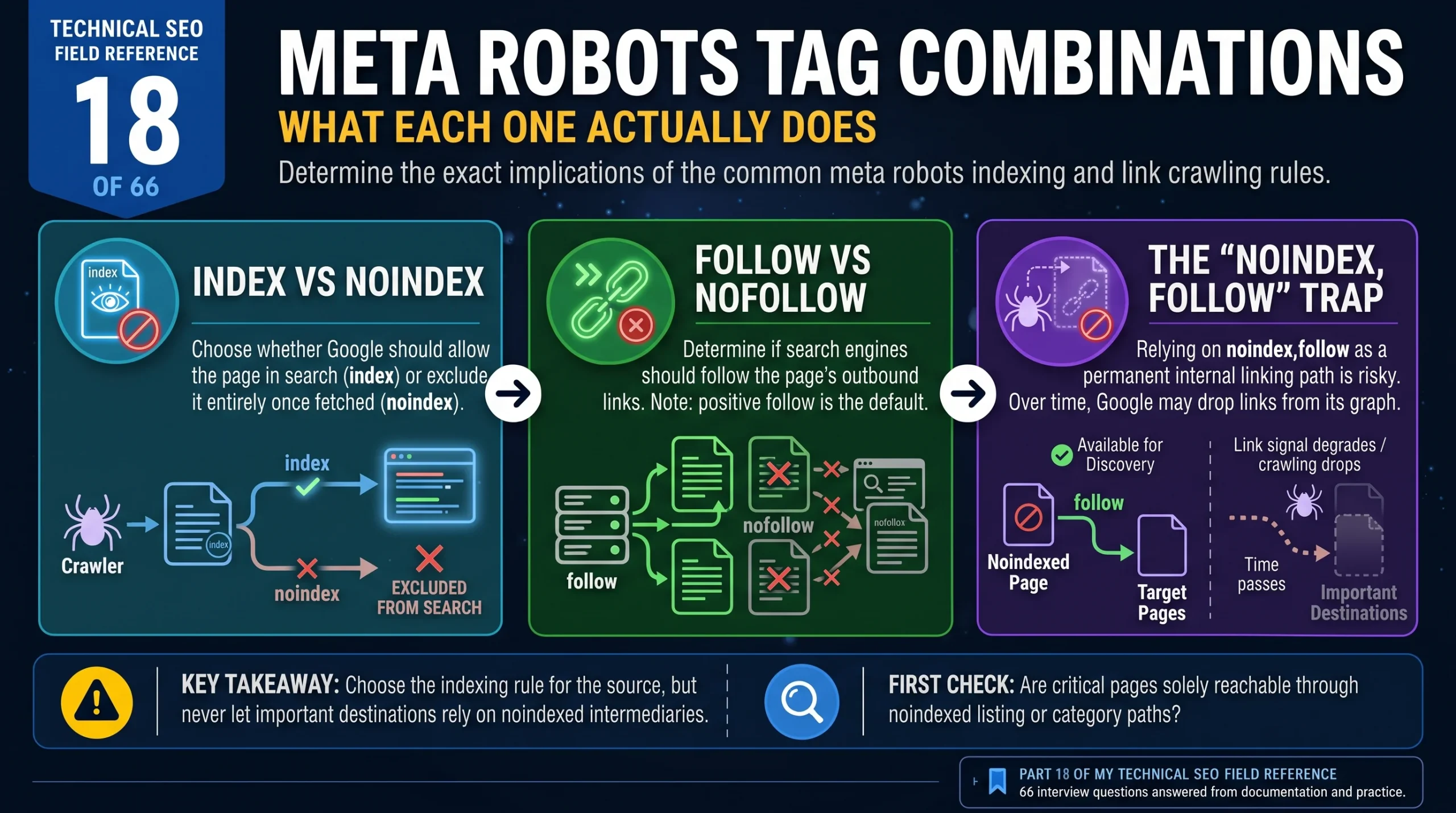
Technical SEO Field Reference, Question 18 of 66. The meta robots tag combinations question, checked against what Google currently documents.
Index,follow expresses Google’s default behaviour; it does not force indexing or link crawling. Noindex excludes a page from search once Google reads it. Page-level nofollow asks Google not to follow that page’s links. Noindex,follow leaves links available for discovery without an explicit nofollow restriction, but it does not guarantee lasting link signals or frequent recrawling. Understanding meta robots tag combinations starts with separating the indexing decision from the link-handling decision.
Noindex,follow sounds like a convenient compromise. Keep the page out of search, but let its links help the pages you do want found.
That is often the intention. The mistake is assuming the word “follow” guarantees that Google will keep revisiting the page and using its links indefinitely.
Question 17, robots.txt versus meta robots, explains why Google must be able to fetch a page to read its tags. This question looks at what the meta robots tag combinations mean once Google has read them.
Why meta robots tag combinations matter
These meta robots tag combinations concern two separate decisions: whether the page can appear in search, and how Google handles links on it.
But the positive words are not commands. Writing index does not make Google index a page. Writing follow does not make it crawl every destination.
That becomes a problem when a site uses noindexed listing pages as the main route to products or articles. The owner may have excluded the listings correctly while assuming that follow preserves their role in discovery and ranking.
Discovery, recrawling and link signals are not the same thing. A tag that leaves links available does not guarantee any particular amount of ranking credit.
What Google says about meta robots tag combinations
Google’s robots meta tag documentation lists the supported rules and explains how to combine them. Indexing and using links for discovery are the unrestricted defaults; positive wording does not force either outcome.
The noindex rule excludes the page from search after processing. Nofollow applies to links on the page. Neither makes the linked destination inaccessible if Google finds it elsewhere.
The long-term noindex,follow warning comes from Mueller’s earlier comments. In a SearchLove interview published in 2018, he discussed why pages dropped permanently from the index could lose their links from Google’s link graph. The interview also references his 2017 explanation of the behaviour.
I would treat that as a warning against relying on those links indefinitely. It does not give us a fixed timetable, establish what happens to every page today, or show that Google always stops fetching noindexed pages altogether.
The practical recommendation is narrower: do not make an important destination depend entirely on a noindexed page for its internal links.
The nofollow footnote
Google’s 2019 nofollow announcement concerned link attributes, including rel="nofollow". Their treatment as hints for crawling and indexing took effect on 1 March 2020.
That announcement should not be used on its own to claim that every robots meta instruction became a hint. Noindex remains an exclusion instruction. For page-level nofollow, use Google’s documented meaning and avoid promising exact PageRank outcomes.
The interview answer for meta robots tag combinations
Index,follow is the default, so writing it does not force Google to index the page or crawl its links.
Noindex,nofollow combines exclusion from search with a request not to follow links on that page. Index,nofollow leaves the page eligible for indexing while applying that link restriction.
Noindex,follow excludes the page without adding a nofollow restriction. I would still avoid relying on it as a permanent source of link signals or the only discovery route to important pages. Mueller has explained the long-term risk, and follow does not guarantee continued crawling.
I would also check that Google can fetch the page. A robots.txt block can prevent it from reading whichever combination you have chosen.
An internal linking example involving meta robots tag combinations
Consider a site with internal listing pages it wants excluded from search. Those pages contain useful links to products the owner wants indexed.
The listings are set to noindex,follow. The intention is understandable: remove the listings from results while keeping their links available.
If some products later appear as Crawled – currently not indexed, that status does not prove the listings caused the problem. It also does not establish that Google stopped following their links. Google has fetched those product URLs, and indexing involves other decisions.
I would inspect the architecture and logs. Are those listings the products’ only internal link source? How often does Googlebot revisit them? Are products reachable from indexable categories? Have the products themselves changed?
If the destinations depend entirely on noindexed intermediaries, I would add relevant links from crawlable, indexable pages. That removes the dependency without needing to claim that every noindex,follow tag has turned into noindex,nofollow.
The four meta robots tag combinations, one by one
Index,follow
You usually do not need to write this explicitly. It describes the default.
Check for restrictive tags or headers elsewhere in the response. Adding index,follow does not cancel a noindex rule delivered through another applicable tag or header.
Noindex,nofollow
Use this when you want the page excluded from search and also want page-level nofollow.
It does not make the page private. If people should not be able to access the content, require authentication. Nor does nofollow stop Google finding the destinations through links on other pages.
Index,nofollow
This leaves the page eligible for indexing and applies nofollow to all its links.
That is a broad choice. If only a few links need qualification, consider appropriate link-level attributes instead of applying the setting across the page.
Noindex,follow
This can be a valid setting for a page you do not want in search. It is not inherently limited to temporary pages.
The limitation concerns what you expect from its links. Do not assume that excluding the page preserves its link signals indefinitely, or that adding follow commits Google to revisiting it.
For a retired page, assess whether a redirect or another response better fits the situation. Noindex,follow is not automatically a retirement strategy.
What to check after changing meta robots tag combinations
Inspect both the HTML head and the HTTP response headers. Templates, plugins and server settings can add separate instructions.
Then check representative URLs in Search Console to see what Google has processed. Use verified crawl logs if you are investigating changes in recrawl frequency.
For important linked destinations, inspect their other internal paths too. A sitemap can help discovery, but it does not replace a considered internal linking structure.
The interview trap on meta robots tag combinations
The main mistake is presenting noindex,follow as a guaranteed way to preserve link equity while excluding the source page.
Explain the intended setting, then its limits. Mueller’s historical warning supports avoiding that architectural dependency; it does not justify inventing a deadline for when the links stop working.
The smaller mistake is proposing index,follow as an indexing fix. It adds no promise that Google will store or rank the page.
Takeaway
Choose the indexing rule for the source page, then check how its destinations are linked elsewhere.
If an important product or article depends entirely on a noindexed listing, give it another relevant internal link path. The word follow is not a guarantee that Google will keep using that route.
Have questions about this topic? Contact The GEO Lab · Return to homepage