
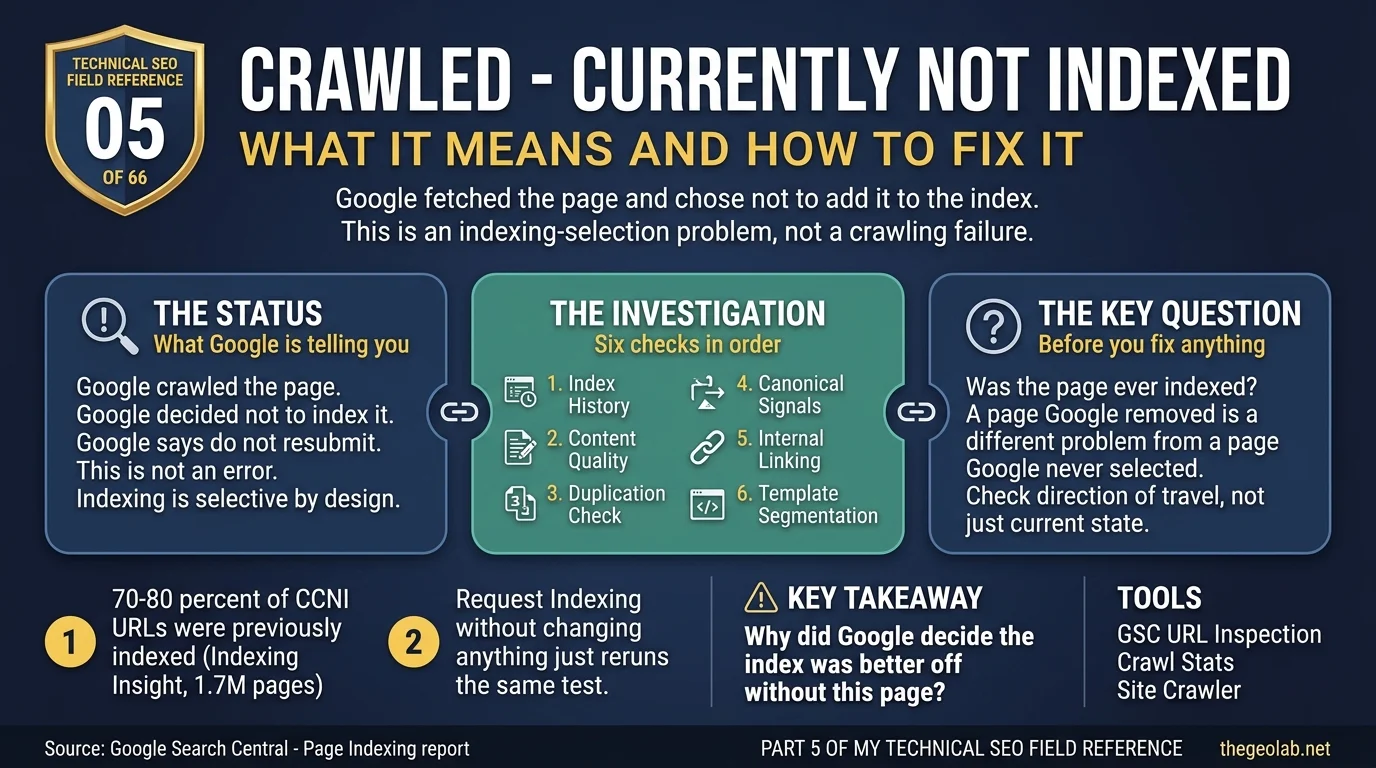
Technical SEO Field Reference, Question 05 of 66. The interview answer, checked against what Google currently documents.
Crawled – currently not indexed is a Google Search Console status meaning Google fetched the page but chose not to add it to the index. It is not a crawling failure, and Google’s own Page Indexing documentation says there is no need to resubmit the URL. So the investigation should start with the page and the signals around it: content quality, duplication and canonicalisation, internal linking, and whether the URL was ever indexed in the first place.
Every SEO has stared at this status.
And most of us, at some point, have clicked Request Indexing and hoped for the best.
The problem is that the status is basically Google saying: “I saw the page. I decided not to keep it.” That makes it uncomfortable, because the fix usually isn’t a button. It’s an indexing-selection problem. And what you do next tells me whether you understand that difference or whether you’re just trying to push the URL back through the same process again.
What Google actually says about crawled – currently not indexed
Google’s definition is pretty clear. The page was crawled, but it wasn’t indexed. It may or may not be indexed in the future, and Google says there is no need to resubmit the URL for crawling.
Three things matter here. First, Google already fetched the page. So this is not a discovery problem and it is not a crawling problem. Second, this is not automatically a penalty or an error. Google does not index every page it crawls. Indexing is selective by design, and the factors that influence how Google crawls are separate from what it chooses to index. And third, Google itself tells you not to keep resubmitting the URL. That last point matters because “request indexing again” is probably the most common response to this status.
The crawled – currently not indexed interview answer
If I had to answer this in an interview, I’d keep it simple:
Crawled – currently not indexed means Google fetched the page and decided not to index it, so I’d treat it as an indexing-selection problem rather than a crawl failure.
I’d investigate the page’s quality and uniqueness, duplication and canonical signals, internal linking, and whether the URL was previously indexed. That last check matters because a page Google removed from the index is a different problem from a page Google never selected in the first place.
How I’d investigate crawled – currently not indexed
I wouldn’t start editing pages randomly. I’d start by working out what kind of problem I actually have.
1. Check the history first
Was the URL ever indexed? That’s my first question. I’d look at Google Search Console URL Inspection, previous rankings, previous organic traffic, and site-search spot checks where useful. A URL that has never been indexed is one thing. A URL that ranked for months and then dropped into crawled – currently not indexed is telling me something very different. That distinction changes the whole investigation.
2. Look at content quality and uniqueness
Next, I’d ask the uncomfortable question: does the index actually need this page? Not “is the page technically indexable?” but “does it add enough value to justify being there?” I’d look for thin template pages, near-empty categories, boilerplate-heavy pages, automatically generated copy, and pages that barely differ from stronger URLs already indexed. This is a different shape of the same crawl trap problem. If ten URLs are saying basically the same thing, Google does not need all ten.
3. Check duplication and canonicalisation
Then I’d look for a stronger sibling. What canonical did Google select? Is there another URL covering the same intent? Are parameter variants competing with the clean version? Are multiple pages targeting the same topic with only minor differences? Sometimes the problem isn’t that Google dislikes the content. It’s that Google thinks another URL is the better representative.
4. Check internal linking
Then I’d look at what the site itself is saying about the page. Does anything important link to it? Where does it sit in the architecture? Is it buried five levels deep? Is it effectively orphaned apart from the XML sitemap? Weak internal linking doesn’t prove a page should be excluded, but if your own site barely acknowledges the URL, retrieval probability drops and, it’s hard to argue that Google should treat it as important.
5. Segment the problem
This is where I think a lot of crawled – currently not indexed investigations go wrong. If you have 20 affected URLs, you can inspect them individually. If you have 20,000, you need patterns. I’d group affected URLs by template, directory, content type, page purpose, publication period, and canonical behaviour. Because crawled – currently not indexed at scale is usually not 20,000 separate problems. It’s usually one or two template, quality or duplication problems repeated thousands of times.
6. Accept that some cases are fine
Not every crawled – currently not indexed URL needs fixing. You can see perfectly legitimate URLs in this state: paginated URLs, feeds, expired products, URLs that consolidate elsewhere, low-value archive pages. Sometimes the correct outcome is: do nothing. The skill is separating pages that genuinely deserve indexing from pages where Google’s decision is perfectly reasonable.
Quick crawled – currently not indexed investigation table
| Check | What I look at | What it tells me |
|---|---|---|
| Index history | URL Inspection, previous rankings and traffic | Removed vs never selected |
| Content quality | Page value compared with indexed competitors | Whether the page deserves selection |
| Duplication | Google-selected canonical, similar URLs | Whether another page won instead |
| Internal linking | Links in, anchor text, depth | Whether the site signals importance |
| Segmentation | CCNI URLs grouped by type or directory | Individual problem vs systemic problem |
A real-world crawled – currently not indexed example
Say a content site has 1,200 published articles. Google Search Console shows 300 URLs as crawled – currently not indexed. Looking at 300 URLs one by one would be painful and mostly pointless. So I segment them.
220 of the 300 are tag archive pages. That may be perfectly fine. The remaining 80 are articles. Now it gets interesting. Of those 80 articles, 70 were previously indexed. That completely changes the interpretation. These are not pages waiting patiently to enter the index. Google had them. Then it removed them.
And those 70 pages all sit in the same directory: short articles covering topics that are now handled better by newer, more complete pieces elsewhere on the site. Now I have a pattern. The fix isn’t “submit all 70 again.” It’s editorial. Some should be expanded. Some should be merged. Some may need redirecting to a stronger replacement. Others may not deserve to exist anymore.
The technical detail behind crawled – currently not indexed
Here’s the part I find most interesting. Google’s wording can sound like the page is sitting in some kind of waiting room: “It may or may not be indexed in the future.” But observed data suggests that isn’t always the right mental model. Indexing Insight, analysing 1.7 million pages, reported that roughly 70-80% of URLs carrying this status had previously been indexed.
That’s an important distinction. If the same pattern exists on your site, crawled – currently not indexed is often not a queue. It’s an exit. Google had the page in the index, evaluated it again and removed it. That’s why checking history is step one. The Search Console status tells you the page’s current state. Its history tells you which direction it was travelling. This is a core principle across the GEO Stack: measure the direction, not just the state. And that changes the diagnosis completely.
One other distinction matters: Discovered – currently not indexed is an earlier-stage problem. Google knows about the URL but hasn’t crawled it yet. That needs a different investigation, and it connects to the crawl budget and crawl budget optimisation questions in this series.
The crawled – currently not indexed interview trap
The obvious trap is: “Just request indexing.” That sounds practical. Usually it isn’t.
The subtler trap is treating every crawled – currently not indexed URL as something broken. Some of those URLs are exactly where they should be. So before fixing anything, I’d divide the report into three buckets: correct behaviour (pages I don’t particularly need indexed), quality decisions (pages Google has seen but doesn’t currently think deserve a place), and signal conflicts (pages where duplication, canonicals or internal linking may be pointing Google somewhere else). That segmentation is more useful than treating the whole report as one giant indexing emergency.
Takeaway
I wouldn’t ask: “How do I get these pages indexed again?” I’d ask: “Why did Google decide the index was better off without them, and is that decision actually wrong?”
Because once Google has already crawled the page, repeatedly asking it to look again isn’t much of a strategy. You need to give it a reason to make a different decision.
Part 05 of my Technical SEO Field Reference: 66 interview questions answered from what Google currently documents, what we observe in practice, and where the two do not match.
Have questions about this topic? Contact The GEO Lab · Return to homepage