
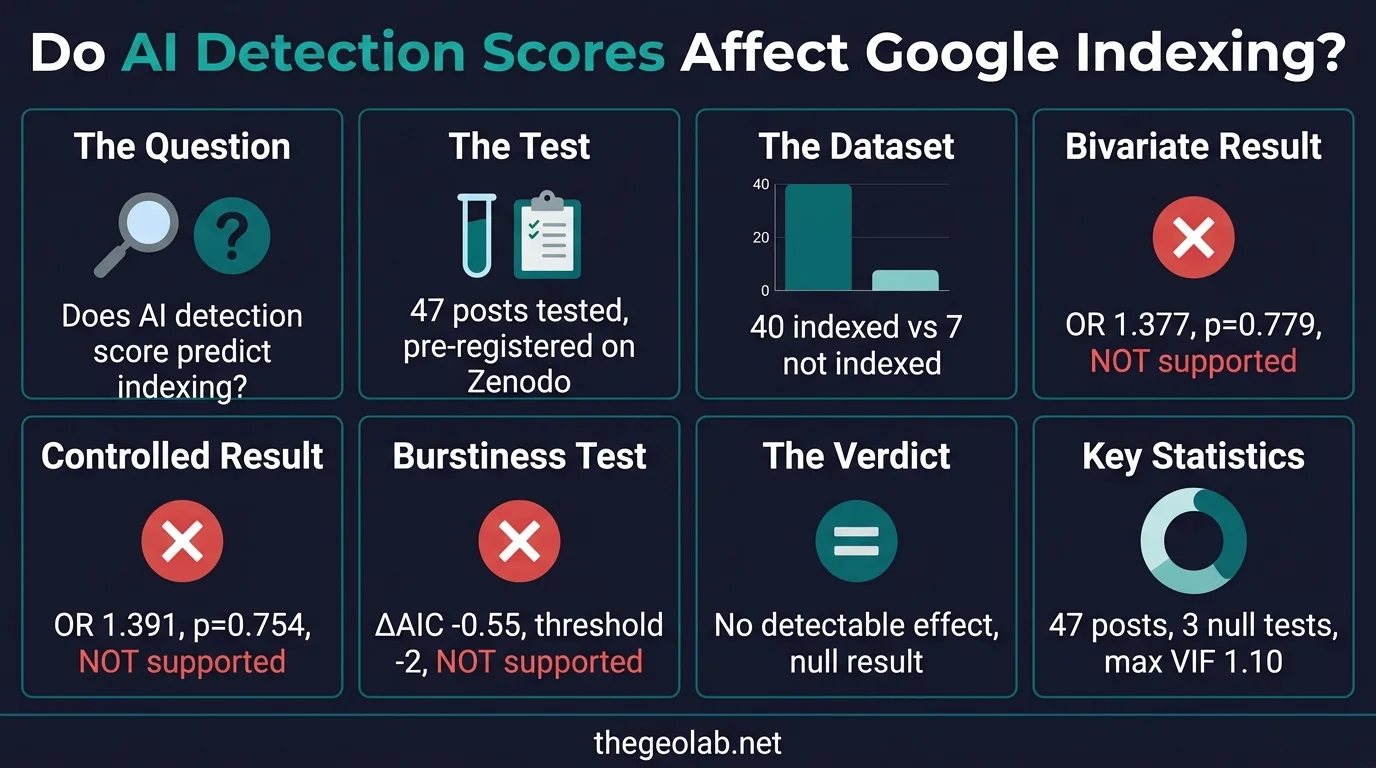
Experiment E064. Pre-registered analysis of whether AI detection scores predict Google indexing, tested across 47 posts.
The claim: higher AI detection score, lower indexing rate
Short answer: I couldn’t find any evidence that AI detection scores affect whether Google indexes it. I tested 47 posts on The GEO Lab, pre-registered the analysis before I looked at the results, and the relationship simply wasn’t there. It was weak, statistically non-significant and, if anything, pointed slightly the opposite way.
That doesn’t prove AI detection scores have no relationship with indexing. This is one site, 47 posts and only seven non-indexed pages. But it does give a reason to question a claim I’ve seen repeated far more confidently than the evidence behind it.
The claim is simple: the higher a page’s AI detection score, the less likely Google is to index it. Jesper Nissen shared it on LinkedIn on 29 May 2026, based on correlation data from Primeindexer. Of the eight points in that post, this was the one that caught my attention, because it made a specific prediction I could actually test.
If AI detection score really predicts indexing, I should be able to see that relationship in my own pages. So I tested it.
Why the raw AI detection score correlation is not enough
Comparing AI scores and indexing rates directly has an obvious problem. Thin, repetitive and formulaic content can score highly on AI detectors, and that same content may struggle to get indexed for completely different reasons. So if you find that high-AI-score pages are indexed less often, you haven’t shown the AI score did it. You might just be watching weaker content produce both outcomes.
That’s why the question that matters is whether the relationship survives once you account for things like content length and age. There’s also a more interesting mechanism underneath. Google’s leaked Content Warehouse documentation included a field called contentEffort, described as an LLM-based effort estimate for article pages. If Google is estimating effort, an AI detector could correlate with indexing without Google caring about the AI score at all: low-effort content might simply be more likely to look AI-written. In that case the detector score is the passenger, not the driver.
How I tested it
I took 47 posts from The GEO Lab and compared an AI-likelihood signal against their actual indexing status in Google Search Console, with the analysis pre-registered on Zenodo before I ran it. I’d planned to use Originality.ai, but couldn’t reach it through the API from my server. Rather than quietly swapping instruments after seeing the results, I documented the change in the pre-registration and used GPT-2 perplexity as an open, reproducible proxy, where lower perplexity means more predictable, more AI-like prose.
That distinction matters: I’m testing the broader claim that AI-like writing predicts indexing, not validating or invalidating Originality.ai specifically. Indexing came from the Google Search Console URL Inspection API. The final dataset contained:
- 40 submitted and indexed posts
- 7 crawled but not indexed posts
- 47 indexable pages in total
Redirects and URLs Google didn’t know about were excluded. I then tested indexing against perplexity on its own, then a model controlling for post age and word count, and finally whether adding burstiness improved the model. Because 47 pages is a small dataset, I fixed the limitation in advance: whatever came back would be directional evidence, not a new SEO rule. That pre-registration discipline runs through the whole series, the same reason I keep replication checks like the 14-day intra-day citation stability on Perplexity test.
The result: AI detection scores null across every test
All three pre-registered tests came back null. Nothing dramatic, and that’s the point. The bivariate model gave an odds ratio of 1.377, with a 95% confidence interval from 0.611 to 3.104 and a one-tailed p-value of 0.779. Controlling for post age and word count barely moved it: OR 1.391, p = 0.754. Adding burstiness didn’t rescue the hypothesis either, improving AIC by just 0.55, nowhere near the threshold of 2 I’d set as meaningful. Collinearity wasn’t hiding anything, with a maximum VIF of 1.10.
| Test | N | Result | Key statistic |
|---|---|---|---|
| Bivariate (H1) | 47 | Not supported | OR 1.377, 95% CI 0.611 to 3.104, p₁ 0.779 |
| Confound-controlled (H2) | 45 | Not supported | OR 1.391, p₁ 0.754 |
| Burstiness gain (H3) | 45 | Not supported | ΔAIC −0.55 (threshold −2) |
| Collinearity (VIF) | 45 | Interpretable | max VIF 1.10 |
Table 1. Pre-registered results for E064 (AI detection score vs Google indexing, The GEO Lab, 47 posts). All three tests null; the controlled estimate is interpretable.
The coefficient did keep pointing the opposite way from the original claim: more human-typical prose was weakly associated with higher odds of indexing. But I want to be clear, because this is exactly where a null gets overread. I did not find a reverse effect. At a p-value near 0.78, the sensible reading is no detectable effect at all.
What this does and does not say about AI detection score
This is directional evidence, not a debunk, and it does not become an audit rule. What it says: across these 47 posts, an open AI-likelihood signal showed no association with indexing, and an independent, confound-controlled test failed to reproduce Nissen’s claim. What it doesn’t say is that AI detection scores definitely don’t matter. There were only seven non-indexed pages, nowhere near enough to rule out a smaller relationship.
The instrument caps it further. GPT-2 perplexity is a crude measure for modern AI-written technical content: it captures predictability and stylistic uniformity, not who or what actually wrote the page. So a null here has two possible explanations, and this experiment can’t separate them: either the relationship isn’t there, or my instrument isn’t sensitive enough to catch it. That’s the same reason I hold a measured day-scale citation noise floor for citation work, so I know what “no effect” looks like before claiming one. It’s also why I wouldn’t turn this into an SEO rule any more than I’d use the original correlation as one.
What I’d do with these AI detection scores
I wouldn’t rewrite a page just because an AI detector gives it a high score. If content is thin, repetitive, poorly structured or doesn’t answer the query, fix those things; they matter independently of any detector. But I found no evidence here that lowering an AI detection score, on its own, earns an indexing benefit.
The next test needs to be much bigger: a corpus with known human-written and AI-written content, a current detector, many more non-indexed pages, and enough observations to test the controlled relationship properly. That could either reproduce the effect or give much stronger grounds for retiring the claim. For now the result is simpler. Forty-seven posts tested, no detectable relationship between the AI-likelihood signal I measured and Google indexing. The full pre-registration and analysis are on Zenodo under DOI 10.5281/zenodo.20529052 for anyone who wants to check the numbers or replicate it.
FAQ
Does a high AI detection score stop Google from indexing a page?
Not in this test. Across 47 posts, AI detection score showed no significant association with whether Google indexed the page, and the weak trend actually ran the opposite way. The sample is small, so treat this as directional rather than proof, but there was no detectable indexing penalty here.
Should I rewrite content that Originality.ai flags as AI-written?
Not for the score alone. Thin or unstructured content does index poorly, for its own reasons, and that’s worth fixing. But rewriting purely to lower a detector number, with nothing else changed, showed no indexing benefit in this data. Fix depth, structure and how well the page answers the query, not the detector reading.
Why use GPT-2 perplexity instead of Originality.ai?
Originality.ai wasn’t reachable through the API on my server, so I used GPT-2 perplexity as an open, reproducible proxy, where lower perplexity means more predictable, more AI-like prose. That tests the general claim that AI-like writing predicts indexing, rather than Originality.ai specifically. The trade-off is that GPT-2 is a weak, dated instrument, which I’ve flagged as a limit on the result.
Does this debunk the AI-detection-hurts-indexing claim?
No. With only seven non-indexed pages, the study is underpowered to falsify anything, and the finding is explicitly directional. It shows the claim didn’t reproduce on an independent, confound-controlled corpus, which is a reason for doubt, not a refutation. A larger corpus with real authorship labels is needed to settle it.
Have questions about this topic? Contact The GEO Lab · Return to homepage