
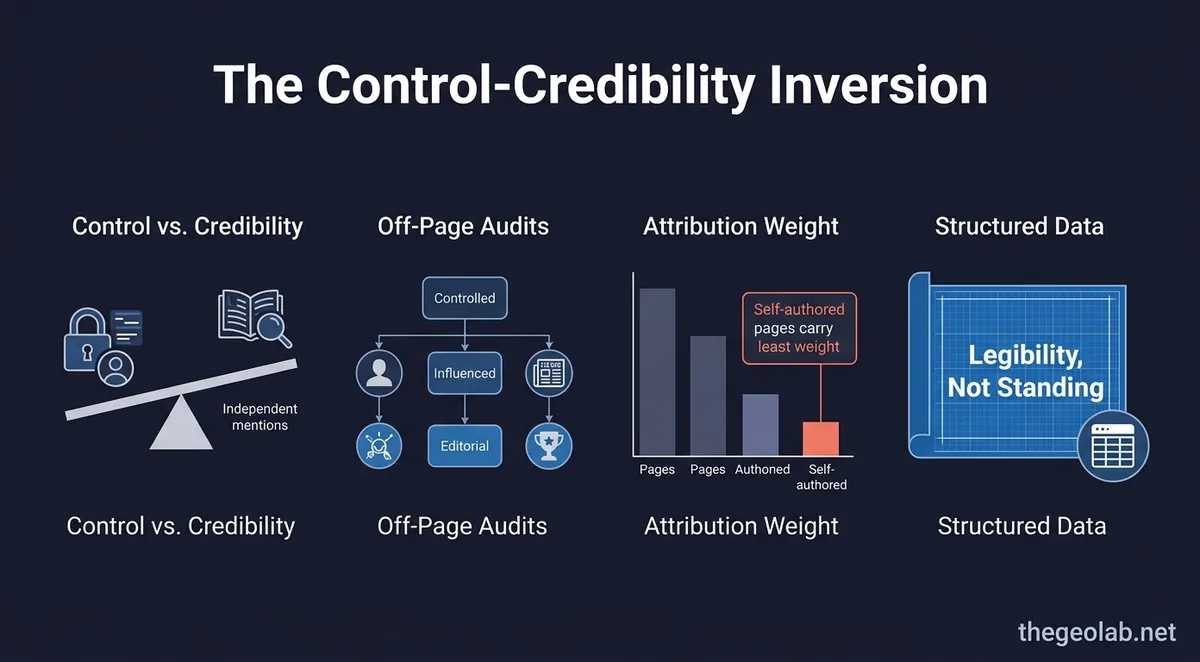
The control-credibility inversion means the pages you can edit are the pages engines trust least. Control and credibility run in opposite directions, and that changes which tier of your off-page footprint you should fix first.
TL;DR
The control-credibility inversion is the observation that the off-page sources you can most easily edit carry the least attribution weight. Editable means self-authored, and self-authored means marketing copy. Off-page audits sort brand mentions by how much control you have over them: profiles and directories sit at one end, editorial coverage at the other. The standard advice is to fix what you control first. That priority is backwards. The GEO Lab’s entity-density experiment found 0% competition citation rate across all density levels. Domain authority gates citation eligibility. The tier you control most is the tier that persuades least, and the same structural constraint holds for off-page work: start where you have no control, because that is where the credibility lives.
What the control-credibility inversion actually says
The control-credibility inversion describes a control-credibility inversion in off-page audit priority. The advice going round is that you should audit your off-page footprint, sort the results into what you control, what you can influence, and what is purely editorial, then start fixing the tier you control. That last step is backwards. The sources you can edit are the sources an engine has the least reason to trust, because editable means self-authored, and self-authored means marketing copy. Control and credibility run in opposite directions. Start where you have least control.
The audit itself is sound. It is the priority order that is wrong. The GEO framework reorders this, and underneath the priority order sits a bigger problem: the genre has no concept of an authority gate, so it cannot tell you when any of this stops working.
The tiers are usually drawn as three bands. Green is what you own or can directly edit, which typically means your review-site profiles, your company directory listings, your professional-network pages. Amber is what you can influence but not edit, meaning journalists, podcasters, and people who might cover you if asked. Red is editorial coverage you cannot touch.
Ranked by how much control you have, green wins. Ranked by how much attribution weight the source carries, green loses, and it loses badly. A page you wrote about yourself on a platform that lets anyone write about themselves is the weakest possible evidence that a claim about you is true. It is the same signal class as a self-authored review, and the same signal class as a testimonial nobody can verify.
So the correct reading of the triage is inverted. The green tier is where you have the most control and the least to gain. The red tier is where you have no control and where the attribution weight lives. Time spent polishing your own directory listing is time spent optimising the tier that moves the needle least.
The useful step in the whole exercise is reading the red tier, not editing the green one. What do independent sources say about you, and what gap is there between that and what you say about yourself? That gap is the finding. Closing it is a digital PR problem, not a markup problem.
Going deeper? The GEO Authority Playbook covers advanced citation strategy, including how authority signals interact with the retrieval pipeline.
The triple that is not a triple
The version of this advice that circulates most widely tells you to write sentences about your brand in subject-predicate-object order, describes those sentences as semantic triples, and implies that a model stores them as facts.
A semantic triple is a machine-parsed subject-predicate-object statement in RDF, expressed through schema.org or Wikidata or an equivalent vocabulary. It is the substrate the Knowledge Graph is built on. It is stored, queried, and reasoned over as a structured record.
A body sentence written in subject-predicate-object order is a clear declarative sentence. A language model reads it as text. Nothing about the word order causes it to be stored as a triple, because nothing in the pipeline is parsing your prose into RDF.
The advice borrows the authority of a formal knowledge representation and spends it on prose styling. What survives the swap is real but much smaller: clear declarative sentences extract better than hedged narrative ones, which is a structural claim about extractability, not a claim about the model learning what you are. Write the clear sentence without telling yourself you have written a triple.
We ran the rigorous version of this and it returned nothing
The obvious objection is that prose triples are a weak proxy, and the strong version would work. Deploy the real structured data, the argument goes, and the model will stop guessing and start repeating your narrative.
We pre-registered exactly that test on our own domain before collecting any data. The intervention was the real thing rather than a proxy for it: a persistent researcher identifier expressed as a structured node, archived publication identifiers marked up as scholarly work, a unified entity graph binding person to organisation to published concepts, and corresponding items created in the open knowledge base the advice points at.
The result was null on category-level queries. The structured facts were valid, the markup parsed, the entity graph was internally consistent, and the citation behaviour on the queries that mattered did not move above the 22-percentage-point threshold at which we consider an effect interpretable at all, which is the noise floor our repeated baseline runs established. The open knowledge base then deleted the person item within a day as failing its notability criteria, which is itself the point stated more bluntly than any experiment could state it.
The mechanism that explains the null is the authority gate. Structured data is legibility. It helps a system parse what you are. It does not confer standing on a claim, and on a contested category query the engines are not short of parseable, credible sources. Below the gate, better markup gets you cleanly understood and still uncited. The genre never mentions this, because the genre has no gate in its model of the world.
Above the gate, the structural work does pay. That is not a contradiction. It is the whole reason the gate is worth naming.
The operator most people are copying is backwards
A practical note, because this one propagates by copy-paste.
The search operator printed in these posts is usually some form of site:yourbrand.com "yourbrand". That returns your own pages on your own domain. It is the precise opposite of an off-page footprint.
The operator you want is "yourbrand" -site:yourbrand.com, which excludes your domain and returns what everyone else has published about you. Run it past the first page, because the interesting material is rarely in the top ten.
If an audit template hands you an operator that surfaces your own site while claiming to audit your off-site presence, treat that as information about the template.
What to do instead
Read the tier you cannot edit, and read it deeply enough to find the narrative gap. That gap is the only output of this exercise that tells you something you did not already know.
Fix factual errors wherever they sit, including the green tier, because a wrong association propagates and an entity edge responds to consistent structured correction in a way a narrative does not.
Deploy real structured data because it makes you legible to machines, and hold that claim at its true size. Legibility is not standing.
Then ask the question the genre never asks, which is whether you are above the authority gate on the queries you care about. If you are not, the markup is not the binding constraint, and no amount of it will become one.
Control and credibility run in opposite directions. The tier of your off-page footprint you can edit most easily is the tier that carries the least attribution weight.
A pre-registered test of real structured entity data returned no interpretable citation-rate change on category queries. Structured data is legibility, not standing. Below the authority gate, it is not the binding constraint.
The control-credibility inversion says: read the tier you cannot control. The gap between what independent sources say about you and what you say about yourself is the only finding worth acting on.
Ready to apply this? The AI Visibility Diagnostics Console surfaces off-page signals alongside citation data. See the GEO Brand Citation Index for cross-platform citation tracking.
Questions? Contact The GEO Lab.
Frequently Asked Questions
What is the control-credibility inversion?
The control-credibility inversion is the observation that the sources you can most easily edit (your own profiles, directory listings, marketing pages) carry the least attribution weight, because they are self-authored. The sources you cannot edit (independent coverage, editorial mentions) carry the most weight, because they are third-party evidence. Control and credibility run in opposite directions.
What is a semantic triple?
A semantic triple is a structured subject-predicate-object statement expressed in a machine-readable vocabulary such as RDF, schema.org or Wikidata. It is stored and queried as a record. A prose sentence written in subject-predicate-object order is not a semantic triple, because nothing in a language model’s pipeline parses body copy into RDF.
Does structured data help you get cited in AI search?
Structured data makes a page legible to machines, which is a real and separate benefit. It does not by itself confer the authority a source needs to be cited on a contested query. In a pre-registered test on our own domain, deploying structured entity data returned no interpretable change in citation rate on category-level queries.
How do I audit my off-page footprint?
Search your brand name while excluding your own domain, using "yourbrand" -site:yourbrand.com, and read well past the first page. Sort what you find by how much control you have over it, then work the tiers you control least, because those carry the most attribution weight.
What is the authority gate?
The authority gate is the threshold above which structured data and entity signals begin to affect citation rate on contested queries. Below the gate, better markup makes you more legible but does not move the citation needle. Above the gate, it pays. The gate is determined by domain authority relative to the competitive set for a given query, not by the quality of your markup alone.