
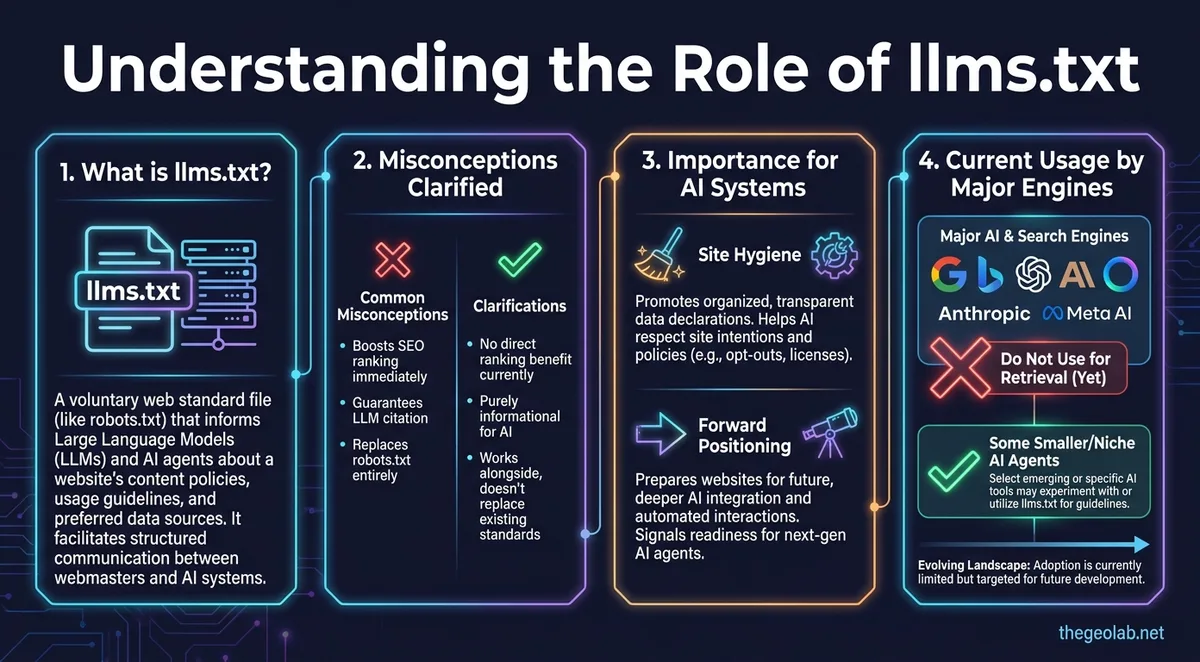
llms.txt is a proposed standard that gives AI systems a curated map of a site’s important content. It is reasonable site hygiene and forward positioning, but it is not a citation lever. The GEO Lab’s E042 work found citation-rate differences were driven by content and retrieval probability, not by the presence of llms.txt. Sites with the file showed no citation advantage on category queries. The major AI engines do not currently consume it as a retrieval or ranking input. Maintain it as low-cost hygiene; do not expect it to move citation rate.
What llms.txt is
llms.txt is supposed to help AI systems understand your site. The GEO Lab has one. We still measured no citation-rate advantage on category queries that could be attributed to its presence. The honest assessment of what llms.txt does is narrower than the way it is usually sold, and getting the distinction right saves you from over-investing in a file that is not the lever it is presented as.
llms.txt is a proposed standard: a plain-text or markdown file at the root of a site that gives AI systems a curated map of the site’s most important content, in a clean format that is cheap to parse. The intent is reasonable. A model that wants to understand a site can read a structured summary instead of crawling and parsing every page. As a piece of site hygiene and a statement of what matters on a site, it is sensible to have.
The problem is the gap between what the file provides and what practitioners assume it buys. The assumption is that publishing llms.txt raises citation rate. The mechanism for that does not currently hold up to measurement.
Going deeper? The GEO Glossary defines llms.txt, ai.txt, and 200+ other AI search terms with practitioner-level precision.
What the measurement shows
The GEO Lab’s E042 experiment compared citation behaviour across competitors with differing technical setups. Sites with llms.txt, and even sites with both llms.txt and ai.txt, did not show a citation-rate advantage that tracked with the presence of those files. The differences in citation rate were driven by content and retrieval rank, not by whether a site published an llms.txt. Our own site has llms.txt and still measures no citation lift attributable to it on category queries.
The reason is that the major AI search engines do not currently appear to consume llms.txt as a retrieval or ranking input in the way the file’s promise implies. Retrieval is driven by the engine’s own crawling, indexing and relevance scoring of actual pages. A curated map at the root does not insert your pages into a retrieval set they would not otherwise enter. The file describes the site. It does not change how the site is retrieved.
What it does not do
llms.txt does not raise citation rate on its own. It does not substitute for the work that actually moves citation, which is content that answers queries in extractable form on a domain that has cleared an eligibility threshold. It does not guarantee that any AI system reads it, because adoption of the standard by the engines is uneven and not transparently documented. Treating it as a GEO lever puts effort into a file when the same effort spent on extractable, retrievable content would produce measurable results.
| Claim about llms.txt | Evidence | Verdict |
|---|---|---|
| Raises citation rate | E042: no citation advantage on category queries | Not supported |
| Engines consume it as retrieval input | No transparent documentation of consumption | Not confirmed |
| Useful as site hygiene | Low cost, declares canonical pages | Reasonable |
| Forward positioning value | If adoption grows, file is already in place | Reasonable |
This is a Structural Authority question at its core. llms.txt is a structural signal: it declares what the site is and which pages matter. But structural signals that are not consumed by the retrieval pipeline do not earn citations, and the current evidence is that this one is not consumed that way.
What it is reasonably for
llms.txt is worth maintaining as low-cost site hygiene and as forward positioning. If adoption grows and engines begin consuming it as a signal, having a clean, current file in place costs little and may help later. It is a reasonable statement of which pages a site considers canonical and important. Just hold it in the right category: a tidy, optional, possibly-future-useful file, not a current citation lever.
One practical note for anyone maintaining one. If your llms.txt is generated by a plugin, confirm whether it updates automatically when you publish. On some setups it becomes static and needs a manual update after each new post, otherwise it silently drifts out of date and stops reflecting the site it is meant to describe. The WordPress GEO setup guide covers this verification step alongside other infrastructure checks.
- llms.txt is site hygiene, not a citation lever. The GEO Lab’s E042 data found no citation advantage from its presence. Citation rate is driven by content and retrieval rank.
- The major engines do not consume it as a retrieval input. Retrieval is driven by crawling, indexing and relevance scoring of actual pages. A curated map at the root does not change that.
- Maintain it as low-cost forward positioning. If adoption grows, having a clean file in place costs little. Do not prioritise it over extractable content.
- Check whether yours auto-updates. Some setups make llms.txt static. After each new post, verify the file reflects the current site or update it manually.
Want to measure what actually moves citation rate? The 30-check citation protocol separates retrieval from citation across platforms, so you test content, not infrastructure files.
Questions? Contact The GEO Lab.
Frequently asked questions
Does llms.txt improve AI citation rate?
Not on its own. The GEO Lab’s E042 work found citation-rate differences were driven by content and retrieval rank, not by the presence of llms.txt. Sites with the file, including those with both llms.txt and ai.txt, showed no citation advantage attributable to it on category queries.
What is llms.txt for?
It is a proposed standard that gives AI systems a clean, curated map of a site’s important content at the root. It is reasonable site hygiene and a statement of which pages are canonical, but it is not a current citation lever, because the major engines do not appear to consume it as a retrieval or ranking input.
Should I bother creating an llms.txt?
It is low cost, so it is reasonable to have for hygiene and forward positioning in case adoption grows. Just do not expect it to raise citation rate, and do not prioritise it over extractable content on an eligible domain, which is what actually moves citation.
Does llms.txt update automatically?
No, llms.txt is a static file by default and must be updated manually after each new post or content change. Some CMS plugins and static-site generators can regenerate it automatically, but most implementations require a manual edit. If the file is not kept current it drifts out of date and stops describing the site accurately, so check whether your deployment auto-updates or requires a manual step.
Is llms.txt the same as robots.txt for AI?
No. robots.txt controls crawl access, which pages an AI crawler is allowed to fetch. llms.txt describes site structure, which pages the site considers important. They serve different purposes. robots.txt affects whether a page can be retrieved at all; llms.txt is an informational declaration that does not currently affect retrieval or citation.