
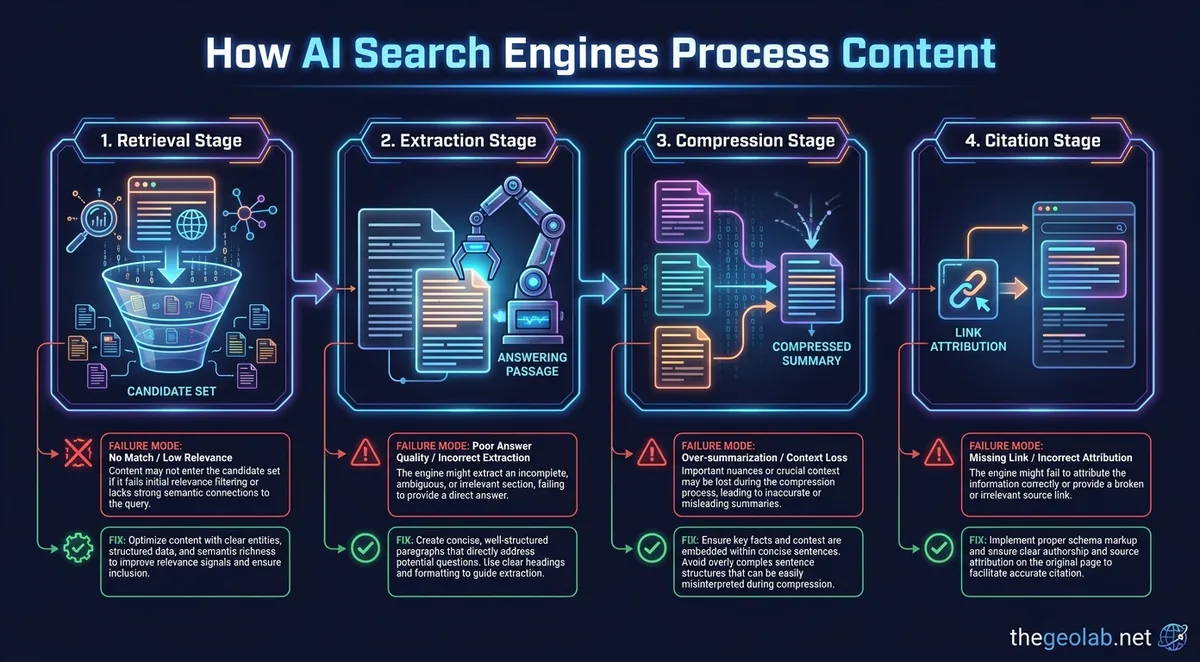
AI search engines process content in four stages: retrieval (is the page relevant enough to enter the candidate set?), extraction (which passage answers the query?), compression (does this passage survive selection against competitors?), and citation (does the engine attribute a visible link?). A page can pass some stages and fail others, and each failure has a different fix. Diagnosing by stage is the difference between guessing and fixing. Missing citations can mean failure at retrieval, extraction or compression, not just at the citation step itself.
Stage one: retrieval
You optimise content for Google. Google reads your page. AI search does not read your page in the same sense. It runs the page through a pipeline of four stages, and your content can fail at any one of them while passing the others. Understanding how AI search engines process content, retrieval, extraction, compression and citation, is what lets you diagnose where a page is losing rather than guessing.
Retrieval probability is the engine deciding your page is relevant enough to pull into the candidate set for a query. This is a relevance and eligibility test. If the page is not indexed, not crawlable by the engine’s bot, or not relevant to the query as the engine rewrote it, retrieval fails and nothing downstream can save it. On some engines there is an earlier decision still, whether to search at all, which means a page can be excluded before retrieval even begins.
A retrieval failure is invisible from the answer alone. The page simply never appears. The fix is upstream work on crawl access, indexing and relevance, and it is wasted effort to improve wording on a page that never reaches this stage.
Going deeper? SEO to GEO: The Complete Framework covers the full transition from traditional search signals to the AI search pipeline described here.
Stage two: extraction
Once retrieved, the engine extracts the part of the page that answers the query. It does not use the whole page. It pulls the passage that most directly addresses the question, which is why answer-first structure matters so much. If your answer is buried under three paragraphs of preamble, the extractable unit is weaker, and a competitor with a cleaner self-contained passage is easier to lift. This stage is where the extractability of a page is decided.
Extraction rewards passages that stand alone. A sentence that answers the implied question in full, without depending on the paragraph before it, is a clean extraction target. A sentence that only makes sense in context is not. This is a structural property of the writing, separate from whether the content is correct or thorough.
Stage three: compression
The engine then compresses the extracted material into the synthesised answer, merging it with passages from other sources. This is where competition between candidates happens. Your extracted passage is weighed against the other candidates’ passages, and the engine keeps what it judges to be the clearest, most directly relevant material for the answer it is building. A passage can be retrieved and extracted and still be dropped here in favour of a tighter one.
Compression is why being a candidate is not the same as being in the answer. The stage is selective by design, because the output is a short synthesised response, not a list of everything relevant. Losing at compression is a different problem from losing at retrieval, and it is solved by sharper, more self-contained passages rather than by broader relevance.
Stage four: citation
Finally the engine decides whether to attribute the material it used with a visible link. This is the citation stage, and it does not always fire even when your content made it into the answer. Content can be compressed into the response while the engine attributes a different source, or no source at all. The relationship between making the answer and getting the link is covered in the work on being retrieved versus cited, and the short version is that they are separate decisions.
Citation is the only stage the page owner sees directly, which is why it gets blamed for failures that actually happened upstream. A missing citation can mean failure at retrieval, extraction or compression, not just at the citation step itself.
Using the pipeline to diagnose
Read failures by stage. Not in the candidate set means a retrieval problem, so work on crawl access, indexing and relevance. In the candidates but the wrong passage got used means an extraction problem, so work on answer-first structure. Extracted but dropped from the answer means a compression problem, so tighten the passage against competitors. In the answer but unattributed means a citation problem specific to that engine. The pipeline turns a vague “AI search ignored my page” into a specific, fixable stage. That is the entire value of knowing how AI search optimisation works at the processing level.
| Stage | Failure symptom | Fix |
|---|---|---|
| Retrieval | Not in candidate set at all | Crawl access, indexing, relevance |
| Extraction | In candidates but wrong passage used | Answer-first structure, self-contained passages |
| Compression | Extracted but dropped from answer | Tighter, sharper passages vs competitors |
| Citation | In answer but no attributed link | Engine-specific; separate from content quality |
- Four stages, four failure modes. Retrieval, extraction, compression and citation each have a distinct job. A page can pass some and fail others.
- Diagnose by stage before fixing. A missing citation could mean failure at any of the four stages. The fix depends on which stage failed, not on the symptom.
- Extraction is structural, not qualitative. Answer-first, self-contained passages are extraction targets. Writing quality does not compensate for buried answers.
- Citation is the only visible stage. Page owners see citations and blame content when the failure is upstream at retrieval or extraction. Read the pipeline, not just the output.
Want to measure which stage is failing? The 30-check citation protocol separates retrieval from citation across platforms, so you diagnose the stage before choosing the fix.
Questions? Contact The GEO Lab.
Frequently asked questions
How do AI search engines process a web page?
In four stages: retrieval pulls relevant pages into a candidate set, extraction lifts the passage that answers the query, compression merges and selects passages into the synthesised answer, and citation decides whether to attribute a visible link. A page can pass some stages and fail others, and each failure has a different fix.
Does AI search read my whole page?
No. After retrieving the page, the engine extracts the passage that most directly answers the query rather than using the whole document. This is why answer-first structure and self-contained passages matter: the extractable unit is what competes, not the full page.
Why does my content appear in some answers but not others?
Because each query runs through the pipeline independently, and your page can clear retrieval and extraction on one query but lose at compression on another where a competitor had a tighter passage. The stage where it fails determines what to change.
Which pipeline stage should I optimise first?
Diagnose before optimising. If the page is not in the candidate set, fix retrieval through crawl access, indexing and relevance. If it is a candidate but the wrong passage is used, fix extraction with answer-first structure. Only optimise the later stages once the earlier ones are confirmed clear.
Can content be in the AI answer without being cited?
Yes. The compression stage can include your content in the synthesised answer while the citation stage attributes a different source or no source at all. Being in the answer and being cited are separate decisions made at separate stages of the pipeline.