
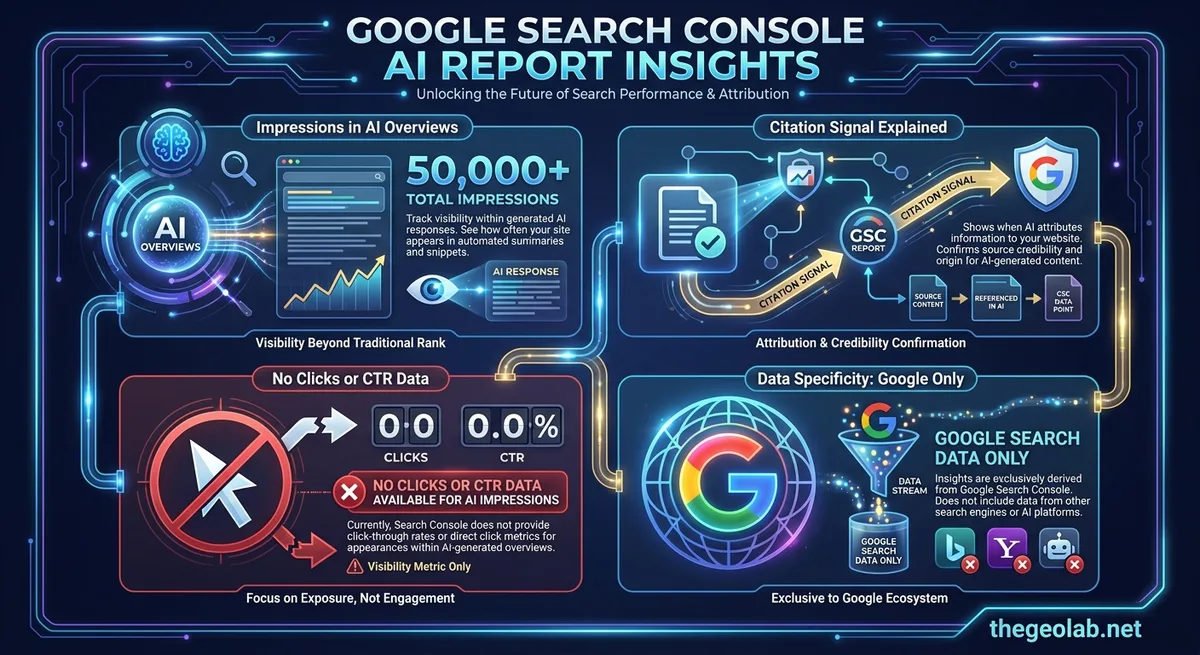
The GSC Generative AI report, launched 3 June 2026, counts impressions defined as links shown to a user in AI Overviews or AI Mode. That is a displayed-citation signal, not a grounding or retrieval metric. If your content informed an AI answer but no link was rendered, it does not count. The report currently shows impressions only, with no clicks, CTR, position or query data. It is Google-surface only. Data starts 18 May 2026 with no backfill. The chart and table aggregate differently by design, so totals will not match. The metric is directly comparable to independent AIO citation measurement on the same URLs.
The exact definition of an AI impression
Google just handed you AI-visibility data for the first time. It is labelled impressions. Most teams will read it as citations. It is not the same thing. The GSC Generative AI report, launched on 3 June 2026, is a genuine first-party signal for AI Overviews and AI Mode, but its core metric counts something narrower than people assume, and getting the definition exactly right determines whether the number tells you about citation or about something else entirely.
Per Google’s own Search Console help documentation, an impression in this report is how many times links to your site were shown to a user in a generative AI feature on Google Search. The operative word is shown. An AI impression is a displayed link, not a record of your content being retrieved, read, or used to ground the answer. If your page informed an AI Overview but no link to it was rendered, that does not count here.
This places the metric on the citation side of the funnel rather than the retrieval side — the same distinction the GEO Stack framework builds on. It is closest to a displayed-citation signal: your URL appeared as a linked source in an AI Overview or AI Mode answer. Several early write-ups describe it as a grounding metric, framing it as which pages Google used as source material. By Google’s wording that reading is wrong. A link being shown is a display event, not a grounding event, and the two come apart constantly in AI search.
This maps directly onto the distinction the GEO Lab has measured for some time: a page can be retrieved without being cited, and a brand can be mentioned without a link. The mention versus citation gap is the same fault line. GSC impressions land on the cited-and-linked end of it, which is useful precisely because it is specific.
Going deeper? The GEO Workbook includes a 30-day action plan covering citation measurement setup, per-platform reporting, and how to build a baseline from first-party signals like this report.
What the report covers
The Search version of the report covers two generative AI features: AI Overviews and AI Mode. Google states that Search Labs experiments are not included, because those are still in active development. There is a separate Generative AI report for Discover. The data feeds the overall Performance report as well, so the dedicated view is a slice carved out for visibility, not a new collection pipeline.
The Pages dimension groups data by the final URL linked by a generative AI feature after any redirects, assigned to the canonical URL rather than a duplicate. That confirms the unit of measurement is a rendered, clickable link resolved to its canonical destination, which is exactly what you would want if you intend to cross-check it against an independent citation measurement.
| Dimension | Available now | Expected later |
|---|---|---|
| Impressions | Yes — links shown in AI features | — |
| Clicks | No | Yes (regulatory timeline) |
| CTR | No | Yes (once clicks arrive) |
| Position | No | Unknown |
| Query | No | Unknown |
| Pages | Yes — canonical URL after redirects | — |
| Countries | Yes | — |
| Devices | Yes | — |
| Dates | Yes — from 18 May 2026, no backfill | — |
What it cannot tell you yet
The report shows impressions, pages, countries, devices and dates. It does not show clicks, click-through rate, position or query. Clicks and CTR are expected to arrive later under the regulatory timeline attached to the rollout, but today the report is impression-only. You can see that your link was shown and on which page, and nothing about what happened next.
It is also Google-only. It says nothing about Perplexity, ChatGPT or any non-Google surface, so it is one window onto one ecosystem rather than a cross-platform visibility metric. Treating a Google-surface impression count as a measure of total AI visibility repeats the platform-flattening error that gives misleading results elsewhere in GEO.
The aggregation trap that will trip up reports
The chart and the table count differently, by design. The chart aggregates by property, so if two results from your site appear in the same generative AI feature, they count as a single impression in the chart total. The table, when grouped by page, counts each URL separately. The chart total will therefore not equal the sum of the page rows, and that gap is expected behaviour rather than a bug. Anyone exporting both and reconciling them needs to know this before drawing conclusions.
Baseline, rollout and the cross-check worth running
The data starts on 18 May 2026 with no backfill, so that is your baseline date whether you like it or not. The report and the opt-out toggle are rolling out to a subset of site owners first, beginning in the UK, so access is not guaranteed even for UK-based properties until the cohort widens. Confirm your property has the report before building any analysis on live figures.
Because the metric is a displayed-citation signal on the Google surface, it is directly comparable to an independent AI Overview citation measurement on the same pages. The GEO Lab measures AIO citation through DataForSEO on thegeolab.net, which means GSC’s first-party impression count and a third-party citation flag can be checked against each other on identical URLs. Where they agree, the impression metric is validated as a citation proxy. Where they diverge, the divergence is itself a finding about what an impression really counts. That cross-check is the next step here, and it will be published once cohort access is confirmed.
- An AI impression is a displayed link, not a grounding signal. If your content informed an AI answer but no link was rendered, it does not count in this report.
- The report is impression-only today. No clicks, no CTR, no query data. Clicks are expected later under a regulatory timeline.
- Google-surface only. It says nothing about Perplexity, ChatGPT or Gemini outside of Google Search. One platform, one window.
- Chart and table totals will not match. The chart deduplicates by property; the table counts each page URL separately. That is by design, not a bug.
- Data starts 18 May 2026, no backfill. That is your baseline date. Confirm your property has access before building on the numbers.
Want to cross-check GSC AI impressions against independent citation data? The 30-check citation protocol explains how to run per-platform measurement alongside first-party signals.
Questions? Contact The GEO Lab.
Frequently asked questions
What is an AI impression in Google Search Console?
An AI impression is how many times links to your site were shown to a user in a generative AI feature on Google Search, per Google’s help documentation. It counts a displayed link in AI Overviews or AI Mode. It does not count cases where your content was used to ground an answer without a visible link.
Does the GSC Generative AI report measure citations or grounding?
It measures displayed citations, not grounding. The metric is a shown link, which is a display event. Content used to generate an answer without a rendered link does not register, so reading the report as a grounding or source-usage metric overstates what it captures.
Does the report show clicks and CTR?
Not yet. The report currently shows impressions, pages, countries, devices and dates only. Clicks and click-through rate are expected later under the rollout’s regulatory timeline. Today you can see that a link was shown but nothing about what the user did next.
When does the GSC AI data start?
The data starts on 18 May 2026 with no backfill, so that is the earliest baseline available. The report is rolling out to a subset of site owners first, beginning in the UK, and covers AI Overviews and AI Mode but excludes Search Labs experiments.
Why do the chart total and page table total not match?
The chart aggregates by property, so if two URLs from your site appear in the same AI feature, they count as one chart impression. The table counts each page URL separately. The gap is by design, not a data error. Use the table for page-level analysis and the chart for property-level trending.