
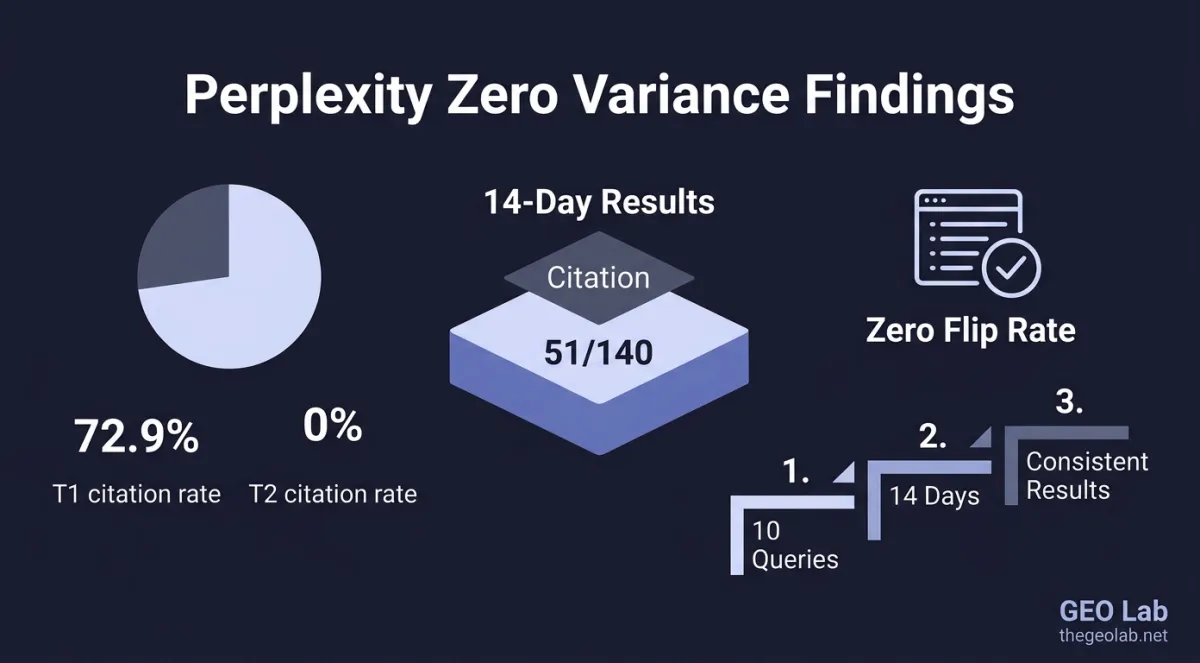
Zero variance — how stable is Perplexity’s citation behaviour? We ran the same queries every day for two weeks to find out.
Published as Zenodo working paper v1.0. DOI: https://doi.org/10.5281/zenodo.20245814
Over 14 days, three Perplexity query→page bindings held without a single exception: Retrieval Probability, GEO Stack, and Extractability each returned the same citation every day. Zero variance across 140 checks. This extends E016’s 5-day noise floor finding into a stronger claim — Perplexity doesn’t just have stable counts, it has stable identity. The same pages. For the same queries. Every day. (Dataset: DOI 10.5281/zenodo.20085753)
What We Tested
E027 ran the E014 universal query set — ten queries, five Tier 1 proprietary concepts and five Tier 2 category terms — through Perplexity sonar-pro every day from 24 April to 7 May 2026. One run per query per day, 10:00 UTC, full annotations[] array captured per response. No content changes to cited pages during the window. No publishing freeze — all other site activity was logged.
The experiment extends E016’s 5-day noise floor measurement across a 3× longer window spanning two full weekly cycles. E016 found Perplexity citation rate at 40% ±0pp across five days. The question E027 asks is whether that zero variance holds when the window is long enough to capture weekday-of-measurement effects and index refresh cycles.
It does. But the more precise finding isn’t about the count — it’s about which pages get cited.
14-Day Perplexity Results
| Day | Date | Total | Cited queries |
|---|---|---|---|
| 1 | 24 Apr | 3/10 | Q02, Q05, Q06 |
| 2 | 25 Apr | 3/10 | Q02, Q05, Q06 |
| 3 | 26 Apr | 3/10 | Q02, Q05, Q06 |
| 4 | 27 Apr | 3/10 | Q02, Q05, Q06 |
| 5 | 28 Apr | 3/10 | Q02†, Q05, Q06 |
| 6 | 29 Apr | 4/10 | Q02†, Q05, Q06, Q09‡ |
| 7 | 30 Apr | 4/10 | Q02, Q05, Q06, Q03§ |
| 8 | 1 May | 4/10 | Q02, Q05, Q06, Q09‡ |
| 9 | 2 May | 3/10 | Q02†, Q05, Q06 |
| 10 | 3 May | 3/10 | Q02†, Q05, Q06 |
| 11 | 4 May | 4/10 | Q02†, Q05, Q06, Q03§ |
| 12 | 5 May | 5/10 | Q02†, Q05, Q06, Q03§, Q09‡ |
| 13 | 6 May | 5/10 | Q02, Q05, Q06, Q03§, Q09‡ |
| 14 | 7 May | 4/10 | Q02†, Q05, Q06, Q03§ |
† Dual URL: old slug /retrieval-probability/ appeared alongside /retrieval-probability/ in the annotation array. 301 deployed 30 Apr; old slug persisted 8/14 days (Perplexity index propagation lag — see failure modes). ‡ Q09 System Memory: cited /geo-stack/ — a thegeolab.net citation but the wrong page for the query. Other days: GeoSCADA industrial software or Dell RAM hardware as annotation [1]. § Q03 LLM readability: first cited Day 7 after PerplexityBot re-crawled the page. Appeared 5/8 subsequent days.
The Core Finding: Zero-Variance Citation Identity
E016 reported aggregate stability: Perplexity citation rate = 40% ±0pp over five days. That framing is correct but it underspecifies what’s happening. E027 reveals the more precise finding.
Three query→page bindings were stable across every one of the 14 days:
- Q02 (Retrieval Probability) → /retrieval-probability/ — 14/14 days
- Q05 (GEO Stack) → /geo-stack/ — 14/14 days
- Q06 (Extractability) → /extractability/ — 14/14 days
Zero flip rate. No weekday-of-measurement pattern. The same pages, for the same queries, every day across two full weekly cycles. This is citation-identity stability — a stronger instrument property than citation-rate stability.
Perplexity behaves as a deterministic lookup for disambiguation-resolved proprietary queries. If a citation changes, it’s signal — not noise. This validates Perplexity as the primary measurement platform for T1 GEO experiments on this domain.
Why does citation-identity stability matter more than citation-rate stability? Because it changes what counts as a detectable result. If citation rate could drift ±20pp while citing the same pages, you’d need large sample sizes to detect treatment effects. Instead, any change in which page is cited is immediately interpretable — the instrument is precise enough to register a single-page movement.
The 22.0pp interpretability threshold established by E016 remains valid and is confirmed by this result. Zero variance persists over 14 days, ruling out the artefact of a short window.
Two Failure Modes of the Deterministic Zone
The deterministic zone isn’t universal. Two queries fell outside it, for different reasons. Both are characterisable — which means they’re avoidable in future experiment design.
Failure mode 1: Disambiguation miss (Q09)
Q09 asks about System Memory in GEO. Across 14 days, it produced four distinct outcomes as annotation [1]:
| Annotation [1] source | Days | Count |
|---|---|---|
| Dell RAM page (dell.com) | 4, 7, 9, 10, 11, 14 | 6 days |
| GeoSCADA (Schneider Electric) | 1, 3, 5 + partial 13 | 4 days |
| /geo-stack/ (thegeolab.net, wrong page) | 6, 8, 12, 13 | 4 days |
| GeoServer (docs.geoserver.org) | 2 | 1 day |
Dell RAM is the dominant annotation [1] at 6/14 days. The query “System Memory in GEO” is contested by four unrelated referents: computer hardware (Dell), industrial software (Schneider GeoSCADA), geospatial mapping (GeoServer), and the GEO Stack framework layer. None stabilises.
This is the expected result for a query where the key term (“system memory”) is a general-purpose technical phrase with established referents in multiple domains. The GEO Lab’s proprietary use has no Wikidata disambiguation to distinguish it from the established meanings. Until entity disambiguation is resolved — a target for E025 Wave 2 — Q09 cannot be used as a reliable measurement query.
Failure mode 2: Redirect propagation lag (Q02)
The 301 redirect from /retrieval-probability/ to /retrieval-probability/ was deployed on 30 April. Despite this, the old slug appeared in Q02 annotation arrays on 8 of the remaining 10 days. The propagation was non-monotonic — the old slug disappeared on Days 7, 8, and 13, then reappeared.
The redirect was never broken server-side (confirmed: curl -I returns 301 on both slash variants throughout). The persistence was entirely Perplexity index staleness. Minimum propagation latency on this domain: 7+ days, non-monotonic.
Practical rule: deploy any URL change at least 14 days before opening a measurement window, and monitor annotation arrays for old-slug persistence before declaring the instrument clean.
The Q03 Entry Event and What It Reveals
/llm-readability/ was not cited on any of Days 1–6. On Day 7 (30 April), PerplexityBot crawled the page at 10:00:26 UTC — confirmed from Nginx logs. The page was cited for the first time in that same morning’s cron run. From Day 7, it appeared on 5 of the remaining 8 days.
At the time, this looked like it might be an early signal from E003 — a heading-format intervention deployed on 18 April, 12 days before the crawl. But E003 R1 (run 2 May) returned a null result: /llm-readability/ was not cited on any platform, and Nginx logs confirmed PerplexityBot had not re-crawled the page between Day 7 and the R1 measurement.
The conclusion is clean: the Day 7 citation was a crawl-timing artefact. The re-crawl on 30 April refreshed Perplexity’s index entry for the page, producing a 5/8-day citation window that then expired. The heading-format intervention had no effect — not because it was inadequate, but because it was never observed by PerplexityBot during the measurement window.
A content intervention that isn’t followed by a confirmed PerplexityBot re-crawl is invisible at the measurement layer. Crawl confirmation — grepping Nginx logs for PerplexityBot hits on the target URL after intervention deployment — must be a pre-measurement gate, not a post-hoc check.
This finding changes the E003 protocol for any future replication. The intervention was deployed. The crawl didn’t happen in time. The null result is structural, not content-driven.
T2 Null: No Authority Gate Signal at Day 14
T2 category queries returned zero citations across all 70 checks (14 days × 5 queries). No E025 Wave 1 entity-graph signal detected within the 14-day window.
This is the expected result. EDX established that below the domain authority gate, on-page variables and entity-graph interventions are non-operative on competitive category queries. E025’s pre-registered measurement horizon is M1 (22 May) and M2 (19 June) — not a 14-day window. The E027 T2 null doesn’t falsify E025; it’s a baseline reading within a window too short to detect entity-graph propagation effects.
Zero T2 citations across 70 checks also confirms the T1/T2 tier model holds over 14 days. Citation or nothing — no “mentioned” state was observed on any T2 query at any point in the window.
Four Rules for GEO Experiment Design
E027 produces four practical rules for anyone running controlled experiments on Perplexity:
- Use Perplexity sonar-pro as the primary signal platform for T1 proprietary-concept experiments. Citation-identity is deterministic for disambiguation-resolved proprietary queries above the authority gate. Any movement in the citation set is signal, not noise.
- Confirm disambiguation before the measurement window opens. Run target queries manually and verify annotation [1] reflects the intended concept. If a non-target-domain source leads the annotation array on multiple manual runs, the query is outside the deterministic zone until entity disambiguation is resolved.
- Confirm PerplexityBot crawl before declaring an intervention active. Grep Nginx access logs for PerplexityBot hits on every target URL after intervention deployment. Do not open the measurement window until crawl is confirmed. This is a gate, not a check.
- Deploy URL changes at least 14 days before any measurement window. Redirect propagation in Perplexity’s index is non-monotonic and incomplete within 14 days on this domain. Monitor annotation arrays for old-slug persistence before the window opens.
Frequently Asked Questions
Does this mean Perplexity never changes which pages it cites?
No. It means that for disambiguation-resolved proprietary-concept queries on a domain Perplexity has established a stable index entry for, citation-identity is deterministic across a 14-day window. New pages can enter the citation set (Q03 entered on Day 7 after a re-crawl). Queries with disambiguation conflicts (Q09) are unstable. The deterministic zone has boundaries — this experiment characterises them.
What does this mean for the 22.0pp interpretability threshold?
It remains valid and is strengthened by E027. The threshold was derived from E016’s 5-day noise floor. E027 confirms zero variance persists over 14 days, ruling out a short-window artefact. Any experiment on this domain that produces a delta below 22.0pp on combined citation rate cannot be attributed to a treatment effect.
Does the T2 null result mean E025 isn’t working?
No. E025 Wave 1 was a bundled entity-graph intervention (ORCID, Zenodo DOIs, @graph mu-plugin). Its pre-registered measurement horizon is M1 (22 May) and M2 (19 June). A 14-day null is consistent with the propagation horizon required for entity-graph changes to affect Perplexity’s competitive source-ranking decisions. E025 Wave 2 (Wikidata ×3) launched 8 May.
Why did the old slug persist in Perplexity’s annotation arrays after the 301 was deployed?
Server-side, the redirect was working correctly from day one — confirmed via curl -I on both slash variants. The persistence was entirely Perplexity index staleness: Perplexity had cached both URLs as valid annotation sources and the index update was non-monotonic, taking 7+ days to propagate fully. This is distinct from a redirect failure and is worth distinguishing when diagnosing URL instability in citation data.
Is the full dataset available?
Yes. The 14-day citation CSV, Q09 annotation URL log, and Day 1 raw API responses are deposited at Zenodo: DOI 10.5281/zenodo.20085753. Days 3–14 are from live VPS cron data. Day 1 is from the PC repo (format-verified). Day 2 outcome codes are from contemporaneous session notes — documented in the dataset README.
Perplexity operates as a deterministic lookup for disambiguation-resolved proprietary queries: three query→page bindings held without a single exception across 140 checks over 14 days. Any change in which page is cited is signal, not noise — making citation-identity stability a more precise instrument than citation-rate stability.