
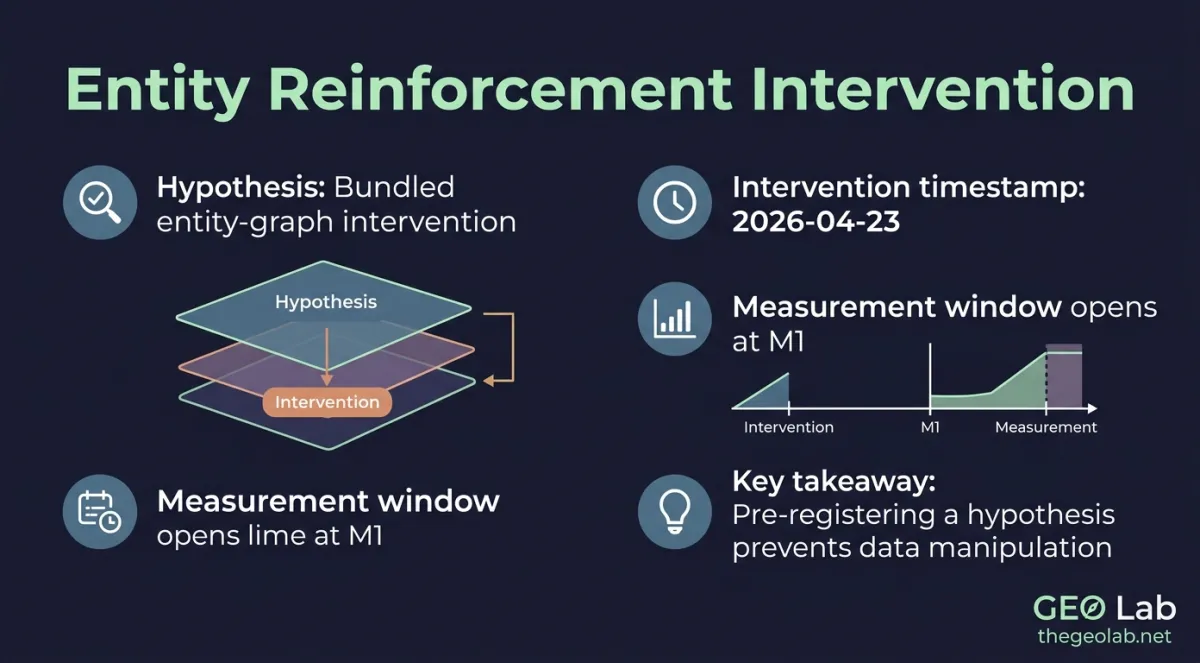
The entity-graph intervention produced no T2 citation lift across two monthly measurements. The authority gate held. A 32pp T1 Perplexity drop at M2 fired the pre-registered confound branch.
Hypothesis: A bundled entity-graph intervention — ORCID identifier, two Zenodo DOIs referenced as ScholarlyArticle and Dataset nodes in the About page JSON-LD, a public research code repository with cross-referenced DOIs, and (in a later follow-up intervention) three Wikidata items — raises Tier 2 Perplexity citation rate above the 22.0pp interpretability threshold established by E016.
Null prediction: T2 Perplexity citation rate stays at 0% on the next two E014 monthly measurements (M1 late May, M2 late June). A below-threshold lift is noise.
Intervention timestamp: 2026-04-23T22:33:39Z. Measurement window opens at M1.
Why This Post Exists Before the Data
The usual GEO Lab post order is: hypothesis, intervention, measurement, writeup. This post inverts it. The intervention deployed yesterday. The first usable measurement is five weeks away. The writeup is happening now.
The reason is not enthusiasm. It is a hygiene problem specific to bundled interventions: once a result comes in, there is always a tempting rewrite where the hypothesis becomes whatever the result happened to support. The safest defence against that is to write down the hypothesis in public before the result arrives. If the data comes back positive and the post’s prediction was null, the site reports a positive finding against a pre-registered null. If the data comes back null and the prediction was null, the post reports a null against a pre-registered null — which is also a legitimate finding.
Either way, the interpretation is constrained by what this page says today, and not by what looks good to say in June.
M2 confounds observed (June 2026): T1 Perplexity dropped 32pp (80% to 48%) between M1 and M2. Two causes identified: T1-Q2 benign query reinterpretation (persistent since M1, not attributable to intervention); T1-Q3 and T1-Q4 competitive displacement (new at M2, not attributable to intervention). The FAQPage duplicate on /entity-reinforcement/ noted at M1 was confirmed clean by M2. Falsification criterion 3 fired.
How the Intervention Was Designed
The starting point was not a controlled hypothesis. It was an audit. In reviewing the site’s entity footprint, the gap was straightforward: no Wikidata item, no sameAs cross-references between the identifiers that did exist, no unified JSON-LD on the About page, no DOI links into the Zenodo records, no public research repositories. The standard framing for closing those gaps is aspirational: do all of this and the site becomes “Knowledge Panel eligible.”
The framing did not survive contact with the Lab’s existing measurement record. Three pieces of that record mattered.
First, the EDX null (Zenodo 10.5281/zenodo.19450361) established that on Tier 2 category queries, the site achieves 0% Perplexity citation rate across ten pages spanning 12.9 to 29.5 unique named entities per 1,000 words. The finding was interpreted as a domain authority threshold effect: below a competitive citation gate, page-level variables do not operate. If the gate is real, an on-page entity density intervention cannot move T2 citation rate. The only interventions that can move the gate are external authority signals — not more entities on the page.
Second, the E016 noise floor measurement (within the GEO Stack framework) established that the interpretability threshold for any citation rate change is 22.0 percentage points combined. Anything below that is indistinguishable from platform variance. This is the threshold any claimed lift has to clear.
Third, E016 also established zero within-day variance on Perplexity (40% across all checks of a Tier 1 query set) and 0% across 50 checks on Google AI Overviews. Those platform behaviours constrain what “positive result” can mean on each platform.
With those three findings in hand, the entity-footprint audit was re-scoped as a narrow, pre-registered, measurement-first experiment. The “Knowledge Panel eligibility” framing was dropped — it overclaims what any Wikidata item can produce on its own. The question became smaller and testable: does adding external, cross-referenced entity identifiers move T2 Perplexity citation rate above the E016 interpretability threshold, or does the authority gate hold?
That is E025.
M2 confounds observed (June 2026): T1 Perplexity dropped 32pp (80% to 48%) between M1 and M2. Two causes identified: T1-Q2 benign query reinterpretation (persistent since M1, not attributable to intervention); T1-Q3 and T1-Q4 competitive displacement (new at M2, not attributable to intervention). The FAQPage duplicate on /entity-reinforcement/ noted at M1 was confirmed clean by M2. Falsification criterion 3 fired.
Hypothesis and Null Prediction
EXPERIMENT_ENTITY_REINFORCEMENT_E025:

  hypothesis: "External, cross-referenced entity identifiers (ORCID, Zenodo

               DOIs as JSON-LD nodes, public research repos, Wikidata items)

               raise T2 Perplexity citation rate above the 22.0pp

               interpretability threshold from E016."

  null_prediction: "T2 Perplexity citation rate remains at 0% on M1 and M2

                    post-intervention measurements. A below-threshold lift

                    is noise, not signal."

  interpretability_threshold: "22.0pp combined (from E016 noise floor)"

  intervention_date: "2026-04-23T22:33:39Z"

  measurement_cadence: "E014 monthly, M1 late May 2026, M2 late June 2026"

  design: "bundled — positive result does not identify which component

           produced the lift; decomposition is a follow-up experiment"
The hypothesis is framed against the authority gate finding from EDX. If the gate is real and on-page variables do not operate below it, the intervention’s only path to a T2 lift is by partially clearing the gate itself — through external identifiers that systems outside the site recognise as authority signals. Not through anything the site says about itself.
The null prediction is the stronger position. If the gate holds against this intervention, that is a meaningful Layer 4 result: it says ORCID plus Wikidata plus cross-referenced DOIs plus public repos are not enough, on their own, to partially clear the citation gate for a site at this authority tier. A companion null to EDX, at a different layer.
M2 confounds observed (June 2026): T1 Perplexity dropped 32pp (80% to 48%) between M1 and M2. Two causes identified: T1-Q2 benign query reinterpretation (persistent since M1, not attributable to intervention); T1-Q3 and T1-Q4 competitive displacement (new at M2, not attributable to intervention). The FAQPage duplicate on /entity-reinforcement/ noted at M1 was confirmed clean by M2. Falsification criterion 3 fired.
Intervention Components
The intervention is bundled. It has eight components across three waves. The first wave deployed on 23 April. The second and third waves follow over the coming weeks with their own intervention timestamps.
| Component | Description | Wave | Status |
|---|---|---|---|
| ORCID | Researcher identifier 0009-0004-4072-9741 attached to Person schema node and both Zenodo records |
1 | Live 23 Apr |
| Public code repo | arturseo-geo/geo-citation-index flipped public with Zenodo DOI badge and BibTeX in README |
1 | Live 23 Apr |
| Zenodo related identifiers | Record 19253920 linked to GitHub repository; ORCID attached to creator on both records | 1 | Live 23 Apr |
Unified @graph on /about/ |
Single JSON-LD block emitting Person, Organization as ResearchProject, DefinedTerm for the GEO Stack, Dataset for Zenodo 19253920, ScholarlyArticle for Zenodo 19450361. Cross-referenced by @id |
1 | Live 23 Apr |
| Wikidata Person item | Submitted as Q139710735 on 8 May 2026 (item subsequently deleted by Wikidata editors). Nominated for deletion same day under WD:N notability (“not notable”). See Wikidata RfD entry | 2 | Halted |
| Wikidata Lab item | Planned but not submitted — halted after Person item deletion. See Wave 2 Outcome section | 2 | Halted |
| Wikidata Stack item | Planned but not submitted — halted after Person item deletion. See Wave 2 Outcome section | 2 | Halted |
| Cross-platform profile alignment | LinkedIn headline and featured section + GitHub profile README aligned with the About page entity description | 3 | Pending |
The bundled design is a deliberate trade-off. A single-variable test across eight components would take two years at a one-per-month cadence and the earliest components would decay before the last ones deployed. A bundled test produces an interpretable yes or no on the overall intervention in two months. Decomposition is a follow-up experiment.
M2 confounds observed (June 2026): T1 Perplexity dropped 32pp (80% to 48%) between M1 and M2. Two causes identified: T1-Q2 benign query reinterpretation (persistent since M1, not attributable to intervention); T1-Q3 and T1-Q4 competitive displacement (new at M2, not attributable to intervention). The FAQPage duplicate on /entity-reinforcement/ noted at M1 was confirmed clean by M2. Falsification criterion 3 fired.
Methodology
The measurement design reuses E014 Month 1 Citation Rate Baseline‘s monthly cadence and query set. No new measurement infrastructure is introduced. This is intentional — it keeps the measurement comparable to the baseline and to every other monthly run.
The E014 combined query set of Tier 1 proprietary concept queries and Tier 2 category queries. Same ten queries per tier, same phrasing, same order.
Perplexity sonar-pro with return_citations=True, Google AIO via DataForSEO, ChatGPT web search. Five iterations per query per platform, matching E016.
Tier 2 Perplexity citation rate post-intervention minus pre-intervention. Positive result: lift above 22.0pp combined threshold. Null: lift at or below threshold.
T1 Perplexity rate change (should stay at the E016 baseline of 80%), T2 AIO and ChatGPT rates (expected 0% floor from E016), and Tier 2 mention rate across all platforms.
No content changes to thegeolab.net between intervention and M1 measurement. No new posts at all on the query-matched pages. Posts unrelated to the query set are permitted and expected. The intervention window is the JSON-LD graph, the Wikidata items once accepted, and the external identifiers — nothing else.
M2 confounds observed (June 2026): T1 Perplexity dropped 32pp (80% to 48%) between M1 and M2. Two causes identified: T1-Q2 benign query reinterpretation (persistent since M1, not attributable to intervention); T1-Q3 and T1-Q4 competitive displacement (new at M2, not attributable to intervention). The FAQPage duplicate on /entity-reinforcement/ noted at M1 was confirmed clean by M2. Falsification criterion 3 fired.
Wave 2 Outcome — 11 May 2026
Wave 2 was a staged three-item submission to Wikidata: a Person item, a project item for The GEO Lab, and a conceptual model item for The GEO Stack. The plan was to submit them sequentially over several days, allowing each to settle in the editorial queue before the next.
The first item — Q139710735, the Person item — was submitted on 8 May 2026 and nominated for deletion the same day under Wikidata’s notability criteria (WD:N), with the reason given as “not notable.” The deletion request is logged on the Wikidata Requests for Deletions page.
The remaining two submissions — Lab item and Stack item — had not yet been drafted when the first deletion was filed. The deletion outcome was treated as new information about Wikidata’s notability bar at this domain’s authority tier, and the remaining submissions were halted on that basis rather than proceeding to the same outcome.
This is a partial trigger of pre-registered falsification criterion 4. Strict reading: criterion 4 requires all three Wikidata items to be deleted. Substantive reading: the criterion was designed to catch the case where Wave 2 fails to deploy meaningful Wikidata surface, and that is what happened — one of three items was submitted, and that one was rejected. The methodologically clean reading is to treat Wave 2 as a non-event for M1 measurement purposes. The M1 measurement on 22 May will reflect Waves 1 and 3 plus the v1.2.0 schema deployment of 10 May, not Wave 2.
This outcome does not change the pre-registered null prediction: T2 Perplexity citation rate stays at 0% on M1 and M2. It does narrow what a positive result could be attributed to. If T2 lifts above 22.0pp on either measurement, the lift cannot be attributed to Wikidata coverage — that surface was never deployed.
What Would Falsify This
Four outcomes would constitute clear falsification or partial falsification of the hypothesis:
- T2 Perplexity stays at 0% on both M1 and M2. Strong falsification. The authority gate holds against the full bundled intervention. Publishable as a Layer 4 null, companion to EDX.
- T2 Perplexity lifts but stays below 22.0pp combined on both measurements. The intervention produced a sub-threshold shift indistinguishable from platform variance. Reported as null with the raw numbers shown. Not claimed as positive.
- T1 Perplexity drops below the E016 baseline of 80%. An unexpected secondary effect. Either a confound or an indication the intervention hurt an existing signal. Triggers investigation before M2.
- Wikidata items are all deleted under notability criteria. A valid outcome on its own — the intervention was not deployable at this stage. Reported as a deployment-failure null, distinct from a citation-rate null.
M2 confounds observed (June 2026): T1 Perplexity dropped 32pp (80% to 48%) between M1 and M2. Two causes identified: T1-Q2 benign query reinterpretation (persistent since M1, not attributable to intervention); T1-Q3 and T1-Q4 competitive displacement (new at M2, not attributable to intervention). The FAQPage duplicate on /entity-reinforcement/ noted at M1 was confirmed clean by M2. Falsification criterion 3 fired.
Known Confounds and Honest Limits
Three limits apply to whatever this experiment produces. They are flagged here rather than after the data because their presence shapes what a positive or negative result can and cannot support.
The intervention is bundled. A positive result cannot attribute the lift to any single component — ORCID, Wikidata, public repos, JSON-LD graph. The follow-up experiment (E026, not yet designed) would need to hold some components constant and add others sequentially. The current design answers the yes-or-no question, not the which-component question.
Indexing latency is unknown. Wikidata items that are accepted still take time to propagate into the downstream knowledge graphs that AI platforms draw on. If M1 shows no lift and M2 shows a lift, the finding is positive but the timing tells us nothing clean about when the signal reached the platform. Two months of measurement is the minimum honest window, not a precise one.
The authority gate is measured, not modelled. EDX established the gate as an empirical regularity on this site at this point in time. It does not provide a model of how the gate clears. The intervention is a bet on the gate being partially clearable by external identifiers — a bet grounded in existing entity-disambiguation literature, but still a bet. A null result does not rule out the gate clearing for a different combination of signals. It rules out this one.
M2 confounds observed (June 2026): T1 Perplexity dropped 32pp (80% to 48%) between M1 and M2. Two causes identified: T1-Q2 benign query reinterpretation (persistent since M1, not attributable to intervention); T1-Q3 and T1-Q4 competitive displacement (new at M2, not attributable to intervention). The FAQPage duplicate on /entity-reinforcement/ noted at M1 was confirmed clean by M2. Falsification criterion 3 fired.
Results: M1 and M2
M1 was measured on 22 May 2026 (day 29 post Wave 1). M2 was measured on 19 June 2026 (day 57). Both used the E014 universal query set: 10 queries, 3 platforms, 5 iterations each = 150 calls per round.
T2 intervention outcome (primary DV)
| Platform | T2 M1 | T2 M2 |
|---|---|---|
| Perplexity sonar-pro | 0/25 (0%) | 0/25 (0%) |
| ChatGPT | 0/25 (0%) | 1/25 (4%) |
| Google AIO | 0/25 (0%) | 0/25 (0%) |
| Combined T2 | 0/75 (0%) | 1/75 (1.3%) |
Combined T2 at M2 = 1.3%, far below the 22.0pp E016 interpretability floor. The single ChatGPT T2 hit (T2-Q5 “GEO vs SEO differences” citing /geo-vs-seo/, iteration 3 only) is indistinguishable from noise. No lift.
T1 Perplexity per-query trajectory (M0, M1, M2)
| Query | M0 | M1 | M2 |
|---|---|---|---|
| T1-Q1 GEO Stack framework | 5/5 | 5/5 | 5/5 |
| T1-Q2 retrievability in GEO | 5/5 | 0/5 | 0/5 |
| T1-Q3 GEO citation rate measurement | 5/5 | 5/5 | 0/5 |
| T1-Q4 extractability score GEO | 5/5 | 5/5 | 2/5 |
| T1-Q5 Artur Ferreira GEO Lab | 5/5 | 5/5 | 5/5 |
| T1 Perplexity total | 25/25 (100%) | 20/25 (80%) | 12/25 (48%) |
T1 Perplexity dropped from 80% (M1) to 48% (M2), a 32pp decline. This fires pre-registered falsification criterion 3 (T1 drops below 80%), which forces the confound investigation branch of the decision tree. The branded queries (Q1 “GEO Stack framework” and Q5 “Artur Ferreira GEO Lab”) held at 5/5 across all three rounds. The drops are on the non-branded concept queries.
Interpretation: Null With a Documented T1-Degradation Confound
Under the pre-registered decision tree: T2 shows no lift (the authority gate holds, direction unchanged from the null prediction). But falsification criterion 3 fired (T1 < 80%), which means T2 cannot be cleanly interpreted until the T1 drop is explained. The result is a null with a documented confound, not a clean strong null.
The T1 confound has two distinct causes, which should not be merged:
T1-Q2: benign query reinterpretation (persistent since M1)
“Retrievability in GEO” now resolves on Perplexity to the general information-retrieval and spaced-repetition concept (Wikipedia/Retrievability, Anki forums, SuperMemo), not to GEO Lab content. The retrieval set contains zero GEO-related sources. This is a query construction failure: the site concept is “retrieval probability”, not “retrievability”, and “GEO” alone does not disambiguate. The drop appeared between M0 and M1 and persisted at M2. Title rewrites and access regressions were both ruled out in the diagnostic. T1-Q2 is flagged as a known-dead query, carried as-is (rewording would break M0/M1/M2 comparability).
T1-Q3 + T1-Q4: real competitive displacement at M2
T1-Q3 (“GEO citation rate measurement”) and T1-Q4 (“extractability score GEO”) held at 5/5 through M1 and dropped only at M2. The displacement is real: T1-Q3’s retrieval set is now dominated by competitors (averi.ai, gigawattgroup.com, similarweb.com, guptadeepak.com, hashmeta.ai). T1-Q4 retains thegeolab.net at position 1 in 2/5 iterations but is losing share to “GEO Score” tool sites. This is the genuine confound signal and is recorded as a Findings Ledger entry.
ChatGPT divergence
ChatGPT T1 moved from 4% (M1) to 64% (M2), the opposite direction from Perplexity’s decline, in the same measurement window. ChatGPT T1-Q2 even cited /retrieval-probability/ once (iteration 4), a query Perplexity entirely lost. This cross-platform divergence is consistent with the E042 and E030 findings: platform-level citation behaviour is independent, and a drop on one platform does not predict a drop on another.
EC Activation: HOLD
A confounded null does not satisfy the stable-authority-tier premise that the E026 Component Decomposition (EC) experiment presumes. EC was designed as a follow-up to a clean null: “the gate held, now test which component of the intervention might partially clear it.” A T1 degradation confound means the measurement context shifted between M1 and M2, so the baseline EC would compare against is not stable.
EC is therefore held, not cancelled. M3 (late July E014 cycle) is now materially more likely to be needed: if T1 stabilises or recovers, the measurement context is again clean enough for EC to proceed. If T1 continues to degrade, the confound deepens and EC remains inappropriate. This is a decision, not an auto-confirm.
FAQ
What did the E025 entity reinforcement intervention test?
E025 tested whether adding external, cross-referenced entity identifiers (ORCID, Zenodo DOIs as JSON-LD nodes, public research repositories, and Wikidata items) could raise Tier 2 Perplexity citation rate above the 22.0pp interpretability threshold established by E016. The hypothesis was framed against the authority gate finding from EDX: below a competitive citation threshold, page-level variables do not operate.
What was the result of the E025 experiment?
The entity-graph intervention produced no T2 citation lift across two monthly measurements (M1 and M2). T2 Perplexity stayed at 0% on both. The authority gate held. A 32pp T1 Perplexity drop at M2 fired the pre-registered confound branch, making this a documented null rather than a clean strong null.
Why did T1 Perplexity citation rate drop during the experiment?
The T1 drop had two distinct causes. T1-Q2 underwent benign query reinterpretation where Perplexity resolved the query to general information-retrieval concepts rather than GEO Lab content. T1-Q3 and T1-Q4 experienced real competitive displacement at M2, with retrieval sets dominated by new competitors. Neither cause was attributable to the intervention itself.
Key Takeaway
E025 produced a null with a documented confound. The entity-graph intervention generated no T2 citation lift across two measurements. The authority gate held. A 32pp T1 Perplexity drop at M2 fired the pre-registered confound branch, making this a documented null rather than a clean one. EC (component decomposition) is held pending M3 stabilisation.