
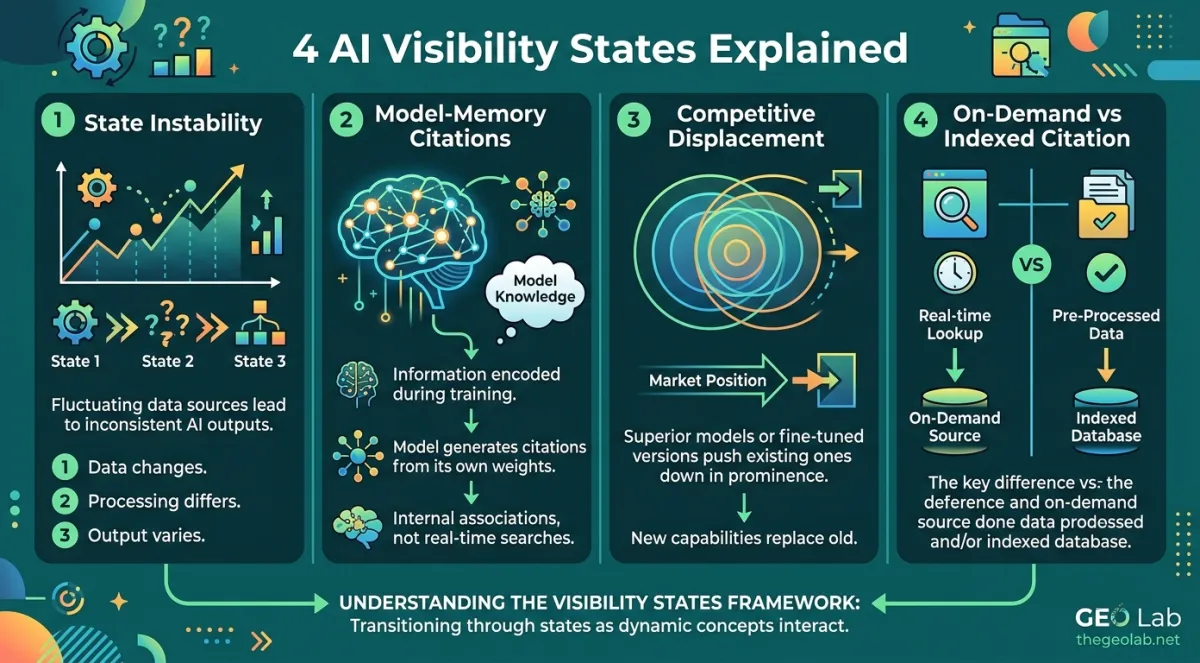
AI visibility states — edge cases, transitions, and measurement boundaries that the four-state classification can’t capture on its own. A working companion to the Four States framework.
The Four AI Visibility States — Invisible, Stage 0, Mentioned, Cited — are the working classification for where a URL sits in an AI system’s awareness. They’re also an abstraction. Ten things the four-box model doesn’t capture on its own: state instability, platform divergence, stuck Stage 0, model-memory citations, partial citation, regressions without content change, per-query-type variation, on-demand vs indexed citation, competitive displacement, and the meaning of a site-wide state claim.
This isn’t a critique of the framework. It’s the second page of the manual — the one you reach for when a measurement stops making sense under the first page.
Why Any Framework Needs a Second Page
The four AI visibility states — Invisible, Stage\u00a00, Mentioned, Cited — and the four-state model built on them is the most useful abstraction I’ve used for thinking about AI visibility. Invisible, Stage 0, Mentioned, Cited — four boxes, clear boundaries, meaningful transitions between them. It’s the right level of resolution to hold in your head while thinking about a page or a site.
It’s also, like every useful abstraction, wrong in specific ways. Not wrong in the sense of misleading — wrong in the sense that reality has edge cases the boxes don’t cover, and if you use the boxes without knowing the edge cases, you’ll sometimes draw conclusions the measurement can’t actually support.
I learned this by making a series of small but unmistakable errors. A page I confidently placed in Cited turned out to be in a different state next week with no content change. A page I called Invisible turned out to be Cited on one platform and Mentioned on another — the word “Invisible” was averaging across platforms in a way I hadn’t noticed. A page in Stage 0 turned out to be in Stage 0 for two very different reasons, one of which was fixable and one of which was not.
A concrete example: in fourteen days of daily measurement across a fixed query set (E016), the observed citation rate moved 6.7 percentage points between Day 1 and Day 2 with no content change, no new competing sources, and no detectable model update. The reading was accurate at the moment it was taken. It was not a property of the page.
The ten caveats below are the ones that have changed how I read a visibility measurement. They don’t replace the four-state model. They sit underneath it — the thing you consult when the four boxes are giving you an answer that doesn’t quite make sense.
This post assumes familiarity with the Four AI Visibility States. The core vocabulary is defined in the GEO Glossary. What follows is about the model’s limits.
Going deeper? The GEO Authority Playbook covers durable AI visibility strategy — including how to act on each state. For the experimental methodology behind the data in this post, see GEO Experiments.
Three Categories of Caveat
The ten caveats group into three types, each requiring a different kind of care when interpreting a visibility measurement.
•
States that look distinct but aren’t
When the four boxes share a label but reflect fundamentally different underlying situations — for example, two pages both “Stage 0” for reasons that require opposite interventions.
•
Movements between states the model abstracts over
When a page moves between states for reasons that aren’t explained by the model — platform-level shifts, temporal instability, competitive displacement.
•
Where the state itself becomes hard to define
When aggregating across URLs, queries, or platforms produces a state claim the underlying data can’t actually support.
The difference between the three matters because the response to each is different. Edge cases require looking beneath the state label to the underlying signals. Transition caveats require reporting state alongside time, query, and platform. Measurement boundaries require restricting the scope of any state claim to what the measurement actually supports.
The Ten Caveats
Ordered by how often they change a conclusion the four-state model alone would give. The first four are the ones that will mislead you soonest if you treat the four states as complete.
A state is a point-in-time reading, not a property
Transition
A page that is Cited today can be Mentioned next week and back to Cited the week after, with no content change. The state reflects a measurement at a moment in time, not a durable property of the page.
AI retrieval indexes shift. Competing sources enter and leave. Model versions update. The underlying pipeline is in motion continuously, and the state reading at any moment is partly a measurement of that motion, not just of the page.
Report state alongside the time window of the measurement. “Cited (week of June 16)” is defensible; “Cited” as an unqualified claim is not.
The same page can be in different states on different platforms
Measurement
A page commonly sits at Cited on Perplexity, Mentioned on ChatGPT, and Invisible on Claude at the same moment. “The page’s state” as a single value erases exactly the signal that tells you what’s happening.
Each AI operator maintains its own retrieval index, uses its own citation heuristics, and has its own selection thresholds. The three systems don’t agree about which pages are good sources, and they shouldn’t be expected to.
Report state per platform. A visibility dashboard that collapses three platforms into one state is hiding the data you actually need. Three state labels is not three times the work — it’s the minimum resolution the data actually has.
Stage 0 is two different states
Edge case
Two pages can both be classified as Stage 0 — indexed but not cited — for fundamentally different reasons. One is pre-citation (recently indexed, citation signals still accumulating). The other is stuck (structural problems prevent citation entirely). The four-state label is identical; the prognosis is opposite.
A pre-citation Stage 0 page resolves itself with time and normal propagation. A stuck Stage 0 page will stay in Stage 0 indefinitely unless the structural issue is identified and fixed. Treating them identically means either waiting forever on a stuck page, or pushing unnecessary interventions on a page that was about to move anyway.
Look at the structural signals — extractability, schema alignment, declarative opening, crawler access — independently of the state. A pre-citation page passes the structural checks. A stuck page fails at least one. An LLM readability audit gives you the fastest read on which type applies.
A “Cited” state may not mean the page was retrieved
Edge case
AI systems sometimes cite pages based on model memory — content that was in training data but not freshly retrieved at query time. A citation appears in the response without a corresponding fetch in server logs.
Model-memory citations and retrieval-time citations look identical to a visibility dashboard. They are not the same thing. Retrieval-time citations respond to recent content changes; model-memory citations do not, because the content being cited is the pre-training snapshot, not the current page.
Cross-reference citations with server logs. A citation with no corresponding on-demand fetch in the relevant time window is likely model-memory. The how retrievable your content is explains how on-demand and indexed fetch patterns diverge. This distinction matters heavily for attribution — a content update won’t show up in citation rate if the citations are all from model memory.
Citation is partial, not binary
Edge case
The four-state model treats Cited as binary — either the page is cited or it isn’t. In practice, citation has degrees: full citation with linked source, inline citation with partial source, named citation without link, quoted text without attribution.
A page cited with a link drives traffic and authority. A page named without a link builds brand recognition but no traffic. A page quoted without attribution contributes to the answer but gets no credit. These are different business outcomes, collapsed into a single label.
Track citation quality as a secondary metric alongside the Cited state. The difference between a dominant and a marginal citation can be the difference between a meaningful outcome and a nominal one.
States regress without content change
Transition
A page moving from Cited back to Mentioned is often interpreted as a content problem. It is frequently not. The page hasn’t changed; the environment around it has — new competing sources, updated model, shifted retrieval priorities, competitive displacement.
Interpreting an environmental regression as a content problem triggers unnecessary content work. Worse, the content work can make the page weaker for the next regression cycle by over-optimising for what currently reads as a problem.
Record the cited sources each time a state reading is taken. A regression accompanied by a new competing source appearing in cited results is environmental. A regression with no change in the competitive set points at content — but verify that separately, don’t assume.
States vary by query type on the same page
Measurement
A single page can be Cited for proprietary-concept queries, Mentioned for definitional queries, and Invisible for category queries — all simultaneously. “The page’s state” as a single value is meaningless without specifying which query type it was measured under.
A page’s visibility is as much a property of the queries it was tested against as of the page itself. Reporting state without reporting the query type (or probe category) produces numbers that move without explanation as different query sets are used.
Always report state per probe type from a structured query taxonomy. “Cited for proprietary queries, Stage 0 for category queries” is the minimum meaningful resolution. The 30-check measurement protocol gives the full procedure.
On-demand citation and indexed citation are different
Edge case
A Cited state can reflect either a citation coming from the AI’s retrieval index (scheduled crawl, indexed content) or a citation from an on-demand fetch (user-triggered, real-time). These look identical in the response and are very different in what they require to reproduce.
Indexed-citation state is durable — the page is in the index and will be cited again for similar queries. On-demand-citation state is transient — it happened this time because a specific user asked about this specific URL. The two require different content strategies.
Cross-reference citations with server logs for on-demand user-agents (ChatGPT-User, Perplexity-User, Claude-User). A citation within seconds of an on-demand fetch is on-demand; without one, it’s indexed.
Competitive displacement is invisible in the state
Transition
A page moves from Cited to Mentioned because a new authoritative source entered the retrieval index and took the citation slot. The displaced page hasn’t become worse; the competitive set has become stronger.
Competitive displacement can’t be fixed by improving the displaced page alone. If the displacer is an authoritative source that legitimately covers the topic better in context, the right response may be to target a different query set rather than chase the citation slot.
Track the full set of cited sources per query over time. A Cited→Mentioned regression on the target page that coincides with a previously absent competitor appearing in citations is displacement, not decay.
A site-wide state is either an average or a marketing metric
Measurement
“This site is in a Cited state” is not a diagnostic measurement. Visibility is a URL-level property observed under a specific query on a specific platform. Collapsing that to a site-wide state produces a number that may be useful for reporting but not for diagnosis.
A site-wide state obscures exactly the per-URL, per-query, per-platform signal that tells you where the site is working and where it isn’t. It encourages treating visibility as one number to move up, rather than many specific states to fix or protect individually.
Report per-URL state per query per platform as the core measurement. If a site-wide number is required — for a stakeholder conversation, a dashboard summary — flag it as an aggregation, name the method, and keep the per-URL data one click away.
The Ten at a Glance
One reference table. Use when a visibility measurement is producing a conclusion that doesn’t quite make sense — the row that matches the situation will usually tell you what’s missing.
| # | Caveat | Category | Correct by |
|---|---|---|---|
| 01 | Point-in-time reading, not a property | Transition | Report state with the time window it was observed in |
| 02 | Different states on different platforms | Measurement | Report per platform, never a single cross-platform state |
| 03 | Stage 0 is two different states | Edge case | Check structural signals independently of the state label |
| 04 | Cited may not mean retrieved | Edge case | Cross-reference citations with server logs |
| 05 | Citation is partial, not binary | Edge case | Track citation quality alongside the state |
| 06 | Regressions without content change | Transition | Record cited sources each time to spot environmental shifts |
| 07 | Varies by query type on one page | Measurement | Report state per probe category, not per page |
| 08 | On-demand vs indexed citation | Edge case | Check server logs for on-demand user-agents |
| 09 | Competitive displacement is invisible | Transition | Track full set of cited sources per query over time |
| 10 | Site-wide state is an aggregation | Measurement | Keep per-URL, per-query, per-platform data as the source |
Reading a Visibility Measurement Carefully
Three habits make the difference between a measurement that holds up under scrutiny and one that doesn’t.
First: qualify every state claim with scope. Time window, query, platform. A state reading without all three is an assertion, not a measurement. “Cited” is not a fact — “Cited on Perplexity for the proprietary-concept probe set in the week of June 16” is. The qualification isn’t fussy detail; it’s the minimum condition for the claim to be falsifiable.
Second: track cited sources, not just your state. Half the caveats above are impossible to diagnose from the target URL alone. Competitive displacement, environmental regression, model-memory citation — all of them require knowing what else the AI system cited, not just whether it cited you. A visibility log that records “Cited” or “Not Cited” without the full retrieval set is missing the information that lets you interpret the changes over time.
Third: keep the structural signals separate from the state. The four states describe where the page is. The structural signals — extractability, schema alignment, crawler access — describe whether the page should be there. A page in Stage 0 with good structural signals is in a different situation than a page in Stage 0 with bad ones, and the model alone can’t tell you which is which. Keep both measurements in the same diagnostic view.
A practical translation of these three habits into the kinds of claims that survive scrutiny:
| Unqualified claim | Qualified version | What was added |
|---|---|---|
| “The page is Cited” | “The page is Cited on Perplexity for the proprietary-concept probe set, week of June 16” | Platform, query type, time window |
| “The site’s visibility dropped” | “12 of 40 URLs moved from Cited to Mentioned on ChatGPT, coinciding with a new competitor entering the cited set” | URL count, platform, competitive context |
| “The page is in Stage 0” | “The page is in Stage 0; structural signals pass; extractability audit clean — likely pre-citation rather than stuck” | Separation of state from structural diagnosis |
| “We moved from Mentioned to Cited” | “We moved from Mentioned to Cited on definitional queries; still Mentioned on category queries” | Per-probe-type breakdown |
On the risk of over-engineering the state model. The response to these ten caveats is not to replace the four-state model with a twenty-state model. The four boxes are the right level of abstraction for most day-to-day use. What the caveats suggest is that the four-state model is the headline, not the entire report. Under the headline sit the per-query, per-platform, per-time-window breakdowns that explain what the headline actually means. The model remains simple; the measurement underneath it cannot be.
Frequently Asked Questions About AI Visibility States
Are the four AI visibility states stable over time?
No. A page that was Cited last week may be only Mentioned this week, then back to Cited the week after — without any content change. Visibility state is not a property of the page; it’s a property of the page at a specific point in time, under a specific query, on a specific AI platform. Reporting a state without the time window, query, and platform it was observed in can lead to misleading conclusions.
Can a page be in different visibility states on different platforms?
Yes, and it usually is. A page commonly sits at Cited on Perplexity, Mentioned on ChatGPT, and Invisible on Claude at the same moment. Each AI operator maintains its own retrieval index and has its own citation-selection heuristics. Visibility states are platform-specific by construction, and any site-wide claim about visibility has to be qualified with the platform on which it was observed.
What’s the difference between “not yet cited” and “will never be cited”?
The four-state model describes the present state. It does not distinguish a page in Stage 0 because it’s just been indexed and hasn’t accumulated citation signals yet from a page in Stage 0 because it has structural problems that prevent citation entirely. The first resolves with time; the second never does. Diagnosing which type of Stage 0 a page sits in requires looking at the structural signals independently of the state label.
Does Cited always mean the page was retrieved?
No. AI systems sometimes cite pages based on model memory — content that was in training data but not freshly retrieved at query time. A citation can appear in the response without any corresponding fetch in the server logs, because the content is being recalled rather than retrieved. This distinction matters for attribution: model-memory citations are harder to reproduce and less responsive to recent content changes than retrieval-time citations.
Is a site-wide visibility state a meaningful measurement?
Not without qualification. Visibility is a URL-level property measured under a specific query on a specific platform. Averaging across URLs, queries, and platforms produces a number, but that number hides exactly the signal that makes the state useful — which URLs are cited for which queries on which platforms. A site-wide “visibility state” is usually either a category average or a marketing metric, not a diagnostic measurement.
Key Takeaway
A visibility state without its time window, query set, and platform is an assertion, not a measurement. Ten caveats — edge cases, transitions, and measurement boundaries — that sit beneath the four-state model and explain when it stops making sense.