
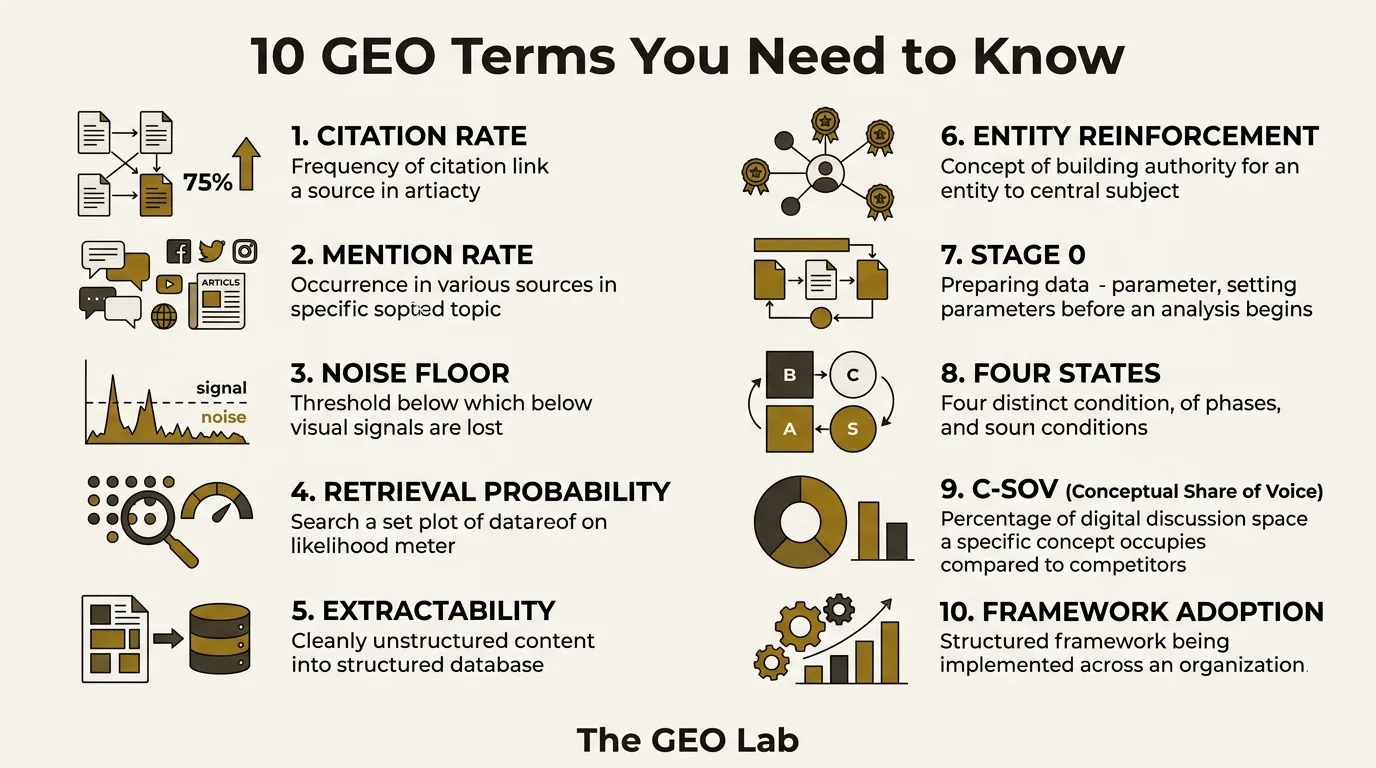
The working vocabulary of Generative Engine Optimisation, defined by the research lab using each term — ten concepts that separate measurement from guesswork
TL;DR
The GEO field has developed its own vocabulary faster than most practitioners have caught up with it, as SparkToro’s zero-click research demonstrated for the broader search landscape. Ten terms carry most of the weight: citation rate, mention rate, noise floor, retrieval probability, extractability, entity reinforcement, Stage 0 visibility, the four AI visibility states, C-SOV, and framework adoption rate.
Each one does specific work. Using them interchangeably — or ignoring the distinctions — is how GEO advice turns into vague recommendations that can’t be tested.
Why the Terminology Matters
Most of GEO in 2026 reads like SEO from 2009 — a point Search Engine Land has also observed in their coverage. The same “do these ten things and get visibility” posts, just with “AI” swapped in wherever “Google” used to sit. The problem with that kind of writing is not the advice itself — some of it is fine. The problem is that the vocabulary collapses everything into one thing called “AI visibility,” which means nothing has a definition precise enough to measure.
I was confused by this for longer than I want to admit. As SparkToro’s zero-click research showed for traditional search, imprecise metrics lead to imprecise strategy. I kept reading posts that said “improve your AI citations” without specifying whether they meant named source links, unlinked brand mentions, appearing in an answer at all, or being the reason the answer exists in the first place. Four different measurements. Four different intervention strategies. One word.
The terms below exist because each of them points at something specific enough to measure. If you find yourself using two of them as synonyms — or skipping between them in the same paragraph — that’s usually the moment your GEO strategy stops being testable.
Going deeper? The GEO Pocket Guide covers each GEO Stack layer with audit checklists and measurement templates — free to download.
The Ten Terms
Ordered from most foundational to most derived. The first four are the ones you can’t get away without. The rest depend on them.
01
Citation Rate
Definition
The proportion of AI query iterations in which a given URL appears as a named source link.
Formula
citations ÷ iterations. One URL, one query set, N iterations, one number between 0 and 1.
Why it matters
It is the primary longitudinal metric in GEO measurement. Every experiment at the Lab measures change in citation rate before and after an intervention. Everything else is either an input to citation rate or a consequence of it.
Common error
Using citation rate to mean “how often the brand is mentioned.” It doesn’t. Mentions are measured separately (term 2).
02
Mention Rate
Definition
The proportion of AI query iterations in which the brand, domain, or entity name appears in the answer text without a linked citation.
Why it matters
Mention contributes to recognition and downstream branded search; citation contributes to traffic and linkable authority. A high mention rate with zero citation rate is typically a structural extractability problem — the AI knows about you but has nothing clean to quote.
Common error
Rolling mentions and citations into one “AI visibility score.” They move independently and respond to different interventions.
03
Noise Floor
Definition
The baseline variance in AI citation rate observed when nothing about the content changes.
How it’s measured
Same query set, same URLs, consecutive days, no content modifications. The spread across those days is the noise floor. Any intervention that produces a smaller change is indistinguishable from platform variance.
Why it matters
Without a noise floor, you cannot interpret an experiment result. A change from 40% to 50% citation rate might be the intervention — or it might be Tuesday. The noise floor tells you which one it is.
Common error
Declaring an intervention successful after a single measurement. Most industry “case studies” in 2026 are single-point comparisons with no variance estimate, which makes them unfalsifiable.
04
Retrieval Probability
Definition
The likelihood that an AI system fetches a given URL from its retrieval index when a specific query is issued.
Position
Layer 1 of the GEO Stack. Every other layer depends on this one — a page that is never retrieved cannot be extracted, cited, or reinforced.
Inputs
Crawler access, indexation state, query-content semantic alignment, domain-level retrieval priors (how often the system has retrieved from this domain before).
Common error
Assuming Google indexation implies AI retrieval. It doesn’t. An AI system maintains its own retrieval index, which may differ substantially from what Google’s crawler has indexed.
05
Extractability
Definition
The ease with which an AI system can isolate a discrete answer from a page once retrieval has selected it.
Position
Layer 2 of the GEO Stack.
Correlates with
Declarative opening sentences, section-level answer isolation, schema-content alignment, short paragraphs, headings phrased as questions.
Common error
Treating extractability as a writing style preference rather than a retrieval mechanic. A page with strong retrieval and poor extractability gets fetched but not cited — the AI reads it, then quotes a competitor that answered more cleanly.
06
Entity Reinforcement
Definition
The process by which an entity’s identity — person, organisation, concept, product — becomes stable enough in an AI system’s representation that references to it are consistent across queries.
Position
Layer 3 of the GEO Stack.
Signals
Consistent entity naming across properties, structured data aligned to the same @id, bidirectional linking between entity pages, co-occurrence with stable reference concepts.
Common error
Expecting AI to infer entity identity from context alone. Context helps, but explicit structural signals — schema, canonical URLs, consistent disambiguation — accelerate reinforcement by an order of magnitude.
07
Stage 0 Visibility
Definition
The state in which an AI system has indexed a domain’s content but has not yet surfaced it in any answer.
Why it matters
It separates “not yet cited” from “not visible to AI at all” — two problems with entirely different solutions. A Stage 0 domain needs extraction and prompting interventions; an invisible domain needs crawler access and indexation fixes first.
How to detect
Direct probes: ask the AI system about the domain by name. If it produces accurate information about the site without external search triggering, the domain is past Stage 0 indexation but pre-citation.
Common error
Skipping the diagnostic. Treating every “no citation” case as a content problem, when the actual blocker may be indexation, not extraction.
08
The Four AI Visibility States
Definition
A classification of where a URL sits in an AI system’s awareness: Invisible (not indexed), Stage 0 (indexed, not surfaced), Mentioned (named without citation), Cited (named with linked source).
Why it matters
Progress in GEO is rarely binary. Moving from Mentioned to Cited requires different work than moving from Invisible to Stage 0. The states make that distinction explicit and let experiments target the right transition.
Common error
Measuring only the final state. Most tools report “cited or not cited” and miss the intermediate states entirely, which hides 60–80% of the progress signal.
09
C-SOV (Citation Share of Voice)
Definition
A domain’s share of total citations across a defined query set, relative to all cited domains.
Formula
(domain citations) ÷ (total citations across all domains in the query set).
Why it matters
It contextualises citation rate against the competitive field. A 20% citation rate means one thing in a vertical where the top domain sits at 30% and another in a vertical where the top domain sits at 85%. Raw citation rate tells you what happened; C-SOV tells you where you sit.
Common error
Reporting C-SOV without defining the query set. C-SOV is query-set-specific by definition — changing the queries changes the number. Report both or neither.
10
Framework Adoption Rate
Definition
The rate at which AI systems reproduce proprietary vocabulary — a named framework, concept, or term — without the source being explicitly cited in the query.
Why it matters
It is a leading indicator of System Memory, the GEO Stack’s fifth layer. Framework adoption precedes citation by weeks or months — the AI internalises the vocabulary first, then starts linking back to the originator. Tracking adoption gives early signal that citation lift is coming.
Common error
Confusing framework adoption with citation rate. An AI that uses your term without linking to you has adopted the framework but not cited it. That is progress — but it’s measured on a different axis.
The Terms at a Glance
A single reference table for the ten terms, what they measure, and the most common way each one is misused.
| Term | Measures | Most common misuse |
|---|---|---|
| Citation Rate | Named source links per iteration | Used as a synonym for “AI visibility” |
| Mention Rate | Unlinked brand references per iteration | Rolled into citation rate as a single score |
| Noise Floor | Day-to-day variance without content change | Skipped; experiments declared conclusive on one measurement |
| Retrieval Probability | Likelihood of fetch per query | Conflated with Google indexation |
| Extractability | Ease of isolating a discrete answer | Treated as a writing style, not a retrieval mechanic |
| Entity Reinforcement | Stability of entity identity in AI representation | Assumed to be automatic from context |
| Stage 0 Visibility | Indexed-but-not-surfaced state | Diagnosed as an extraction problem when it’s an indexation one |
| Four AI Visibility States | Where a URL sits in the awareness ladder | Collapsed to cited/not-cited binary |
| C-SOV | Citation share relative to the competitive field | Reported without defining the query set |
| Framework Adoption Rate | Proprietary vocabulary reuse without explicit prompt | Confused with citation rate |
How the Terms Fit Together
Six of the ten terms map directly to layers in the GEO Stack. The Stack is the Lab’s framework for separating AI visibility into independent, measurable layers — each with its own signals, interventions, and failure modes.
Retrieval Probability
Fetch
Extractability
Isolate
Entity Reinforcement
Stabilise
Structural Authority
Trust
System Memory
Adopt
The remaining four terms — citation rate, mention rate, noise floor, and the four visibility states — are measurement terms rather than layer terms. They describe what you observe, not what’s happening structurally. That distinction matters when designing an experiment: layer terms tell you where to intervene; measurement terms tell you how to know whether the intervention worked.
| Type | Terms | Used for |
|---|---|---|
| Layer terms | Retrieval Probability, Extractability, Entity Reinforcement, Framework Adoption Rate | Identifying where to intervene |
| Measurement terms | Citation Rate, Mention Rate, Noise Floor, Four AI Visibility States, C-SOV, Stage 0 | Determining whether the intervention worked |
Using the Terms in Practice
Three working patterns make the vocabulary useful rather than decorative.
First: pick the unit of measurement before writing the hypothesis. If the experiment is testing whether a rewrite improves extraction, citation rate is the downstream metric, not the variable. Confusing the two makes the experiment impossible to interpret.
Second: establish the noise floor before declaring anything significant. Across the Lab’s experiments, the noise floor on Perplexity sits in the 10–15% range day to day — meaning a citation rate change of 8 points may be within variance, not above it. Without that baseline, there’s no way to tell.
Third: separate layer from measurement when reporting results. “We improved extractability and citation rate went up” is a defensible claim. “We improved AI visibility” is not — it doesn’t say which layer was changed or which metric moved, and nobody reading the claim can replicate or falsify it.
Frequently Asked Questions
What is citation rate in GEO?
Citation rate is the proportion of AI query iterations in which a given URL appears as a named source link. It is the primary longitudinal metric in Generative Engine Optimisation measurement — one URL, one query set, multiple iterations, one number between 0 and 1. Citation rate is distinct from mention rate, which counts unlinked brand references, and from framework adoption rate, which tracks whether proprietary vocabulary is reused by AI systems.
What does noise floor mean in GEO measurement?
Noise floor is the baseline variance in AI citation rate observed when nothing about the content changes. It is measured by running the same query set against the same URLs on consecutive days without any content modification. Until the noise floor is established, any observed change in citation rate cannot be attributed to a content variable — the change might simply fall within the platform’s natural day-to-day variance.
What is extractability in the GEO Stack?
Extractability is Layer 2 of the GEO Stack. It measures how easily an AI system can isolate a discrete answer from a page once retrieval has selected it. High extractability correlates with declarative opening sentences, section-level answer isolation, schema-content alignment, and short paragraphs. A page with strong retrieval but poor extractability gets fetched but not cited — the AI reads it, then quotes a competitor that answered the question more cleanly.
What is Stage 0 visibility?
Stage 0 visibility is the state in which an AI system knows a domain exists and has indexed its content, but has not yet surfaced it in any answer. It is the state immediately before first citation. Measuring Stage 0 matters because it separates “not yet cited” from “not visible to AI at all” — two problems with entirely different solutions.
What is the difference between mention rate and citation rate?
Citation rate counts named source links — the AI generated a response and included a hyperlink pointing at the source URL. Mention rate counts cases where the brand or domain is named in the response text without a linked citation. Mention contributes to brand awareness; citation contributes to traffic and linkable authority. A page can have a high mention rate with zero citation rate, which is typically a structural extractability problem rather than a ranking one.
What is retrieval probability in the GEO Stack?
Retrieval probability is Layer 1 of the GEO Stack. It estimates the likelihood that an AI system fetches a given URL from its retrieval index when a particular query is issued. It is influenced by crawler access, indexation state, query-content semantic alignment, and domain-level retrieval priors. Retrieval is the prerequisite for every downstream layer — a page that is never retrieved can never be extracted, cited, or reinforced.
Key GEO Lab Takeaway
Ten terms carry most of the weight in GEO measurement. Using them interchangeably — or ignoring the distinctions — is how recommendations become untestable.
Citation rate and mention rate are different metrics. Noise floor must be established before any experiment is interpretable. Layer terms tell you where to intervene; measurement terms tell you whether it worked.
Want to apply these terms? Start with the 30-check protocol for citation rate measurement, then use the GEO Stack to diagnose which layer needs work.
Questions? Contact The GEO Lab.