
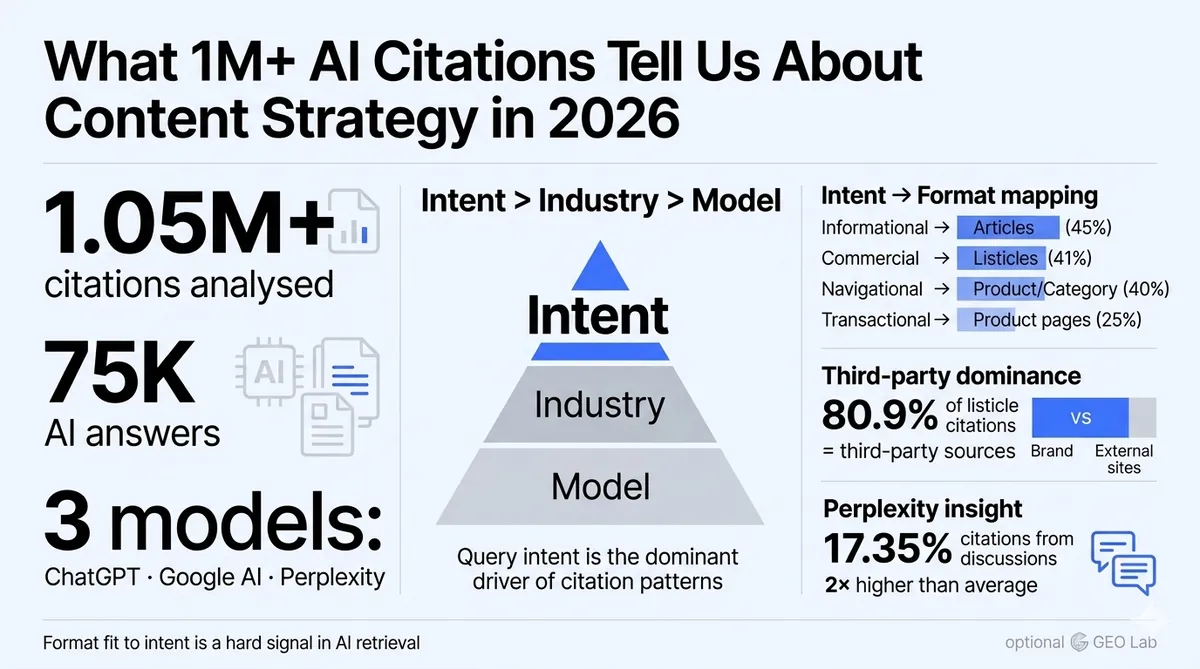
A new large-scale study from Peec AI and Wix confirms what GEO practitioners have been saying — and surfaces one finding that should change how you think about Perplexity.
Peec AI and Wix just published one of the largest citation studies in GEO to date — 1,056,727 citations across ChatGPT, Google AI Mode, and Perplexity, segmented by prompt intent and industry. It’s worth reading in full. Here’s my analysis of what matters most for practitioners.
The headline finding: intent beats industry
The study’s central conclusion is that query intent is a stronger predictor of citation patterns than either industry vertical or AI model choice. That’s a big deal, and it runs counter to a lot of the “optimise for ChatGPT vs Perplexity” advice circulating right now.
In practice, this means a commercial intent query in health and wellness follows similar citation patterns to a commercial intent query in SaaS — despite those industries having very different content ecosystems. The user’s intent is the dominant signal, not the niche.
Intent-to-format: the table you need to save
The most actionable output of the study is the breakdown of citation rates by content type and prompt intent. Here’s the distilled version:
| User intent | Dominant format | % of citations | Avoid |
|---|---|---|---|
| Informational Learning, researching a topic |
Articles | 45.5% | Product pages |
| Commercial Comparing options, pre-purchase |
Listicles | 40.9% | Long-form articles |
| Navigational / Local Finding a specific site or service |
Product + Category pages | 40.3% | Listicles |
| Transactional Ready to buy or act |
Product pages | 24.9% | Articles nearly disappear |
The sharp drop-off is what’s telling. Articles capture 45% of informational citations but only 5.6% of transactional ones. Listicles own commercial intent at 41% but barely register for navigational queries at 5.4%. Format fit to intent isn’t a soft preference — it’s a hard signal.
The listicle question: self-promo vs third-party
The study addresses the current debate about listicles head-on. Google has been cracking down on self-promotional listicles where the same brand places itself at number one. But the data distinguishes between two very different types:
This is the most underreported finding in the study. Most GEO strategy focuses on owned content — your own articles, your own product pages. But when it comes to listicles, which dominate commercial intent, it’s third-party placements that are driving citation volume. That means getting featured in roundups, comparison posts, and curated lists on neutral sites is not a nice-to-have — it’s a core visibility lever.
Industry variations: know your baseline
While intent is the primary signal, industry does set the citation baseline. A few patterns worth noting:
- ⚙️ SaaS: Listicles dominate at 35.4%. The sector is wired for tool comparison before commitment. If you’re not in the roundups, you’re not in the consideration set.
- 🏥 Health & wellness: Articles invert the trend and outperform listicles. Authority and trust signals carry more weight than structured comparisons. This is one of the few verticals where long-form editorial content still leads across intent types.
- 💼 Professional services: The highest listicle citation rate of any industry (25.2%), but articles follow close behind at 16.8%. You need both: listicles to get discovered, thought leadership to get chosen.
- 🛒 eCommerce: The most balanced distribution — listicles, articles, and category pages all compete. Multiple content strategies can work here simultaneously.
The Perplexity finding: discussions are a first-class signal
This is the finding most practitioners will overlook, and it’s the one I’d flag most strongly for 2026 strategy.
While ChatGPT and Google AI Mode both under-index on discussion content (Reddit, LinkedIn, G2, forums), Perplexity is a different beast. 17.35% of Perplexity citations come from discussions — more than double the 7.52% average across all models. Perplexity actively values community opinion and peer insight in a way the other two don’t.
This also has implications for how you think about content distribution vs content creation. A well-argued LinkedIn post that gets engagement may generate more Perplexity citation surface than a 2,000-word blog post optimised for informational intent.
Model differences: real but overrated
The study does find meaningful differences between models at the format level:
- 🤖 ChatGPT skews toward articles — 43.3% of citations from articles and listicles combined, with the highest article representation of the three models.
- 🔍 Google AI Mode has the most balanced distribution across all 11 content types, with slight preference for educational content. Unsurprising given its search heritage.
- ⚡ Perplexity uniquely elevates discussions and de-emphasises traditional articles — the most community-weighted citation profile of the three.
The researchers’ own conclusion: these model differences are less significant than intent-based patterns. Optimising for user intent will outperform optimising for specific AI models in most cases. The Perplexity discussion preference is the one exception worth building around explicitly.
What this means for your GEO strategy
The practical takeaway from this study isn’t about any single content type. It’s about building a content ecosystem that maps to the full awareness journey — and ensuring your third-party footprint is as intentional as your owned content.
- ✅ Audit by intent layer, not just by page type. The same product page serves different intent signals. Make sure your most-cited pages are optimised for the intent that actually drives traffic to them in AI search.
- ✅ Map third-party placements as GEO inventory. Third-party listicles at 80.9% of commercial citations is the study’s most underreported finding. Getting mentioned in neutral roundups is a direct citation lever.
- ✅ Treat discussion content as a channel, not a byproduct. Especially for Perplexity-heavy audiences. Active LinkedIn posts, forum participation, and community presence are citation surface.
- ✅ Know your niche baseline before benchmarking. A 15% article citation rate means different things in SaaS (below average) vs health and wellness (expected). Context is everything.
The brands building durable AI visibility in 2026 aren’t just publishing more content. They’re publishing the right content format for each stage of how their specific buyer actually thinks — and making sure that content is surfaced across both owned and third-party channels.
Source: The content types most cited by LLMs — Peec AI & Wix Studio AI Search Lab, March 2026. Study analysed 75,000 AI answers and 1,056,727 citations across ChatGPT, Google AI Mode, and Perplexity across five industries and four prompt intent categories.