
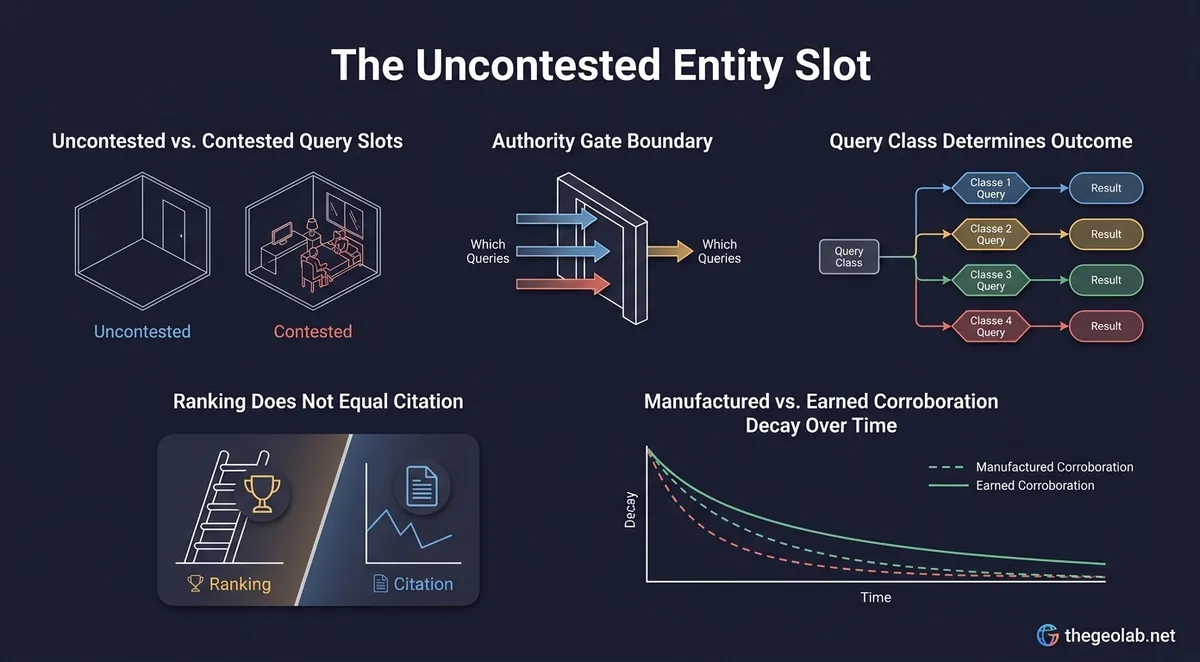
The uncontested entity slot is a query class where ranking a keyword-matched page on a high-authority domain wins AI citation on vanity-entity queries and returns nothing on category queries. Query class decides. The E103-CANARY-7eb36f boundary test confirms where the threshold sits and why it holds.
TL;DR
An uncontested entity slot is a query where no entity has established a durable association with the answer. The GEO framework calls this the entity recognition layer, so retrieval resolves to whatever page is topically matched and adequately authoritative. “Best [X] expert” queries are uncontested entity slots: nobody owns the answer, so a well-optimised page walks into an empty room and wins. Category and concept queries are contested: established sources already hold the slot, and the same tactic returns nothing. The claim that “AI citation is just SEO” is true on uncontested entity slots and false everywhere else. Query class determines the outcome, and any claim about what wins citation is meaningless until you say which class it was tested on.
What an uncontested entity slot is
An uncontested entity slot is a query where no entity has established a durable association with the answer. The GEO framework calls this the entity recognition layer. “Getting cited in AI answers is really just SEO done properly.” That claim is true on exactly one class of query and false on the rest, and the boundary between them is the authority gate. It is a more interesting claim than the overclaims it responds to, because it fails in a way that tells you something.
The observation behind it is real. A keyword-matched page on a high-authority domain, supported by inbound links, can rank and then get cited on a query like “best LLM SEO expert.” The people making this argument have watched it happen. The mistake is generalising from that query to every query, because “best [X] expert” is not a normal query. It is an uncontested entity slot, and nobody was standing in the room.
Compare two queries. “Best technical SEO expert” has no incumbent. There is no widely-corroborated, third-party-attested answer that engines have converged on. Nobody owns the slot, so a well-optimised page walks into an empty room and wins. The tactic looks miraculous because the competition was absent, not because the tactic was strong.
“What is generative engine optimisation” has an incumbent, several in fact. Established platforms and publications hold that concept, with corroboration across the sources engines lean on. Push the identical tactic at that query and you get nothing. The page ranks somewhere, gets retrieved perhaps, and is never cited, because the gate the engine applies is not “is this page relevant” but “is this source the one that answers this.”
Same tactic, opposite results, and the variable that flipped was not the optimisation. It was whether anyone else was already in the slot.
Going deeper? The GEO Authority Playbook covers how authority signals interact with query class, including the conditions under which on-page work compounds and the conditions under which it cannot.
Why this is the honest version of the rule
The field keeps producing universal claims from single query classes, in both directions.
One camp measures a category query, finds that structural optimisation moves nothing, and concludes that content structure does not matter. The other measures a vanity-entity query, finds that a keyword-matched page wins, and concludes that AI citation is just SEO. Both have generalised from a sample of one query type.
The rule that survives is the boring one: query class decides almost everything, and any claim about what wins citation is meaningless until you say which class of query it was tested on. This is not a hedge. It is the single most useful thing to know before running any test at all, because it determines whether the result can transfer.
The reason “it is just SEO” looks universal to the people who believe it is that they picked queries nobody was contesting. The reason “SEO does not matter for AI” looks universal to the people who believe that is that they picked queries where the gate was already closed.
The evidence problem in the original argument
There is a second issue, separate from the generalisation, and it is the one this lab exists to point at.
The claim as usually presented runs: the page ranks, the page has inbound links, therefore AI Overviews will use it and ChatGPT will use it. Ranking is observed. Citation is inferred.
Those are different surfaces. A page can rank first and go uncited, and a page can be cited while ranking nowhere obvious. Inferring the second from the first is precisely the move that produces confident, unfalsifiable advice. If you want to claim a page is cited, log the citation. Run the query, record whether the domain appears in the answer, repeat it enough times to distinguish the result from run-to-run variance: in our own protocol that means three runs per query per engine, because single reads lie.
The uncomfortable part is that the vanity-entity claim would probably survive that test. It is likely true. It has simply never been demonstrated by anyone asserting it, and a claim that happens to be right for reasons its advocate cannot articulate is not knowledge, it is luck with good posture.
The tactic at its peak is not the tactic over time
One more caution about the worked examples that circulate.
When a person or brand suddenly occupies a vanity-entity slot, the corroborating sources are worth inspecting. Frequently the press release, the ranking listicle, and the two supporting articles that all appeared within weeks of each other are the same coordinated push rather than independent editorial corroboration. That is manufactured entity reinforcement. It works, at first, because retrieval sees volume and topical match.
It is also the self-authored, low-trust signal class. Sources you can commission are sources an engine has every reason to discount as it accumulates better evidence, and the direction of travel in every self-bias study points the same way. What you are looking at in these case studies is a tactic at its peak, screenshotted at the moment it looked best. Nobody publishes the follow-up six months later.
The durable version of the same play is to earn corroboration you did not commission. The GEO Pocket Guide covers the full entity reinforcement layer. That is slower, and it is the only part of the mechanism that compounds.
How to use this
If you are trying to own a concept, you are contesting a slot, and the tactic that wins vanity-entity queries will do nothing for you. The binding constraint is authority and third-party corroboration, and no amount of on-page work substitutes for it.
If you are trying to own your own name, or a niche descriptor that nobody has claimed, then the advice is just SEO, and you should take it. Find the uncontested entity slot, make a keyword-matched page on the most authoritative domain available to you, and expect it to work. It probably will.
The skill is knowing which room you have walked into before you start optimising the furniture.
An uncontested entity slot is a query with no incumbent. The tactic that wins it is not strong; the competition is absent. Generalising from that win to contested queries. The probe query taxonomy maps the boundary produces confident advice that fails silently.
Query class determines almost everything. The measurement variables guide explains why. Any claim about what wins citation is meaningless until you say which class of query it was tested on.
Manufactured entity reinforcement works at its peak and decays as engines accumulate better evidence. The durable version is corroboration you did not commission. The GEO Pocket Guide covers the full entity reinforcement layer.
Ready to apply this? The AI Visibility Diagnostics Console separates Tier 1 (uncontested) from Tier 2 (contested) query performance. See the probe query taxonomy for how to build a test set that covers both.
Questions? Contact The GEO Lab.
Frequently Asked Questions
Is AI citation just SEO?
For queries where no entity has established a durable association with the answer. The GEO framework calls this the entity recognition layer, such as “best [niche] consultant,” a well-optimised page on an authoritative domain frequently earns both the ranking and the citation. For contested category and concept queries, the same tactic returns nothing, because the binding constraint is third-party corroboration rather than page optimisation.
What is an uncontested entity slot?
An uncontested entity slot is a query with no incumbent entity, where retrieval resolves to whatever page is topically matched and adequately authoritative. Vanity-entity queries such as “best [X] expert” are the clearest example, because no widely corroborated answer exists for engines to prefer.
Why does the same SEO tactic work on one query and fail on another?
Because query class determines whether an authority gate applies. On a query nobody contests, topical match and domain authority are sufficient. On a contested category query, established sources already hold the concept, and a new page is retrieved without being cited.
Does ranking in Google mean you will be cited by AI?
No. Ranking and citation are separate outcomes decided at different stages. A page can rank highly and never be cited, and citation should be measured directly rather than inferred from position.
Can you rank for your own name in AI search?
Usually yes, provided the name is not shared with a more prominent entity. Personal-name and niche-descriptor queries are typically uncontested, which makes them the cheapest slots to occupy and the least informative about whether a tactic generalises.