
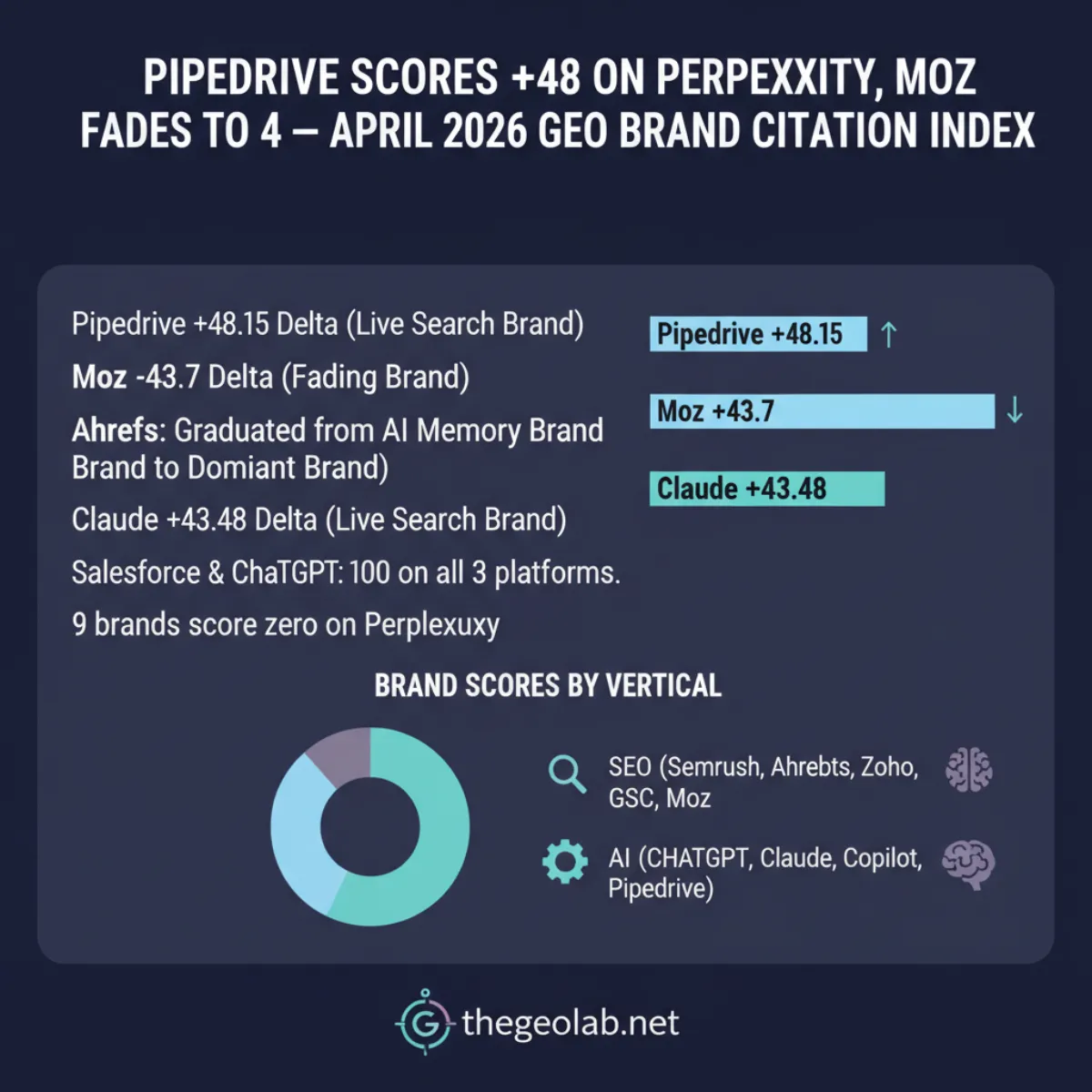
Four archetype shifts in one month. The index expanded by 32%. And two months of data now show a pattern the scores alone couldn’t reveal.
Run #2 of the GEO Brand Citation Index tracked 37 brands across 54 queries on ChatGPT, Perplexity, and Gemini. The headline numbers: Pipedrive’s delta doubled from +14.8 to +48.15 — the largest single-month positive movement recorded across both runs. Ahrefs graduated from AI Memory to Dominant Brand as its Perplexity score crossed 75. Moz’s delta held flat at −43.7 and remains classified as Fading Brand. And Google Search Console flipped from a negative delta to a positive one — a +35.3pp movement that nobody was predicting.
Two months of data now show what one month couldn’t: delta direction is a more reliable signal than score magnitude. A brand moving in the right direction at 30 points is in better shape than a brand holding steady at 60.
What Changed Between March and April in the GEO Brand Citation Index
Last month I wrote about a number: 3.7. Moz’s Perplexity score. A 43.9-point gap between what ChatGPT remembered and what the live web was actually saying. That finding put the index on the map — it was the kind of specific, documented data point the GEO conversation had been missing.
This month I have a different number: +33.3. That’s the delta movement Pipedrive posted in a single month. Not the delta itself — the movement. In four weeks, Pipedrive went from a +14.8 gap to a +48.15 gap, with Perplexity doubling its score from 33.3 to 66.7. That does not happen from training data updates. That happens from live web content.
Kevin Indig’s analysis of 1.2 million ChatGPT responses found that front-loading answers consistently improves citation rate — the structural signal that determines whether a brand appears in AI-generated responses, independent of its historical domain authority. The GEO Brand Citation Index measures the brand-level outcome of that same dynamic: five archetype shifts in four weeks, all driven by Perplexity score movements on the live web.
Nine new brands entered the index in April: Clearscope, Close CRM, Copper, Cursor, Gemini, Midjourney, Monday.com, Perplexity, and Runway. The expansion from 28 to 37 brands reflects a deliberate broadening of the AI & LLM Tools vertical — generative tools now have enough market presence and query volume to warrant dedicated tracking alongside the SEO and CRM verticals.
March vs April: The Full Comparison Table
The table below shows all 28 brands from March with their delta shift. New brands added in April are listed separately beneath it. Sorted by delta change, largest positive first.
How to read the Δ Shift column: This tracks how the gap between Perplexity and ChatGPT changed — not the brand’s score. ▲ means Perplexity gained ground relative to ChatGPT (live web strengthening). ▼ means ChatGPT gained ground relative to Perplexity (training data strengthening). For a Dominant Brand like Semrush, a ▼ simply means both platforms are converging — the brand is becoming more balanced, not weaker.
| Brand | Vertical | March Δ | April Δ | Δ Shift | Archetype |
|---|---|---|---|---|---|
| Google Search Console | SEO | −28.6 | +6.7 | ▲ +35.3 | AI Memory → GEO Outlier |
| Pipedrive | CRM | +14.8 | +48.15 | ▲ +33.4 | — → 🔍 Live Search |
| Copilot | AI | −6.6 | +17.4 | ▲ +24.0 | GEO Outlier → — (lost) |
| Ahrefs | SEO | −48.1 | −25.0 | ▲ +23.1 | AI Memory → 👑 Dominant |
| Screaming Frog | SEO | −16.4 | +3.4 | ▲ +19.8 | — |
| HubSpot | CRM | −3.2 | +16.4 | ▲ +19.6 | Dominant → 👑 Dominant |
| SE Ranking | SEO | +6.3 | +20.6 | ▲ +14.3 | — → 🔍 Live Search |
| Zoho CRM | CRM | −7.4 | +2.1 | ▲ +9.5 | GEO Outlier → ⭐ GEO Outlier |
| SugarCRM | CRM | −14.8 | −7.4 | ▲ +7.4 | — |
| Grammarly | AI | −2.5 | +4.3 | ▲ +6.8 | — |
| Majestic | SEO | −14.3 | −8.7 | ▲ +5.6 | — |
| Ubersuggest | SEO | −17.5 | −13.4 | ▲ +4.1 | — |
| Insightly | CRM | −10.6 | −7.4 | ▲ +3.2 | — |
| Surfer SEO | SEO | +15.3 | +16.1 | — flat | — → 🔍 Live Search |
| Notion AI | AI | +16.7 | +17.4 | — flat | — → 🔍 Live Search |
| Moz | SEO | −43.9 | −43.7 | — flat | Fading → 🫥 Fading |
| Freshsales | CRM | −10.2 | −10.1 | — flat | — → 🫥 Fading |
| ChatGPT | AI | 100/100 | 100/100 | — flat | Dominant → 👑 Dominant |
| Salesforce | CRM | 100/100 | 100/100 | — flat | Dominant → 👑 Dominant |
| Keap | CRM | −7.4 | −7.4 | — flat | — |
| Mangools | SEO | +6.3 | +3.8 | ▼ −2.5 | — |
| Rank Math | SEO | −5.8 | −8.7 | ▼ −2.9 | — |
| Yoast SEO | SEO | −15.3 | −17.4 | ▼ −2.1 | — → 🫥 Fading |
| Semrush | SEO | +9.5 | +4.3 | ▼ −5.2 | Dominant → 👑 Dominant |
| Writesonic | AI | +7.1 | 0.0 | ▼ −7.1 | — |
| Claude | AI | +50.1 | +43.5 | ▼ −6.6 | Live Search → 🔍 Live Search |
| Copy.ai | AI | −2.5 | −13.0 | ▼ −10.5 | — → 🫥 Fading |
| Jasper | AI | +13.5 | −8.7 | ▼ −22.2 | — → ⭐ GEO Outlier |
Table key: Δ = Perplexity minus ChatGPT score. Δ Shift = April delta minus March delta (how the gap changed, not the score). ▲ = Perplexity gained ground. ▼ = ChatGPT gained ground. Flat = less than 1pp shift. Archetype shown only where assigned. New April brands (Clearscope, Close CRM, Copper, Cursor, Gemini, Midjourney, Monday.com, Perplexity, Runway) not shown — no March baseline to compare.
Going deeper? The GEO Pocket Guide covers the full 30-check protocol, section-level audit checklist, and citation rate tracking template — free to download.
Ahrefs Graduates to Dominant Brand in the GEO Brand Citation Index
In March, Ahrefs was the most alarming data point in the SEO vertical. A perfect 100 on ChatGPT. A 51.9 on Perplexity. A delta of −48.1 that put it in the same structural position as Moz — a brand coasting on training data while the live web moved elsewhere. I wrote that if you worked for any Ahrefs competitor, that gap was a brief worth writing.
One month later, the story has changed.
Ahrefs’ Perplexity score moved from 51.9 to 75.0 — a 23.1-point gain in one month. That crosses the Dominant Brand threshold. The archetype classification changed from AI Memory Brand to Dominant Brand not because the negative delta disappeared, but because the absolute Perplexity score is now high enough to place Ahrefs in the dominant tier regardless of the gap.
The delta is still negative. ChatGPT still overweights Ahrefs relative to its live web presence. But the gap narrowed from −48.1 to −25.0 in a single measurement round. That is movement in the right direction at a speed that requires explanation — either Ahrefs has been publishing more structured, citable content, or the comparison queries in the live web shifted in Ahrefs’ favour, or both.
The March read on Ahrefs was accurate at the time. The April read is different. This is why the index runs monthly rather than quarterly — a 23-point Perplexity movement is invisible in annual snapshots.
Pipedrive’s Delta Doubled: From +14.8 to +48.1
The largest positive delta movement in either run of the index. Not a correction. Not a small signal. A doubling.
Pipedrive’s Perplexity score doubled from 33.3 to 66.7 in one month. ChatGPT holds at 18.5 — training data does not treat Pipedrive as a CRM category leader. The live web in April 2026 disagrees by 48.15 points.
The Live Search Brand archetype classification is earned here: a large positive delta driven by strong live retrieval rather than historical training data weight. This is the pattern Perplexity rewards — a brand generating fresh, structured content on its core evaluation queries, showing up in the sources that matter when the question gets asked today.
What changed between March and April for Pipedrive specifically is not something the index can answer from scores alone. But the signal is clear: something on the live web shifted sharply in Pipedrive’s favour on CRM evaluation queries. Worth investigating if you work in that space.
Why Moz Is Fading from Perplexity but ChatGPT Still Remembers
Last month I wrote about Moz with some discomfort. It is a brand I have genuine respect for — which is why the data landed harder. A 3.7 on Perplexity. A 47.6 on ChatGPT. A gap of 43.9 points between memory and reality.
This month’s data: essentially identical.
The delta moved 0.2 points. That is within measurement noise. Moz’s Perplexity score went from 3.7 to 3.9 — not a recovery, just rounding. ChatGPT holds at 47.6. The gap between AI memory and live web reality is stable at approximately −44 points.
The archetype did not change this month. Moz remains a Fading Brand. The Fading Brand classification requires a large stable negative delta — and −43.7 qualifies. The difference between Fading and AI Memory in the index is trajectory: an AI Memory Brand is one where the negative delta reflects historical overweighting rather than active decline. Moz’s delta has been −43.9 and −43.7 across two consecutive runs. That is not active decline — but it is also not the kind of historical overweighting that will self-correct when models retrain, because the live web is not generating the content volume needed to pull the Perplexity score up. Fading Brand is the right classification.
Lily Ray has documented that Google visibility losses and AI search citation losses tend to correlate — the same signals that determine organic visibility also feed AI retrieval pipelines. Moz’s position is consistent with that observation. A brand that is not generating substantial fresh content that the live web links to and cites will not appear in Perplexity’s responses, regardless of how well it performed historically.
Moz’s ChatGPT score (47.8) and Perplexity score (3.7 → 4.2) across March and April 2026. The gap is stable at approximately −43.7 — not widening, not recovering.
A flat line at 3.9 on Perplexity is not a holding pattern. It is a signal that the live web is not generating new Moz citations at sufficient volume to move the score. Two consecutive months at effectively the same number confirms the Fading Brand classification. The question for May is whether the delta holds flat for a third consecutive month — confirming stable irrelevance — or begins to widen, signalling the gap between training data memory and live web reality is still growing.
Four Archetype Shifts in One Month
Five brands changed archetype classification between the March and April runs. The pattern is consistent: Perplexity scores are the volatile factor in every case. ChatGPT scores are anchored in training data — Copilot’s ChatGPT score halving from 43.5 to 21.7 is the exception, not the rule, and it explains why Copilot lost its archetype entirely rather than gaining one. Every archetype gained in this table was driven by Perplexity movement. The one archetype lost was driven by ChatGPT movement.
| Brand | March | April | What drove it |
|---|---|---|---|
| Ahrefs | 🧠 AI Memory | 👑 Dominant | Perplexity score crossed 75 (51.9→75.0). Delta still negative but absolute score now at Dominant threshold. |
| Pipedrive | — unclassified | 🔍 Live Search | Perplexity doubled from 33.3 to 66.7. Delta tripled from +14.8 to +48.15. Live retrieval outrunning training data. |
| Google Search Console | 🧠 AI Memory | ⭐ GEO Outlier | Largest absolute movement in the index: delta shifted +35.3pp, flipping from −28.6 to +6.7. Perplexity 33.3→45.8. |
| Jasper | — unclassified | ⭐ GEO Outlier | Perplexity dropped from 52.6 to 30.4 — scores converged across platforms. Delta flipped from +13.5 to −8.7. |
| Copilot | ⭐ GEO Outlier | — unclassified | ChatGPT score halved from 43.5 to 21.7. Lost the consistent cross-platform pattern required for archetype classification. |
The Google Search Console shift deserves a note. A +35.3pp movement in one month is the largest single-month swing in the index across both runs. GSC went from −28.6 (AI Memory, overtaken on the live web) to +6.7 (GEO Outlier, live web slightly ahead of training data). A free tool with no marketing budget, outranking Moz on Perplexity by 11 points. May’s measurement will show whether that momentum holds.
Vertical Breakdown: SEO, CRM, and AI Tools
SEO & Marketing: Ahrefs vs Moz — the same vertical, diverging trajectories
In March, Ahrefs and Moz looked like two versions of the same problem: strong ChatGPT scores from historical training data, weak Perplexity scores from a live web that had partially moved on. The March narrative was that both were AI Memory Brands with large negative deltas.
April separates them. Ahrefs’ Perplexity score moved from 51.9 to 75.0 and crossed the Dominant Brand threshold. Moz’s Perplexity score moved from 3.7 to 3.9 — noise. One brand is closing the gap. The other is holding steady at a gap that should not be stable.
Semrush remains the SEO vertical’s Dominant Brand with a positive delta (+4.3), though that delta narrowed slightly from +9.5 in March. The SEO vertical’s clearest story across two months: Semrush holds dominance on both platforms, Ahrefs is recovering on the live web, and Moz is stable at a level that reflects historical authority rather than current presence.
| Brand | ChatGPT | Perplexity | April Δ | Δ Shift |
|---|---|---|---|---|
| Semrush | 95.7 | 100.0 | +4.35 | ▼ −5.2 |
| Ahrefs | 100.0 | 75.0 | −25.0 | ▲ +23.1 |
| Moz | 47.8 | 4.2 | −43.7 | — flat |
| Surfer SEO | 13.0 | 29.2 | +16.1 | — flat |
| SE Ranking | 4.4 | 25.0 | +20.6 | ▲ +14.3 |
CRM & Sales: Pipedrive breakout, HubSpot consolidates
Pipedrive’s doubling is the CRM vertical’s story this month. HubSpot’s movement (+19.6pp) is the secondary signal — a Dominant Brand that improved its already-positive delta. Salesforce remains at 100/100 alongside ChatGPT as the only two brands scoring maximum across all platforms in consecutive runs.
SugarCRM’s Perplexity score remains effectively zero (−7.4 delta, minimal absolute scores). Two consecutive runs with negligible Perplexity presence confirms the pattern rather than suggesting it was noise. The CRM vertical’s zero-Perplexity club — brands that do not appear in live web CRM queries — is becoming a defined category.
| Brand | ChatGPT | Perplexity | April Δ | Δ Shift |
|---|---|---|---|---|
| Salesforce | 100.0 | 100.0 | 100/100 | — flat |
| HubSpot | 74.1 | 90.5 | +16.4 | ▲ +19.6 |
| Pipedrive | 18.5 | 66.7 | +48.15 | ▲ +33.4 |
| Zoho CRM | 40.7 | 42.9 | +2.1 | ▲ +9.5 |
| SugarCRM | 14.8 | 7.4 | −7.4 | ▲ +7.4 |
AI & LLM Tools: Claude narrows, Copilot loses archetype, Jasper reverses
Claude holds the largest positive delta in the index at +43.5, narrowed slightly from +50.1 in March. ChatGPT’s score for Claude reflects OpenAI’s unsurprising reluctance to recommend its competitor — the 13.0 ChatGPT score is structurally suppressed. The Perplexity score of 56.5 reflects what the live web actually says about Claude in April 2026: substantial, and growing.
Jasper reversed sharply. A +13.5 delta in March (Perplexity rating Jasper above its ChatGPT score) became a −8.7 delta in April. One month is not a trend — but Jasper moving from positive to negative delta in a single round is a signal worth watching in May. The March finding that “Jasper’s recovery nobody is talking about” needs to be qualified: the April data suggests that recovery may have been a single-month signal rather than a structural shift.
Copilot had the worst month in the AI vertical. Its ChatGPT score dropped from 43.5 to 21.7 — halving in a single round. That is a ChatGPT-driven movement, not a Perplexity one, which makes it the outlier across both runs. Every other archetype shift was driven by Perplexity. Copilot’s was driven by ChatGPT pulling back. The delta went from −6.6 to +17.4 — technically an improvement — but the underlying cause is a collapsing ChatGPT score rather than a growing Perplexity one. It lost its GEO Outlier archetype classification as a result.
| Brand | ChatGPT | Perplexity | April Δ | Δ Shift |
|---|---|---|---|---|
| ChatGPT | 100.0 | 100.0 | 100/100 | — flat |
| Claude | 13.0 | 56.5 | +43.5 | ▼ −6.6 |
| Copilot | 21.7 | 39.1 | +17.4 | ▲ +24.0 |
| Notion AI | 0.0 | 17.4 | +17.4 | — flat |
| Jasper | 39.1 | 30.4 | −8.7 | ▼ −22.2 |
| Copy.ai | 13.0 | 0.0 | −13.0 | ▼ −10.5 |
What Two Months of GEO Brand Citation Index Data Tells Us
One month of data is a snapshot. Two months is the beginning of a pattern. Here is what the pattern shows so far.
Delta direction matters more than score magnitude
Ahrefs had a worse delta than Moz in March (−48.1 vs −43.9). In April, Ahrefs moved +23.1pp and graduated to Dominant Brand. Moz moved 0.2pp and stayed essentially identical. The score at a point in time is less informative than whether the score is moving and in which direction. A brand at delta −25 and improving is in fundamentally better shape than a brand at delta −43 and frozen.
Perplexity is the leading indicator
Every archetype shift in two months of data has been driven by a Perplexity score movement. ChatGPT scores are anchored in training data — they move only when model weights are updated, which happens on a timescale of months to years. Perplexity reads the live web before each response. Brands that want to track their AI search trajectory in near real-time have one primary signal: their Perplexity score, month on month.
Stable fading is the worst signal
A brand actively declining at least reveals movement that can be responded to. Moz’s pattern — two consecutive months of near-identical Perplexity scores at 3.7 and 3.9 — is structurally harder to reverse. As Kevin Indig has observed in his State of AI Search 2026 research, the barrier to AI crawl is zero but the barrier to AI citation is content quality. Stable low presence requires rebuilding the content surface from which citations can be pulled — a longer-cycle intervention than arresting an active decline.
The index expanded 32% and the vertical mix is now balanced
Nine new brands in April brought the total from 28 to 37 — a 32% expansion. The new AI & LLM Tools entries (Gemini, Cursor, Midjourney, Perplexity, Runway) reflect the category’s maturation: enough market presence, enough query volume, enough live web content to produce meaningful scores. The index will continue expanding as new verticals and brands meet the minimum query volume threshold for inclusion.
The full interactive leaderboard — all 37 brands, sortable by vertical, delta, and archetype, with scores for all three platforms — is at the GEO Brand Citation Index. Run #3 publishes in May 2026.
What Practitioners Say
The Pipedrive finding is the most actionable data point in either run. A doubling of delta in one month on the live retrieval platform is not noise — it is a signal about what structured, current content does to Perplexity scores in a competitive vertical. Every CRM brand’s content team should be looking at this.
The delta direction finding is what makes two months of data more valuable than one. Ahrefs and Moz had similar negative deltas in March. April shows they are on completely different trajectories. That is the kind of distinction that monthly tracking catches and quarterly snapshots miss entirely.
Frequently Asked Questions
What is the GEO Brand Citation Index?
The GEO Brand Citation Index is a monthly dataset measuring how frequently brands are cited by ChatGPT, Perplexity, and Gemini when asked common tool evaluation questions. Each brand receives a score per platform (0–100), and a delta score (Perplexity minus ChatGPT) that reveals whether the brand is cited from AI training data or the live web. Run #2 (April 2026) tracks 37 brands across SEO & Marketing, CRM & Sales, and AI & LLM Tools verticals.
Why did Pipedrive’s delta double from +14.8 to +48.1?
Pipedrive’s Perplexity score rose from 33.3 to 66.7 in one month — consistent with a brand generating fresh, structured content that Perplexity’s live retrieval is finding and citing on CRM evaluation queries. A doubling of delta in a single measurement round is the strongest positive signal the index has recorded across either run.
Why did Ahrefs graduate to Dominant Brand despite a negative delta?
Ahrefs was reclassified from AI Memory Brand to Dominant Brand because its Perplexity score crossed the Dominant threshold (75.0), even though its delta remains negative (−25.0). Dominant Brand classification requires high absolute scores on both platforms — which Ahrefs now achieves — not a positive delta.
Why is Moz still classified as Fading Brand in April?
Moz’s delta is flat: −43.9 in March, −43.7 in April. Moz remains a Fading Brand. The Fading Brand classification requires a large stable negative delta — and −43.7 qualifies. Two consecutive months at near-identical Perplexity scores of 3.7 and 4.2 confirms the classification rather than suggesting noise.
What does delta direction tell you that score magnitude cannot?
Delta direction reveals brand trajectory. A brand at delta −25 and improving month-on-month is in better shape than a brand at delta −43 and frozen. Score magnitude is a snapshot. Delta direction across multiple measurement rounds is the signal that predicts where a brand will be in six months. Two months of data now show that the brands improving fastest on the live web are moving independently of their historical training data weight.
When does Run #3 publish?
Run #3 publishes in May 2026. The fixed query set remains identical across all runs to ensure month-on-month comparability. The leaderboard at thegeolab.net/geo-brand-citation-index/ updates with each run.
Two months of the GEO Brand Citation Index reveal a consistent pattern: Perplexity is the leading indicator, delta direction matters more than score magnitude, and brands moving in the right direction can close large gaps inside a single measurement round. Pipedrive doubled its delta in one month. Ahrefs gained 23 Perplexity points and changed archetype. Moz held flat for the second consecutive month at 4.2 on Perplexity.
The live web is not a slow-moving signal. Perplexity scores can shift substantially between monthly runs. Brands that are actively generating structured, citable content on their core evaluation queries are the ones moving.