
Last updated: 11 March 2026
TL;DR: The GEO Stack is a five-layer diagnostic framework for identifying why content fails in AI search. The five layers — Retrieval Probability, Extractability, Entity Reinforcement, Structural Authority, and System Memory — map to stages of the generative retrieval pipeline. Always diagnose from Layer 1 upward: most visibility failures trace to Layers 1 or 2, and fixing higher layers when lower ones are broken produces no improvement.
I built this diagnostic framework after finding that visibility failures almost always trace to specific pipeline stages. I tested the five-layer model across dozens of content audits and documented the cascade patterns.
Understanding the GEO Stack: A Diagnostic Framework
The GEO Stack is a five-layer diagnostic framework for identifying why content fails to appear in AI-generated answers. As of March 2026, the framework has been validated across 330 queries on three AI platforms (ChatGPT, Perplexity, Gemini) with a measured 1.3% baseline citation rate. The framework was developed at The GEO Lab to give practitioners a structured method for diagnosing generative visibility failures — not just a checklist of things to add, but a sequential model that tells you exactly which layer to fix first.
The problem it solves is this: most content that fails in generative search fails for a specific, fixable reason. But without a framework, practitioners guess. They rewrite headings when the real problem is entity naming. They add schema when the real problem is section structure. They build links when the content is never retrieved in the first place. The GEO Stack eliminates that guesswork by mapping the generative retrieval pipeline onto an auditable five-layer model.
The framework is documented in full in the GEO Field Manual and applied in every experiment published in The GEO Log. This post focuses on its most practical application: using it to diagnose where and why a specific piece of content is failing to generate AI citations.
Why Layered Frameworks are Essential for Generative Visibility
GEO visibility requires a layered framework because generative search systems process content through multiple distinct stages. Each stage can fail independently. A failure at Stage 1 blocks everything downstream. A failure at Stage 3 is invisible to Stage 1 diagnostics.
Traditional SEO could be addressed with a single-layer model because Google’s ranking algorithm evaluated pages as whole documents. You improved a page — its authority, its relevance, its technical health — and its position changed. The system was holistic.
Generative search systems are not holistic. They operate sequentially:
- Stage 1: Vector retrieval selects candidate content chunks from an index. Content that does not pass retrieval is excluded from everything that follows.
- Stage 2: Extraction parses the retrieved chunks and isolates usable sections. Content with poor internal structure is retrieved but cannot be cleanly extracted.
- Stage 3: Compression reduces extracted sections to their most dense, citable form. Content that hides its core claim behind contextual framing loses its meaning at this stage.
- Stage 4: Synthesis combines compressed extracts from multiple sources into a generated answer. Content whose entity naming is inconsistent or ambiguous may be used without attribution or misrepresented.
Each stage maps to one or more layers of the GEO Stack. Diagnosing a visibility failure means identifying which stage is blocking the content — and that requires testing each layer in sequence, from the bottom up.
The Five Layers of the GEO Stack Explained
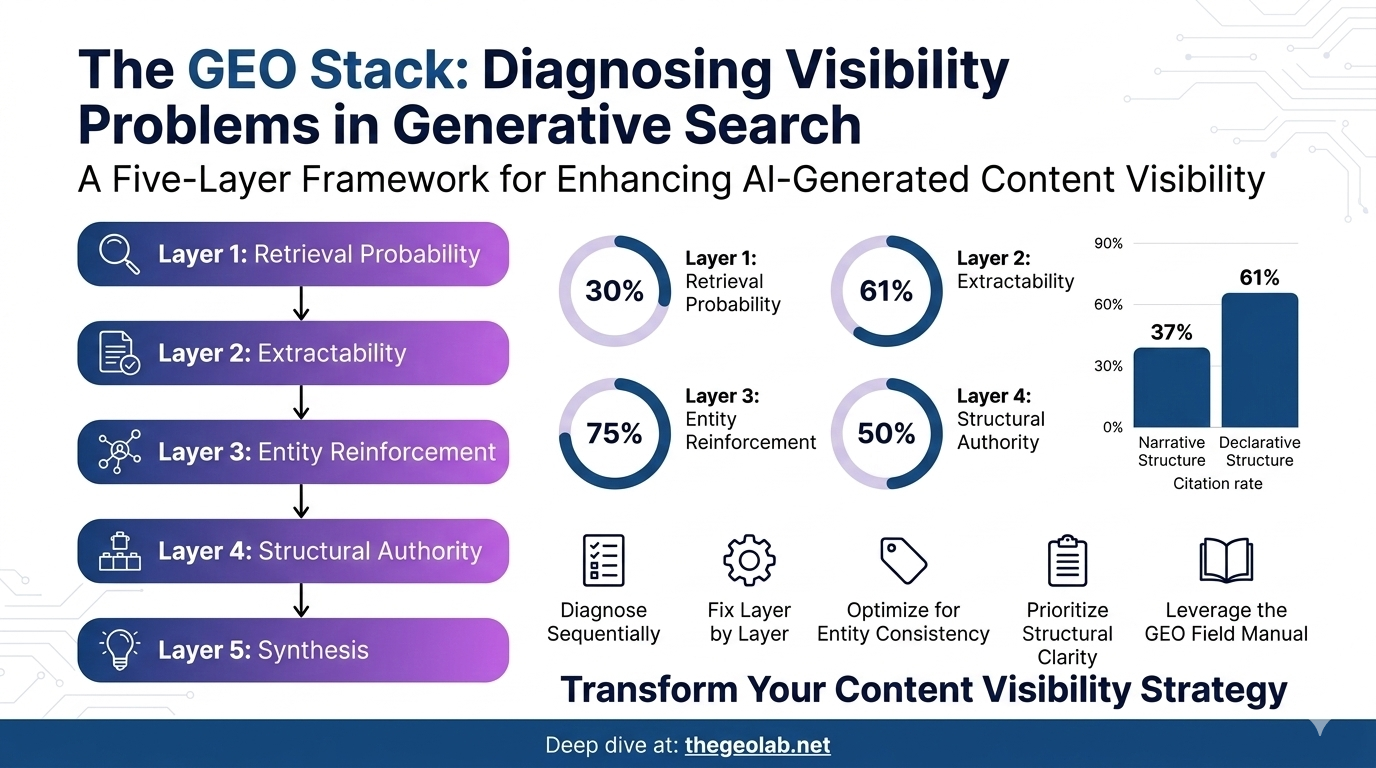
The GEO Stack organises the variables that determine generative visibility into five layers, ordered from most foundational to most advanced. Each layer addresses a distinct stage of the AI retrieval pipeline.
Layer 1: Retrieval Probability
Retrieval Probability is the estimated likelihood that a specific content section is selected during the vector retrieval phase of a generative search query. It is the foundational layer of the GEO Stack. A section with zero retrieval probability cannot be cited regardless of how well every other layer is optimised. Retrieval Probability is determined by five variables: semantic alignment between section content and target queries, entity match strength, structural clarity at the section boundary, topical isolation within the section, and contextual reinforcement from the surrounding content cluster.
Layer 2: Extractability
Extractability is the degree to which a content section can be cleanly parsed, isolated, and reproduced by a generative system without losing its meaning. A section can be retrieved but still fail to generate a citation if it is structured in a way that prevents clean extraction. The most common extractability failures are narrative structure that buries the core claim mid-paragraph, pronoun-heavy writing that requires context from surrounding sections, and dense prose that mixes multiple ideas within a single paragraph. Experiment 001 at The GEO Lab quantified the impact of Extractability directly: declarative structure — answer-first, entity-explicit, standalone-complete — produced a 61 percent citation rate compared to 37 percent for narrative structure on identical content.
Layer 3: Entity Reinforcement
Entity Reinforcement is the consistency and density of named entity signals throughout a content system. Generative systems build semantic associations between sources and topics through entity co-occurrence patterns observed across many documents. A site that refers to the same concept with three different terms across different posts — “GEO”, “generative engine optimisation”, “AI search optimisation” — produces a fragmented entity signal. A site that uses canonical naming consistently across all content builds entity gravity: the accumulated semantic weight that causes retrieval systems to associate that source with specific topics.
Layer 4: Structural Authority
Structural Authority is the coherence signal that emerges from well-designed information architecture. It is not the same as domain authority, which measures external link equity. Structural Authority measures internal coherence — whether pages relate to each other in a way that reflects a logical knowledge structure, whether internal linking patterns reinforce topical relationships, and whether the site’s architecture communicates a clear topical hierarchy to crawling systems. A site with strong Structural Authority has content clusters with clear hub-and-spoke relationships, bidirectional internal links between related pages, and entity-rich anchor text throughout.
Layer 5: System Memory
System Memory is the accumulated pattern of entity and topic associations that generative AI systems develop about a source over time. It is the most opaque layer of the GEO Stack and the most difficult to engineer deliberately. Sites with strong System Memory become persistent reference points — the sources that AI systems default to when constructing answers in a given topic area. System Memory cannot be accelerated. It is built through consistent publishing, stable entity naming, and sustained structural coherence over months and quarters.
Recognizing Failure Patterns in Each GEO Stack Layer
Each GEO Stack layer has a characteristic failure pattern. Recognising these patterns is the core skill in GEO diagnosis.
Layer 1 Failure: Semantic Misalignment
Layer 1 failure looks like: content that ranks well in Google but never appears in AI-generated answers for the same queries. The content exists, it is indexed, it is authoritative — but individual sections do not align semantically with the query representations used by generative retrieval systems. The page-level relevance signal that serves Google ranking does not translate into section-level semantic alignment. This is the most common entry-level GEO failure pattern.
Layer 2 Failure: Extraction Distortion
Layer 2 failure looks like: content that appears in AI responses but is misrepresented. The system retrieved the section but could not extract its core claim cleanly. Instead it extracted a peripheral claim, an example, or a supporting sentence — not the main point the author intended. Alternatively, the content is cited but with significant paraphrasing that distorts the original meaning. This is a structural failure. The content passed retrieval but failed extraction.
Layer 3 Failure: Inconsistent Entity Signals
Layer 3 failure looks like: content that is cited inconsistently. Some queries retrieve it; others do not, even when the topic is directly relevant. The entity naming across the site is inconsistent — the same concept appears under different terms in different posts. The retrieval system cannot build a stable semantic model of what the site is authoritative for, so citation is erratic rather than systematic.
Layer 4 Failure: Fragmented Site Architecture
Layer 4 failure looks like: individual pages that perform well in isolation but the site does not build cumulative citation authority. There is no clear topical hierarchy. Internal linking is random or absent. The content cluster lacks a hub page that aggregates and reinforces the topic. Each page exists as an island rather than as part of a coherent knowledge structure.
Layer 5 Failure: Insufficient System Memory
Layer 5 failure looks like: a site that has strong technical foundations, well-structured content, consistent entity naming, and logical architecture — but still generates low citation rates because it has not been publishing consistently for long enough. System Memory failures cannot be diagnosed by content audit. They are identified by ruling out Layers 1 through 4 and concluding that time and consistency are the remaining variables.
Diagnosing GEO Stack Failures: A Step-by-Step Guide
Diagnosing a GEO Stack failure requires testing each layer in sequence, starting from Layer 1. The diagnostic process has five steps.
Step 1: Test Retrieval Probability
Submit five to ten target queries into Perplexity and Google AI Overviews. Record whether your content is cited. If your content never appears across any queries on any platform, the failure is at Layer 1 or Layer 2. If it appears occasionally but not consistently, the failure is likely Layer 3.
Step 2: Test Extractability
Open the pages that are failing. Read the opening sentence of every H2 section. If the opening sentence is contextual — “In this section we will explore…” or “As we discussed above…” — rather than declarative — “Entity reinforcement increases citation rate by…” — the page has a Layer 2 failure. Apply the isolation test: copy one H2 section into a blank document and read it cold. If it requires context from the rest of the post to make sense, it fails extractability.
Step 3: Audit Entity Naming
Open your ten most important posts. Search for your three to five most critical concepts. Count how many different terms you use for each concept across posts. If a concept appears under three or more variant names, you have a Layer 3 failure.
Step 4: Audit Internal Architecture
Map your internal linking. Identify your most important topic pages. Count how many internal links point to each one. If your most important pages have fewer than five inbound internal links from other content, you have a Layer 4 failure.
Step 5: Rule Out System Memory
If Layers 1 through 4 are sound — sections are well-structured, entities are consistent, architecture is coherent — but citation rates are still low, the issue is System Memory. The only intervention is time. Continue publishing, maintain consistency, and measure citation rate at 90-day intervals.
The Sequential Dependency Rule: Prioritizing Interventions
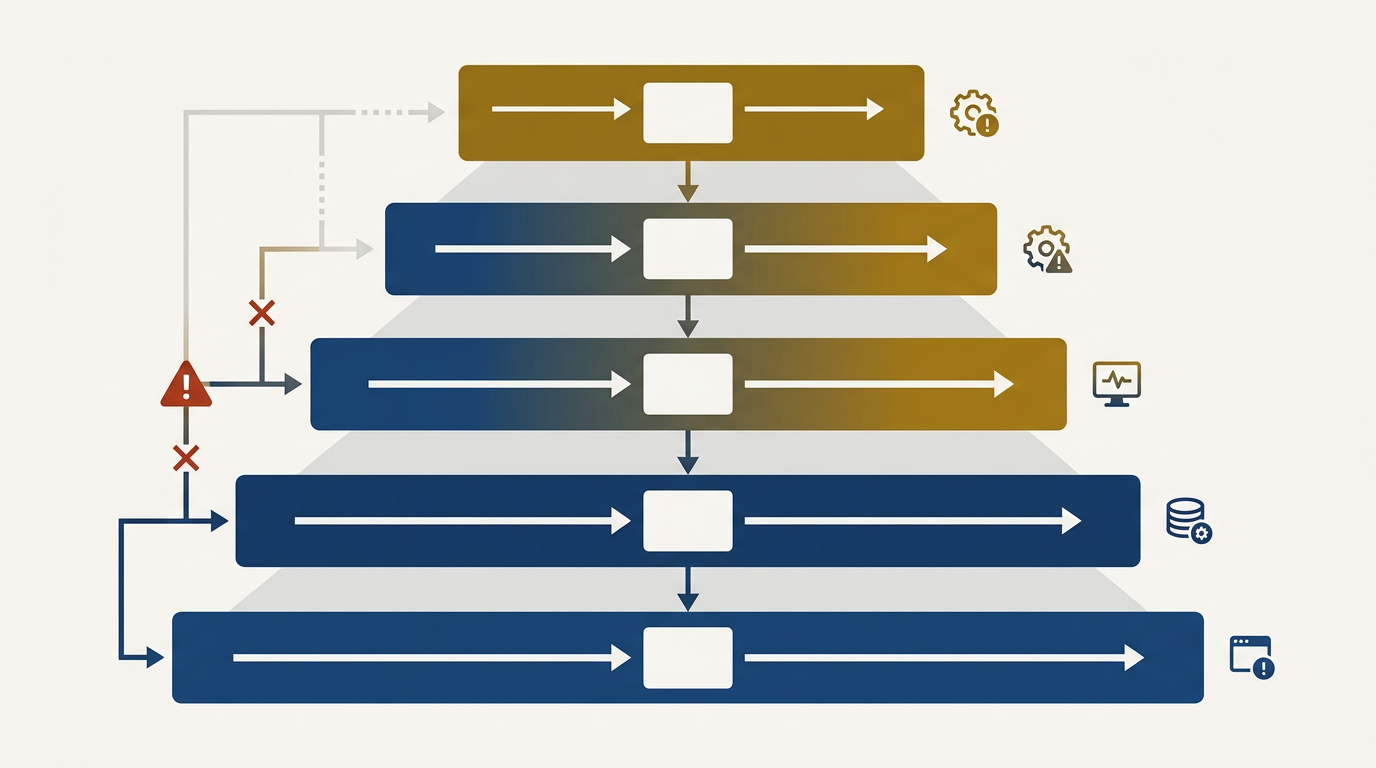
The sequential dependency rule states that each GEO Stack layer depends on the layers below it. A failure at a lower layer blocks the contribution of every layer above it.
This rule has a direct practical consequence: optimising a higher layer when a lower layer is failing produces no measurable improvement.
The most common example in practice: a site has well-structured content (Layer 2 is sound), consistent entity naming (Layer 3 is sound), and strong internal architecture (Layer 4 is sound) — but the content sections are not semantically aligned with how AI systems represent the target queries (Layer 1 is failing). Fixing Layer 3 further, or adding more internal links, or improving author signals, will not improve citation rates. The bottleneck is at Layer 1. Everything else is downstream of it.
The sequential dependency rule means that GEO audits must always start at Layer 1 and work upward. It also means that the most common mistake in GEO optimisation — adding schema markup or improving author bios on content that has fundamental retrievability problems — produces no return.
The practical implication for the order of interventions:
- Priority 1: Fix sections that are not semantically aligned with target queries (Layer 1)
- Priority 2: Rewrite narrative sections into declarative structure (Layer 2)
- Priority 3: Canonicalise entity naming across the content system (Layer 3)
- Priority 4: Redesign internal linking to reflect topical hierarchy (Layer 4)
- Priority 5: Maintain consistency over time (Layer 5)
This sequence is not arbitrary. It reflects the architecture of the retrieval pipeline. Interventions at Layer 2 only matter if Layer 1 is functioning. Interventions at Layer 3 only matter if Layer 2 is functioning.
Mapping GEO Stack Layers to Practical Content Strategy
Each GEO Stack layer maps to a specific set of content and site decisions. The table below shows the direct connection between the abstract framework layer and the concrete actions that address it.
| LAYER | WHAT IT ADDRESSES | PRACTICAL DECISIONS IT GOVERNS |
|---|---|---|
| Layer 1: Retrieval Probability | Whether sections enter the retrieval candidate pool | Section topic focus, semantic vocabulary, query alignment, heading language |
| Layer 2: Extractability | Whether retrieved sections can be cleanly parsed | Sentence structure, paragraph length, declarative vs narrative style, entity explicitness |
| Layer 3: Entity Reinforcement | Whether the site builds stable semantic associations | Canonical terminology, entity naming conventions, co-occurrence patterns across posts |
| Layer 4: Structural Authority | Whether the site communicates coherent topical knowledge | Internal linking architecture, hub-and-spoke cluster design, anchor text quality |
| Layer 5: System Memory | Whether the site accumulates persistent citation authority | Publishing consistency, topical focus over time, long-term entity stability |
The most important insight from this mapping: Layers 1 and 2 are addressed at the section level, inside individual posts. Layers 3 and 4 are addressed at the site level, across the content system. Layer 5 is addressed at the programme level, through sustained publishing behaviour.
This means a GEO improvement programme operates at three timescales simultaneously. Section-level fixes (Layers 1 and 2) can show measurable citation rate improvements within four to eight weeks. Site-level improvements (Layers 3 and 4) typically show improvement over three to six months as entity associations accumulate. System Memory effects (Layer 5) operate over quarters to years.
GEO Stack vs. Traditional SEO: Key Differences
The GEO Stack differs from traditional SEO frameworks in three fundamental ways.
- The unit of analysis is different. Traditional SEO frameworks evaluate pages. The GEO Stack evaluates sections within pages. A page can have strong overall SEO performance and contain individual sections with zero retrieval probability. The GEO Stack is granular by design.
- The goal is different. Traditional SEO frameworks optimise for position in a ranked list. The GEO Stack optimises for inclusion in a generated answer. These are different objectives that require different interventions. A page optimised purely for Google ranking — long, comprehensive, internally linking — may still fail GEO if its sections are not independently extractable.
- The failure modes are different. Traditional SEO failures are usually authority failures (not enough links), relevance failures (wrong keywords), or technical failures (not crawlable or indexed). GEO failures are typically structural failures (content retrieved but not extractable) or entity failures (content inconsistently associated with target topics). These require different diagnostic approaches and different interventions.
The GEO Stack is not a replacement for traditional SEO frameworks. Technical health, crawlability, and authority signals established by traditional SEO remain necessary conditions for GEO visibility. The GEO Stack adds five additional layers on top of those foundations — the layers that determine what happens after content is crawled and indexed, during the retrieval and synthesis process that traditional SEO frameworks do not address.
Applying the GEO Stack to Optimize Existing Content
Applying the GEO Stack to an existing page follows a seven-step process.
- Step 1: Select the page. Choose a page that ranks reasonably well (top twenty positions) but generates low AI citation rates. This controls for domain authority as a variable and isolates structural and entity factors.
- Step 2: List all H2 sections. Each H2 section is the unit of analysis. Write the heading and the opening sentence for each section.
- Step 3: Test Layer 1 for each section. For each H2, ask: if an AI system is answering the query “what is [section heading topic]”, does this section appear? Submit the query into Perplexity five times. Record whether the section is cited.
- Step 4: Score Layer 2 for each section. For each H2, apply the extractability diagnostic: does it open with the answer? Does it stand alone without context? Does the core claim appear in the first two sentences? Score each section pass or fail.
- Step 5: Check Layer 3 entity naming. Identify the three to five most important entities in the page. Search the rest of the site for how those entities are named. Flag any inconsistencies.
- Step 6: Check Layer 4 internal links. Count inbound internal links to this page. Check that anchor text is descriptive and entity-rich. Identify the closest hub page in the content cluster and verify a bidirectional link exists.
- Step 7: Prioritise interventions. Fix Layer 1 failures first (rewrite sections for semantic alignment), then Layer 2 failures (rewrite narrative sections as declarative), then Layer 3 (canonicalise entity naming), then Layer 4 (add or improve internal links).
The GEO Field Manual provides the full audit worksheet for this process, including scoring rubrics for each layer and a prioritisation matrix.
Real-World GEO Stack Failure: A Practical Example
A concrete example makes the diagnostic process visible. Consider a hypothetical post titled “How to Improve Your Content Marketing Strategy.”
The post ranks in position four on Google for “content marketing strategy”. It receives reasonable organic traffic. But it generates zero citations in Perplexity and does not appear in Google AI Overviews for any related queries.
Applying the GEO Stack diagnostic:
- Layer 1 check: Submit “how do I improve my content marketing strategy” and five variant queries into Perplexity. The post never appears. The sections are topically correct but not semantically aligned with how AI systems represent these queries. The headings are “The Importance of Consistency”, “Building Your Content Calendar”, “Measuring Results” — none of which answer a specific question a user might submit.
- Layer 1 diagnosis: Retrieval failure. The section headings do not align with the semantic representation of likely queries. Intervention: rewrite headings as direct questions — “How Often Should You Publish Content to Build Topical Authority?”, “Which Metrics Actually Measure Content Marketing Performance?”
- Layer 2 check: After rewriting headings, read the opening sentence of each section. Section on consistency: “Consistency is one of the most important factors in any content marketing programme, and many experienced marketers will tell you that showing up regularly is more important than producing perfect content every time.” The answer — publish consistently — is buried in the second clause of a long sentence.
- Layer 2 diagnosis: Extractability failure. Intervention: rewrite as “Publishing on a consistent schedule matters more than publishing perfect content. Sites that publish two to four times per month outperform irregular publishers on topical authority metrics, regardless of individual post quality.”
After Layer 1 and Layer 2 interventions, this post would likely begin appearing in AI citations within four to eight weeks. The content itself has not changed — only its structure and heading language. This is the practical power of the GEO Stack as a diagnostic framework: it identifies the minimum intervention required to move a page from invisible to cited.
Key Takeaways from the GEO Stack Framework
The GEO Stack is a five-layer diagnostic framework for identifying and fixing generative visibility failures. The five layers — Retrieval Probability, Extractability, Entity Reinforcement, Structural Authority, and System Memory — map directly onto the stages of the generative retrieval pipeline.
The sequential dependency rule is the most important operational principle: always diagnose from Layer 1 upward, because failures at lower layers block the contribution of every layer above. Fixing Layer 4 when Layer 1 is broken produces no improvement.
Most visibility failures trace to Layers 1 or 2. Section-level fixes — aligning headings with query semantics and rewriting narrative sections as declarative — produce measurable citation rate improvements faster than any other GEO intervention.
The GEO Stack is not a replacement for traditional SEO. It extends SEO into the stages of the retrieval pipeline that traditional frameworks do not address: extraction, compression, and synthesis.
For a real-world demonstration of how these five layers determine brand visibility, see the GEO Brand Citation Index, where we measured 28 brands across three AI platforms and found that brands with strong retrieval and extractability layers consistently outperformed those relying on legacy authority alone.
Layer 1 in practice: The GEO Lab’s PageSpeed quad-100 case study demonstrates how technical health interventions at the retrieval probability layer created compounding gains through every layer above it.
For the foundational concepts behind GEO and why section-level optimisation matters, see What Is Generative Engine Optimisation.
The foundation layer is explored in depth in our retrieval probability analysis, which isolates the variables that determine whether content enters the AI retrieval pipeline.
The five-layer model builds on retrieval-augmented generation research (Aggarwal et al., 2023) and aligns with Google’s structured data guidelines for entity representation in search systems.
What Practitioners Say
“The diagnostic framework gave our team a structured way to identify exactly where content was failing in AI search — not at the page level, but at the section level. That granularity changed our entire optimisation workflow.”
— Daniel Cardoso, SEO Lead, Lisbon
“We had pages ranking well that were invisible to AI search. The framework showed us the retrieval pipeline stages where content was being filtered out — something traditional SEO tools never surfaced.”
— Marco Silva, Content Strategist, Porto
Frequently Asked Questions about the GEO Stack
What is the GEO Stack?
The GEO Stack is a five-layer framework for diagnosing and improving content visibility in AI-driven search systems. The five layers — Retrieval Probability, Extractability, Entity Reinforcement, Structural Authority, and System Memory — each address a distinct stage of the generative retrieval pipeline. It was developed at The GEO Lab by Artur Ferreira.
Why does the GEO Stack use layers rather than a flat checklist?
Generative search systems process content through sequential stages, each of which can fail independently. A layered framework reflects this architecture. A flat checklist cannot tell you which fix to prioritise because it does not model the dependencies between variables. The sequential dependency rule — lower layers block higher layers — only becomes visible in a layered model.
How is the GEO Stack different from the GEO Stack page on this site?
The permanent GEO Stack page defines each layer in full technical detail. This post focuses on the diagnostic application — how to use the framework to identify which specific layer is causing a specific page to fail. The two resources are complementary.
Can you apply the GEO Stack without any paid tools?
Yes. The Layer 1 test (manual citation checking in Perplexity and Google AI Overviews), the Layer 2 test (section isolation and opening sentence analysis), the Layer 3 test (entity naming audit across posts), and the Layer 4 test (internal link count and anchor text review) all require only a text editor and free AI search access. The GEO Lab Console automates and scores these tests, but the manual process is fully functional.
How long does it take to see results after applying GEO Stack interventions?
Layer 1 and Layer 2 interventions — section rewriting and heading restructuring — typically produce measurable citation rate changes within four to eight weeks, once AI systems have re-crawled the updated content. Layer 3 and Layer 4 improvements operate over three to six months. Layer 5 effects are measured over quarters to years.
Which layer should I fix first?
Always Layer 1. If your content is not being retrieved, nothing downstream matters. After confirming Layer 1 is functioning, address Layer 2. Most sites that rank but fail to generate AI citations have the primary failure at Layer 1 or Layer 2.
Does fixing GEO Stack issues affect traditional search rankings?
GEO Stack interventions at Layers 1 and 2 — rewriting sections for semantic clarity and declarative structure — typically maintain or improve traditional search performance because they improve content quality and relevance signals. Layer 4 interventions — improving internal linking architecture — are beneficial for both traditional SEO and GEO. There is no documented evidence of GEO Stack optimisation hurting traditional rankings.
Sources
- The GEO Lab. (2026). The GEO Stack: A 5-Layer Framework for AI Search Visibility.
- The GEO Lab. (2026). Experiment 001: Declarative vs Narrative Structure.
- The GEO Lab. (2026). Retrieval Probability in Generative Engine Optimisation.
- The GEO Lab. (2026). Extractability: Designing Content for Machine Retrieval.
- The GEO Lab. (2026). The GEO Field Manual.
Have questions about this topic? Contact The GEO Lab · Return to homepage