
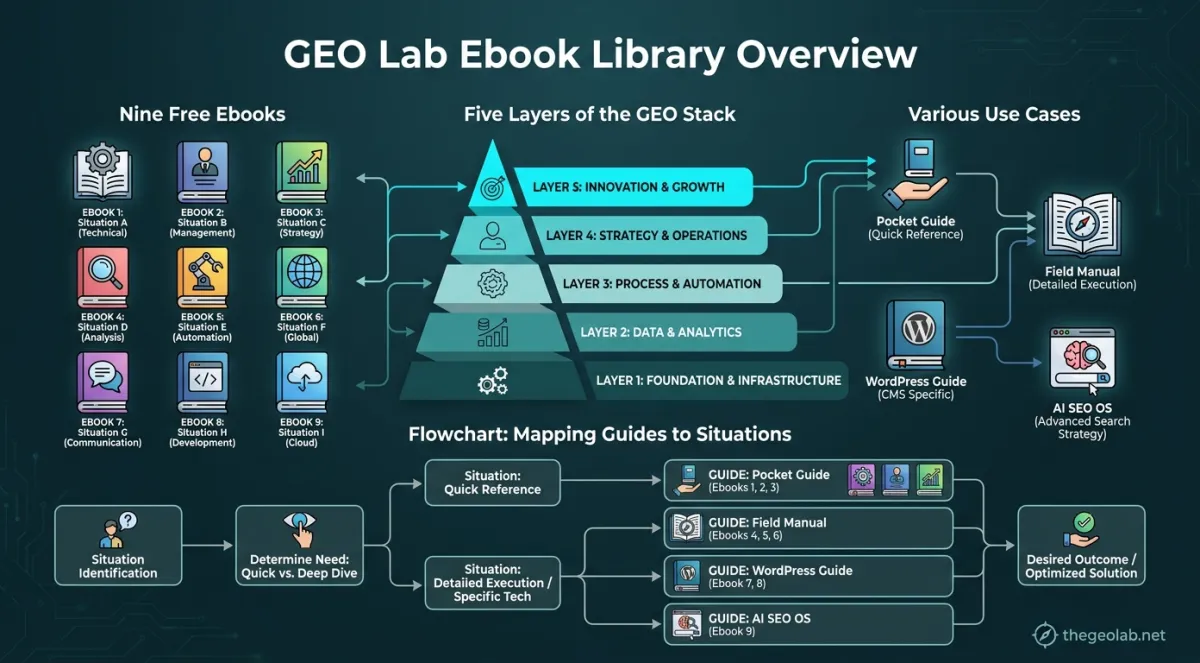
Nine free GEO ebooks covering Generative Engine Optimisation, grouped by the situation each one is designed to solve, not by the order I wrote them
The GEO Lab publishes nine free GEO ebooks covering the full stack of AI search optimisation, from a pocket-sized introduction through to a complete operating system. The GEO ebooks library isn’t designed to be read end-to-end; each guide is designed for a specific situation. This post maps the nine guides to the situations they’re built for, first contact with GEO, transitioning from SEO, running experiments, implementing over 30 days, setting up WordPress, looking up terminology, building a field diagnostic kit, earning authority citations, and running a complete AI search operating system.
All nine are free, current, and based on the same five-layer GEO Stack framework. The question this post answers is which one you should read first.
Why Nine Guides and Not One Book
The first version of the GEO Lab library was a single long GEO ebook. I wrote it, read it back, and realised it didn’t work. People who needed a five-minute introduction were being handed a 200-page manual. People who wanted to implement on WordPress were wading through strategic framework material they’d already absorbed from three other posts. One book, nine audiences, zero fits.
So the library became nine guides instead. Each one is sized to its actual use case. The Pocket Guide exists to be read in one sitting. The Field Manual exists to sit on your desk and get consulted mid-diagnosis. The WordPress guide exists for an afternoon of configuration. The AI SEO OS exists for the team that wants to operationalise the whole thing. These GEO ebooks are not chapters of a book, they’re different tools for different situations.
What follows is a map. Five situational categories, nine ebooks, and a deliberate attempt to send you to the right one on the first try. The worst outcome is you download the wrong guide for your stage, find it doesn’t match what you need, and conclude the whole library is off. The second-worst outcome is the opposite. Each guide maps to a specific layer of the GEO Stack, you read all nine before starting any practical work, which is a form of procrastination the library is specifically designed to prevent.
Every ebook listed below is free at the ebooks page. Email address requested at Gumroad checkout, zero price, no upsell. That’s the entire transaction.
Where Are You Right Now?
The single most useful question for picking a guide is where you currently sit in relation to GEO. Six common situations cover most readers.
If none of the six matches you exactly, default to the Pocket Guide. It’s the shortest GEO ebook, and reading it rarely wastes time, it clarifies which of the other GEO ebooks you actually need.
The Nine GEO Ebooks
Ordered by where most readers get value first. The first four are the most-downloaded starting points. The middle three are specialist references. The last two are the advanced end of the library.
The GEO Pocket Guide, 2026 Edition
BeginnerYou’ve heard “Generative Engine Optimisation” and want to know what it actually means before committing to a longer guide.
The five-layer GEO Stack, retrieval probability, extractability, entity reinforcement, structural authority, system memory, at introductory depth. Extractability principles, the core vocabulary, and a short set of checklists for AI search optimisation. Start with the extractability layer if citation rate is the immediate problem.
Marketers, content strategists, and business owners who need a defensible working model of GEO without committing to technical implementation yet.
SEO to GEO: The Complete Framework
IntermediateYou have an SEO background and want the systematic translation to GEO rather than a from-scratch introduction.
The strategic and measurement differences between classical SEO and GEO. Where existing SEO practices still work, where they need adjustment, where they actively break on AI search. Implementation plans for teams transitioning an existing SEO programme.
SEO professionals, heads of organic growth, and teams with established SEO programmes who need to extend their work into AI visibility without starting over.
The GEO Workbook, 30-Day Action Plan
IntermediateYou prefer a structured daily plan to a reference guide. You want to move from reading to shipping inside a month.
Daily tasks and weekly milestones across 30 days, covering audit, implementation, and measurement. Progress tracking sheets, priority rubrics, and a clear target state by day 30.
Content teams implementing GEO across an existing site. Consultants running GEO programmes for clients. Anyone who reads three strategy books and still hasn’t changed their content.
GEO for WordPress, Technical Setup Guide
TechnicalYou run WordPress and need the specific configuration, plugins, schema, server, that turns a generic WordPress site into a GEO-ready publishing platform.
Schema markup configuration via plugins. JSON-LD implementation patterns. Server optimisations for AI crawler access. Specific plugin recommendations with configuration walkthroughs. Common WordPress pitfalls that hurt AI visibility.
WordPress site owners, agencies running WordPress-based client sites, and anyone shipping content on WordPress who wants AI visibility without rebuilding on a different stack.
GEO Experiments, Design, Measure, Learn
IntermediateYou’ve implemented basic GEO and want to start running your own controlled experiments rather than relying on other people’s measurements.
Experiment design for AI citation measurement. Noise floor establishment. Isolating content variables. Documented experiments from The GEO Lab’s own programme with methodology, results, and the failures that didn’t get written up anywhere else.
In-house teams measuring their own AI visibility. Consultants who want defensible measurement methodology. Practitioners tired of vendor-generated benchmarks and ready to run their own.
The GEO Glossary & Quick Reference
ReferenceYou encounter a term, extractability, retrieval probability, citation rate, C-SOV, and want the canonical definition rather than five contradictory blog-post definitions.
Comprehensive glossary of GEO terminology. Each entry includes the canonical definition, common synonyms and variants, and references to how the term is used in the broader GEO literature.
Anyone working on GEO content, proposals, or reports who needs consistent vocabulary. Especially useful for teams where multiple people write GEO content and need to avoid terminology drift between pieces.
GEO Field Manual
ReferenceYou need the practitioner’s diagnostic kit, what to check when something’s wrong, how to tell which layer of the Stack is failing, what intervention each failure maps to.
The definitive implementation reference across all five GEO Stack layers. Detailed strategies for each layer, real examples from deployments, diagnostic frameworks for common failure modes. Not introductory, built for practitioners already working on GEO.
Practitioners past the introductory stage. The guide that gets consulted during actual diagnosis, not at the planning stage. The one to keep bookmarked on the desk.
GEO Authority Playbook, Advanced AI Citation Strategy
AdvancedBasic GEO is working. The site gets cited occasionally. You want to move from occasional citation to consistent, authoritative positioning across your category.
Entity reinforcement at scale. Structural authority patterns that move sites from Mentioned to Cited repeatedly. Systematic approaches to earning citations on proprietary-concept queries versus category queries. Advanced strategies for compounding authority over time.
Teams with basic GEO already in place who want to go from 10% citation rate to 30% citation rate. Thought-leadership operators. Anyone trying to own a named concept in their category.
AI SEO OS, The Complete AI Search Operating System
AdvancedYou’re running or leading an AI search programme across a team. You need the full operational layer, dashboards, workflows, roles, cadences, integration with existing SEO and content ops.
The complete operating system for AI search. Integrates all five GEO Stack layers into a unified workflow. Includes dashboards, checklists, implementation blueprints, role definitions, and cadence frameworks for weekly, monthly, and quarterly operations.
Heads of SEO, marketing directors, and consultants running GEO as a programme rather than a project. Teams past the individual-contributor stage who need the organisational scaffold.
The Nine GEO Ebooks at a Glance
Reference table. Skim the “Read when” column to identify which guide matches your situation.
| # | Guide | Level | Read when |
|---|---|---|---|
| 01 | The GEO Pocket Guide | Beginner | First contact with GEO |
| 02 | SEO to GEO: The Complete Framework | Intermediate | Coming from an SEO background |
| 03 | The GEO Workbook — 30-Day Action Plan | Intermediate | Need a structured daily plan |
| 04 | GEO for WordPress — Technical Setup Guide | Technical | Running WordPress, need specific configuration |
| 05 | GEO Experiments — Design, Measure, Learn | Intermediate | Ready to run your own measurements |
| 06 | The GEO Glossary & Quick Reference | Reference | Need canonical definitions for GEO terms |
| 07 | GEO Field Manual | Reference | Practitioner’s diagnostic kit, past introductory stage |
| 08 | GEO Authority Playbook | Advanced | Basic GEO working, ready for authority strategy |
| 09 | AI SEO OS | Advanced | Running a GEO programme at team or organisation scale |
A GEO Ebooks Reading Order That Actually Works
Three reading paths fit most readers. Pick the one that matches your situation and resist the temptation to read everything before starting.
The Beginner Path: Pocket Guide → Complete Framework → Workbook. Three ebooks, about 8–10 hours total reading, gets you from unfamiliar with GEO to implementing inside a month. Add the Glossary as a look-up reference during implementation. Leave the specialist guides for later.
The SEO Professional Path: Complete Framework → Workbook → Field Manual. Skip the Pocket Guide; the Complete Framework is where the actual content starts for someone with SEO background. The Field Manual enters the rotation once you’ve started diagnosing real issues on real sites.
The Technical Path: Pocket Guide → GEO for WordPress → Experiments → Field Manual → AI SEO OS. Heavier stack, built for teams running production systems where the strategic-only guides aren’t enough. Plan four to six weeks of reading time interleaved with implementation.
The Authority Playbook and the AI SEO OS are not in these core paths deliberately. Both are strong guides but they solve problems that most readers don’t yet have. Coming to them too early is how good advice gets implemented without the prerequisite foundation and then blamed for not working.
A compact mapping of situation to path:
| Your situation | Recommended path | Roughly how long |
|---|---|---|
| Never worked on GEO before | Pocket Guide → Complete Framework → Workbook | 3–4 weeks to first measurable change |
| Strong SEO background, no GEO | Complete Framework → Workbook → Field Manual | 2–3 weeks to first measurable change |
| Running WordPress production sites | Pocket Guide → WordPress → Experiments → Field Manual | 4–6 weeks including implementation |
| Leading a team or programme | Complete Framework → AI SEO OS → Authority Playbook | 6–8 weeks to programme launch |
| Need a specific term defined | Glossary only | Minutes, as needed |
On reading less and doing more. The library is nine guides because the problem space needs nine distinct treatments. That does not mean any one reader needs nine guides. Most readers benefit from two or three, in sequence, with implementation work between them. If you find yourself on the fifth ebook without having changed any content yet, stop reading. Go ship something. Come back when a specific question from the implementation sends you looking for the next guide.
Frequently Asked Questions
Are The GEO Lab ebooks really free?
Yes. All nine guides are free to download from the ebooks page. An email address is requested at checkout on Gumroad but the price is zero. No payment information is collected.
Which GEO ebook should I read first?
Start with The GEO Pocket Guide if you want a quick overview of the five-layer GEO Stack and the core vocabulary. Start with SEO to GEO: The Complete Framework if you’re coming from a classical SEO background and want the systematic translation. Start with The GEO Workbook if you prefer a structured 30-day plan over a reference guide. The rest of the library fills specific gaps, experiments, WordPress, glossary, field manual, authority, and the full operating system.
Do I need technical skills to use these GEO guides?
Most of the library is written for marketers and content creators without technical backgrounds. The two more technical GEO ebooks, GEO for WordPress and AI SEO OS, include step-by-step instructions suitable for non-developers, but they assume more willingness to touch site configuration. If you’re not comfortable editing WordPress themes or configuring plugins, start with the Pocket Guide or the Complete Framework and come back to the technical guides once the concepts are settled.
Are the ebooks updated as AI search changes?
Yes. The ebooks are updated when significant changes occur in AI search behaviour or when The GEO Stack methodology itself is extended. Each GEO ebook carries a version number, check it before reading to confirm you’re on the current edition. Major AI operator changes typically trigger a refresh within 30 to 60 days.
Can I share The GEO Lab ebooks with my team?
Yes. The guides are designed to be shared freely within teams and organisations implementing GEO. No licensing fee, no per-seat limit, no restriction on internal redistribution. Send the GEO ebooks page link to anyone who would benefit, the team pricing for GEO ebooks is zero because the public pricing is zero.
Key GEO Lab Takeaway
Nine ebooks, nine GEO ebooks for nine distinct situations. Start with the Pocket Guide GEO ebook to identify which layer of the GEO Stack your problem sits in, then read the guide that matches. The library is not designed to be read end-to-end. Reading all nine before starting practical work is the procrastination the structure is designed to prevent.