
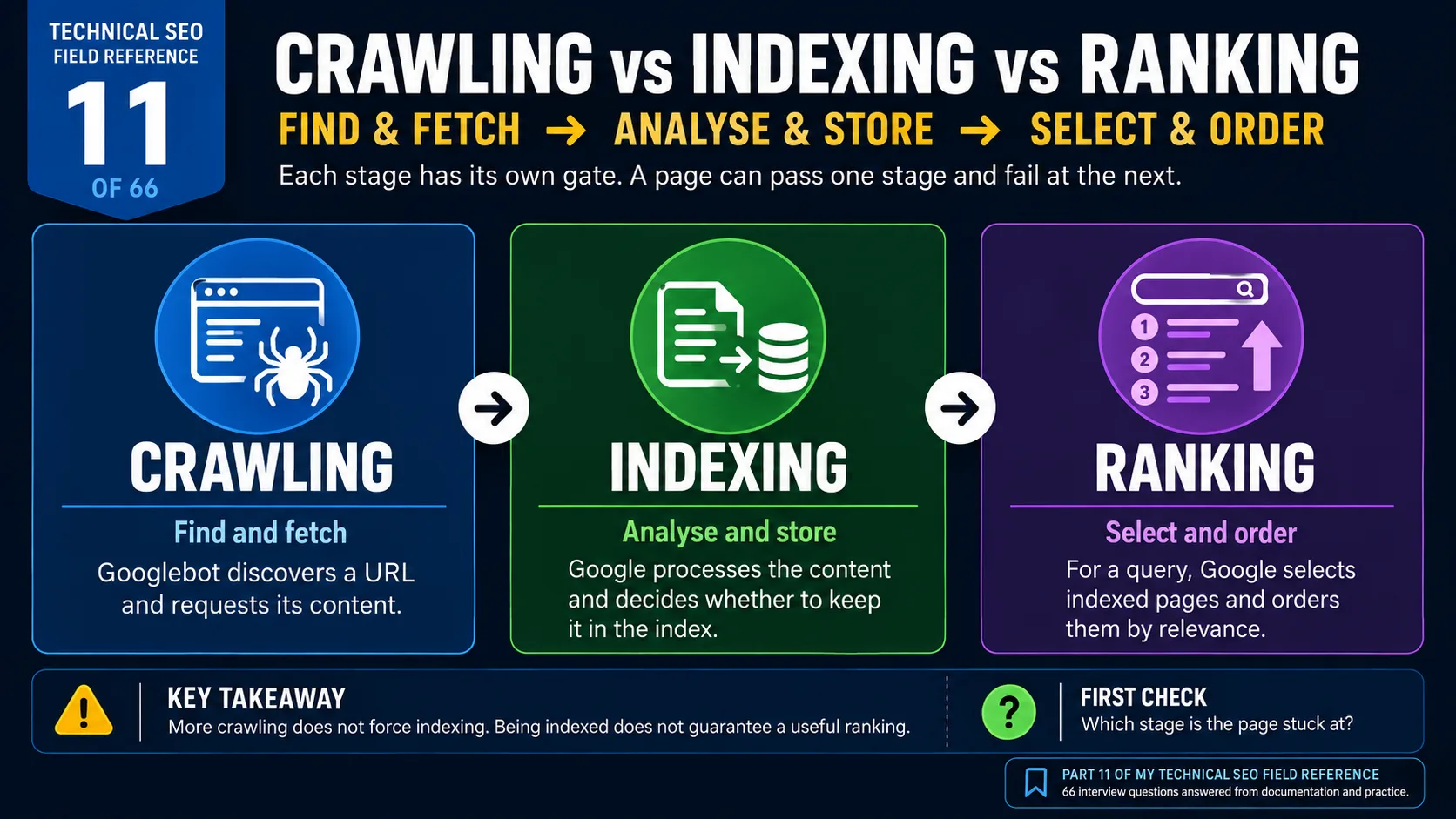
Technical SEO Field Reference, Question 11 of 66. The crawling indexing ranking interview answer, checked against what Google currently documents.
Crawling is Googlebot discovering a URL and fetching it. Indexing is Google analysing that content and deciding whether to store it. Ranking is Google selecting indexed pages for a query and ordering them by relevance. Crawling indexing ranking – three sequential stages that are independent – a page can succeed at one stage and fail at the next, and each failure needs a different fix (Google Search Central, as of September 2026).
This closes out the crawling and indexing cluster for a reason. Every question before this one – crawl budget, crawl traps, Crawled and Discovered states, 404s, noindex conflicts, the Removals tool – only makes sense once you can place it on one of three stages. Candidates who blur crawling indexing ranking together tend to diagnose the wrong problem: they treat a ranking issue like an indexing issue, or throw crawl budget at something that was never a crawling problem in the first place.
It is also one of the few questions in this series where the correct answer is short. That is the trap in itself: interviewers ask it expecting a two-sentence answer, then use the follow-up to find out whether you can actually place a real symptom on the right stage.
Why crawling indexing ranking matter as separate stages
When someone treats these as one process, they usually end up fixing the wrong thing. A page that is not showing up for its target term could be stuck at any of the three stages, and each one has its own diagnostic path and its own fix.
A ranking issue gets treated like an indexing issue. Crawl budget gets blamed for something that was never a crawling problem. The URL gets resubmitted a dozen times when the real issue is thin content, or the content gets rewritten when the real issue is that Googlebot never fetched the page.
Understanding crawling indexing ranking as distinct stages is fundamental. The follow-up is where the question earns its weight: placing a symptom at the right stage and knowing what tool to reach for.
What Google says about crawling indexing ranking
Google documents how Search works as three distinct processes.
Crawling. Googlebot discovers URLs and fetches their content. A page has to be found and requested before anything else can happen. If it is blocked by robots.txt, returns a server error, or has no inbound links, it may never be crawled at all.
Indexing. Google analyses the fetched content and stores it in the index if the page is eligible. A page can be crawled and still not indexed. Thin content, duplication, and noindex directives are common reasons a page clears crawling but fails at indexing. This is the stage where most of the Discovered – currently not indexed and Crawled – currently not indexed statuses in Search Console originate.
Serving results, or ranking. When someone searches, Google returns results from the index that it judges relevant to the query, ordered using its ranking systems. A page can be indexed and never rank for anything useful – indexing only means Google stored it, not that it will surface for competitive queries.
Each stage has its own gate. A page that fails at crawling never reaches indexing. A page that fails at indexing never reaches ranking. A page that clears both can still rank poorly, because ranking runs on relevance and quality signals that have nothing to do with whether Google could technically fetch or store the page.
The interview answer
Crawling is discovery and fetching: Googlebot finding a URL and requesting it. Indexing is analysis and storage: Google processing that content and deciding whether to keep it in the index. Ranking is retrieval and ordering: when a query comes in, Google selects from the index and orders results by relevance. They are sequential and independent – a page can succeed at one stage and fail at the next, and each failure needs a different fix.
A real-world example
A client’s product page is not showing up for its target term. Before touching content or backlinks, I place the symptom on one of the three stages.
Not discovered or fetched. Is the URL in Search Console’s coverage report at all? If not, check robots.txt, server errors and internal linking. This points to a crawling problem.
Crawled but excluded. Is it showing one of the “not indexed” statuses? That is an indexing problem – thin content, duplication, or Google deciding the page is not worth storing.
Indexed but buried. URL Inspection confirms it is in the index, but it ranks on page 4 for a term with real competition. That is a ranking problem. No amount of resubmitting the URL or tweaking robots.txt will move it. It needs better content, stronger internal links, or backlinks.
Treating a ranking problem as a crawling problem is one of the most common misdiagnoses I see. The URL Inspection tool exists specifically to tell you which of the three stages you are actually looking at.
How crawling indexing ranking connect
The three stages are gated, not parallel. Google cannot rank what it has not indexed, and it cannot index what it has not crawled. But the reverse relationship does not hold: crawling more does not force indexing, and indexing does not force a good ranking.
I think of it less as a pipeline and more as three separate gates, each with its own failure conditions and its own fix. That framing is not Google’s – it is how I work through it in practice.
Google’s own myths and facts about crawling material is explicit that crawling itself is not a ranking factor. A page can be crawled constantly and still rank nowhere, because crawling only gets it as far as being eligible for the indexing decision. This is the same principle covered in crawl budget: more crawling does not mean better outcomes.
The interview trap
The first trap is describing crawling indexing ranking as one process with different names. “Crawling is when Google finds you, then it ranks you” skips indexing entirely and misses the stage where most technical SEO problems actually live.
A stronger variant: treating “indexed” and “ranking well” as the same outcome. Plenty of correctly indexed pages rank on page 6 for their target terms – that is not an indexing failure, and no indexing fix will touch it.
The diagnostic version is jumping straight to a ranking-stage fix – content, links – for a problem that is actually stuck at the crawling stage, or changing crawl controls when the page is already indexed and simply ranks poorly. Interviewers use this question’s follow-up specifically to catch that confusion.
Takeaway
The wrong question is “why isn’t this page ranking?” The better question is “which of the three stages is this page actually stuck at?” The definition is the easy part. Placing a real symptom on the right stage is what the question is actually testing.
Have questions about this topic? Contact The GEO Lab · Return to homepage
Have questions about this topic? Contact The GEO Lab · Return to homepage